For many people, this is the question that sits behind every other question. The retreat sounds right. The timing feels possible. The work you need to do is clear. But the thought of your employer - or HR, or colleagues - knowing where you went and why creates a hesitation that can last for months. Sometimes it stops people from going at all.
This article answers the question directly. It explains what can and cannot be known, how private treatment in another country works in terms of confidentiality, what your employer can and cannot see when you take leave, and the narrow set of circumstances where different rules apply. The goal is to give you accurate information so you can make this decision clearly, rather than through anxiety about something that may not be a risk at all.
The Short Answer
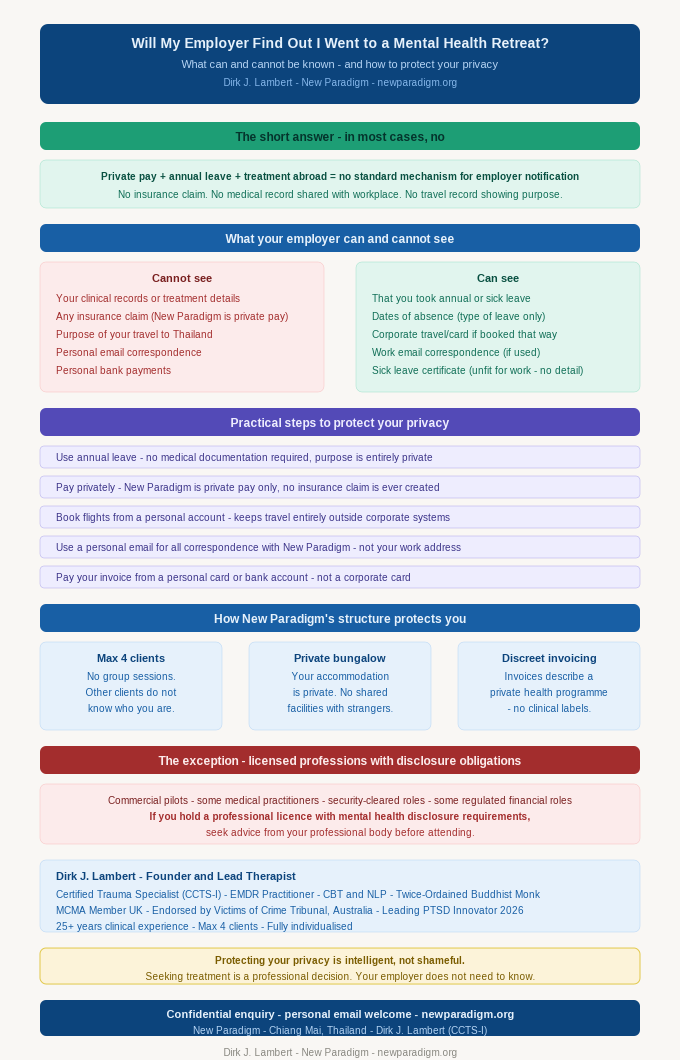
In most cases, no - your employer will not find out. If you are paying privately, taking annual leave, and attending a retreat in another country, there is no standard mechanism by which your employer is informed. There is no insurance claim creating a trail, no medical record shared with your workplace, no travel record that discloses the purpose of your trip. The concerns most people carry about this are significantly larger than the actual risk.
That said, the full answer is more nuanced than a simple no, and it is worth understanding why the answer is no rather than just accepting it as reassurance. The sections below explain the specifics.
What Private Payment Means for Your Privacy
The single most significant factor in whether mental health treatment remains private is how it is paid for. When treatment is billed through health insurance, a claim is submitted that includes a diagnosis code, a provider name, and dates of service. In many jurisdictions, employers who provide health insurance can - in certain circumstances, and depending on the plan structure - see aggregate claims data. Individual claims may be protected, but the trail exists.
When treatment is paid for privately - which is the only payment model at New Paradigm - none of that trail is created. There is no insurance claim. There is no diagnosis code submitted to a third party. There is no record in any insurance system. The financial transaction is between you and the treatment provider, and it generates the same kind of paper trail as any other private health expenditure: an invoice from a provider in Thailand, paid from your personal account. Nothing on that invoice identifies the nature of the treatment in clinical terms.
This is one of the structural reasons that high-functioning professionals, executives, and others for whom confidentiality is particularly important often choose private residential treatment abroad. The privacy architecture of private pay is qualitatively different from anything insurance-billed treatment can offer.
What Your Employer Can See When You Take Leave
The type of leave you take matters, and the choice is yours to make. Annual leave - in most jurisdictions and most employment contracts - requires no explanation of purpose. You are entitled to take it. You are not required to say where you are going or why. An employee taking two weeks of annual leave to attend a private health retreat in Thailand is doing exactly the same thing, in administrative terms, as an employee taking two weeks of annual leave to travel anywhere else.
Sick leave is more complicated, because many employers require medical certification and some contracts specify conditions around extended sick leave. A sick note or medical certificate from a treating clinician will typically state that you were unfit for work during a given period - it will not, in standard practice, specify the nature of treatment or a detailed diagnosis. But the process of obtaining certification and submitting it introduces more steps and more people, which introduces more complexity. If confidentiality is a priority, using annual leave is the simpler and cleaner approach, provided you have sufficient leave available.
In either case, your employer does not receive a treatment summary, a clinical report, or any information about the specific nature of the care you received. What they see is that you were absent, and for what category of leave.
What Travel Records Show
Your passport records your exit from your home country and your entry into Thailand. That is all. Travel records do not record the purpose of travel. Business travel, tourism, and medical travel are entirely indistinguishable from border records and passport stamps. There is no category on a border card or passport that says "medical treatment" or "mental health programme." You entered Thailand. Nothing in the official record says why.
If you are concerned about corporate travel records, the solution is straightforward: book and pay for your flights personally rather than through a corporate account. This keeps your travel entirely within your personal financial records and entirely outside anything your employer's systems might log.
How New Paradigm's Structure Protects Your Privacy
Beyond the general privacy architecture of private pay and annual leave, there are specific features of how New Paradigm operates that are relevant to confidentiality.
New Paradigm accepts a maximum of four clients at any one time. There are no group sessions, no shared therapeutic spaces where other attendees learn who you are or what you are working on, and no community model that involves introducing yourself to a group of strangers. The programme is entirely individual. The only people who know you are there are Dirk and the small core team. Other clients, if present, have no reason to know your name, your employer, or your circumstances.
Accommodation is private. You are not sharing facilities with other guests in the way that a large retreat centre or residential facility operates. The bungalow structure means your presence on the property is not visible to or knowable by others in the way it would be in a hotel or shared residential setting.
All correspondence - enquiry, assessment, booking, invoicing - can be conducted through a personal email address. If you use a personal device and a personal account for all communication with New Paradigm, there is no corporate system through which any of that communication passes. This is basic digital hygiene, but it is worth stating clearly: use your personal email, not your work email, for any health-related correspondence of this kind.
The Exception - Professions With Disclosure Obligations
The answer above applies to the large majority of people in standard employment. There is, however, a narrower set of professions and licence categories where different rules apply, and if you work in one of them, you need to be aware of this rather than assume the general answer covers your situation.
Commercial pilots in many jurisdictions have specific obligations to disclose mental health treatment to aviation authorities as part of medical certification requirements. Certain regulated medical practitioners carry similar obligations to their licensing bodies. Some roles involving security clearances - particularly at higher classification levels - involve periodic review processes in which mental health treatment history may be relevant. Certain regulated financial services roles in some jurisdictions have fit-and-proper requirements that include mental health disclosure in specific circumstances.
These obligations are profession-specific and jurisdiction-specific. They are also, in many cases, more nuanced than a blanket requirement to disclose any and all mental health treatment - the specifics of what triggers a disclosure requirement, what treatment modalities are included, and what the actual process looks like vary significantly. New Paradigm cannot advise on professional licence obligations in your jurisdiction or profession - this requires guidance from your professional body or a legal adviser who understands your specific regulatory context. If you are in a profession where this is relevant, get that advice before making a decision, rather than assuming either that you must disclose or that you do not need to.
What to Do If Confidentiality Is a Priority
If protecting your privacy is important to you, the practical steps are straightforward. Use annual leave rather than sick leave. Pay for the programme privately - which is the only option at New Paradigm in any case. Book and pay for your flights from a personal account. Use a personal email address for all correspondence. Pay your invoice from a personal bank account or personal card rather than anything connected to your employer.
None of these steps are unusual or excessive. They are simply the natural choices of someone who is paying for private healthcare in another country during their own leave time. The people who attend New Paradigm are, very often, precisely the kind of professionals for whom privacy matters - executives, clinicians, lawyers, senior managers - and the structure of the programme reflects that reality.
The question of who else in your life to tell - not just your employer, but family, friends, and close colleagues - is a separate and equally important one. Whether to tell family about a mental health retreat covers that dimension in detail and may be worth reading alongside this article.
The Deeper Question Behind the Concern
Many people who ask whether their employer will find out are asking something underneath that question too: is it safe to seek help at all? Will this be used against me? Does needing this kind of support mean something about my professional standing that I should be afraid of?
The stigma around mental health in professional contexts is real. It has diminished considerably in recent years, but it has not disappeared, and the fear of professional consequences for seeking help is not irrational - it reflects something that has historically been true in some workplaces and some professions. Protecting your privacy while you do this work is not shameful. It is intelligent. You do not owe your employer your medical history, and choosing to manage that boundary carefully is entirely legitimate.
What is also true is that seeking treatment is, in most cases, an act of professional competence rather than fragility. The people who do not seek help when they need it are not stronger for having withheld it from themselves. The people who address what needs addressing and return to their lives with more capacity, more clarity, and more ground under their feet are making a professional and personal decision that serves everyone around them, including their employer - who simply does not need to know about it.
If you are wondering whether this level of investment makes practical sense, whether mental health retreats are actually worth it addresses that question directly. Understanding what a typical day at New Paradigm looks like gives a clearer picture of what the programme actually involves. And if you have been wondering whether residential treatment requires a clinical crisis to justify it, residential PTSD treatment in Thailand explains who this level of care is genuinely appropriate for.
Contact New Paradigm today for a confidential conversation - by personal email, at whatever pace feels right.
About the Author
Dirk J. Lambert is the founder and lead therapist at New Paradigm, a private mental health retreat in Chiang Mai, Thailand. He is a Certified Trauma Specialist (CCTS-I), EMDR practitioner, CBT and NLP specialist, and twice-ordained Buddhist monk with more than 25 years of clinical experience working with complex trauma, PTSD, depression, and attachment disorders. Dirk founded Thailand's first alternative recovery centre in 2000 and established New Paradigm in 2014. He is a recognised specialist in the treatment of sexual abuse survivors, an endorsed provider through the Victims of Crime Assistance Tribunal in Melbourne, Australia, a member of the Complementary Medical Association UK (MCMA), and was named Leading PTSD Innovator in 2026 by Global Health and Pharma. He works personally with every client who enters the programme.