About the Author
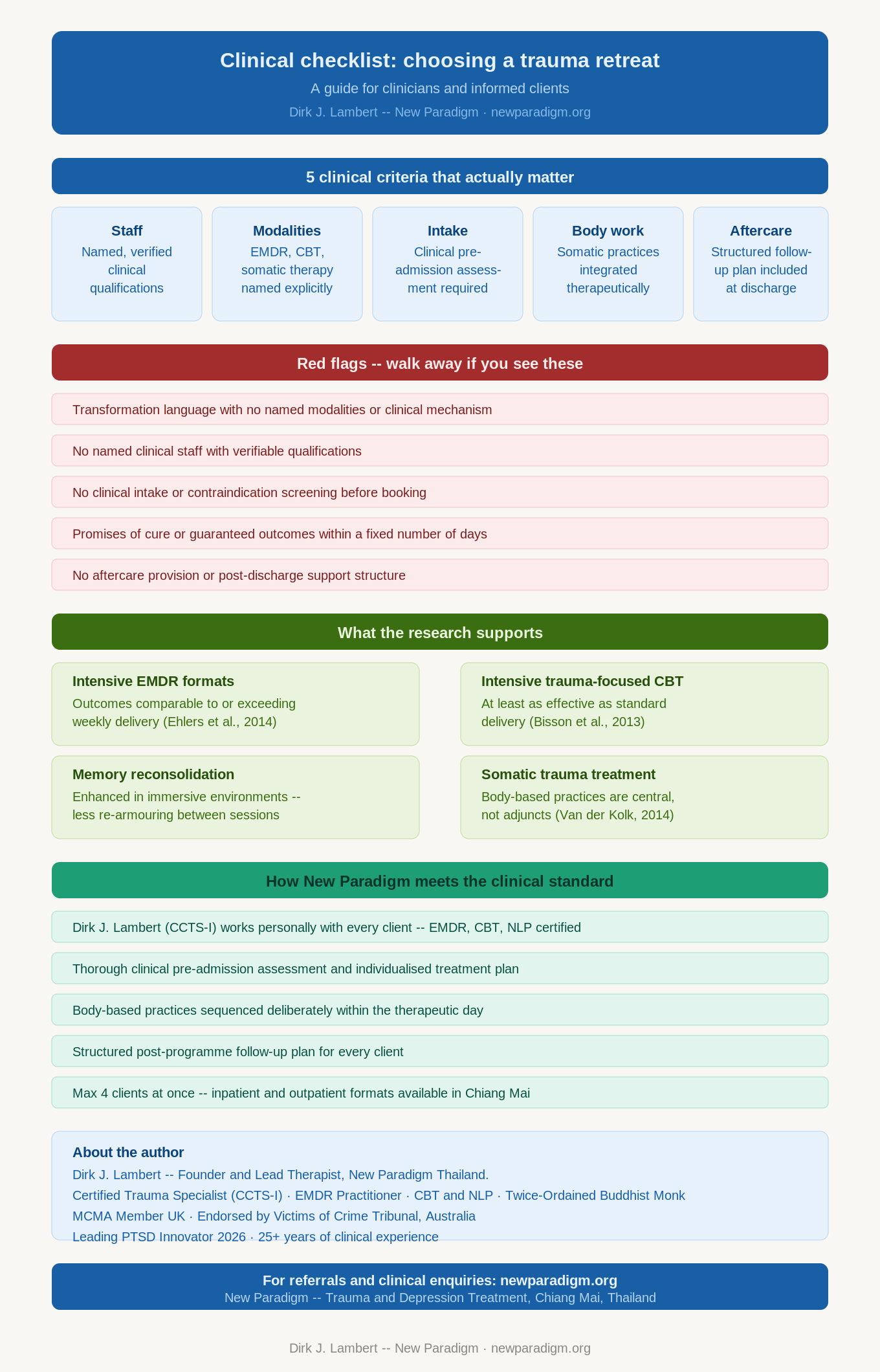
Dirk J. Lambert is the founder and lead trauma therapist at New Paradigm Trauma Recovery in Chiang Mai, Thailand. With more than 25 years of experience, he specialises in the treatment of complex trauma, PTSD, depression, anxiety, attachment wounds, and emotional abuse. Dirk is trained in EMDR, CBT, NLP, somatic trauma work, meditation, and nervous system regulation. He is also a twice-ordained Buddhist monk and an authorised teacher within the Theravada Buddhist meditation tradition. He created New Paradigm to provide focused, intensive treatment that works across the cognitive, emotional, physical, behavioural, and relational effects of trauma. Unlike larger treatment centres, New Paradigm accepts only a small number of residential clients. Dirk works personally with every client throughout the programme, providing individual guidance, trauma processing, emotional regulation training, and practical support for long-term recovery.
Why This Guide Exists
The term "trauma retreat" has become widespread. A search returns hundreds of results -- from clinically rigorous intensive programmes to luxury wellness resorts that have added the word trauma to their marketing without adding the clinical substance to back it up.
For referring clinicians and informed clients alike, this creates a genuine problem. A client who arrives at a programme expecting therapeutic depth and receives spa treatments and breathwork is not just disappointed -- they may feel their experience has been minimised, or worse, come away more sceptical of seeking genuine help. As practitioners, we have a responsibility to help people navigate toward the real thing.
This guide sets out the clinical criteria that define a genuine trauma retreat, the research supporting intensive treatment formats, the red flags that indicate a retreat is wellness tourism dressed in clinical language, and a practical checklist for evaluating any programme before referral or attendance.
What the Research Says About Intensive Formats
The evidence base for intensive, concentrated trauma treatment has strengthened considerably over the past two decades. Several key findings are relevant to clinical decision-making.
Research into intensive EMDR formats -- where multiple sessions are delivered across consecutive days rather than spread across weeks -- has consistently demonstrated outcomes comparable to or exceeding standard weekly delivery, with the additional benefit of reduced dropout and faster symptom reduction. Ehlers et al. (2014) found that intensive cognitive therapy for PTSD produced substantial symptom reduction within one to two weeks of treatment. Studies by Bisson et al. (2013) confirmed that concentrated trauma-focused CBT was at least as effective as standard delivery across a range of populations.
The neurobiological case for immersion is also compelling. Memory reconsolidation -- the process by which traumatic memories are updated and integrated -- is enhanced when the therapeutic environment remains consistent and the nervous system is not repeatedly returned to its habitual stress context between sessions. In standard weekly therapy, the re-armouring that occurs between appointments is a significant limiting factor. Immersive formats reduce this dramatically.
The addition of somatic and body-based practices to clinical programmes is supported by a growing body of research. Van der Kolk's foundational work in The Body Keeps the Score (2014) established the physiological basis for trauma's somatic expression. Subsequent research by Ogden et al. on sensorimotor psychotherapy, and by Levine on somatic experiencing, has produced consistent evidence that body-based interventions are not adjuncts to trauma treatment -- they are central to it.
The Clinical Criteria That Actually Matter
When evaluating a trauma retreat for referral or personal attendance, the following criteria are non-negotiable from a clinical standpoint.
Staff qualifications
The lead clinician and any therapists delivering individual sessions must hold recognised professional qualifications in psychology, psychotherapy, or counselling -- and these should be verifiable. Wellness coaches, yoga teachers, and meditation instructors provide real value as part of an integrated programme, but they are not substitutes for clinical expertise. A programme that cannot name its qualified clinical staff clearly and specifically is telling you something important.
Evidence-based modalities
The programme should explicitly name the therapeutic modalities used and these should have an established evidence base for trauma treatment. EMDR, trauma-focused CBT, somatic experiencing, sensorimotor psychotherapy, and ACT (Acceptance and Commitment Therapy) all meet this standard. Vague references to "holistic healing" or "transformational work" without named modalities do not.
Clinical intake and assessment
No credible trauma programme should accept a client without a thorough pre-admission assessment. This should include a clinical history, symptom assessment, contraindication screening (including active psychosis, current substance dependence, and acute suicidality), and the development of an individualised treatment plan. A programme that requires only a credit card and a booking form is not a clinical programme.
Somatic and body-based integration
Trauma is held in the body as well as in the mind. A programme that delivers only talk therapy -- however skilled -- is incomplete from a trauma-treatment standpoint. Look for explicit integration of body-based practices: yoga, breathwork, somatic movement, bodywork, or nervous system regulation practices such as contrast therapy. Crucially, these should be described in terms of their clinical function, not simply as wellness amenities.
Post-retreat follow-up protocol
What happens after the programme ends is as clinically significant as what happens during it. The period following intensive trauma work is one of consolidation and integration -- and also of potential vulnerability as clients return to their ordinary environments. A responsible programme will have a structured follow-up plan: scheduled check-ins, a recommendation for ongoing therapy, and a clear point of contact if difficulties arise. Programmes that simply wave clients off at the end of the final session are not adequately managing aftercare risk.
Red Flags to Watch For
As important as knowing what to look for is knowing what to be wary of. The following are consistent indicators that a programme is unlikely to deliver genuine clinical depth.
Transformation language without clinical specifics. Words like "transformational", "healing journey", or "breakthrough experience" are not inherently problematic, but they should be accompanied by named modalities, qualified staff, and a described clinical framework. If the language is all promise and no mechanism, be cautious.
No named clinical staff. A legitimate therapeutic programme will list its therapists by name, with their qualifications and training. Anonymous "our team of expert practitioners" copy is a red flag.
No clinical intake process. If you or your client can book and pay without any clinical screening, the programme is not operating at a clinical standard -- regardless of what it calls itself.
Promises of cure or guaranteed outcomes. Ethical clinical practice does not make outcome guarantees. A programme that promises to "heal your trauma" or "cure depression" in a fixed number of days is overstating what any responsible programme can deliver.
No aftercare provision. The absence of a post-programme support structure is a significant clinical oversight and a practical risk factor for clients returning from intensive work.
The Role of the Body in Trauma Treatment
Polyvagal theory, developed by Stephen Porges, provides the neurobiological framework for understanding why body-based practices are clinically essential in trauma treatment. Trauma dysregulates the autonomic nervous system -- specifically the balance between sympathetic activation (the threat response) and parasympathetic regulation (the rest and recovery state). For many trauma survivors, the nervous system has become chronically oriented toward threat detection, rendering sustained therapeutic engagement difficult without first addressing the physiological state.
Practices that work directly with the nervous system -- controlled breathwork, cold-water immersion, yoga nidra, progressive muscle relaxation, rhythmic movement -- do not merely support the clinical work. They create the physiological conditions in which deep therapeutic work becomes possible. At New Paradigm, body-based practices are sequenced deliberately within the therapeutic day to regulate the nervous system before intensive sessions, discharge residual activation after them, and consolidate integration in the hours that follow.
This is the distinction between a spa that offers yoga and a clinical programme that uses yoga therapeutically. The activity may look identical from the outside. The intention, the sequencing, and the clinical oversight are entirely different.
How New Paradigm Is Structured
New Paradigm is designed around the principle that comprehensive trauma treatment must address the mind, the body, and the relational self -- and that these three domains require different tools, applied in the right sequence.
The clinical core of the programme is individual therapy with Dirk, drawing on EMDR for trauma reprocessing, CBT for the thought patterns depression and anxiety have installed, and NLP for the stuck states and identity structures that have formed around traumatic experience. Sessions run 60 to 90 minutes and are paced and adjusted daily as the work unfolds. There is no fixed script -- the therapy follows the client.
Alongside this, the programme includes guided meditation practice drawing on Theravada Buddhist tradition, daily yoga, one-to-one physical training, Thai massage from a senior local practitioner, Finnish sauna and saltwater pool contrast therapy, and structured evening workshops for psychoeducation and integration. Every element is chosen for a specific clinical function and sequenced within the therapeutic day accordingly.
Pre-admission assessment is thorough and involves a clinical conversation with Dirk before any programme is confirmed. Post-programme follow-up is built into every client's discharge plan. Both inpatient (full residential) and outpatient (day attendance) formats are available.
Clinical Checklist: Evaluating a Trauma Retreat
Use the following checklist when evaluating any trauma retreat for referral or personal attendance. A credible programme should be able to provide clear, specific answers to every item.
Clinical staff and qualifications
- Are the lead therapist's qualifications named and verifiable?
- Is there a distinction between clinical staff and wellness practitioners?
- Does the lead clinician work personally with clients, or is delivery delegated?
Therapeutic modalities
- Are specific evidence-based modalities named (EMDR, trauma-focused CBT, somatic therapy)?
- Is the clinical rationale for each modality explained?
- Are body-based practices integrated therapeutically, not merely offered as amenities?
Assessment and intake
- Is there a clinical pre-admission assessment?
- Are contraindications screened for?
- Is an individualised treatment plan developed before arrival?
Programme structure
- Is there a described clinical framework governing how the day is structured?
- Are individual therapy sessions a core component, not optional?
- Is the programme adjusted to the individual client, or fixed across all attendees?
Aftercare
- Is a post-programme follow-up plan included?
- Is ongoing therapy recommended and supported?
- Is there a named point of contact for post-discharge difficulties?
A Note on Referrals
New Paradigm welcomes referrals from clinicians and is happy to provide a detailed programme overview, discuss specific client presentations, and coordinate with referring therapists before, during, and after the programme. Clients referred by a treating clinician are encouraged to maintain that therapeutic relationship alongside the retreat programme where possible -- continuity of care benefits the client and supports the integration of intensive work into the broader treatment narrative.
If you have a client you believe may benefit from an intensive trauma programme, or if you would like to discuss the clinical structure of New Paradigm's approach in more detail, please reach out directly.
Contact New Paradigm to discuss a referral or request a clinical information pack.