It's a fair question. Mental health retreats aren't cheap, they take you away from your normal life, and if you've never done one before, the whole concept can sound a little vague -- somewhere between a spa holiday and an intensive therapy programme, but you're not quite sure which. So before you commit, you want to know: does it actually work? Is it worth it?
The honest answer is that it depends -- on what you're carrying, what you're looking for, and whether the retreat you choose is built around real therapeutic work or simply relaxation rebranded as healing. But for people who have done it the right way, the shift is often profound. Not just "I feel refreshed" profound, but "I understand myself in a way I didn't before" profound.
Let's break down what makes a retreat genuinely valuable -- and what to watch out for.
What Most People Are Actually Asking
When someone asks "is a mental health retreat worth it?", they're usually asking one of a few different things. Am I too far gone for this to help? Am I not far gone enough to justify it? Will I come back the same person, just better rested? Or will something actually change?
These are good questions. And the answer to all of them has less to do with retreats as a category, and more to do with the conditions that make deep change possible -- conditions that a well-designed retreat is specifically built to create.
Ordinary life is rarely conducive to serious inner work. You're managing work, relationships, routines, and expectations -- often all at once. There's almost never a quiet enough moment to sit with the difficult stuff, let alone to process it with professional support. A retreat removes you from that context entirely. That removal alone has real therapeutic value.
What the Research Actually Says
The evidence base for intensive retreat-style treatment is growing. Studies on residential and intensive outpatient programmes consistently show outcomes that outperform standard weekly therapy for conditions like trauma, depression, and anxiety -- particularly when the format combines psychological therapy with body-based and lifestyle interventions.
EMDR (Eye Movement Desensitisation and Reprocessing), one of the most well-evidenced treatments for trauma, has shown particularly strong results in intensive formats. When sessions are concentrated over several days rather than stretched across months, the nervous system gets less opportunity to re-armour between appointments. The work can go deeper, faster.
CBT (Cognitive Behavioural Therapy) follows a similar pattern. Condensed delivery helps clients identify and reframe thought patterns in a way that weekly sessions -- with a week of ordinary life in between -- often can't match.
The addition of somatic and movement-based practices like yoga, martial arts, and cold-water therapy isn't just wellness window dressing, either. Trauma and depression are stored in the body, not just the mind. Practices that work directly with the nervous system -- regulating it, building resilience, creating new physical experiences of safety -- are increasingly understood as essential parts of effective treatment, not optional extras.
What a Good Retreat Actually Gives You
Beyond the research, people who've been through quality mental health retreats tend to describe a few experiences consistently.
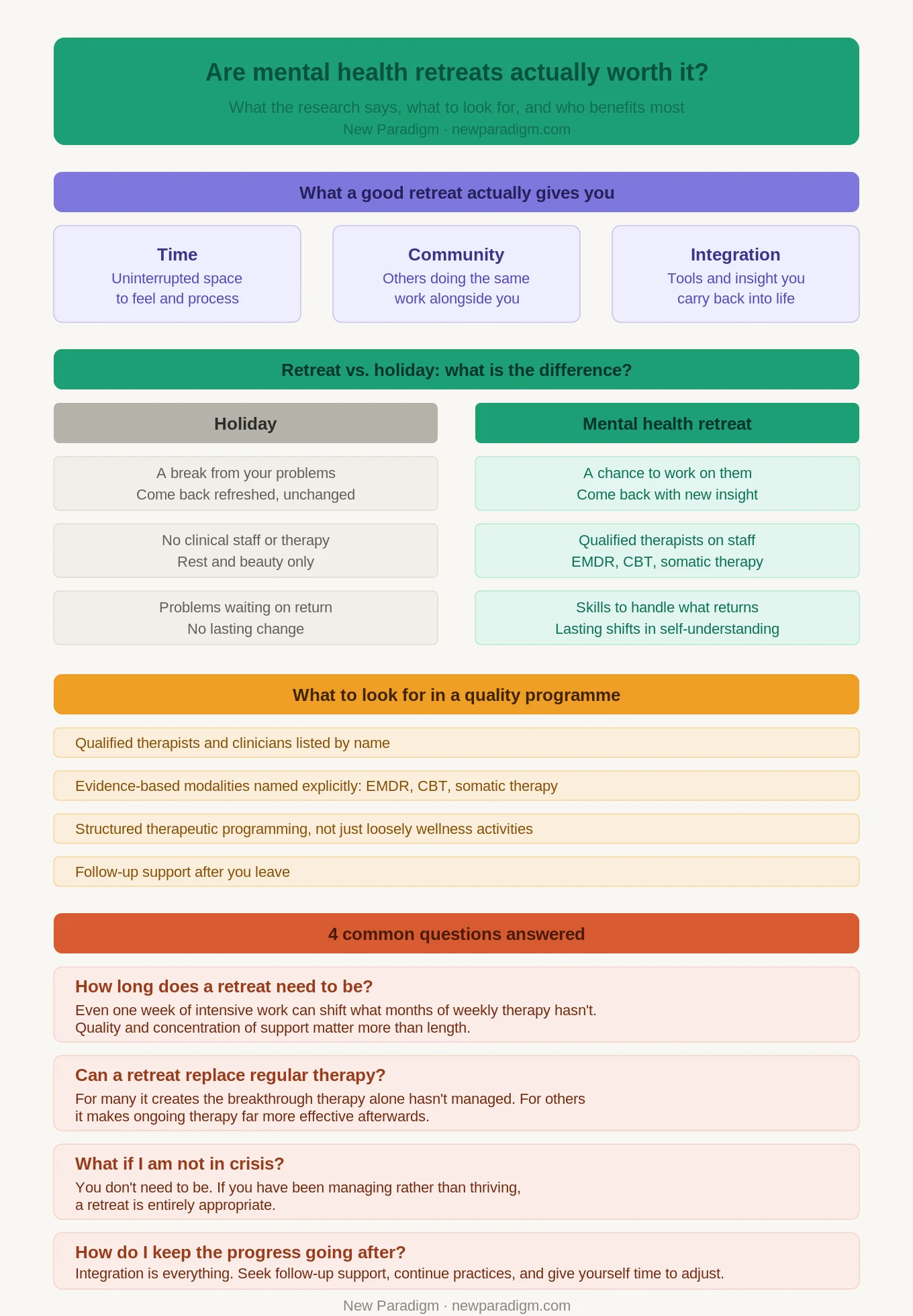
The first is time. Not time off -- time with themselves. Time to feel things that have been waiting to be felt. Time to talk about what's actually going on without having to rush back to something else in an hour. That kind of uninterrupted space is genuinely rare, and for many people it's the first time they've had it in years.
The second is community. Being around other people who are doing the same difficult work creates a particular kind of solidarity. You realise you're not uniquely broken. You see someone further along in the process and understand that progress is possible. You feel less alone in something you may have spent a long time carrying alone.
The third is integration. The best retreats don't just help you feel better for a few days -- they give you tools, language, and insight that you carry back into your life. The yoga practice you discover there becomes something you return to. The pattern you identified in a CBT session reshapes how you relate to yourself for years. The ice bath that taught you something about your own capacity for discomfort changes how you respond to stress long after you've left.
The Difference Between a Retreat and a Holiday
It's worth being honest about this, because not all retreats are equal and not all marketing is transparent.
A holiday -- even a beautiful, restful one -- gives you a break from your problems. A mental health retreat, done properly, gives you a chance to work on them. The distinction matters because after a holiday, you come back refreshed but unchanged. After genuine therapeutic work, you come back with something new: insight, skills, a different relationship with yourself.
The markers of a retreat that's built for real change: it has qualified therapists and clinicians on staff. It uses evidence-based treatment modalities, not just loosely therapeutic activities. It offers structured programming alongside space for personal reflection. It has a clear clinical thread running through everything it offers, even the yoga class and the ice bath.
The markers of a retreat that's more spa than therapy: it's heavy on aesthetics, light on clinical detail. The website talks about "transformation" without explaining how. There are no therapists listed, only coaches and wellness practitioners. The programme has no clear through-line.
This isn't to say rest and beauty don't have value -- they do. But if you're dealing with trauma, depression, or anxiety at a level that's genuinely affecting your life, you need more than a beautiful setting. You need skilled support.
Is It Worth the Cost?
This is the question that stops a lot of people, and it deserves a direct answer.
Quality mental health retreats are expensive. There's no way around that. But the comparison point matters. Compare the cost to years of weekly therapy sessions that don't gain traction because the conditions aren't right for deep work. Compare it to the ongoing cost -- financial, professional, relational -- of leaving depression or trauma unaddressed. Compare it to what it costs to keep functioning at a fraction of your capacity because the things that need healing haven't been healed.
People rarely regret investing in something that fundamentally changed how they relate to themselves and their lives. They do, often, regret waiting. Waiting until it gets worse. Waiting until something forces their hand. Waiting because the cost felt too high, while the cost of not going accumulated quietly in the background.
That said, the value is entirely contingent on choosing the right programme. A retreat that's not well-designed is money spent on atmosphere. A retreat with real clinical rigour, skilled therapists, and a programme built around evidence-based treatment is something else entirely.
Who Gets the Most Out of a Retreat
Mental health retreats aren't only for people in crisis, though they're absolutely appropriate for people who are. They're also for people who have been managing -- holding it together, keeping up appearances, functioning -- but who sense that functioning isn't the same as living. People who have tried weekly therapy and found it slow going. People who want to do serious work in a concentrated way, then carry it forward. People who need to step outside their everyday context to see it clearly.
If any of that sounds familiar, a retreat is worth taking seriously.
The ideal candidate isn't someone who has everything under control and wants a tune-up. It's someone who knows something needs to shift, is willing to do the work, and wants a structured, supported environment to do it in. That's a broad description -- and deliberately so.
What to Look for When You're Choosing
Check the clinical credentials of the staff. Look for programmes that list their therapeutic approaches explicitly -- EMDR, CBT, somatic therapy -- rather than speaking only in generalities. Ask what a typical day looks like. Look for a balance of structured therapeutic work and time for integration. Ask whether there's follow-up support after you leave, because what happens in the weeks after a retreat matters as much as the retreat itself.
A programme that takes your mental health seriously will be able to answer these questions clearly. One that can't is telling you something important.
The Real Question
So: are mental health retreats worth it? For the right person, at the right programme, doing the work with honesty and openness -- yes. Genuinely, substantively yes. Not because retreats are magic, but because the conditions they create -- time, skilled support, community, immersion, and removal from everyday noise -- are conditions that make real change possible in a way that's hard to replicate anywhere else.
The better question isn't whether it's worth it in the abstract. It's whether the particular thing you're carrying would benefit from exactly this kind of concentrated, supported, embodied work. For a lot of people, the answer is yes. They just needed someone to say it plainly.
Ready to Find Out for Yourself?
At New Paradigm, we combine evidence-based therapies -- EMDR, CBT, NLP -- with yoga, meditation, ice baths, martial arts, and therapeutic workshops, all within an in- or outpatient format designed around your needs. Our team of qualified clinicians works with trauma, depression, and the particular exhaustion of people who have been managing for too long.
If you've been asking yourself whether a retreat could help, that question is worth exploring. We're here to talk it through with you -- no pressure, no commitment required.