You've made the decision. You've researched the options, felt the pull toward something different, and quietly committed to taking time away for your mental health. Then comes the question that stops so many people in their tracks: do I tell my family?
It's a question that carries a surprising amount of weight. For some people, the thought of sharing their plans feels exposing — like admitting something they've spent years hiding. For others, the fear isn't about shame at all, it's about managing everyone else's reactions when they're barely managing their own. Whatever is making you hesitate, you're not alone in hesitating.
There's no single right answer here. But there are some things worth thinking through before you decide.
Why This Question Feels So Hard
Mental health still carries stigma in many families, even in families that consider themselves open and progressive. Telling someone you're going to a retreat for trauma or depression isn't quite the same as saying you're taking a holiday. It invites questions, opinions, worry, and sometimes — if you're unlucky — dismissal.
People in your life might mean well and still say the wrong thing. "Are you sure you need that?" or "Can't you just talk to someone locally?" or, worst of all, silence followed by a subtle shift in how they look at you. These aren't hypothetical concerns. They're the real reasons people keep their mental health plans to themselves.
And then there's the other side: carrying a secret feels exhausting. Having to make up a story about where you're going, fielding follow-up questions, pretending everything is normal while you're actually doing something significant for yourself — that has its own cost.
So the question isn't really should you tell them. It's who deserves to know, and how much?
You Don't Owe Anyone a Full Explanation
One of the most liberating things to understand is that disclosure is not binary. You don't have to choose between telling everyone everything or telling no one anything.
You can say you're taking some time away to focus on your wellbeing. That's true. You can say you're attending a wellness program. Also true. You don't have to lead with "trauma retreat" or "depression treatment" if you're not ready for that conversation, and you may never be ready for it with certain people, and that's fine.
Your mental health journey belongs to you. The work you do — whether that's EMDR sessions, somatic therapy, meditation, or simply having the space to breathe and process — that's yours. Sharing it should feel like a choice, not an obligation.
When Telling Family Makes Sense
That said, there are situations where being open with the people close to you can genuinely help.
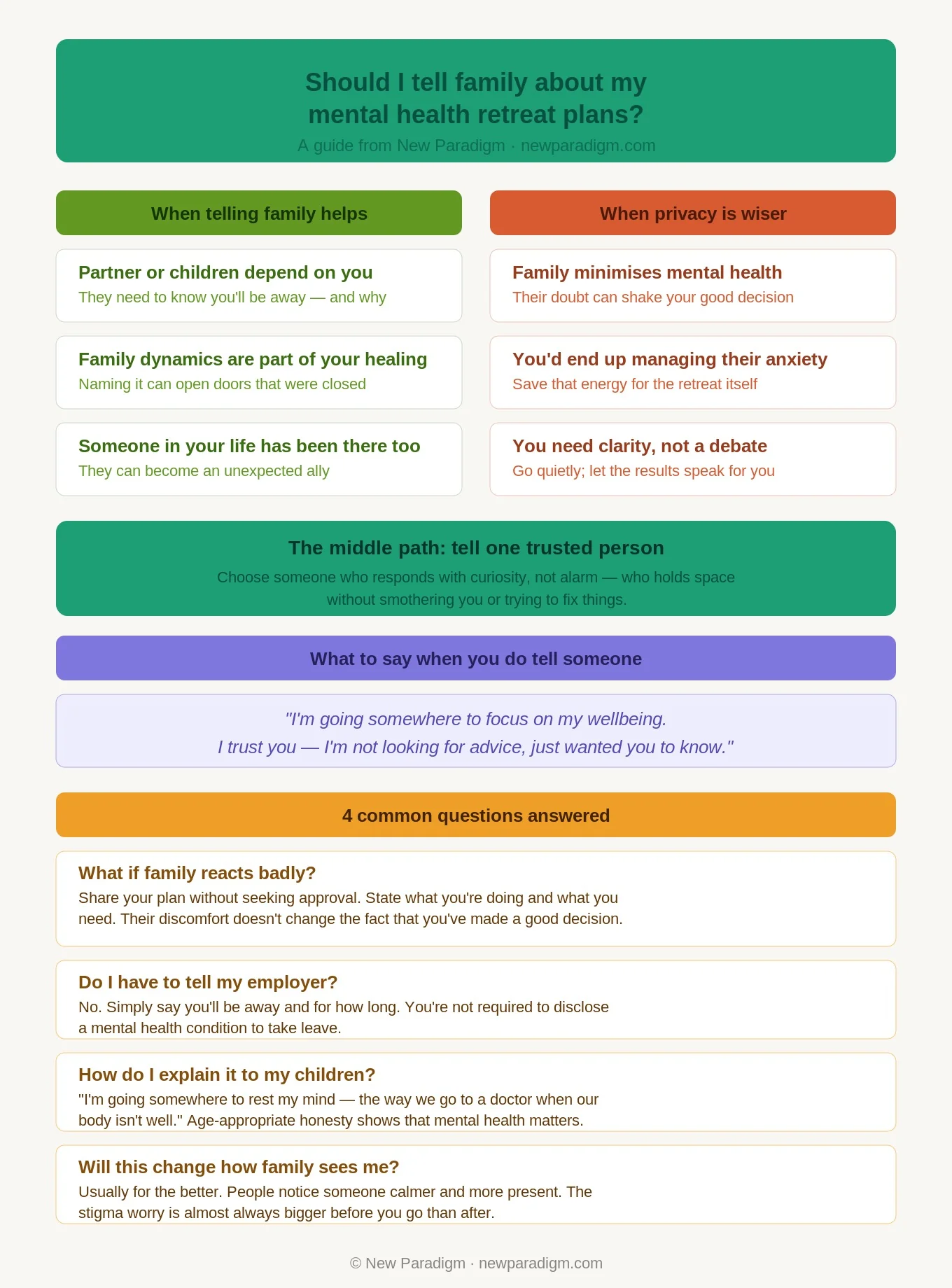
If you live with a partner or have children who depend on your daily presence, some level of explanation is practical. They need to know you'll be away, and they deserve to understand — at least in broad terms — why. A partner who understands you're working on your mental health is in a much better position to support you than one who feels blindsided or left out.
If your family relationships are part of what you're working through, telling them you're seeking support can sometimes be the first step in shifting those dynamics. It takes courage, but naming what you're doing can create an opening that didn't exist before.
And if you have family members who've walked similar paths themselves — who've sought therapy, attended retreats, or been open about their own struggles — they can become unexpected allies. The right person in your corner, even just one, can make the whole thing feel less lonely.
When Keeping It Private Is the Wiser Choice
There are also very good reasons to keep your plans to yourself, at least initially.
If your family has a history of minimizing mental health, you already know what their response is likely to be. Seeking validation or permission from someone who won't understand is a guaranteed way to create doubt right when you need clarity. You've made a good decision. Don't let someone else's limited understanding of mental health unravel it.
If telling your family means taking on the emotional labor of managing their anxiety about you — explaining what the program involves, reassuring them you're not in crisis, defending your choice — then you're spending energy before you've even arrived. Save it.
Sometimes the protective thing is to go quietly, do the work, and come back changed. Let the results speak for themselves. People who love you will notice, and you can have a richer conversation about it once you've had the experience and found your own words for it.
A Middle Path: Telling Selectively
Most people find the answer somewhere in the middle. They tell one person — a sibling, a close friend, a partner — who they trust to hold it well. That person knows where they're going and why, can check in if needed, and gives them a sense of being seen without the exposure of a broader announcement.
This is often the healthiest approach. You're not isolated with your decision, but you're also not managing a crowd of reactions before you've even packed your bag.
Think about who in your life tends to respond to difficult news with curiosity rather than alarm. Who makes you feel supported without smothering you? Who has demonstrated that they can hold space for something without immediately trying to fix it or explain it away? That's your person.
What to Say If You Do Tell Someone
If you decide to share, keep it simple and specific about what you need from them.
"I'm going to spend some time at a wellness retreat focused on mental health. I wanted you to know because I trust you. I'm not looking for advice right now — I just wanted someone to know."
Framing it this way sets a clear expectation: you're not opening a debate. You're choosing to include them. Most people, when given that framing, will rise to meet it.
If they don't — if they respond with skepticism or unhelpful commentary — that's information too. It tells you something about where that relationship is, and it might be exactly the kind of clarity you needed.
The Work You Do There Is Yours to Keep
Whatever you decide about telling family, one thing holds: the healing that happens at a place like New Paradigm is yours. The EMDR session where something finally shifts. The morning yoga practice that puts you back in your body. The ice bath that teaches you something about your own resilience. The moment in a workshop when a pattern you've carried for years suddenly becomes visible.
Those experiences don't need to be shared to be real. You don't need anyone's approval for the decision that led you there, and you don't need to justify the changes you come back with.
You just need to go.