It is a question that comes from a particular kind of love. Your teenager is struggling - or you are, and you know it is affecting them. The idea of addressing this in the same place, at the same time, makes sense. And the practical reality is that a child of eleven, thirteen, or sixteen cannot simply travel to Thailand and attend an intensive residential programme alone. You would need to be there.
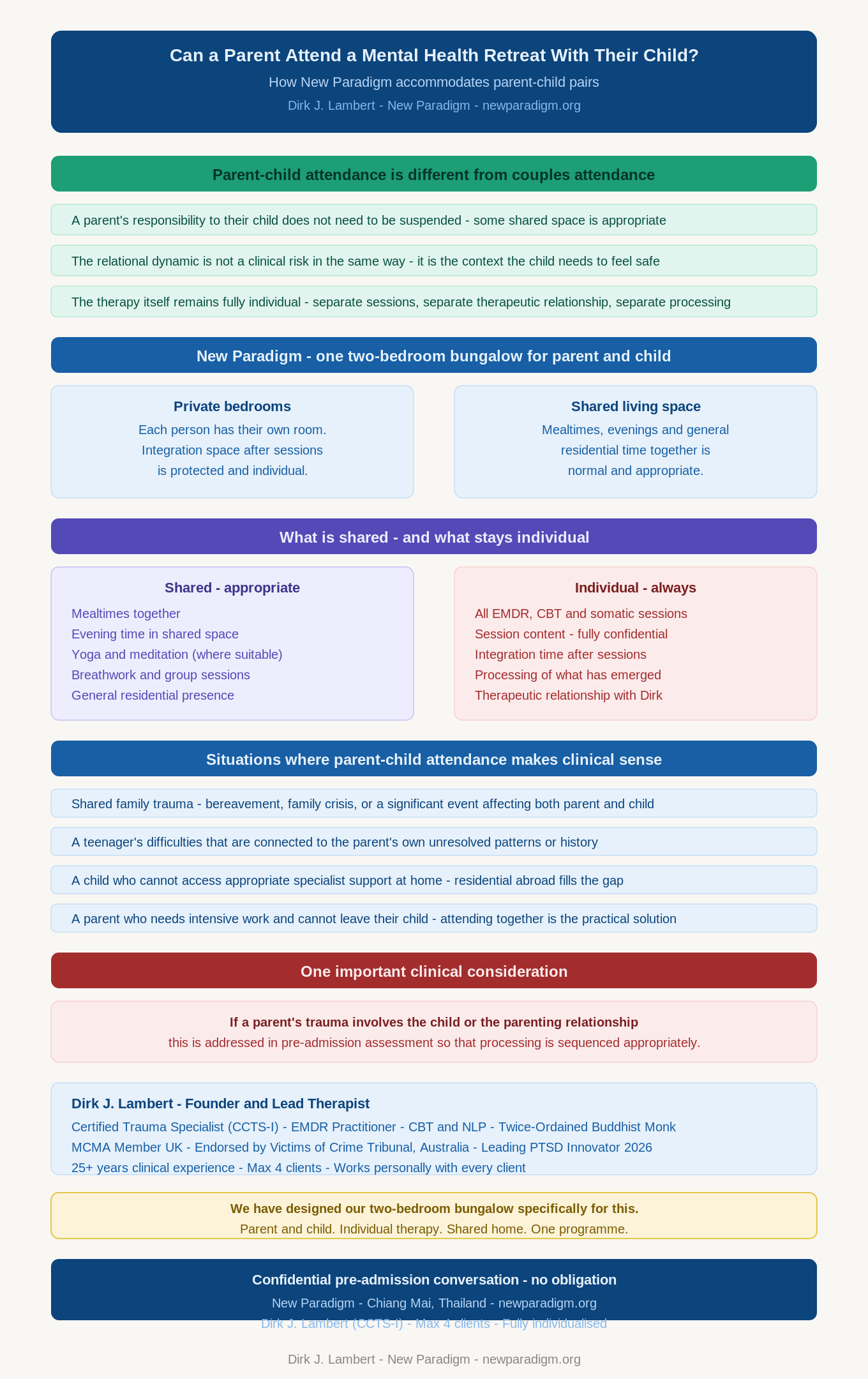
At New Paradigm, we have a specific answer to this question - and it is a more accommodating one than our guidance on couples attending together. We have one two-bedroom bungalow that was designed with exactly this situation in mind. A parent and their child can attend simultaneously, sharing residential space that gives each person their own room, while each receives their own fully individual therapeutic programme. This article explains how that works, what it requires, and what families most commonly ask before they decide.
Why Parent-Child Attendance Is Different From Couples Attendance
When we write about why couples attending intensive trauma work together is generally not recommended, the core concern is that the relational dynamic between two adults in an intimate partnership follows them into the therapeutic work in ways that compromise both individuals' processes. The solution we recommend is separate programmes at different times.
The parent-child relationship is fundamentally different. A parent is responsible for a child. That responsibility does not need to be - and should not be - suspended for the duration of a therapeutic programme. Some degree of shared space, shared mealtimes, and appropriate parental presence is not just acceptable in this context: it is normal and healthy. A fourteen-year-old in an intensive therapeutic programme in a foreign country needs their parent to be close. Expecting otherwise would be neither clinical nor humane.
What remains individually protected is the therapeutic work itself. Each person has their own sessions, with their own therapeutic relationship with Dirk, addressing their own material at their own pace. The shared residential environment at New Paradigm supports this structure rather than undermining it: each person has a private bedroom, and integration time after sessions - the quiet, unstructured period when what has emerged in therapy begins to settle - is individual even when the broader living space is shared.
What Brings Parent-Child Pairs to New Paradigm
There are several distinct situations in which a parent and teenager attending together makes clinical sense.
The most common is shared family trauma. A bereavement that has affected the whole family. Exposure to violence or crisis that both parent and child experienced. A serious parental illness or diagnosis that disrupted the family in ways that have left marks on both generations. In these situations, both people are carrying material from the same event, and addressing it in the same therapeutic environment - even if the processing itself is entirely individual - can be appropriate.
A second situation is a teenager who is visibly struggling in ways that the parent recognises are connected to the parent's own unresolved history. Attachment patterns, emotional regulation difficulties, the inheritance of anxiety or hypervigilance - these pass between generations not through genetics alone but through the relational field of the family. A parent who does intensive individual trauma work while their teenager does the same is addressing the problem at both ends of the transmission simultaneously.
A third situation is simply practical: a teenager who needs intensive support and cannot access it at home, in a country where the provision is limited, from a practitioner with the specific expertise their presentation requires. The parent attends because it is necessary logistically, and uses the time for their own work, which is almost always relevant.
How the Therapeutic Programme Works for a Teenager
Intensive trauma work with adolescents requires different pacing and different emphasis than work with adults. The developmental context matters: a teenager's nervous system, sense of identity, and relationship to authority and trust are all in active formation. Therapeutic approaches that work well with adults may need to be adapted significantly.
At New Paradigm, EMDR with younger clients uses age-appropriate resourcing and bilateral stimulation in formats that are accessible and non-intimidating. Somatic work - the body-based approaches that run alongside EMDR and CBT in the programme - tends to be particularly effective with teenagers, who are often more connected to physical experience than to verbal processing. The yoga, meditation, martial arts, and breathwork components of the programme are, in many cases, more naturally accessible for a teenager than structured talking therapy, and these elements form an important part of the daily structure for younger clients.
Session length and frequency are calibrated to the individual, and this is especially true with pre-teens and younger teenagers who may have a shorter window of productive processing time within a single session than an adult would. The overall programme is adapted in pre-admission assessment based on the specific person, their age, and their presentation.
The Therapeutic Confidentiality Between Parent and Child
This is the element that parents most often underestimate in advance and feel most acutely during the programme. Your child's sessions are confidential. What your teenager discusses with Dirk, what emerges in EMDR processing, what they name about their inner life or their experience of the family - this is not reported back to you as the parent, except in circumstances where safety concerns require it.
This is not a bureaucratic position. It is clinical. A teenager who knows that their therapeutic work will be relayed to their parent cannot do the same quality of work. The therapeutic relationship requires the same conditions of privacy and safety for a young person as it does for an adult. In some cases, what emerges in a teenager's sessions is directly relevant to the parent - and if your child chooses to share it with you at some point after the programme, that is their choice. It is not communicated by the therapist without explicit consent.
Parents who find this difficult are encouraged to explore what that difficulty is about in their own sessions. The impulse to know what your child is carrying is entirely understandable. It is also, often, material.
When the Parent's Trauma Involves the Child or the Parenting Relationship
There is one situation that requires careful pre-admission assessment: when a parent's presenting trauma is directly connected to the child who is attending with them. Parental shame, a specific incident involving the child, or a pattern of behaviour the parent recognises as harmful and wants to address - these are legitimate and important areas for therapeutic work. They require, however, that the structure is considered carefully before the programme begins.
Processing shame about your relationship with your child while your child is in the next room is not the same as processing it in a separate residential environment. The proximity introduces a layer of complexity - the risk of the parent's internal state leaking into the shared living space, the possibility that the child senses something without context to understand it, the way that uncontained material can enter the relational field between two people sharing a home even without words. This is addressed directly in the pre-admission assessment with Dirk. In some cases the structure can accommodate it. In others, the parent's work in this specific area may be sequenced differently within the programme so that the most sensitive processing happens at points when the relational risk is lower. Understanding what a genuine clinical pre-admission assessment looks like gives a clearer picture of why this conversation happens before, not after, the programme begins.
The Practical Arrangements at New Paradigm
The two-bedroom bungalow at New Paradigm is the physical foundation that makes parent-child attendance possible. Each person has a private bedroom - not an adjoining room, not a shared space with a partition, but a genuinely private room with a door that closes. This matters because the integration period after sessions is where much of the real work happens, and that period needs to be individual even in a shared residential context.
Mealtimes together are not only permitted but encouraged. Shared meals are an appropriate and grounding part of the parent-child relationship, and the structure of the day at New Paradigm accommodates them naturally. Some elements of the wider programme - yoga, guided meditation, certain somatic sessions - may also be joined, where this is clinically appropriate for both individuals. These shared elements are not therapy sessions: they are the integrative, regulating practices that support the clinical work, and experiencing them alongside each other can, in some cases, be genuinely supportive.
Evening time is shared and appropriate. There is no expectation that a parent and teenager should be entirely separate in the hours after the therapeutic day. What is expected is that the content of individual sessions - what emerged, what was processed, what is still moving - is not brought into the shared space for joint processing. Each person integrates their own material. The evening is for the relationship as it normally is, not for the therapeutic work of the day. A sense of how the daily structure at New Paradigm is organised makes it easier to see how this balance works in practice.
What Parents Most Often Ask Before They Book
Most parents who contact New Paradigm about attending with a teenager have thought carefully before they reach out. The questions they ask tend to be specific, clinical, and honest. Is my child old enough for this? Will they be willing? What if what they share in therapy changes how I see them, or how they see me? What if the programme reveals things I was not prepared to know?
These are good questions, and they deserve direct answers rather than reassurance. The most useful thing to do before deciding is to have a clinical conversation with Dirk - separately, and then possibly together - about each person's presenting situation and what the structure would need to look like. The pre-admission process exists precisely because no two family situations are the same, and the programme that serves a fifteen-year-old processing bereavement alongside a father addressing his own grief looks very different from the one that serves a twelve-year-old with anxiety alongside a mother working through a complex trauma history. The way childhood experience shapes the nervous system and the relational patterns we carry into adult life is often the thread that connects what a parent and child are each carrying - and naming that connection is where the clinical conversation begins.
If you are wondering whether this level of commitment makes sense for your family, the question of whether intensive residential treatment actually produces lasting change is addressed directly elsewhere on this site.
Contact New Paradigm today for a confidential conversation about whether parent-child attendance is the right structure for your situation - and what that programme would look like for each of you.
About the Author
Dirk J. Lambert is the founder and lead therapist at New Paradigm, a private mental health retreat in Chiang Mai, Thailand. He is a Certified Trauma Specialist (CCTS-I), EMDR practitioner, CBT and NLP specialist, and twice-ordained Buddhist monk with more than 25 years of clinical experience working with complex trauma, PTSD, depression, and attachment disorders. Dirk founded Thailand's first alternative recovery centre in 1999 and established New Paradigm in 2016. He is a recognised specialist in the treatment of sexual abuse survivors, an endorsed provider through the Victims of Crime Assistance Tribunal in Melbourne, Australia, a member of the Complementary Medical Association UK (MCMA), and was named Leading PTSD Innovator in 2026 by Global Health and Pharma. He works personally with every client who enters the programme.