It is a question we receive regularly at New Paradigm, and it is a reasonable one. You and your partner are both struggling. You want to do the work. Attending together feels efficient, supportive, even bonding. Why not go through this process side by side?
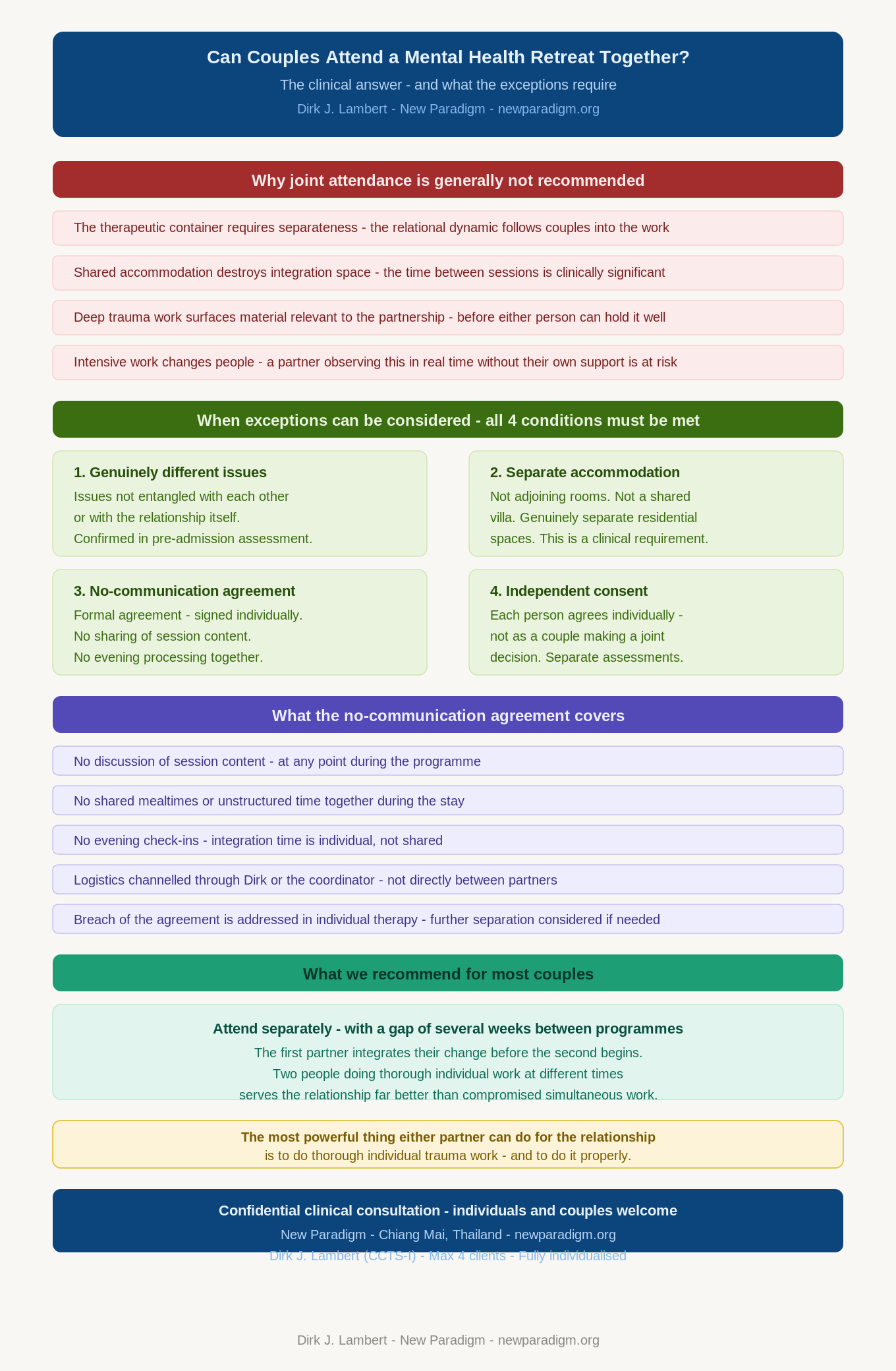
The honest clinical answer is: joint attendance is generally not recommended for intensive trauma work, and the reasons matter more than the conclusion. This article explains why, what the specific risks are, and under what circumstances exceptions can be considered - and what those exceptions require to work safely.
Why Intensive Trauma Work Is Individual Work
Intensive trauma treatment is, by its nature, a deeply personal process. What surfaces in EMDR sessions, in somatic work, in meditation, and in the therapeutic relationship is material that belongs to the individual - their specific memories, their particular nervous system responses, their own developmental history and survival strategies. This material is not shareable in real time. It is often not fully formed enough to be shared at all during the active processing phase.
When two people who are in an intimate relationship attend the same intensive programme simultaneously, several things become complicated that should be simple. The therapeutic container - the sense of safety, privacy, and separateness from ordinary relational dynamics that effective trauma work requires - is immediately compromised. Your partner is there. Everything you process will be filtered, consciously or unconsciously, through what your partner might think, feel, or need in response to it.
This is not a hypothetical concern. It is a consistent clinical observation: people in relationships who attempt simultaneous intensive trauma treatment do not get the same depth of individual processing as those who attend alone. The relational dynamic follows them into the work.
The Problem With Sharing a Room
The residential environment matters enormously in intensive trauma treatment. The space between sessions - the time in the room alone, the unstructured hours, the process of digesting what has emerged in therapy before the next session - is not downtime. It is integration time, and it is clinically significant.
When two partners share a room during an intensive trauma programme, that integration space disappears. What replaces it is the relational field of the partnership - the habits, the dynamics, the unresolved tensions, the impulse to process with each other what has just emerged in individual therapy. Even with the best intentions, this is almost impossible to avoid. A partner who has had a difficult EMDR session returns to the shared room. The other partner notices. Something is communicated - verbally or non-verbally - and the boundary between individual therapeutic work and the couple's relational dynamic collapses.
This is a problem for two distinct reasons. First, it disrupts the individual's integration process. What emerged in session needs space to settle - not immediate relational response, however well-intentioned. Second, it introduces relational material into the therapeutic process before either individual has the capacity to handle it. Deep trauma work often surfaces material that is directly relevant to the partnership - old wounds, attachment patterns, things that have never been named between the two people. Encountering this material in the couple's shared space, without therapeutic containment, is a risk to both the individuals and the relationship.
When One Person's Healing Affects the Other
There is a further clinical reality that couples attending together rarely anticipate: intensive trauma work changes people. The person who returns from a session in which an early attachment rupture has been reprocessed through EMDR is, in some meaningful sense, different from the person who went in. Their relationship to themselves has shifted. Their nervous system has updated. Something that was frozen has begun to move.
This is the intended outcome. It is also, for the partner observing it in real time, potentially destabilising. The relationship between two people is a system, and when one element of that system changes significantly, the system responds. A partner who is simultaneously in their own intensive process does not have the capacity to hold that response well. They are processing their own material, their own shifts, their own emerging material. The result can be two people in significant personal flux, sharing a small residential space, without adequate containment for what is arising between them.
This is one of the reasons that at New Paradigm - as in most serious trauma programmes - we recommend that couples who both need treatment attend separately, with sufficient time between programmes for each individual to stabilise and integrate before the other begins. The relationship benefits more from two people doing thorough individual work at different times than from two people doing compromised individual work simultaneously.
The Exception - When Joint Attendance Can Be Considered
There are circumstances in which two people who are in a relationship may attend New Paradigm during the same period. These are exceptions, not the rule, and they require a specific set of conditions to be in place before they can be considered.
The most important condition is that the two people are working on genuinely different issues that are not directly entangled with each other. If both partners are carrying trauma that is rooted in their shared relational history - if the relationship itself is a significant part of the presenting material for either person - joint attendance is not appropriate. The work cannot be kept separate. If, however, one person is processing medical trauma from a previous diagnosis and the other is working through childhood attachment wounds that predate the relationship, the risk of entanglement is significantly lower.
The second condition is separate accommodation. Not adjoining rooms. Not a shared villa where each has a separate bedroom. Genuinely separate residential spaces, ideally without easy informal access to each other during the programme. This is not a social arrangement - it is a clinical one. The integration space must be protected.
The third and most critical condition is a formal no-communication agreement. Before the programme begins, both individuals must explicitly agree - and demonstrate genuine understanding of why - they will not communicate with each other during the retreat stay about anything related to their therapeutic work. This means no checking in about sessions. No sharing of what has emerged. No processing together in the evenings. No texting from across the property about how the day went.
In practice, this agreement typically extends further than most couples initially anticipate. Even casual communication between partners during intensive trauma work carries the risk of introducing relational material into a process that needs to remain individual. Some couples who have considered joint attendance, when they understand what the no-communication agreement actually requires, conclude that they would prefer to attend separately. That conclusion is a healthy one.
What the No-Communication Agreement Actually Means in Practice
When joint attendance is agreed and a no-communication protocol is in place, the structure at New Paradigm is explicit. Both individuals are briefed separately on the agreement and its clinical rationale before they arrive. Both confirm understanding and consent independently - not as a couple making a joint decision, but as two individuals each taking responsibility for their own therapeutic boundary.
During the programme, mealtimes, communal spaces, and any shared elements of the daily schedule are structured to avoid creating informal time together that would naturally generate conversation. If both individuals are using the same facilities at different times, the scheduling is managed to prevent overlap. Evening time - the integration period after the day's clinical work - is protected as individual time. There is no shared evening for the couple during the programme.
Communication about logistics - practical matters relating to travel, accommodation arrangements, or administrative necessities - is permitted but is channelled through Dirk or the programme coordinator rather than directly between the two individuals. This removes the risk of practical communication becoming a gateway to therapeutic communication.
Both individuals also have the explicit understanding that if the no-communication boundary is broken - regardless of the reason or the intention - this will be addressed in their individual therapy session, and the option of separating the two programmes further (in time or physical location) will be considered if necessary.
These are not bureaucratic arrangements. They exist because the evidence of what happens when intensive trauma work leaks into the relational field is consistent and clear. The agreement protects both individuals and the therapeutic work they have come to do. Understanding what a typical day at New Paradigm looks like gives a clearer picture of why the structure of the therapeutic day makes these boundaries both necessary and achievable.
The Recommendation We Give Most Couples
When a couple contacts New Paradigm asking about joint attendance, the clinical conversation begins with the question of whether the presenting issues are genuinely separable. If they are not - if the relationship is a significant part of what either person needs to work through - we recommend individual programmes at different times, with a gap of at least several weeks between them.
The partner who attends first will change. They need time to integrate that change before their partner enters a similar process. The relationship then has the benefit of two individuals who have each done thorough, uncontaminated individual trauma work - which is a far stronger foundation for whatever relational work may follow than two people who attempted simultaneous processing in a shared residential space.
If you are considering a retreat and your partner is also thinking about attending, the most useful first step is a clinical conversation with Dirk - separately, if possible - about each person's presenting issues and what structure would best serve the therapeutic work. Our clinician's guide to choosing a trauma retreat covers what a genuine clinical assessment looks like, and why pre-admission conversation is the foundation of any programme that works. If you are still weighing whether this level of commitment makes sense, whether mental health retreats are actually worth it addresses that question directly.
Many of the relationship difficulties that bring couples to consider a shared retreat are rooted in the individual trauma histories each person carries - the attachment patterns, the survival strategies, the relational blueprints formed long before this relationship began. Understanding how childhood trauma affects adult relationships often reframes the question entirely: the most powerful thing either partner can do for the relationship is to do thorough individual trauma work, and to do it properly.
Contact New Paradigm today for a confidential conversation about what the right structure looks like for your situation.
About the Author
Dirk J. Lambert is the founder and lead therapist at New Paradigm, a private mental health retreat in Chiang Mai, Thailand. He is a Certified Trauma Specialist (CCTS-I), EMDR practitioner, CBT and NLP specialist, and twice-ordained Buddhist monk with more than 25 years of clinical experience working with complex trauma, PTSD, depression, and attachment disorders. Dirk founded Thailand's first alternative recovery centre in 1999 and established New Paradigm in 2016. He is a recognised specialist in the treatment of sexual abuse survivors, an endorsed provider through the Victims of Crime Assistance Tribunal in Melbourne, Australia, a member of the Complementary Medical Association UK (MCMA), and was named Leading PTSD Innovator in 2026 by Global Health and Pharma. He works personally with every client who enters the programme.