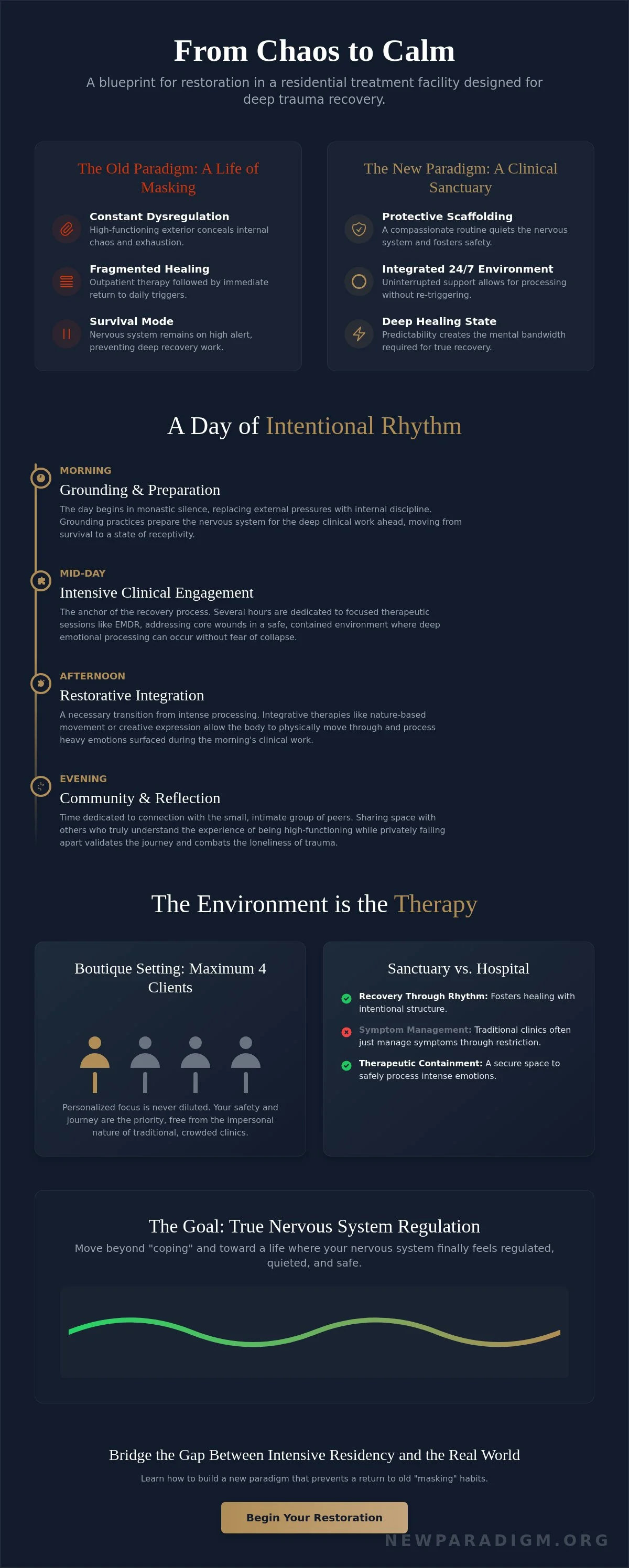
What if the most effective way to regain control of your life isn't through more discipline, but through a radical surrender to a different kind of structure? You've likely spent years perfecting the art of masking your exhaustion, appearing high-functioning to the world while privately falling apart under the weight of unresolved trauma. It's a lonely, draining cycle that leaves you fearing that any loss of routine will lead to total collapse. Understanding the daily life in a residential treatment facility shouldn't feel like looking at a hospital schedule; it should feel like discovering a blueprint for your own restoration.
We've spent 25 years refining a model that rejects the crowded, impersonal nature of traditional clinics. You aren't just another number here. Instead, you'll discover how a structured, private environment with a maximum of four clients provides the scaffolding for deep trauma recovery and genuine nervous system regulation. This article details the transition from the chaos of survival to the peace of a clinical sanctuary. We'll walk through the rhythm of a day designed to move you past "coping" and toward a life where your nervous system finally feels regulated, quieted, and safe.
Key Takeaways
- Understand why a rigid yet compassionate routine serves as the essential scaffolding to settle a dysregulated nervous system and begin deep trauma work.
- Explore how daily life in a residential treatment facility balances intensive clinical sessions, like EMDR, with monastic stillness to ensure the brain remains receptive to healing.
- Discover why a boutique, four-client maximum setting provides the safety and personalized focus that traditional, hospital-grade environments often lack.
- Learn how to bridge the gap between intensive residency and the real world by building a new paradigm that prevents a return to old "masking" habits.
Why Routine is the Scaffolding for Intensive Trauma Recovery
For high-functioning individuals, the daily life in a residential treatment facility often represents the first time in years they've been able to stop performing. You might be accustomed to a life that looks successful on paper while you're privately falling apart. This internal dissonance creates a state of constant dysregulation. By entering a residential treatment facility, you aren't entering a place of confinement. You're entering a clinical sanctuary where the routine serves as a protective layer, shielding you from the external chaos that keeps your trauma responses active.
To better understand how this structured environment supports your journey, watch this helpful video:
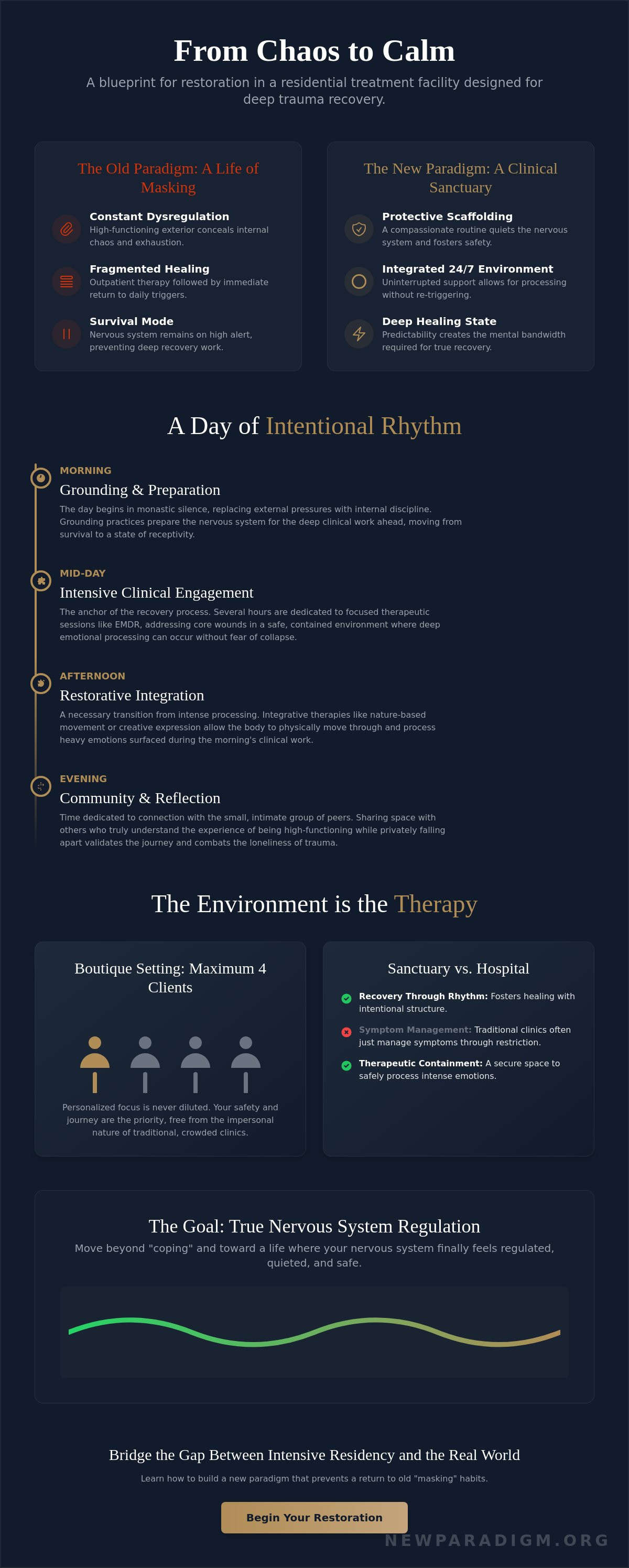
The difference between a hospital-grade ward and a clinical sanctuary is the intent behind the schedule. A hospital manages symptoms through restriction; a sanctuary fosters recovery through rhythm. When every hour is accounted for, the "unknown" disappears. For a trauma survivor, the unknown is a primary trigger for anxiety. Predictability allows the hyper-vigilance of the nervous system to soften, moving you from a state of survival into a state of deep work.
The Psychology of a Structured Environment
Structure creates the mental bandwidth required for recovery. When you don't have to manage the logistics of survival, your brain can finally focus on the unresolved pain you've been masking. The daily life in a residential treatment facility is designed to transition you from the exhaustion of masking to the honesty of a therapeutic day. In clinical terms, containment is a therapeutic framework that provides a secure, bounded space where you can safely experience intense emotions without the fear of external collapse. This stability is essential for those who have spent decades coping elegantly while their inner world remains in turmoil.
Residential vs. Outpatient: Why the 24/7 Environment Matters
Traditional outpatient therapy often forces a re-triggering cycle. You might spend sixty minutes processing a core wound, only to immediately face the stress of a commute, a demanding career, or a complicated home life. This leads to the exhaustion of privately falling apart every evening. A 24/7 environment provides uninterrupted support, ensuring that when the heavy work of therapy ends, the sanctuary of the facility remains. This continuity is why residential trauma treatment is often the only way to recover from the inside out. With a maximum of four clients, the focus is never diluted, and your safety is never compromised.
A Day in the Life: Balancing Clinical Intensity with Restorative Stillness
The rhythm of daily life in a residential treatment facility is designed to replace the frantic, disjointed pace of a life in crisis with a steady, intentional flow. Mornings begin in silence. Instead of waking up to the immediate pressure of a high-stakes career or family obligations while privately exhausted, you engage in grounding practices. These monastic mindfulness exercises aren't just about relaxation; they're a form of internal discipline that prepares the nervous system for the deep work ahead. By 9:00 AM, the focus shifts toward the day's primary clinical objective, ensuring your energy is directed toward healing rather than merely surviving the hour.
Mid-day at New Paradigm serves as the anchor of the recovery process. This is when intensive emotional processing occurs, often involving several hours of focused therapeutic engagement. After these deep dives, the afternoon provides a necessary transition into integrative therapies. You might participate in nature-based movement or creative expression, which allows the body to physically move through the heavy emotions surfaced during the morning. Evenings are dedicated to community connection and reflection, sharing space with a maximum of three other individuals who truly understand what it means to be high-functioning on paper but falling apart inside. This structure ensures that by the time you reach your bed, your mind is quieted and prepared for the restorative sleep that is so often elusive in the outside world.
The Role of Intensive EMDR Sessions
Traditional outpatient therapy often fails because the 50-minute hour is too short to process complex trauma. Daily life in a residential treatment facility changes this dynamic by allowing for 180-minute EMDR blocks. Within this secluded sanctuary, you don't have to worry about the logistics of driving home or returning to work immediately after a breakthrough. Reprocessing memories in a safe, private environment allows for a level of psychological depth that standard clinics cannot replicate. This uninterrupted time is clinically vital; it permits the brain to complete the processing of a traumatic memory in a single session rather than leaving it "open" for a week between appointments.
Integrating Monastic Mindfulness into Modern Recovery
We reject the idea of simply "coping" more elegantly. Instead, we use Buddhist-influenced practices to cultivate a rigorous discipline of internal observation. This isn't about escaping reality, but about learning to stay present with uncomfortable sensations without being overwhelmed by them. These practices complement evidence-based interventions by providing the necessary stability for the brain to rewire itself. Practicing mindfulness as a disciplined clinical tool creates a reliable bridge between your intellectual understanding of trauma and the actual regulation of your nervous system. If you're ready to move beyond temporary fixes, you can reach out to our team to discuss a personalized path forward.
The Environment: Beyond the Clinical Hospital Setting
Most high-functioning professionals fear the sterile, fluorescent-lit hallways of a traditional psychiatric ward. They worry about being reduced to a diagnosis or a chart number. At New Paradigm, the daily life in a residential treatment facility is defined by a boutique, four-client maximum. This isn't about luxury for the sake of it; it's about clinical efficacy. When a facility limits its intake to just four individuals, the clinical team can observe every nuance of a client's nervous system regulation in real time. It allows for a level of privacy that protects a professional's reputation while providing the safety needed to be vulnerable.
A sanctuary must feel like a home to support deep emotional work. While we maintain rigorous clinical standards, we've removed the cold, institutional barriers that often trigger defensiveness. This environment is designed for the person who is "successful" on paper but privately falling apart. It's a place where you can stop performing and start recovering from the inside out.
The Sanctuary Effect in Chiang Mai
Chiang Mai offers a specific kind of serenity that acts as a biological intervention. The lush, green backdrop of Northern Thailand helps down-regulate a brain that's been stuck in a fight-or-flight loop for years. Unlike a standard wellness spa that offers surface-level relaxation, this environment supports deep clinical trauma recovery. You aren't just resting; you're engaging in evidence-based emotional processing in private rooms and secluded gardens. This physical distance from the sources of your burnout, often located thousands of miles from your home office, allows for 100 percent uninterrupted focus.
Compassionate Realism in Daily Interactions
The staff aren't just monitors; they're trauma specialists who understand the weight of being the one who always has it together. In a setting with 20 or 30 people, it's easy to hide. Here, the small group size means you're seen and heard every hour of the day. This structure addresses a common objection: the fear of being lost in a crowd or forced into generic, one-size-fits-all therapy. The interactions are grounded in a 25-year history of clinical experience, blending discipline with monastic mindfulness. We don't want you to just cope more elegantly; we want you to find a new way to live.
If you're ready to step away from the noise and begin the work of real recovery, reach out to our clinical team today.
Sustainable Integration: Preparing for Life After Residency
The transition from a clinical sanctuary back to the demands of a high-pressure career is where your internal work is truly tested. You've spent weeks focusing on nervous system regulation and emotional processing in a controlled, supportive environment. Now, you must translate those internal shifts into a sustainable lifestyle that survives the noise of the real world. We don't want you to return to the exhausting habit of masking your pain just to appear functional on paper. Instead, we help you build a new paradigm for your existence. This involves moving beyond the temporary structure of daily life in a residential treatment facility and into a world where you are the primary architect of your own peace.
From Sanctuary Back to the Real World
The "stepping down" process at New Paradigm is deliberate and patient. You won't be dropped back into your old life without a map. Before departure, our team helps you co-create a personalized Aftercare Blueprint. This plan includes scheduled remote support sessions and clear boundaries for your professional re-entry. While the daily life in a residential treatment facility provides the initial safety, the aftercare provides the longevity. When explaining your absence to colleagues or family, you don't owe anyone the intimate details of your trauma history. You can simply state you were attending to a private health matter to ensure your long-term health and performance. This preserves your privacy while maintaining professional integrity.
The Long-term Value of Intensive Intervention
A 30 day deep dive offers a depth that traditional weekly talk therapy cannot reach. Clinical experience over the founder's 25-year career shows that intensive, concentrated trauma work can accelerate healing by years. It bypasses the "settling in" period required by standard 50-minute sessions. It's a strategic investment in your future self. By addressing the root causes of why you feel privately exhausted, you stop the cycle of temporary fixes. Recovering from the inside out provides a return on investment that manifests as clarity, presence, and genuine stability. You can begin this journey at the New Paradigm Homepage to see how our intimate setting, limited to just four clients, facilitates this profound transformation. We offer a path through the darkness, grounded in mindfulness and evidence-based care.
Moving Toward Lasting Regulation and Peace
You've likely spent years being high-functioning on paper while feeling privately exhausted. True healing requires more than just learning to cope; it demands a fundamental shift in how your nervous system processes trauma. The daily life in a residential treatment facility shouldn't mirror the sterile environment of a hospital. Instead, it should provide a structured scaffolding where clinical intensity meets restorative stillness. By limiting our intake to a maximum of 4 clients, we ensure your recovery is never interrupted by the noise of a crowd or the limitations of a general clinic.
Our team leverages 25+ years of clinical trauma expertise to guide you through specialized EMDR intensive programs and evidence-based processing. This isn't about temporary relief. It's about building the internal capacity to sustain your health long after you leave our grounds. You've carried the weight of unresolved pain for long enough; it's time to step into a space designed specifically for your restoration.
Begin your journey to recovery at our private sanctuary in Chiang Mai
The path back to yourself is waiting, and you don't have to walk it alone.
Frequently Asked Questions
Is daily life in a residential treatment facility like a hospital?
No, it's a clinical sanctuary rather than a sterile medical ward. Unlike traditional hospitals with hundreds of beds, we limit our capacity to 4 clients to ensure intimacy. You'll find private suites and natural surroundings instead of fluorescent lights and shared rooms. This environment supports nervous system regulation by removing the clinical coldness that often triggers anxiety in high-functioning individuals who feel exhausted by traditional settings.
Can I use my phone or laptop during my stay for work?
You'll have scheduled windows for technology use, but we prioritize uninterrupted emotional processing. We understand you're high-functioning on paper and may have professional obligations. However, constant digital connection often fuels the private exhaustion you're here to heal. We limit access to 60 minutes daily during specific blocks. This ensures you can focus on recovering from the inside out without the noise of the outside world.
What kind of therapy will I do every day?
Daily life in a residential treatment facility involves a blend of evidence-based clinical sessions and somatic practices. You'll engage in 1 individual session daily, often focusing on trauma or PTSD, alongside group work and mindfulness disciplines. We integrate Buddhist-influenced self-observation with modern nervous system regulation. This structured approach helps move you from intellectually understanding your pain to actually feeling a sense of grounded, lasting peace.
Will I have any privacy in a residential facility?
Yes, you'll have a private, secluded suite designed for deep reflection and rest. While some facilities house 20 or more people, our 4-client maximum guarantees you won't feel crowded or exposed. Privacy is a core component of our sanctuary. It allows you the space to be honest about being privately falling apart while knowing your dignity is protected by our professional, discerning team.
How long does a typical day of treatment last?
A typical day lasts about 12 hours, beginning with a 7:00 AM mindfulness practice and concluding after an 8:00 PM evening reflection. Your schedule is densely packed with 5 to 6 distinct therapeutic activities. These include clinical sessions, physical movement, and nutritious meals. This discipline creates a predictable rhythm that stabilizes the nervous system and replaces the internal chaos you've been managing for years.
What happens if I feel overwhelmed by the schedule?
If you feel overwhelmed, our clinical team provides immediate support to help you regulate your nervous system. We recognize that daily life in a residential treatment facility can be intense because you're finally facing unresolved pain. Our 1-to-1 staff-to-client ratio ensures someone is always available to adjust the pace. We don't ask you to cope more elegantly; we help you navigate the depth of your experience until you reach calm.
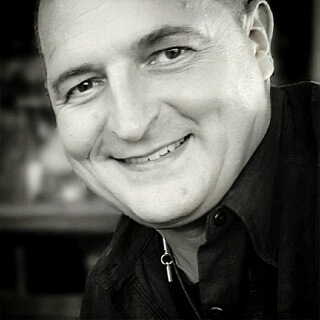
Article by
Dirk J. Lambert (MSc. - CCTS-I)
Dirk J. Lambert is a Licensed Psychotherapist, Mentor, Author, and Certified Trauma & EMDR Specialist with more than 25 years of experience helping people recover from trauma, depression, burnout, emotional abuse, and long-standing unresolved pain. His work is known for being direct, compassionate, and highly practical.
A twice-ordained Buddhist monk, Dirk bridges clinical trauma care with mindfulness, discipline, self-observation, and deep emotional honesty. He does not hide behind jargon, labels, or unnecessary complexity. He listens carefully, speaks plainly, and works toward meaningful change.
New Paradigm reflects the philosophy he has built over decades: intentionally small, deeply personal, private by design, and focused on what actually helps people recover from the inside out rather than simply cope more elegantly.