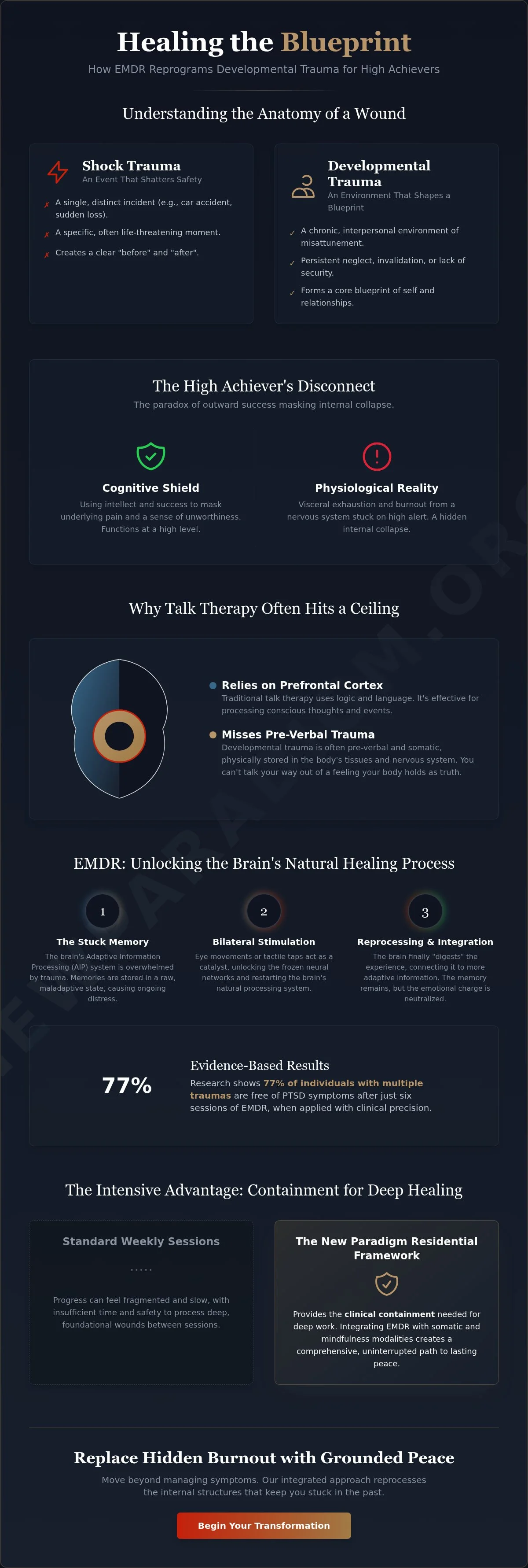
Developmental trauma is not a collection of bad memories; it is a structural blueprint that dictates how you breathe, how you trust, and how you survive. Many high achievers who struggle with this internal collapse often ask: does EMDR work for developmental trauma when the pain is so deeply intellectualized? You might feel a hidden, visceral exhaustion that talk therapy hasn't touched, leading to a quiet fear that you're simply too broken for standard treatments. This disconnect between your outward success and private struggle isn't a personal failing; it's a physiological reality.
We understand that your history requires more than a superficial fix. Research indicates that 77% of individuals with multiple traumas are free of PTSD symptoms after six sessions, but the process must be handled with clinical precision. This article explains how specialized protocols within a residential trauma treatment program provide the containment needed to reprocess chronic, interpersonal wounds safely. You'll discover how we move beyond mere coping to address pre-verbal trauma, guiding you toward an internal transformation that finally replaces hidden burnout with a grounded sense of peace.
Key Takeaways
- Distinguish between single-incident "shock" events and the chronic, interpersonal misattunement that forms the blueprint of developmental trauma.
- Understand how bilateral stimulation works within the Adaptive Information Processing model to unlock memories physically held in your nervous system.
- Discover the evidence-based answer to does EMDR work for developmental trauma when it's applied through specialized, phased clinical protocols.
- Learn why a residential framework provides the containment needed for deep work, rather than the fragmented progress often found in standard weekly sessions.
- Explore how integrating EMDR with somatic and mindfulness modalities creates a comprehensive path toward internal transformation and lasting peace.
Understanding Developmental Trauma vs. Shock Trauma
Shock trauma is an event. It is the car accident, the sudden loss, or the physical assault that shatters a sense of safety in an instant. Developmental trauma, however, is an environment. It is the chronic, interpersonal misattunement that occurs during critical windows of brain development. While "Big T" trauma involves specific, life-threatening incidents, "Small t" developmental trauma consists of persistent neglect, emotional invalidation, or the absence of a secure attachment. When individuals ask, does EMDR work for developmental trauma, they're often seeking a way to heal a life defined by these quiet, repetitive wounds rather than a single catastrophic moment.
This type of trauma creates a foundational blueprint. It dictates how you view yourself and how you trust others. For the high achiever, this blueprint is often masked by outward success. You might have learned to intellectualize your pain, using logic to explain away a deep-seated sense of unworthiness. This cognitive shield allows you to function at a high level, yet it leaves the underlying trauma untouched. To gain a deeper understanding of the therapeutic mechanics involved, it helps to look at the origins of Eye Movement Desensitization and Reprocessing (EMDR) and its clinical evolution.
To better understand this concept, watch this helpful video:
The Anatomy of a Developmental Wound
Chronic stress in childhood fundamentally impairs the body's ability to regulate its response to pressure. This impairment doesn't disappear with age; it matures into a visceral experience of internal collapse. You might call it burnout or exhaustion, but it's actually your nervous system stuck in a state of high alert. These wounds are the root of treatment-resistant depression and anxiety. They aren't about what you're thinking. They're about how your body is reacting to a world it was never taught to perceive as safe.
Why Talk Therapy Often Hits a Ceiling
Traditional talk therapy relies on the prefrontal cortex. It uses language to process experience. However, developmental trauma is often pre-verbal and somatic. You can't always talk your way out of a feeling that is physically stored in your tissues. At New Paradigm, we recognize the heavy disconnect between knowing the truth and feeling it. You might know you're successful and safe, but your body feels small and threatened. We shift the focus from managing these symptoms to reprocessing the internal structures that keep you stuck in the past.
How EMDR Targets the Developmental Blueprint
The foundation of this work rests upon the Adaptive Information Processing (AIP) model. This clinical framework suggests that your brain possesses an inherent system to process experiences toward a state of mental health. When you endure chronic, early-life neglect or misattunement, this system becomes overwhelmed. The traumatic data isn't "forgotten"; it is simply stored in a raw, maladaptive state. When we ask, does EMDR work for developmental trauma, we are essentially asking if this natural processing system can be restarted. Bilateral stimulation, through eye movements or tactile taps, acts as the catalyst that unlocks these "stuck" memories, allowing the brain to finally digest what was previously indigestible.
For those with developmental wounds, the process requires more than just moving eyes back and forth. It requires "interweaves." These are intentional, therapist-led interventions designed to provide the nurturing or protection that a child never received. If a client carries a core belief of "I am not enough," the therapist uses these interweaves to bridge the gap between that old, visceral lie and a new, adaptive truth. Understanding how EMDR is used to treat children provides a window into why these protocols are so effective for adults. We're not just clearing a memory; we're rebuilding the internal architecture of the self. If you feel ready to address these foundational structures, you might consider how to reach out for a clinical consultation regarding our specialized approach.
Reprocessing Pre-Verbal and Attachment Memories
Developmental trauma often lives in the body long before language develops. EMDR is uniquely equipped to access these pre-verbal memories through somatic sensations and emotions rather than narrative stories. We utilize "Resource Tapping" to build a robust internal sense of safety before we ever touch the deepest wounds. This prevents the "fear of the feeling" that often causes survivors to avoid therapy. We don't dive into the abyss; we build a ladder first.
The Role of Neuroplasticity in Recovery
According to 2026 clinical standards, neuroplasticity is the brain's dynamic capacity to rewire its functional architecture in response to targeted bilateral stimulation, effectively moving traumatic data from a state of high-arousal isolation into a coherent, integrated narrative. By reprocessing old data, the brain forms new, healthier neural pathways that weren't possible during the original period of trauma. This leads to a long-term shift in emotional regulation. You don't just learn to cope with your triggers; your brain actually stops perceiving the world through a lens of constant threat. Resilience becomes a physical reality rather than an intellectual goal.
The Intensive Advantage: Why Frequency Matters for Complex Trauma
For many, the central question isn't just does EMDR work for developmental trauma, but whether it is safe to attempt while maintaining a demanding professional life. Standard outpatient therapy often presents a significant risk: the "EMDR hangover." This period of emotional rawness can last for days, leaving you vulnerable in a world that demands you remain composed and productive. When you process deep-seated wounds on a Tuesday afternoon and must lead a high-stakes meeting on Wednesday morning, the disconnect can be paralyzing. The nervous system doesn't always have the luxury of time to settle before the next external demand arrives.
The clinical rationale for intensive, daily intervention in a residential setting is grounded in the need for momentum. When processing complex trauma, the brain needs to stay in a state of neural plasticity without being forced back into defensive survival mode by daily stressors. A residential framework provides a protective container that outpatient care simply cannot offer. It allows for a continuous, focused reprocessing that can achieve in a few weeks what might take years in a standard setting. If you're tired of fragmented progress, inquire about our intensive residential protocols to see if this model fits your needs.
The Problem with Once-a-Week Therapy
Once-a-week therapy forces a difficult cycle of opening and closing. You spend twenty minutes opening a complex wound, twenty minutes doing the work, and the final twenty minutes desperately trying to "close" the session so you can drive home and function. This fragmentation prevents true depth. It's like trying to perform surgery in ten-minute increments; the healing never quite takes hold. Without immediate, 24-hour support, the risk of "flooding"-where the nervous system becomes overwhelmed by re-emerging memories-is high. Many survivors of EMDR therapy for childhood trauma find that traditional outpatient models feel incomplete or even destabilizing because of this lack of containment.
Creating a Clinical Sanctuary in Chiang Mai
Removing external noise is essential for true recovery. By stepping away from professional demands and family triggers, you allow your nervous system to focus entirely on internal work. This sanctuary enables the "grounded recovery" we detail in our Burnout Recovery Program. In the quiet environment of Chiang Mai, the synergy between EMDR and contemplative practices creates a unique intellectual and emotional space. Here, intensity doesn't lead to collapse. Instead, the supportive environment and natural surroundings facilitate long-term stability, allowing you to move beyond mere coping into a state of genuine internal transformation.
The New Paradigm: Integrating EMDR into Residential Recovery
Traditional outpatient models often reach a plateau because they lack the multidisciplinary containment required for deep-seated wounds. New Paradigm serves as the logical conclusion for those who have found that talking about their past hasn't changed their present. We don't just provide isolated sessions; we integrate EMDR with somatic experiencing, cognitive behavioral therapy, and mindfulness to address trauma from every physiological angle. When you ask, does EMDR work for developmental trauma, the answer lies in this synergy. By stabilizing the nervous system through multiple evidence-based modalities, we allow the brain to process what it previously found overwhelming. This isn't about a superficial fix. It's about a structural shift that begins in residential care and continues through our Aftercare Program, ensuring your transition back to daily life is grounded and sustainable.
Our approach is anchored in "Compassionate Realism." We acknowledge the gravity of your past without allowing it to dictate your future. This isn't a leisure stay; it's a personal environment for intensive internal work. We understand the specific internal conflicts of high-achievers who have used their intellect to survive while their bodies remained in a state of hidden exhaustion. Research indicates that for individuals with a history of multiple traumas, 77% are free of PTSD symptoms after just six 50-minute sessions. However, achieving these results for developmental trauma requires the focused, premium atmosphere of a clinical framework that prioritizes depth over scale.
A Path Beyond Coping
You've likely spent years "managing" symptoms through sheer willpower. We help you move toward the "lasting recovery" described in our definitive guide. In our boutique, limited-capacity facility, your treatment is never a template. It's a precise clinical response to your unique history. By addressing the root causes of your internal stress, we help you reclaim the professional spark and personal vitality that chronic trauma has slowly eroded over decades.
Your Journey to Recovery Starts Here
Deciding if a residential trauma treatment program is right for you begins with an honest assessment of your current quality of life. If you've hit a ceiling in talk therapy, your nervous system is likely signaling that it needs a different level of intervention. A comprehensive clinical assessment is the first step in tailoring an EMDR protocol that respects your pace while pushing for transformation. Recovery isn't a mystery; it's a practical methodology. It doesn't require more willpower. It requires the right environment, the right expertise, and the courage to finally look at the blueprint of your pain.
Reclaiming the Self Through Clinical Precision
Healing from developmental trauma requires moving beyond the cognitive limits of talk therapy to address the body's structural blueprint. You've seen how specialized protocols can reach pre-verbal wounds and why the intensive containment of a residential setting prevents the destabilization common in outpatient care. This shift from merely managing symptoms to reprocessing internal structures is the foundation of genuine recovery.
When asking does EMDR work for developmental trauma, the answer is found in the synergy of clinical expertise and a protective environment. We offer clinical authority backed by decades of experience and specialized intensive EMDR protocols within a strictly limited capacity for highly personalized care. It's time to resolve the disconnect between your outward success and your private struggle. Explore our Residential Trauma Treatment Program in Chiang Mai to begin a journey toward lasting internal transformation. You don't have to carry the weight of a fractured past alone; a grounded, practical path forward is waiting for you.
Frequently Asked Questions
Is EMDR effective for childhood neglect where there are no 'big' memories?
Yes, EMDR is highly effective for childhood neglect. It targets the "Small t" traumas of emotional absence and misattunement that form your internal blueprint. Instead of focusing on a single visual memory, the process works with the visceral sense of unworthiness or the physical feeling of being invisible. We focus on the somatic sensations that your body has carried since childhood.
How many EMDR sessions are typically needed for developmental trauma?
The duration of treatment varies, but research offers a helpful baseline. For individuals with a history of multiple traumas, 77% are free of PTSD after six 50-minute sessions. However, developmental trauma often requires an extended preparation phase to ensure your nervous system can safely handle the reprocessing of deep-seated wounds. We prioritize a pace that ensures lasting transformation rather than rushed results.
Can EMDR make developmental trauma worse before it gets better?
It is possible to feel temporarily overwhelmed, a state often called an "EMDR hangover." Processing deep wounds can trigger intense emotions or physical fatigue as your brain rewires itself. This is exactly why we emphasize a residential framework. It provides the immediate clinical support needed to manage these periods of vulnerability without causing a total life collapse or professional burnout.
What is the difference between EMDR for PTSD and EMDR for C-PTSD?
The primary difference lies in the complexity of the target. Standard PTSD protocols focus on a single, isolated event like an accident. When addressing does EMDR work for developmental trauma, we use a phased approach for C-PTSD that prioritizes stabilization and attachment-informed interweaves. This ensures we are rebuilding your internal foundation rather than just clearing a single hurdle.
Do I need to be 'stable' before starting EMDR for childhood trauma?
Stability is a prerequisite for the active reprocessing phase, but it is also a core part of the therapy itself. Phase 2 of the EMDR protocol focuses entirely on building emotional regulation and "Resource Tapping." You don't need to be perfectly healed to start; you just need a contained environment where you can safely build the skills required for deeper work.
What happens if I can't remember my childhood; can EMDR still work?
Narrative memory is not required for EMDR to be effective. Trauma is often stored in the body as somatic sensations or "pre-verbal" imprints before the brain can form clear language. The bilateral stimulation can access these physical blueprints of trauma. This allows your nervous system to release the "stuck" energy even if you don't have a specific story or clear visual memory to tell.

Article by
Dirk J. Lambert (MSc. - CCTS-I)
Dirk J. Lambert is a Licensed Psychotherapist, Mentor, Author, and Certified Trauma & EMDR Specialist with more than 25 years of experience helping people recover from trauma, depression, burnout, emotional abuse, and long-standing unresolved pain. His work is known for being direct, compassionate, and highly practical.
A twice-ordained Buddhist monk, Dirk bridges clinical trauma care with mindfulness, discipline, self-observation, and deep emotional honesty. He does not hide behind jargon, labels, or unnecessary complexity. He listens carefully, speaks plainly, and works toward meaningful change.
New Paradigm reflects the philosophy he has built over decades: intentionally small, deeply personal, private by design, and focused on what actually helps people recover from the inside out rather than simply cope more elegantly.