Intellectualizing your pain is not the same as healing it. You've likely reached a point where another hour of talk therapy feels like circling the same drain, leaving you with a vast vocabulary for your suffering but a nervous system that remains trapped in survival mode. It's exhausting to maintain a successful public life while your internal world feels like it's quietly collapsing. This disconnect is exactly why generic wellness retreats fail. When searching for holistic trauma treatment centers worldwide, you aren't looking for a vacation; you're looking for a clinical environment that understands your trauma isn't a personality flaw, but a physiological reality.
I understand the fear that your history is too complex for standard programs. With 70% of people worldwide experiencing a traumatic event in their lifetime, the need for specialized care is a global reality. You deserve more than a superficial spa stay or a sterile medical ward. In this guide, you'll discover how to identify a world-class center that merges intensive clinical modalities like EMDR with a private, boutique setting. We'll examine the specific criteria that separate deep recovery from decorative self-care, ensuring you find a path toward a regulated nervous system and lasting safety.
In this clinical guide, you'll discover:
Why traditional talk therapy often fails to resolve complex trauma and why a holistic approach is required to regulate a nervous system stuck in survival mode.
The clinical modalities that define world-class care, such as EMDR and Somatic Experiencing, which prioritize internal transformation over superficial symptom management.
How to use five critical selection criteria to vet holistic trauma treatment centers worldwide, focusing on clinical accreditation and intentional, limited capacity.
Why Chiang Mai, Thailand, has become a premier destination for deep recovery, offering a protective environment where clinical expertise meets profound spiritual calm.
Beyond Talk Therapy: Why Holistic Trauma Treatment is Essential for Deep Recovery
Traditional talk therapy relies heavily on the prefrontal cortex, the part of your brain responsible for logic and speech. However, Psychological trauma often bypasses this analytical area, embedding itself in the limbic system and the brainstem. This is why you can talk about your history for years and still experience a racing heart or a crushing sense of dread when triggered. You've intellectualized the pain, but your body hasn't received the message that the danger is over. Approximately 70% of people worldwide will experience a potentially traumatic event in their lifetime, yet many remain trapped in a cycle of "managing" symptoms rather than resolving them.
To better understand how this disconnect impacts your recovery, watch this helpful video:
When evaluating holistic trauma treatment centers worldwide, it's vital to distinguish clinical depth from superficial wellness. This work is not a general leisure spa stay; it's a personal environment for intensive internal work. True holistic care addresses the physiological, psychological, and social roots of PTSD by moving the focus from "thinking" about trauma to "feeling" and releasing it. It's a journey from the noise of a successful facade to the quiet reality of internal safety.
The Science of the Somatic Connection
Trauma is stored in the nervous system and the tissues, not just in your memory. For high-achievers, the ability to intellectualize pain often becomes a sophisticated defense mechanism that prevents true healing. Modern trauma centers prioritize "bottom-up" processing, which addresses the body's survival responses before attempting to change thought patterns. By regulating the autonomic nervous system, you can finally release stored stress that has kept you in a state of hidden exhaustion for years.
Moving Beyond Symptom Management
There is a profound difference between "coping" with triggers and "transforming" the traumatic imprints that cause them. While weekly outpatient sessions provide a steady drip of support, a 30-day residential intensive can achieve breakthroughs that years of standard therapy cannot. It offers the isolation from external noise required for deep, focused recovery. Holistic trauma treatment is a clinical fusion of neurobiology and compassionate care that treats the whole person rather than just the diagnosis.
The Anatomy of World-Class Trauma Centers: Clinical Modalities and Somatic Healing
A world-class center isn't defined by its thread count or its infinity pool. It's defined by its clinical architecture. When researching holistic trauma treatment centers worldwide, you must look for a synergy of evidence-based modalities that target both the mind and the nervous system. This isn't about generic relaxation. It's about a structured, multi-layered approach that addresses the neurobiology of fear. True recovery requires a transition from constant hypervigilance to a state of grounded presence. This is achieved through a deliberate combination of memory reprocessing and physiological regulation.
EMDR Therapy: Reprocessing the Past
Eye Movement Desensitization and Reprocessing (EMDR) is the clinical gold standard for memory reprocessing. In a residential setting, EMDR becomes significantly more potent than in weekly outpatient visits. You don't have to process a visceral memory and then immediately drive through traffic or attend a board meeting. Instead, you have the protective space to stay with the experience. This intensive focus allows for faster desensitization of traumatic triggers. For a deeper understanding of this process, you may want to read more about EMDR Therapy: Healing the Mind After Trauma.
Somatic Healing and Nervous System Regulation
We know that the body keeps the score. If your autonomic nervous system is stuck in a "freeze" response, intellectual insights won't thaw it. Somatic Experiencing provides the tools to regulate this internal state, allowing you to release stored stress safely. This clinical application of Complementary and Integrative Health practices ensures that healing isn't just a mental exercise. It involves grounding techniques and trauma-informed movement to restore a sense of safety within your own skin. By "thawing" the survival responses that have been trapped for years, you can finally move from exhaustion to vitality.
Integrative psychiatry and contemplative practices complete this clinical architecture. We don't rely solely on medication to mask symptoms. We use mindfulness as a clinical tool to observe neurochemistry and foster resilience. This isn't about "finding yourself" in a vague, spiritual sense. It's about recovering the practical capacity to be present without being overwhelmed by the past. If you're ready to explore how these modalities work together in a private setting, reach out for a clinical consultation. Our approach ensures you aren't just a number, but an individual on a path to deep recovery.
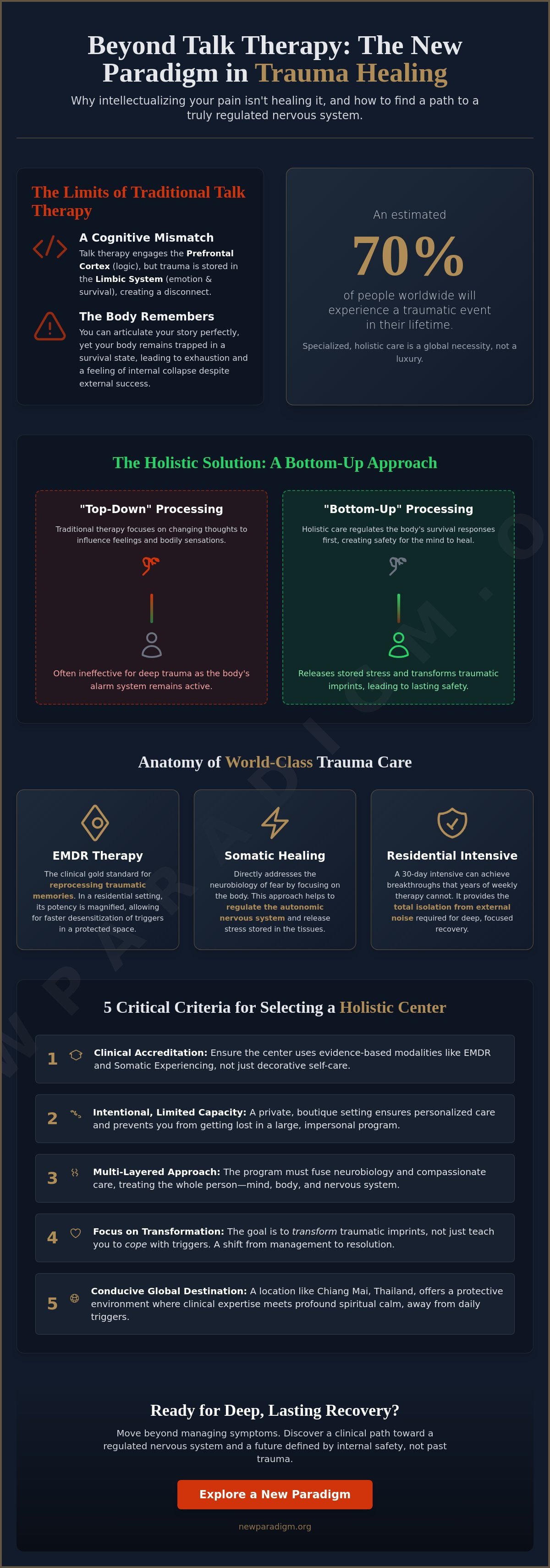
Evaluating Holistic Trauma Centers Worldwide: 5 Critical Selection Criteria
Selecting a recovery path is a high-stakes decision that requires looking far beyond marketing gloss. It's not about finding the most beautiful location, but finding the most effective clinical container for your specific struggle. When vetting holistic trauma treatment centers worldwide, you must look for evidence-based integrity and a structure that prioritizes your safety over its own scale. A world-class facility should feel like a sanctuary, but it must function with the precision of a clinical laboratory. Five critical criteria define this standard of care:
- Clinical Credentials: Look for accreditation from The Joint Commission or equivalent international bodies. This ensures the facility meets rigorous safety and quality standards that go beyond local regulations.
- Staff-to-Client Ratio: A high ratio is the only way to ensure your treatment is truly individualized. You shouldn't be a number in a crowd; you should be a person whose unique neurobiology is understood by every practitioner on your team.
- The Environment: The setting must be designed for intensive internal work, not external distraction. If a facility focuses more on its infinity pools than its clinical modalities, it's a spa, not a treatment center.
- Aftercare Integrity: True recovery doesn't end when you leave the grounds. A credible center provides a robust bridge back to your daily life, ensuring the tools you've learned don't evaporate in the face of old triggers.
- Radical Personalization: Avoid "one size fits all" tracks. Your history is unique, and your program should adapt to your progress in real-time, integrating EMDR, somatic healing, and psychiatry as your nervous system allows.
Boutique vs. High-Volume Facilities
High-volume "rehab factories" often prioritize occupancy over efficacy. In these settings, you risk feeling like a number on a spreadsheet, which can be deeply re-traumatizing for those who already feel unseen in their daily lives. A boutique, private environment is essential for the vulnerability required in trauma work. It provides the isolation from external noise that allows you to drop the facade of outward success and focus entirely on your internal collapse. This isn't about luxury; it's about creating a protective atmosphere where your nervous system can finally feel safe enough to begin the work of transformation.
The Role of Structured Aftercare
The first 90 days following residential treatment are the most critical for long-term success. It's the period where new neural pathways are tested by the realities of your existing environment. When evaluating holistic trauma treatment centers worldwide, ask specifically about their remote support options for international clients. A dedicated Aftercare: Ensuring Long-Term Mental Health Stability program isn't an optional add-on; it's a foundational part of the clinical process that protects your investment in yourself.
If you're ready to move beyond superficial management and begin a journey of deep, clinical recovery, speak with a clinical advisor today to discuss your specific needs in a private consultation.
Why Chiang Mai, Thailand, has become a Global Destination for Trauma Healing
Geographic distance is not merely a change of scenery; it is a clinical intervention. For many seeking holistic trauma treatment centers worldwide, the decision to travel to Northern Thailand is a strategic withdrawal from the environments that maintain their survival responses. Chiang Mai offers what many call a "clean break" from the triggers, noise, and social obligations that keep the nervous system in a state of high alert. It is a place where the spiritual calm of a centuries-old contemplative tradition meets world-class clinical expertise. As of May 11, 2026, Chiang Mai has solidified its reputation as a sanctuary for recovery, supported by a robust infrastructure of English-speaking therapists and specialized wellness facilities.
The accessibility of care here is a primary factor for many international clients. While high-end centers in Europe or the U.S. can cost hundreds of thousands of dollars per month, Thailand offers equivalent clinical standards at a fraction of the cost. This isn't a sacrifice of quality; it's a result of a booming wellness tourism market valued at USD 31.5 billion in 2024. New Paradigm occupies a unique position within this landscape. We combine Western clinical rigors, like EMDR and somatic healing, with an Eastern groundedness that prioritizes silence, presence, and intentionality. It is a fusion designed for those who don't just want to talk about their pain, but want to transform the neurobiology behind it.
Compassionate Realism in a Sanctuary Setting
Our approach is rooted in Compassionate Realism. We aren't interested in superficial positivity or the decorative language of the wellness industry. Instead, we offer a professional, experienced, and quietly confident environment where the gravity of your suffering is acknowledged without judgment. New Paradigm is a privately owned, boutique facility founded by professionals who value depth over scale. The environment is intentionally isolated from external noise to focus on intensive internal work. This limited capacity ensures you aren't a number in a "rehab factory," but an individual receiving focused, clinical attention.
Making the Decision to Travel for Care
High-achieving individuals often face a unique barrier to recovery: the need for absolute privacy and anonymity. Traveling to Thailand provides a layer of protection that local centers cannot offer. You aren't just attending a program; you're stepping out of your narrative to rewrite it. The logistics of international care are streamlined, with standards often exceeding those found in Western metropolitan areas. If you've felt that talk therapy has hit a ceiling and your hidden exhaustion is no longer sustainable, it may be time to consider a more intensive path. You can Explore our Residential Trauma Treatment Program in Chiang Mai to see how a dedicated clinical container can facilitate the deep recovery you've been searching for.
Choosing the Path to Internal Safety
Real recovery requires moving past the intellectualization of pain. You've seen why clinical depth must outperform superficial wellness and how specific modalities like EMDR and somatic experiencing facilitate a regulated nervous system. When evaluating holistic trauma treatment centers worldwide, the most critical factor is finding a container that prioritizes your individual neurobiology over mass-market scale. It's about finding a space where you're truly seen, not just processed.
New Paradigm was founded by clinical professionals with decades of trauma experience who understand the gravity of internal collapse. We maintain a strictly limited capacity because we know that deep transformation requires an intimate, protective environment. Our work isn't about managing symptoms; it's about providing the specialized interventions needed to resolve them. We offer a path that honors your history while giving you the practical tools to handle future triggers.
If you're ready to trade hidden exhaustion for a grounded sense of peace, Contact New Paradigm for a Private Consultation. You don't have to navigate this alone. There's a practical methodology for moving through the depths of your struggle toward a life that feels safe, regulated, and sustainable.
Frequently Asked Questions
What makes a trauma center "holistic" rather than just a traditional rehab?
A holistic trauma center prioritizes the regulation of the autonomic nervous system alongside psychological healing. It moves beyond the behavioral modification found in traditional settings to address the physiological roots of distress. This approach integrates clinical modalities like EMDR with somatic practices and contemplative traditions. It isn't a drug and alcohol rehab or a general leisure spa stay; it's a focused environment where neurobiology and compassionate care meet to facilitate deep transformation.
Is holistic trauma treatment effective for long-term C-PTSD recovery?
Evidence-based holistic methods are specifically designed for the complexities of C-PTSD because they address the "bottom-up" processing of the brain. Traditional talk therapy often hits a ceiling because it ignores the body's survival responses. By integrating somatic experiencing and intensive EMDR, these programs help "thaw" the freeze response associated with long-term trauma. This creates a foundation for a regulated nervous system that feels safe and sustainable long after you return home.
Why should I choose an international trauma center over one in my home country?
Choosing from the top holistic trauma treatment centers worldwide often provides a necessary "clean break" from the triggers of your daily environment. High-achievers frequently seek international care for absolute privacy and anonymity away from their professional circles. Additionally, locations like Chiang Mai provide world-class clinical standards and a protective atmosphere at a fraction of the cost found in major Western metropolitan areas. This distance allows for intensive internal work without the noise of your existing narrative.
Does insurance typically cover holistic residential trauma programs?
Insurance coverage for holistic residential programs varies significantly and often depends on your specific provider and plan. Many premium, boutique centers operate as out-of-network or private-pay facilities to maintain their strictly limited capacity and individualized focus. While some insurers may reimburse portions of the clinical services, such as EMDR or psychiatric consultations, the residential component is frequently a private investment. You should consult with a center's admissions team for a detailed verification of your benefits.
What is the average length of stay at a top-tier holistic trauma center?
A typical stay at a high-quality center ranges from 28 to 90 days depending on the complexity of your history. A 30-day intensive is often the minimum required to move past initial stabilization and begin the deep work of memory reprocessing. Longer stays allow for the integration of new neural pathways and the development of evidence-based tools to handle triggers. The goal is to ensure you don't just feel better temporarily; you must leave with a regulated nervous system.
How do I know if I need a residential program or just intensive outpatient therapy?
If your trauma has created a ceiling that talk therapy cannot break through, or if your "successful facade" is leading to internal collapse, a residential program is likely necessary. Outpatient therapy is effective for maintenance, but it lacks the containment required for intensive somatic work. A residential setting provides the isolation from external noise needed to focus entirely on recovery. If you feel unable to regulate your triggers in your current environment, a boutique residential program offers the highest level of clinical protection.
Article by
Dirk J. Lambert (MSc. - CCTS-I)
Dirk J. Lambert is a Licensed Psychotherapist, Mentor, Author, and Certified Trauma & EMDR Specialist with more than 25 years of experience helping people recover from trauma, depression, burnout, emotional abuse, and long-standing unresolved pain. His work is known for being direct, compassionate, and highly practical.
A twice-ordained Buddhist monk, Dirk bridges clinical trauma care with mindfulness, discipline, self-observation, and deep emotional honesty. He does not hide behind jargon, labels, or unnecessary complexity. He listens carefully, speaks plainly, and works toward meaningful change.
New Paradigm reflects the philosophy he has built over decades: intentionally small, deeply personal, private by design, and focused on what actually helps people recover from the inside out rather than simply cope more elegantly.
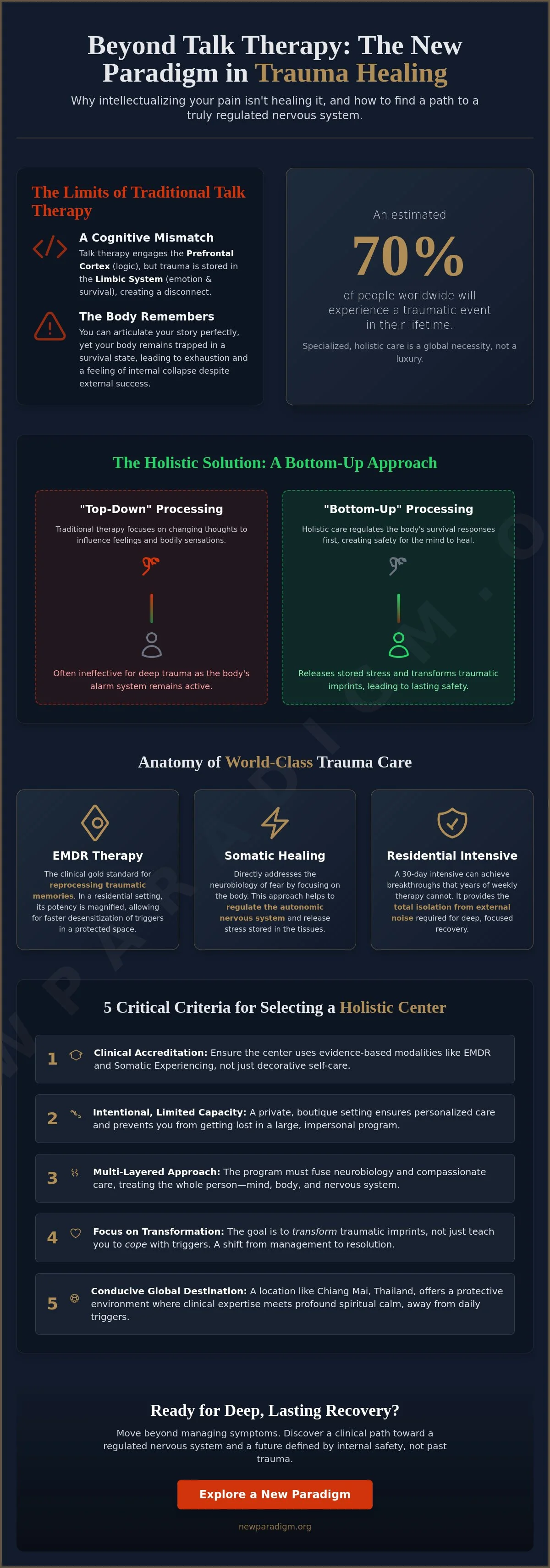
Frequently Asked Questions
Ready to Reclaim Your Life?
Our intensive residential programme in Chiang Mai combines EMDR, CBT, and NLP to create lasting transformation. Maximum 4 clients ensures truly personalised care.