You were sent away young. Six, eight, ten years old -- old enough to understand that you were leaving, not quite old enough to understand what you were losing. You were told it was good for you. An opportunity. A privilege. You learned quickly that crying was weakness, that needing things was inconvenient, and that the way to survive was to get on with it.
And you did. You got on with it. You built a life, a career, perhaps a family. By most external measures, you are absolutely fine. And yet something has never quite sat right. A persistent difficulty with intimacy. A hollow quality to achievement that should feel meaningful. A body that is always slightly braced. A feeling -- hard to name, easy to dismiss -- that you left something behind in those years and never went back for it.
PTSD from boarding school is real, recognised, and profoundly underdiagnosed. This post is for the people who were told their experience was a gift and have spent decades wondering why it does not feel that way.
The Experience Nobody Talked About
Boarding school trauma occupies an unusual cultural position. It is one of the few forms of childhood trauma that comes wrapped in the language of privilege. You were lucky to go. Think of the opportunities. Other children had it so much worse. This framing -- which survivors often absorbed from the very adults who sent them away -- is one of the main reasons so many people reach their 40s, 50s, and beyond before they begin to name what actually happened to them.
The British and colonial boarding school tradition in particular was built on a specific set of values: stoicism, emotional suppression, self-sufficiency, the subordination of individual need to the collective. These were not incidental features of the experience -- they were the point. Children who arrived sensitive, emotional, or deeply attached to home were shaped, deliberately or by necessity, into people who were none of those things.
What was useful for survival in that environment became habitual. And habits formed at seven or eight years old, in conditions of sustained emotional stress, are not easily revised by adult willpower alone.
What Is Boarding School Trauma?
Boarding school trauma is a form of complex, institutional childhood trauma rooted in early and repeated separation from primary attachment figures at a developmentally critical age. When children are separated from their parents during the years in which the attachment system is still forming, the nervous system registers this as abandonment -- regardless of the intention behind it.
Inside the institution, children typically encounter a near-total absence of consistent adult emotional care. Large numbers of children, small numbers of staff, an ethos that actively discouraged emotional expression, and peer environments that could be deeply cruel. Many survivors also experienced bullying, emotional neglect, and in some cases physical or sexual abuse. But even without overt abuse, the structural features of boarding school life -- enforced separation, suppression of emotional needs, and the requirement to perform adjustment -- are sufficient to cause lasting damage.
What survivors carry as adults is increasingly understood by clinicians as complex PTSD (C-PTSD): trauma arising not from a single event but from prolonged, repeated experiences in an environment from which there was no escape. This is not a tough upbringing. It is a recognised clinical condition, and it deserves to be treated as one.
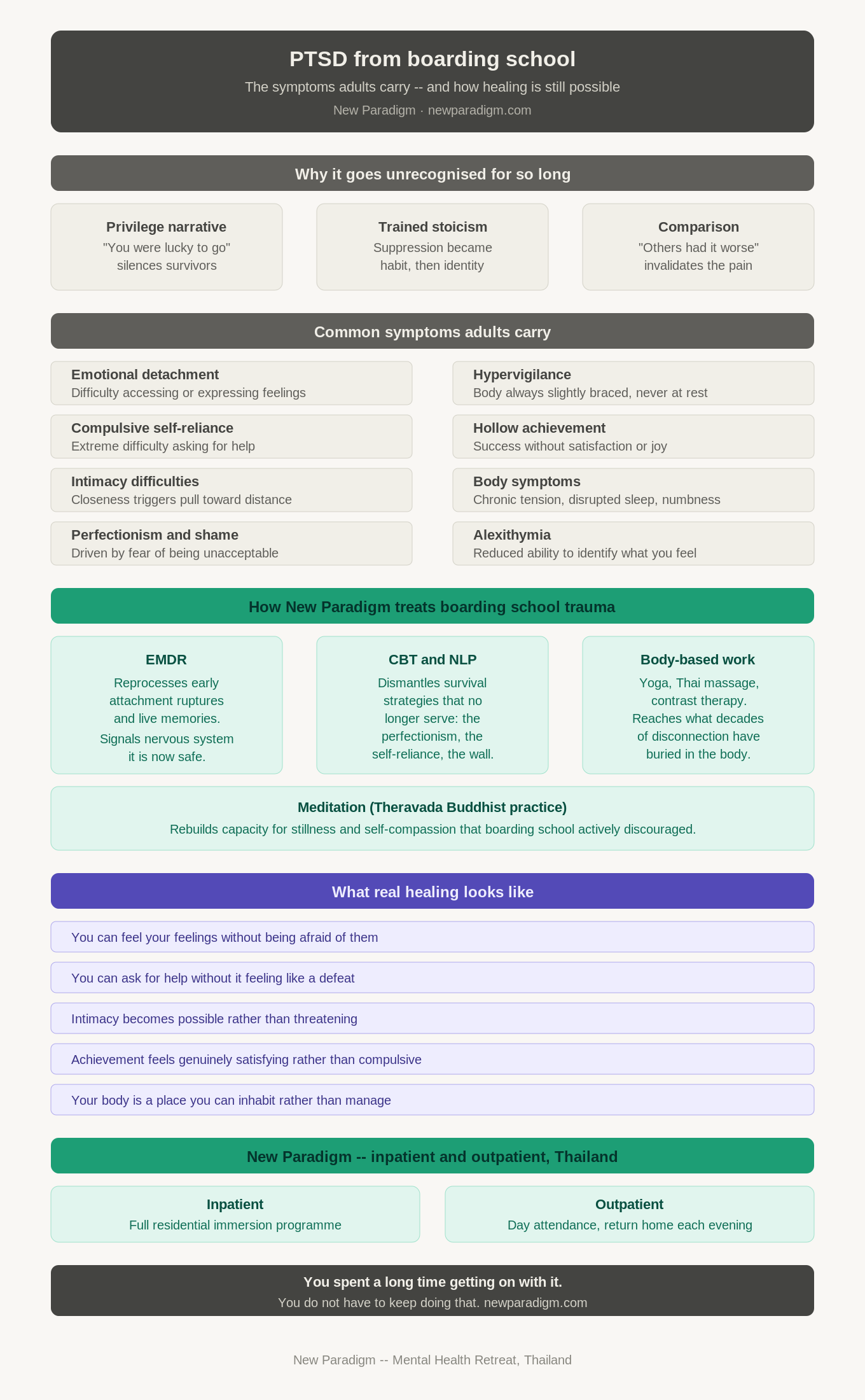
Common Symptoms of PTSD from Boarding School
Because boarding school trauma develops early and is so thoroughly normalised, its symptoms often do not look like what people expect PTSD to look like. There are rarely flashbacks in the cinematic sense. What there is tends to be subtler, more pervasive, and much harder to connect to a specific cause.
Common symptoms include emotional detachment -- a difficulty accessing, naming, or expressing feelings that has become so habitual it no longer registers as unusual. Intimacy can feel threatening even in safe relationships; closeness triggers a pull toward distance. Many survivors describe relationships that begin well and then become inexplicably difficult once they deepen. These patterns share significant overlap with the relational damage caused by other forms of prolonged emotional harm -- including recovering from a narcissistic relationship, which similarly rewires how intimacy feels.
Hypervigilance is common -- a persistent background alertness, a difficulty fully relaxing, a body that is always slightly ready for something. Alongside this, many survivors carry chronic shame and a perfectionism that is driven but joyless: a compulsive need to achieve that does not produce genuine satisfaction, because the original function of achievement was to be acceptable rather than to feel good.
Compulsive self-reliance -- an entrenched difficulty asking for help, admitting vulnerability, or trusting others with anything important -- is one of the most consistent patterns. It made sense as a child in an institution where need was unsafe. As an adult, it quietly destroys the conditions for genuine connection.
Physical symptoms are also common: chronic muscular tension, particularly across the shoulders and chest; disrupted sleep; and what clinicians call alexithymia -- a reduced ability to identify what one is feeling in the body. Decades of emotional suppression leave a physical trace.
Why This Trauma Goes Unrecognised for So Long
There are several interlocking reasons why adults with boarding school trauma so rarely identify it as such.
The privilege narrative is the most obvious: when the dominant story about your experience is that it was a gift, challenging that story feels ungrateful, self-indulgent, or disloyal to parents who made real sacrifices to send you. This alone silences many people for decades.
The suppression itself is another barrier. Boarding school trained people not to make a fuss, not to dwell, to get on with things. Seeking help for something emotional -- particularly something that happened long ago -- runs directly against this conditioning. Many survivors are so practised at performing wellness that they have difficulty accessing distress even when it is genuinely present.
And comparison to more visible forms of trauma compounds it further. "I was not abused. Other people had it so much worse." This kind of minimisation, often internalised from childhood, makes it almost impossible to take one's own experience seriously enough to address it.
Why Standard Therapy Often Misses the Mark
Many boarding school survivors who do seek therapy find it moves painfully slowly. In part this is because they are, typically, highly articulate. They can describe their childhood in clear, organised terms -- the timeline, the key events, the likely explanations. What they cannot always do is feel it. The intellectual account is intact; the emotional and somatic access is not.
Weekly sessions, with an ordinary week of life in between, give the nervous system time to re-armour. The performance of being fine -- so deeply practised -- reasserts itself between appointments. Progress happens, but the gap between understanding the experience and genuinely feeling different about it can remain wide for years.
Healing boarding school trauma requires working at the level where it lives: in the body, in the nervous system, and in the early structures of attachment and self-belief that were formed under conditions of sustained stress. Insight is the beginning, not the destination. If you are weighing up whether an intensive approach is right for you, it is worth understanding what separates a genuine therapeutic programme from a wellness retreat before you decide.
How New Paradigm Treats Boarding School Trauma
At New Paradigm, we work with the specific constellation of difficulties that boarding school trauma leaves behind -- not just the memories, but the body that learned to brace, the self that learned to perform, and the relational patterns that have quietly made intimacy difficult ever since.
EMDR (Eye Movement Desensitisation and Reprocessing) is central to this work. For boarding school survivors, the traumatic material is often not a single dramatic event but a texture of experience: the day they were dropped off, the night they cried alone and no one came, the accumulation of moments in which emotional need was unsafe. EMDR helps the brain reprocess these memories -- updating the nervous system's understanding that the threat is over, that it is now safe to feel, to need, to be known.
CBT (Cognitive Behavioural Therapy) and NLP (Neuro-Linguistic Programming) address the survival strategies that became character. The perfectionism, the compulsive self-reliance, the difficulty with vulnerability -- these are not personality flaws. They are adaptive responses to an environment that punished softness. Therapy helps identify them as such and begin the process of choosing differently.
Body-based practices are not optional extras in this work -- they are essential. Yoga and breathwork rebuild a felt sense of safety in the body that years of suppression have eroded. Thai massage reaches the chronic tension held in the fascia. Contrast therapy -- sauna and cool water -- regulates the nervous system at a physiological level. For people who have spent decades living from the neck up, being guided back into the body is often one of the most significant experiences of the programme.
Meditation, drawn from Dirk's Theravada Buddhist training, builds the capacity for stillness and self-compassion that boarding school actively discouraged. Many survivors have never simply sat with themselves without an agenda. Learning to do this -- and to find it bearable, eventually even nourishing -- is a profound part of recovery.
New Paradigm offers both inpatient and outpatient programmes in Thailand, structured around your specific presentation, history, and pace. The integrated day -- from morning nature walk through to evening reflection -- is designed to hold all of this together, so that the clinical work and the body-based work and the time for integration all support each other. If you would like to understand what a typical day at a mental health retreat actually looks like, we have laid that out in detail.
It Is Not Too Late
Many of the people who come to New Paradigm for boarding school trauma are in their 40s, 50s, and 60s. They have lived full lives -- careers, relationships, children of their own -- while carrying something they never had the language or the permission to address. They often arrive with some version of the same quiet fear: that it has been too long, that they are too set in their ways, that real change is no longer possible.
It is not too late. The nervous system retains the capacity for change throughout life. The patterns laid down in childhood are stubborn, but they are not fixed. And the work of finally addressing them -- of taking seriously, perhaps for the first time, what was actually lost in those years -- is some of the most meaningful work a person can do.
You spent a long time getting on with it. You do not have to keep doing that. If you are thinking about taking this step and wondering how to handle it with the people around you, you might find it useful to read about whether to tell family about your mental health retreat plans before you reach out.
Still weighing it up? Read our honest answer to the question are mental health retreats actually worth it -- and then decide.
Reach out to the New Paradigm team today and take the first step toward healing the thing you were never allowed to name.