You left. Or you are trying to leave. Or you left months ago and still cannot understand why you do not feel better. You know, on some level, that what happened was not okay -- and yet you find yourself doubting your own memory, defending the person who hurt you, and wondering whether you are overreacting to something that was not actually that bad.
That confusion is not a sign that you are weak. It is one of the most reliable signs that you were in a relationship with someone who made confusion their tool. Recovering from a narcissistic relationship is genuinely hard -- not because you are fragile, but because of what those relationships do to the nervous system, to your sense of reality, and to the version of yourself you knew before it all began.
This post will not tell you to just move on. It will tell you what is actually happening inside you, why it is harder than people around you seem to understand, and what real healing -- not just coping -- can look like.
What You Are Carrying Is Real
One of the cruelest aspects of narcissistic relationships is that they are designed -- consciously or not -- to make you question your own experience. By the time most people leave, they have spent months or years being told that their feelings are excessive, their memory is unreliable, and their needs are too much. That kind of sustained invalidation leaves a mark.
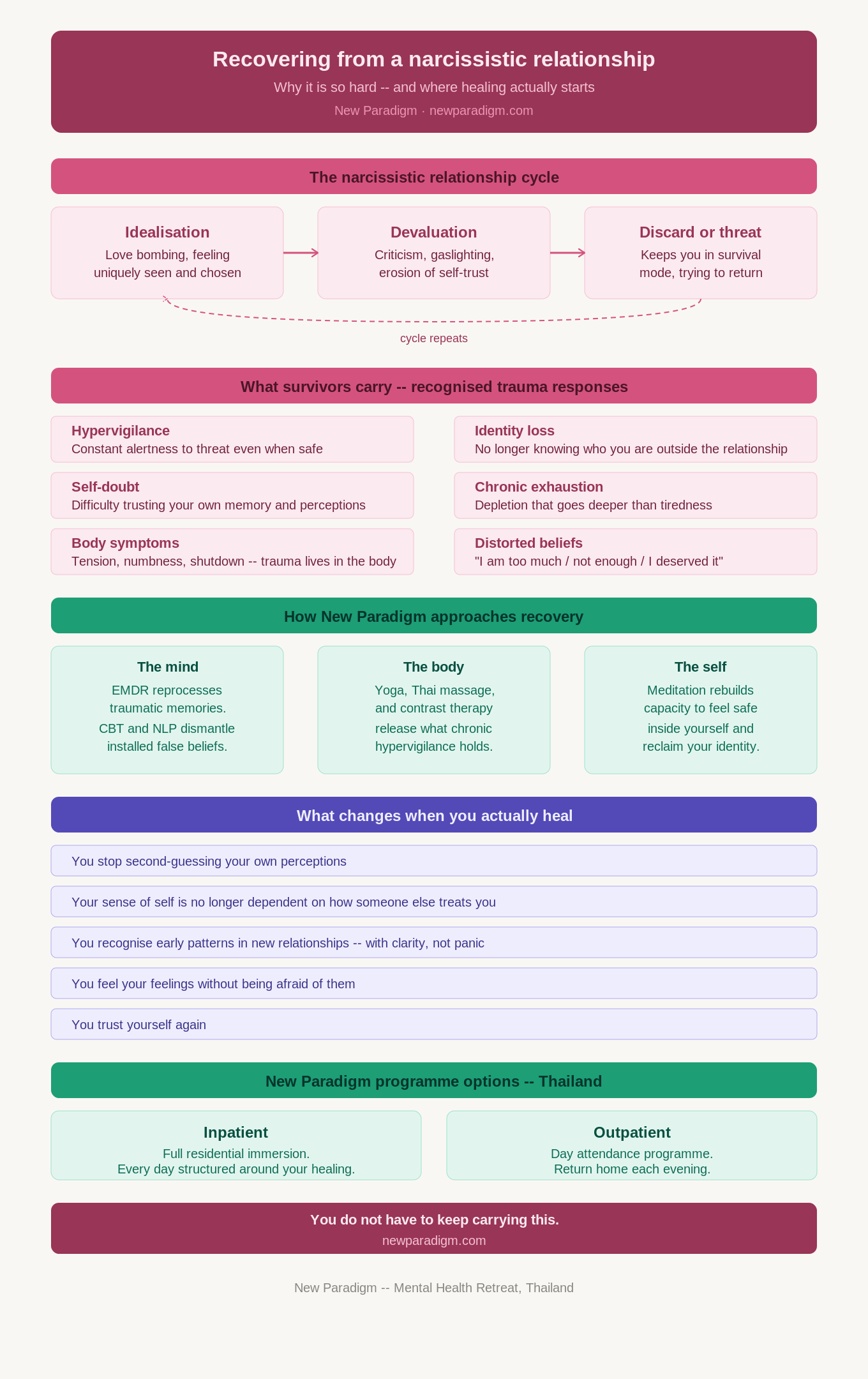
What you are carrying has a name. Survivors of narcissistic relationships commonly experience hypervigilance -- a constant low-level alertness to threat that does not switch off even when you are safe. They experience difficulty trusting their own perceptions, an exhaustion that goes deeper than tiredness, and a loss of identity so significant that they struggle to answer the question: who am I, when I am not trying to manage someone else's moods?
These are not signs of weakness or oversensitivity. They are recognised trauma responses. What happened to you was real, and what you are feeling now is your nervous system's honest reaction to it.
Why Narcissistic Relationships Are So Damaging
To understand why recovery from a narcissistic relationship is so difficult, it helps to understand what these relationships actually do over time.
They typically follow a cycle. The idealisation phase -- where you feel uniquely seen, loved, and chosen -- is followed by devaluation, where the same person who adored you begins to criticise, dismiss, and undermine you. Then the discard, or the threat of it, which keeps you in a constant state of trying to get back to the beginning. This cycle repeats. And each repetition makes it harder to leave, because leaving means losing the person who was also -- at least sometimes -- the most loving presence you had known.
Gaslighting -- being told your perception of events is wrong, that you imagined things, that you are too sensitive -- gradually erodes your ability to trust your own mind. Coercive control, even when it is emotional rather than physical, rewires the nervous system over months and years. You become attuned to the other person's moods in a way that is exhausting and all-consuming, because your sense of safety depended on it.
The damage is often invisible to people on the outside. There are rarely bruises. The relationship may have looked functional, even enviable. This is part of why survivors so often feel unheard -- and why they sometimes struggle to name what happened to them as abuse at all.
This Is Trauma -- And It Lives in the Body, Not Just the Mind
What survivors of narcissistic relationships carry is increasingly understood as a form of complex trauma -- sometimes called C-PTSD. Unlike single-incident trauma, complex trauma develops through repeated, prolonged exposure to a relationship where you could not escape and could not fully trust the person you depended on.
And trauma does not live only in thoughts and memories. It lives in the body. In the tightness across the chest when your phone rings. In the way your stomach drops when someone uses a certain tone of voice. In the chronic tension you have stopped noticing because it has been there so long. In the numbness that descends when you try to access what you actually feel.
This matters enormously for how healing needs to happen. You cannot think your way out of a trauma response. Understanding what happened -- intellectually, analytically -- is valuable, but it does not automatically shift what the nervous system has learned. Real recovery from a narcissistic relationship requires working at the level where the damage actually lives: the body, the nervous system, and the deep structures of self-belief that the relationship quietly dismantled.
Why Standard Approaches Often Fall Short
Many survivors of narcissistic relationships try weekly therapy and find it slow going -- not because therapy is wrong, but because the standard format has real limitations when the nervous system is still in survival mode.
An hour a week, with six days of ordinary life in between, gives the nervous system time to re-armour between sessions. You access something difficult in the room, then spend a week managing the aftermath before you can go back. Progress happens, but slowly. And there is a particular frustration that survivors know well: the gap between understanding what happened and actually feeling different about it. You can know, with complete clarity, that the relationship was harmful -- and still feel the pull back toward it. Still feel the anxiety as though the threat is present. Still struggle to trust your own judgment.
This is not a failure of insight. It is a sign that the healing needs to go somewhere that insight alone cannot reach.
How New Paradigm Approaches Recovery
At New Paradigm, we work with the full picture of what a narcissistic relationship leaves behind -- not just the thoughts, but the body, the nervous system, and the identity underneath.
EMDR (Eye Movement Desensitisation and Reprocessing) is one of the most well-evidenced treatments available for trauma. In the context of narcissistic relationship recovery, it is used to reprocess the specific memories, interactions, and moments that the nervous system has filed as ongoing threats -- helping the brain update its understanding that the danger is over, and that you are safe now. The relief this can bring, when a memory that has caused years of distress begins to lose its charge, is difficult to describe until you experience it.
CBT (Cognitive Behavioural Therapy) and NLP (Neuro-Linguistic Programming) address what the relationship installed in terms of belief. Narcissistic relationships are particularly efficient at teaching people things about themselves that are simply not true: that they are too needy, too sensitive, not enough, too much. These beliefs do not dissolve when the relationship ends. They need to be actively identified, examined, and dismantled -- and replaced with something more accurate.
Alongside this clinical work, the body needs attention. Yoga and breathwork rebuild the felt sense of safety in the body that trauma disrupts. Thai massage releases the chronic muscular holding that years of hypervigilance leave behind. Contrast therapy -- sauna and cold water -- regulates the nervous system at a physiological level. Meditation, drawn from Dirk's Theravada Buddhist training, builds the capacity to observe difficult inner states without being consumed by them. This is not a set of optional wellness extras. Each practice serves a specific function in the recovery process.
The structure of a day at New Paradigm -- from the morning nature walk through to the evening reflection -- is designed to hold all of this together. Clinical depth and genuine care for the whole person, in the same programme, on the same day.
What Changes When You Actually Heal
There is a difference between understanding that a relationship was harmful and actually feeling free from it. Between knowing your worth intellectually and being able to feel it, consistently, in how you move through the world.
Real recovery from a narcissistic relationship looks like this: you stop second-guessing your own perceptions. You can feel your feelings without being afraid of them. Your sense of who you are is no longer dependent on how someone else is treating you on any given day. You recognise the early patterns -- in new relationships, in yourself -- not with panic, but with clarity. You trust yourself again.
This is not a distant or impossible destination. It is what happens when the work goes to the right level, in the right conditions, with the right support.
You Do Not Have to Keep Carrying This
If you are reading this and recognising yourself in it -- the self-doubt, the exhaustion, the sense that you should be over this by now -- please hear this clearly: there is nothing wrong with you. You are having an entirely understandable response to something that caused real harm. And you do not have to stay here.
New Paradigm offers both inpatient and outpatient programmes in Thailand, designed for people who are ready to do the real work of recovery -- not just to understand what happened, but to actually feel different on the other side of it. Our integrated approach combines EMDR, CBT, NLP, yoga, meditation, bodywork, and therapeutic workshops in a programme built around your specific presentation, your history, and your pace.
You gave a great deal of yourself to that relationship. It is time to give something to your own healing.
Reach out to the New Paradigm team today -- and take the first step toward feeling like yourself again.