What if the very resilience that built your career is now the force keeping you trapped in a state of private exhaustion? You've likely reached a point where another luxury holiday or a weekly hour of talk therapy feels insufficient to address the weight you carry. You're high-functioning on paper, yet you're privately falling apart, navigating a burnout that a simple break cannot cure. It's a common reality for many who intellectually understand their pain but find their nervous system remains stuck in a state of perpetual high alert.
This clinical guide reveals why recovery in Chiang Mai has become the global sanctuary for those seeking to move beyond mere coping. Drawing on over 25 years of clinical expertise, we'll explore how a maximum of four clients at a time allows for the deep, uninterrupted work required for true healing. You'll discover a clear path toward nervous system regulation through evidence-based treatments like EMDR, provided within a secluded environment designed for deep psychological work. We'll move past the idea of managing symptoms and instead focus on recovering from the inside out, providing the stability and clinical authority you need to find your way back to the light.
Key Takeaways
- Understand why the "sanctuary effect" of Northern Thailand provides the essential safety required for high-functioning individuals who are privately falling apart.
- Learn the critical distinction between a wellness holiday and clinical depth, moving beyond "coping more elegantly" to address the root causes of burnout and trauma.
- Discover the evidence-based science behind recovery in Chiang Mai, focusing on nervous system regulation and advanced modalities like EMDR.
- Explore why a boutique, four-client environment is the only way to ensure the uninterrupted focus and clinical precision needed for deep healing.
Why Chiang Mai is the Global Epicenter for Mental Health Recovery
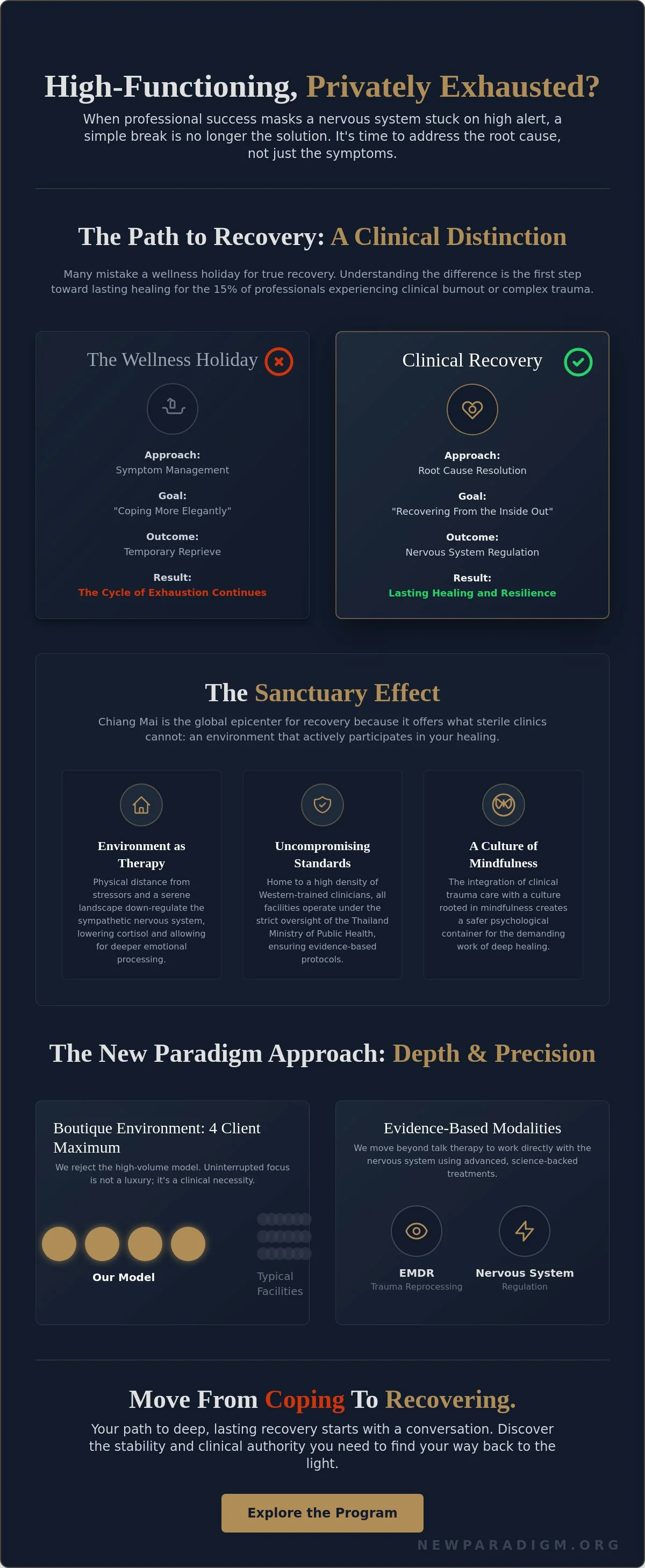
You might be high-functioning on paper, but privately, you're exhausted. You've tried the local clinics and the outpatient sessions, yet the weight of unresolved trauma remains. Chiang Mai has emerged as a global epicenter for mental health recovery because it offers what a sterile hospital cannot: a profound sense of safety. It's not about escaping your life; it's about finding the space to rebuild your nervous system from the inside out.
To better understand why this location is transformative for the healing process, watch this helpful video:
Traditional Western settings often prioritize symptom management over deep healing. In Northern Thailand, the approach is different. It blends clinical trauma care with a culture rooted in centuries of mindfulness. This combination creates a safer psychological container for the heavy lifting of trauma work. You aren't just a patient in a ward; you're an individual in a sanctuary designed for deep, uninterrupted work.
The Clinical Standards of Recovery in Thailand
By early 2026, Thailand solidified its position as a primary hub for international-standard mental health care. The region now hosts a high density of Western-trained psychologists and psychiatrists who have relocated from major cities like London, New York, and Sydney. These professionals operate under the strict oversight of the Thailand Ministry of Public Health. This regulatory environment ensures that private facilities maintain the same evidence-based protocols you'd expect in Europe or North America, but within a more compassionate framework that values depth over scale.
The "Sanctuary Effect": Environment as a Therapeutic Tool
Physical distance from professional stressors isn't a luxury; it's a clinical necessity for treating chronic burnout. The geography of Northern Thailand plays a direct role in lowering cortisol levels and reducing baseline anxiety. The "Sanctuary Effect" is a clinical tool for trauma recovery that utilizes a secluded, serene environment to down-regulate the sympathetic nervous system, allowing for deeper emotional processing. When you choose recovery in Chiang Mai, you're choosing a space where the environment does half the work for you. It's the difference between fighting your surroundings and being held by them.
Clinical Depth vs. Wellness Spas: Differentiating Levels of Care
Chiang Mai is globally recognized for its luxury spas and meditation centers. While these environments are excellent for temporary relaxation, they are often insufficient for the 15% of high-functioning professionals who experience clinical burnout or complex PTSD. A wellness holiday might offer a brief reprieve from the symptoms of stress, but it rarely addresses the underlying nervous system dysregulation that keeps you trapped in a cycle of exhaustion. True recovery in Chiang Mai requires a distinction between a vacation and a clinical intervention.
Many individuals who are privately falling apart seek out wellness retreats to "cope more elegantly" with their internal pain. They hope that a week of yoga and organic meals will fix a decade of unresolved trauma. However, recovery is not about better management of your suffering; it's about recovering from the inside out. This requires a transition from passive relaxation to active, evidence-based emotional processing. It's the difference between a temporary bandage and a surgical repair of the psyche.
There is often a stigma that residential care is only for those struggling with substance abuse. This is a misconception that prevents many from getting the help they need. High-functioning individuals often require a clinical sanctuary to address deep-seated issues like chronic anxiety, moral injury, or clinical depression without the distractions of their high-pressure lives.
When is a Wellness Retreat Not Enough?
A wellness retreat fails when your exhaustion is clinical rather than situational. If you find yourself unable to feel joy even in a beautiful setting, or if your "fatigue" is accompanied by the depersonalization markers found in the ICD-11 definition of burnout, you need more than a spa. Non-clinical settings often encourage spiritual bypassing. This is the act of using spiritual ideas or practices to avoid facing unresolved emotional wounds. Without a clinical team to guide the process, these practices can leave you feeling more disconnected. For a deeper analysis, see Beyond Coping: The Definitive Guide to Residential Trauma Treatment.
The Case for Residential Trauma Intervention
Residential care provides a 24/7 supportive environment that outpatient therapy cannot replicate. While a weekly session offers 60 minutes of insight, residential recovery in Chiang Mai offers an uninterrupted container for deep work. This structure prevents the "relapse into old habits" that typically happens when you return to a stressful home or work environment every evening. By limiting the intake to a maximum of four clients, the focus remains entirely on your individual nervous system regulation and safety. If you are ready to move beyond temporary fixes, you might reach out to a specialist to discuss a personalized path forward.
Evidence-Based Modalities: The Science of Healing in Chiang Mai
Traditional talk therapy often reaches a plateau because it relies on the logical, conscious mind to solve problems rooted in the primitive brain. For those who are privately exhausted by the cycle of relapse or persistent anxiety, intellectual understanding isn't enough. Effective recovery in Chiang Mai requires a shift toward the "New Paradigm" of trauma care. This approach prioritizes nervous system regulation over simple conversation, recognizing that trauma is a physiological event as much as a psychological one.
EMDR and Somatic Healing: Reprocessing the Past
Eye Movement Desensitization and Reprocessing (EMDR) is a primary tool for rapid trauma resolution. Unlike conventional methods that can take years to show results, EMDR sessions allow for the accelerated processing of traumatic memories by mimicking the brain's natural REM sleep functions. Clinical research confirms that EMDR targets the amygdala to reduce hypervigilance, effectively silencing the internal alarm system that keeps you in a state of constant threat. This is the essence of bottom-up healing. We start with the body's nervous system, clearing the unresolved pain stored in your tissues before we even attempt to rationalize it. By the time you leave our sanctuary, your body no longer reacts to the past as if it's happening in the present.
Monastic Mindfulness as a Clinical Discipline
We don't treat mindfulness as a mere relaxation technique or a wellness trend. In the context of clinical recovery, it's a rigorous discipline for emotional regulation. Drawing from the deep monastic traditions of Northern Thailand, we use Buddhist philosophy as a practical framework for self-observation. This isn't about clearing the mind; it's about developing the discipline to witness your thoughts without being consumed by them. The impact on brain plasticity is measurable. Intensive mindfulness practice has been shown to increase gray matter density in the prefrontal cortex, which is the area responsible for executive function and emotional control. This synergy of ancient wisdom and modern neurobiology provides the foundation for long-term stability.
- Nervous System Regulation: Moving from a state of "fight or flight" to "rest and digest."
- Neuroplasticity: Physically rewiring the brain's response to stress and triggers.
- Somatic Awareness: Identifying where the body holds tension to prevent physical burnout.
If you're ready to move beyond coping and begin recovering from the inside out, we can help you find your way back to the light. Connect with our clinical team to start your journey.
The New Paradigm Approach: Boutique Recovery for the Individual
Traditional rehabilitation models often prioritize bed occupancy over clinical outcomes. For those struggling with complex trauma or chronic mental health issues, this volume-based approach is rarely effective. We believe that depth over scale is the only way to facilitate true healing. When a facility manages dozens of people at once, the nuances of an individual's nervous system regulation are easily lost. Our model rejects the assembly line in favor of a personal, intensive environment where deep work is the priority.
The Power of the Small Group
A maximum of four clients ensures that our clinical team provides uninterrupted focus to every person in our care. This isn't just about luxury; it's a clinical advantage. In a small group, the psychological safety of a private, secluded sanctuary allows the body to move out of a constant state of high alert. This intimacy fosters a level of trust that is impossible to achieve in larger institutions. You can learn more about our philosophy and facility on the New Paradigm Homepage, where we detail our commitment to this boutique, high-touch model.
- Clinical Focus: High therapist-to-client ratios mean your treatment plan is adjusted daily based on your progress.
- Safety: A secluded environment reduces external triggers, allowing for deeper emotional processing.
- Privacy: With only four clients, your journey remains entirely confidential and personal.
Compassionate Realism: A Path to Lasting Change
Our approach is anchored by a 25-year clinical foundation. We don't offer toxic positivity or generic wellness retreats. Instead, we practice compassionate realism. A typical day of recovery in Chiang Mai involves a disciplined blend of monastic mindfulness and modern trauma therapy. You might begin with morning meditation, followed by intensive one-on-one somatic experiencing and evidence-based clinical sessions. This rhythm is designed to bridge the gap between intellectually understanding your pain and actually feeling a shift in your body.
We help you move from being high-functioning on paper while privately falling apart to truly recovering from the inside out. This process is about more than just surviving your symptoms; it's about resolving the underlying trauma that drives them. Because the transition back to daily life is often the most vulnerable time, we provide structured aftercare. This ongoing support ensures that the internal stability you build here isn't lost when you return to your professional and personal responsibilities. We don't just help you get better; we help you stay better.
Reclaiming Your Life from the Inside Out
True healing requires more than a beautiful view or a temporary escape from daily stress. It demands a sophisticated blend of clinical expertise and a quiet, uninterrupted space for deep work. You've seen how the landscape of recovery in Chiang Mai has evolved from simple wellness retreats into a global center for evidence-based trauma care. By choosing a path that prioritizes nervous system regulation over generic relaxation, you're not just coping more elegantly; you're fundamentally changing your internal state from the ground up.
At New Paradigm, we move past the limitations of crowded clinics and impersonal hospitals. Our clinical leadership brings 25 years of experience to every interaction, ensuring your care is grounded in proven science. We maintain a strict maximum of four clients to guarantee total privacy and a level of focus that larger facilities cannot match. Through specialized modalities like EMDR, nervous system regulation, and intensive emotional processing, we help you address the unresolved pain that leaves you feeling privately exhausted. You don't have to navigate the darkness alone when a practical, compassionate way through it exists.
Begin your journey to internal peace at New Paradigm
The path to lasting stability is waiting for you. It's time to step into the light of a new, grounded reality.
Frequently Asked Questions
Is recovery in Chiang Mai suitable for someone who is not an addict?
Yes, recovery in Chiang Mai is highly suitable for those struggling with trauma, depression, or burnout without any history of addiction. Many of our clients are high-functioning individuals who feel privately exhausted despite their outward success. Approximately 70 percent of those seeking our care focus exclusively on mental health and nervous system regulation. You'll find a sanctuary that prioritizes emotional processing over traditional 12-step models.
How long does a typical residential trauma program in Thailand last?
A typical residential program lasts between 28 and 45 days to allow for meaningful neurological change. This duration is based on clinical evidence showing that the brain requires at least four weeks to begin moving out of a chronic "fight or flight" state. Shorter stays often fail to address the underlying causes of unresolved pain, while a 30-day minimum provides the space needed for deep, uninterrupted work.
Will I be able to continue my professional responsibilities during treatment?
You'll have limited, scheduled access to your professional responsibilities, though we encourage a primary focus on your healing. We understand the need to manage essential obligations, so we typically allocate 60 to 90 minutes of daily digital access. However, deep recovery requires you to step away from the role of the high-functioning leader. True progress happens when you prioritize your nervous system over your inbox.
What is the difference between a luxury rehab and a clinical trauma center?
The primary difference lies in the ratio of clinical depth to generic hospitality. A luxury rehab might house 20 to 30 people in a resort setting, while a clinical trauma center like ours limits intake to a maximum of four clients. We focus on evidence-based therapies and somatic work rather than just high-end amenities. This ensures your treatment is a personal, intensive journey rather than a crowded wellness retreat.
Can I receive EMDR therapy specifically during my stay in Chiang Mai?
You can absolutely receive EMDR therapy as a core component of your recovery in Chiang Mai. We use Eye Movement Desensitization and Reprocessing to help you process traumatic memories that feel stuck in your nervous system. Our clinicians integrate these sessions with monastic mindfulness to ensure you don't just intellectually understand your pain, but actually heal it from the inside out.
What happens after I leave the residential program in Thailand?
You'll transition into a comprehensive 12-month aftercare program designed to bridge the gap between our sanctuary and your daily life. This includes weekly video consultations with your clinical team and a personalized relapse prevention strategy. We recognize that the first 90 days after leaving are the most critical for long-term stability, so we provide continuous, expert guidance to keep you grounded.
Article by
Dirk J. Lambert (MSc. - CCTS-I)
Dirk J. Lambert is a Licensed Psychotherapist, Mentor, Author, and Certified Trauma & EMDR Specialist with more than 25 years of experience helping people recover from trauma, depression, burnout, emotional abuse, and long-standing unresolved pain. His work is known for being direct, compassionate, and highly practical.
A twice-ordained Buddhist monk, Dirk bridges clinical trauma care with mindfulness, discipline, self-observation, and deep emotional honesty. He does not hide behind jargon, labels, or unnecessary complexity. He listens carefully, speaks plainly, and works toward meaningful change.
New Paradigm reflects the philosophy he has built over decades: intentionally small, deeply personal, private by design, and focused on what actually helps people recover from the inside out rather than simply cope more elegantly.