Search for residential PTSD treatment and most of what you find is addiction rehab. Dual-diagnosis facilities. Twelve-step programmes. Residential centres built around substance recovery that also offer trauma therapy as a secondary component. If you are living with PTSD or complex trauma and have no addiction issue, this landscape is both frustrating and confusing. The level of care you need exists. It is simply not what the most visible results are offering.
This article is for people who need residential-intensity PTSD treatment and are not looking for an addiction programme. It explains what genuine residential trauma treatment involves, how to distinguish it from rehab in disguise, and where to find it.
The Problem With Most Residential Options
The residential mental health treatment sector developed largely around addiction rehabilitation. The infrastructure, the model, and the marketing all followed the same template: residential facilities offering structured programmes combining group therapy, individual counselling, 12-step work, and psychoeducation, designed for people whose substance use had reached a level requiring inpatient support.
As awareness of trauma and PTSD grew, many of these facilities added trauma treatment to their offering - sometimes substantively, sometimes in name only. The result is a market where the majority of residential options are addiction-first facilities that have incorporated trauma language, rather than specialist trauma programmes that happen to offer residential support.
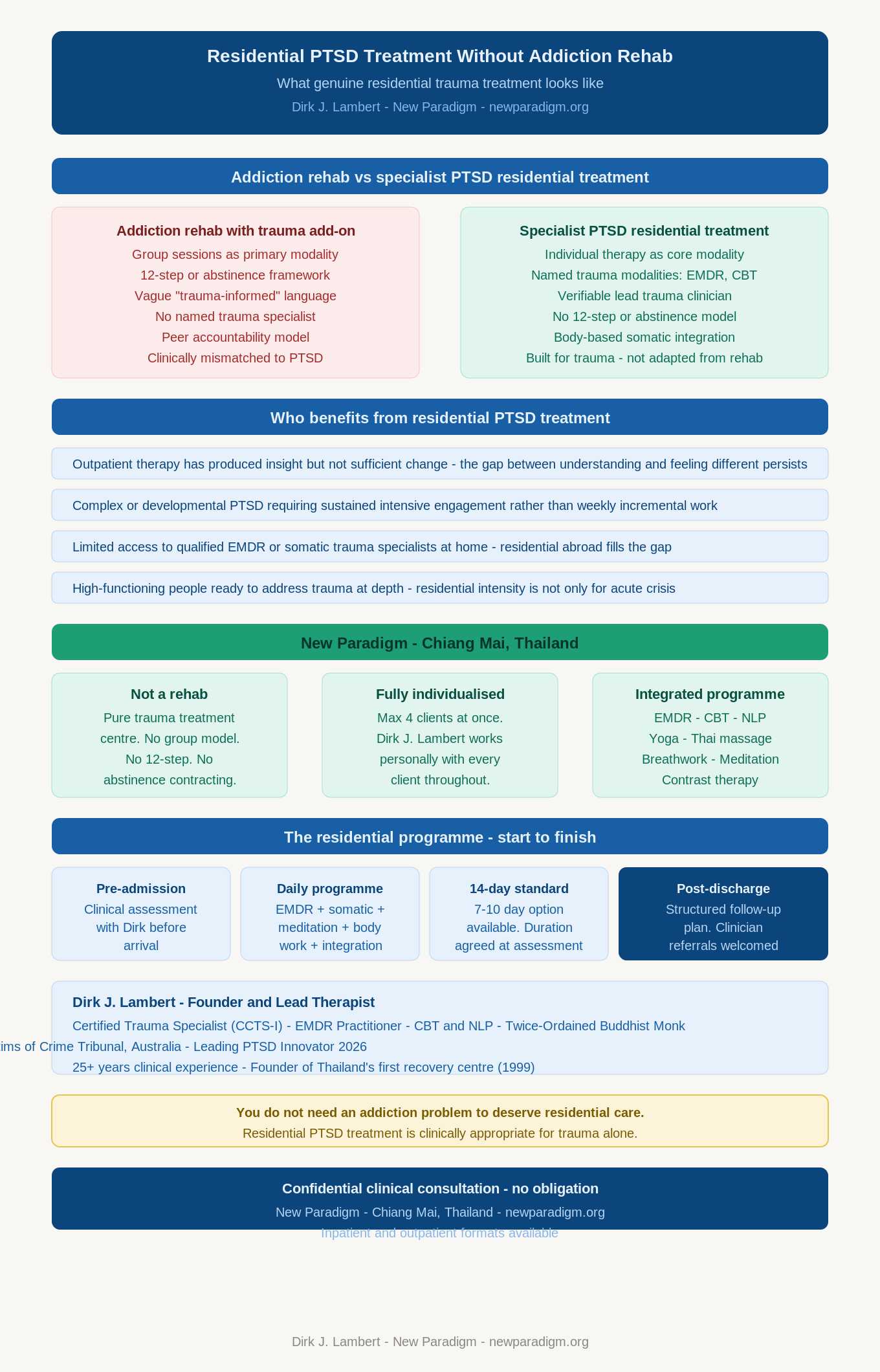
This matters for several reasons. The therapeutic model for addiction recovery and the therapeutic model for PTSD are not the same. The group dynamics that are central to addiction recovery are not appropriate, and can be actively counterproductive, for people in acute trauma processing. The abstinence framework, the peer accountability model, and the 12-step philosophy are clinically irrelevant to someone whose presenting issue is complex PTSD from childhood trauma, a difficult medical experience, or prolonged relational harm. Being placed in that framework when you have no addiction issue does not just fail to help - it can compound the isolation and sense of not being understood that trauma already produces.
What Residential PTSD Treatment Should Actually Look Like
Genuine residential PTSD treatment is built around one principle: the therapeutic intensity and continuity that inpatient care makes possible. When a client is resident, the therapeutic day is not limited to a single weekly session. The clinical work, the body-based practices, the meditation, the integration time - all of it runs as a coherent structure across every day of the programme. The nervous system does not return to its habitual stress environment between sessions and re-armour. The work builds.
The components of a genuine residential trauma programme should include individual therapy with a qualified trauma specialist as the clinical core, delivered with sufficient frequency and duration to allow real processing rather than stabilisation alone. Evidence-based trauma modalities - EMDR, trauma-focused CBT, somatic approaches - should be explicitly named and delivered by practitioners with verifiable training in those approaches. Body-based and somatic practices should be integrated as clinically functional elements, not wellness amenities. And the programme should have a structured pre-admission assessment and post-discharge follow-up plan built in.
What residential PTSD treatment should not include is a group addiction recovery framework, a 12-step model, abstinence contracting, or any clinical infrastructure designed for substance dependency. These are not neutral features - they are structurally mismatched to trauma treatment and signal that the facility's primary expertise lies elsewhere.
Who Needs Residential PTSD Treatment
Residential PTSD treatment is clinically appropriate for a broader range of presentations than most people realise. The common assumption is that residential care is reserved for acute crisis. In trauma treatment, the case for residential intensity is often about therapeutic depth and momentum rather than crisis management.
People who benefit most from residential PTSD treatment include those who have been in outpatient therapy for a significant period without achieving the level of change they need. Weekly sessions have produced insight and partial improvement, but the gap between understanding the trauma and genuinely feeling different persists. The residential format eliminates the re-armouring dynamic that slows outpatient progress and allows the work to go to the level where the trauma actually lives.
People with limited access to qualified trauma specialists in their home location are another consistent group. Access to EMDR-trained practitioners, somatic therapists, and specialist trauma clinicians varies enormously by geography. A residential programme in Thailand may offer the only realistic access to the quality and intensity of care required.
Complex PTSD presentations - where trauma is developmental, relational, or institutional rather than arising from a single incident - also benefit significantly from residential intensity. The relational dimension of complex PTSD, the body-level accumulation, and the depth of the survival strategies that have formed around it all respond better to sustained, immersive therapeutic engagement than to weekly outpatient contact.
And people who are simply ready to do the work at depth, rather than incrementally, are an entirely appropriate residential cohort. Residential PTSD treatment is not only for people who cannot function in daily life. It is also for people who are functioning but carrying something that weekly therapy has not shifted, and who want to address it at the level it deserves.
Red Flags - When a "Trauma Programme" Is Actually a Rehab in Disguise
The language of trauma treatment is now widely used in the residential sector, including by facilities whose primary model is addiction rehabilitation. The following are consistent indicators that a programme is rehab-first rather than trauma-first.
Group therapy as the primary clinical modality. Addiction recovery relies heavily on peer group work - the shared accountability, the collective narrative, the community of recovery. Trauma treatment is fundamentally individual. If the core clinical offering of a residential programme is group sessions rather than individual therapy with a specialist, it is not a trauma programme regardless of what it calls itself.
Twelve-step or abstinence frameworks. These are clinically appropriate for addiction recovery and clinically irrelevant to PTSD. Their presence in a residential programme signals that the facility's expertise and primary model is substance-related.
Vague trauma language without named modalities. "Trauma-informed care" and "trauma-sensitive approach" are not the same as EMDR, trauma-focused CBT, or sensorimotor psychotherapy. If a programme uses trauma language without naming specific evidence-based modalities and the qualifications of the practitioners delivering them, be cautious.
No named lead trauma clinician. A genuine trauma programme will tell you clearly who is delivering the clinical work and what their qualifications are. Anonymised "our team of specialists" copy without named practitioners and verifiable credentials is a consistent red flag. Our clinician's guide to choosing a trauma retreat covers each of these criteria in full and is a useful checklist for evaluating any residential option.
New Paradigm - Residential PTSD Treatment, Chiang Mai Thailand
New Paradigm is a specialist trauma treatment centre in Chiang Mai, Thailand. It is not an addiction rehab. It has never been an addiction rehab. Every clinical element of the programme is designed for trauma - PTSD, complex PTSD, developmental trauma, relational trauma, medical trauma, and the specific presentations that follow prolonged exposure to harmful experiences.
The lead therapist is Dirk J. Lambert - Certified Trauma Specialist (CCTS-I), EMDR practitioner, CBT and NLP specialist, and twice-ordained Buddhist monk with more than 25 years of clinical experience. Dirk works personally with every client throughout the programme. There are no group sessions. There is no 12-step framework. There is no abstinence contracting. There is intensive, individualised, one-to-one trauma treatment delivered by a qualified specialist in a private residential setting.
EMDR is central to the clinical work - delivered in sessions of 60 to 90 minutes across consecutive days, paced and adjusted to the individual client's responses, history, and capacity. CBT and NLP address the cognitive and identity structures that trauma has installed. Body-based practices - yoga, breathwork, Thai massage, and contrast therapy - work with the somatic and physiological dimensions of PTSD that talk therapy reaches only partially. Meditation, drawn from Dirk's Theravada Buddhist training, builds the capacity for stillness and self-regulation that sustained trauma has eroded. Every element is chosen for a specific clinical function and sequenced within the therapeutic day accordingly.
New Paradigm accepts a maximum of four clients at any one time. The programme is genuinely individualised - there is no standardised group curriculum being applied to everyone on-site. Each client's treatment plan is developed through a clinical pre-admission assessment with Dirk and adjusted continuously throughout the programme based on how the work unfolds.
Both inpatient (fully residential) and outpatient (day attendance) formats are available. For people travelling from overseas, the inpatient format provides the most contained and therapeutically productive experience. If you want to understand how the residential day is structured, what a typical day at New Paradigm looks like is laid out in detail. And if you want to understand how intensive EMDR is delivered within the programme, that is covered in full as well.
What the Residential Programme Covers
The residential programme at New Paradigm is structured around a therapeutic day that begins in the morning and continues through to the evening, with clinical work, body-based practice, meditation, and integration time woven into a coherent sequence rather than offered as separate optional components.
Individual therapy with Dirk forms the clinical core of each day. The frequency and duration of EMDR sessions is calibrated to the individual - typically daily during the active processing phase of the programme, with sessions structured to ensure that what is opened can be adequately closed and integrated within each day's work. Between individual sessions, body-based practices provide physiological regulation and somatic integration. Meditation practice develops the capacity to be present with difficult internal experience without being overwhelmed by it. Evening reflection and psychoeducation consolidate the day's clinical work.
Every client enters the programme through a thorough clinical assessment with Dirk. Every client leaves with a structured follow-up plan: scheduled check-ins, recommendations for ongoing outpatient therapy, and a clear point of contact if difficulties arise during the integration period. The weeks following intensive residential trauma work are a significant phase of consolidation, and New Paradigm treats post-discharge support as part of the clinical responsibility rather than an afterthought.
Clinician referrals are welcomed and supported. Dirk is happy to liaise with referring therapists and psychiatrists before, during, and after the programme. If you are still weighing whether a residential programme represents genuine value for a PTSD presentation without addiction, we have addressed that question directly at are mental health retreats actually worth it.
You Do Not Need an Addiction Problem to Deserve Residential Care
The association between residential treatment and addiction recovery is a historical accident of how the sector developed - not a clinical principle. PTSD is a serious, recognised condition that responds well to intensive treatment. The case for residential care in PTSD is as strong as in any other presentation that benefits from therapeutic immersion, continuity, and depth.
You do not need to have a substance dependency to justify the level of care and commitment that residential PTSD treatment represents. You need a presentation that has not responded adequately to outpatient therapy, a readiness to do the work at depth, and a programme that is genuinely equipped to deliver specialist trauma treatment rather than one that has added trauma language to an addiction framework.
Contact New Paradigm today for a confidential clinical conversation about your presentation and what a residential programme might look like for you.
About the Author
Dirk J. Lambert is the founder and lead therapist at New Paradigm, a private mental health retreat in Chiang Mai, Thailand. He is a Certified Trauma Specialist (CCTS-I), EMDR practitioner, CBT and NLP specialist, and twice-ordained Buddhist monk with more than 25 years of clinical experience working with complex trauma, PTSD, depression, and attachment disorders. Dirk founded Thailand's first alternative recovery centre in 1999 and established New Paradigm in 2016. He is a recognised specialist in the treatment of sexual abuse survivors, an endorsed provider through the Victims of Crime Assistance Tribunal in Melbourne, Australia, a member of the Complementary Medical Association UK (MCMA), and was named Leading PTSD Innovator in 2026 by Global Health and Pharma. He works personally with every client who enters the programme.