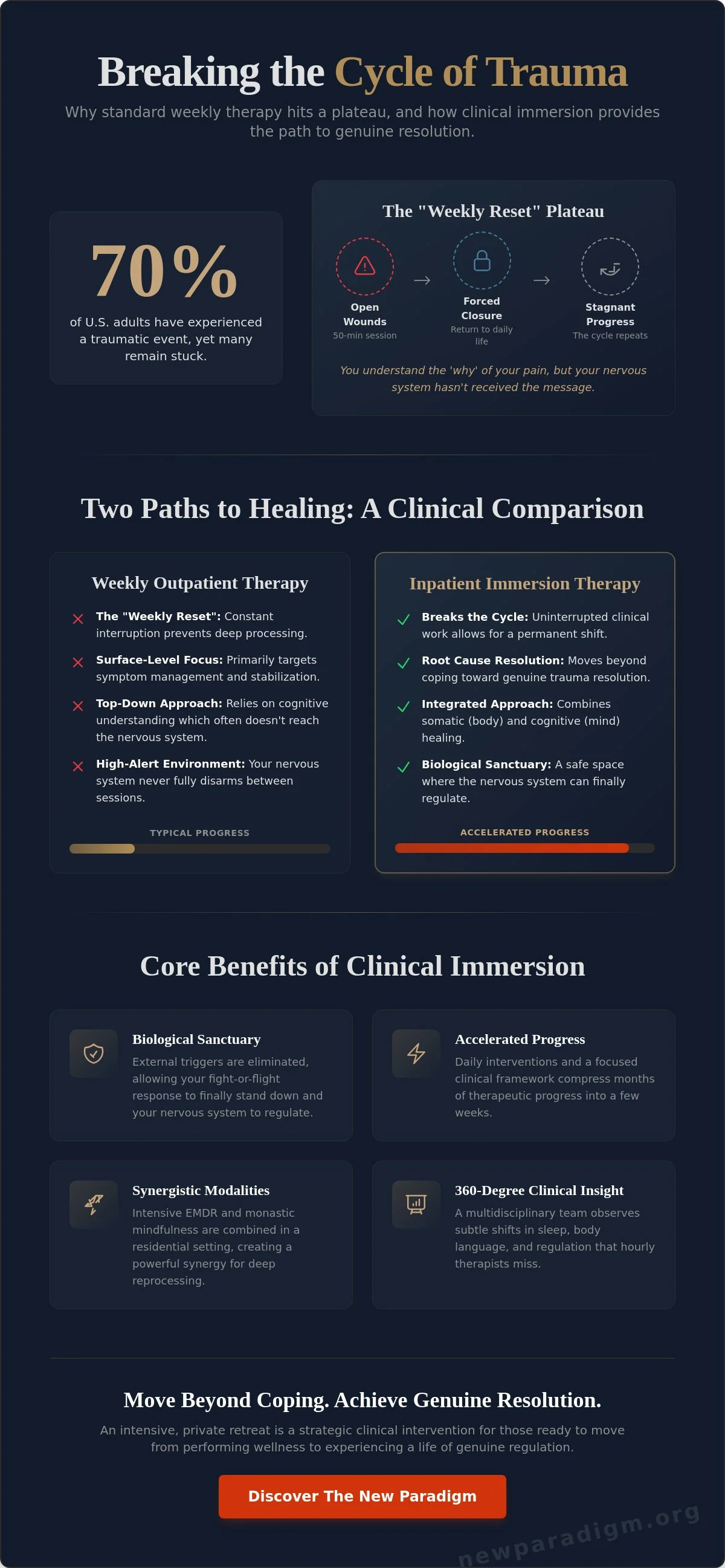
Why can you explain your trauma with clinical precision yet still feel your heart race at a minor setback? You might be part of the 70% of U.S. adults who have experienced a traumatic event; however, you find yourself stuck in a therapeutic plateau. You understand the "why" of your pain, but your nervous system hasn't received the message. You're likely high-functioning on paper but privately falling apart, exhausted by the daily performance of wellness. This state of being privately exhausted is a signal that weekly, hour-long sessions may no longer be enough to bridge the gap between intellectual awareness and physical peace.
One of the primary benefits of inpatient trauma therapy is the ability to bypass the "weekly reset" that occurs in outpatient care. While residential programs can cost between $1,000 and $2,000 per day, this strategic immersion provides a level of clinical depth that standard sessions cannot match. You'll discover why a private, sanctuary-like environment is essential for deep emotional processing and genuine nervous system regulation. We'll also look at how the April 2026 Executive Order on psychedelic treatments and recent Medicaid funding shifts are fundamentally changing how we achieve trauma resolution from the inside out.
Key Takeaways
- Understand why the standard 50-minute outpatient session often leads to a therapeutic plateau and how intensity breaks the cycle of the weekly reset.
- Learn how the specific benefits of inpatient trauma therapy include creating a biological sanctuary where your nervous system can finally disarm and begin to regulate.
- Discover the clinical difference between a sterile hospital environment and a private sanctuary, ensuring your surroundings support deep emotional work.
- Explore how daily clinical immersion allows for months of progress to be compressed into weeks, achieving a permanent shift in how you process pain.
- Identify the unique synergy between intensive EMDR and monastic mindfulness that helps you move beyond coping and toward genuine trauma resolution.
Why Weekly Outpatient Therapy Often Hits a Plateau with Trauma
You might be high-functioning on paper, but you are privately exhausted by the effort it takes to keep your trauma at bay. For many, weekly therapy becomes a cycle of opening deep wounds for 50 minutes and then immediately closing them to survive the work week. This is the "weekly reset." It prevents you from ever reaching the depth required for a permanent shift. One of the core benefits of inpatient trauma therapy is the removal of this survival mask, allowing you to stay in the clinical work without the interruption of daily demands.
To better understand if your current level of care is meeting your needs, watch this helpful video:
Residential care is often misunderstood as a last resort for those in immediate danger. In reality, it's a strategic clinical intervention. It provides a biological sanctuary where your fight-or-flight response can finally disarm. While approximately 70% of adults in the U.S. have experienced at least one traumatic event, many remain stuck in a loop of intellectual understanding without somatic relief. You may understand your past perfectly, yet your body still reacts as if the threat is present today.
The Limits of Traditional Talk Therapy for C-PTSD
Traditional talk therapy often relies on a top-down approach. You talk about the pain, but the body remains in a state of high alert. Research into evidence-based treatment for PTSD shows that while cognitive approaches are vital, the nervous system often requires a more immersive environment to truly reset. Stepping out of your daily environment isn't a luxury; it's a clinical necessity for those whose nervous systems have become habituated to stress. It's about recovering from the inside out, rather than just learning to cope more elegantly with the symptoms.
Moving from Stabilisation to Genuine Resolution
Most outpatient models focus on stabilization, which is simply managing symptoms so you can function. Genuine resolution requires moving toward the root cause in an uninterrupted setting. At New Paradigm Mental Health Retreat, we focus on depth over scale by limiting our environment to only four clients. Residential trauma treatment is a focused period of nervous system retraining. This intensity allows you to achieve months of progress in a few weeks, moving beyond the exhausted state of "performing" wellness and into a life of genuine regulation.
The Core Clinical Benefits of Inpatient Trauma Therapy
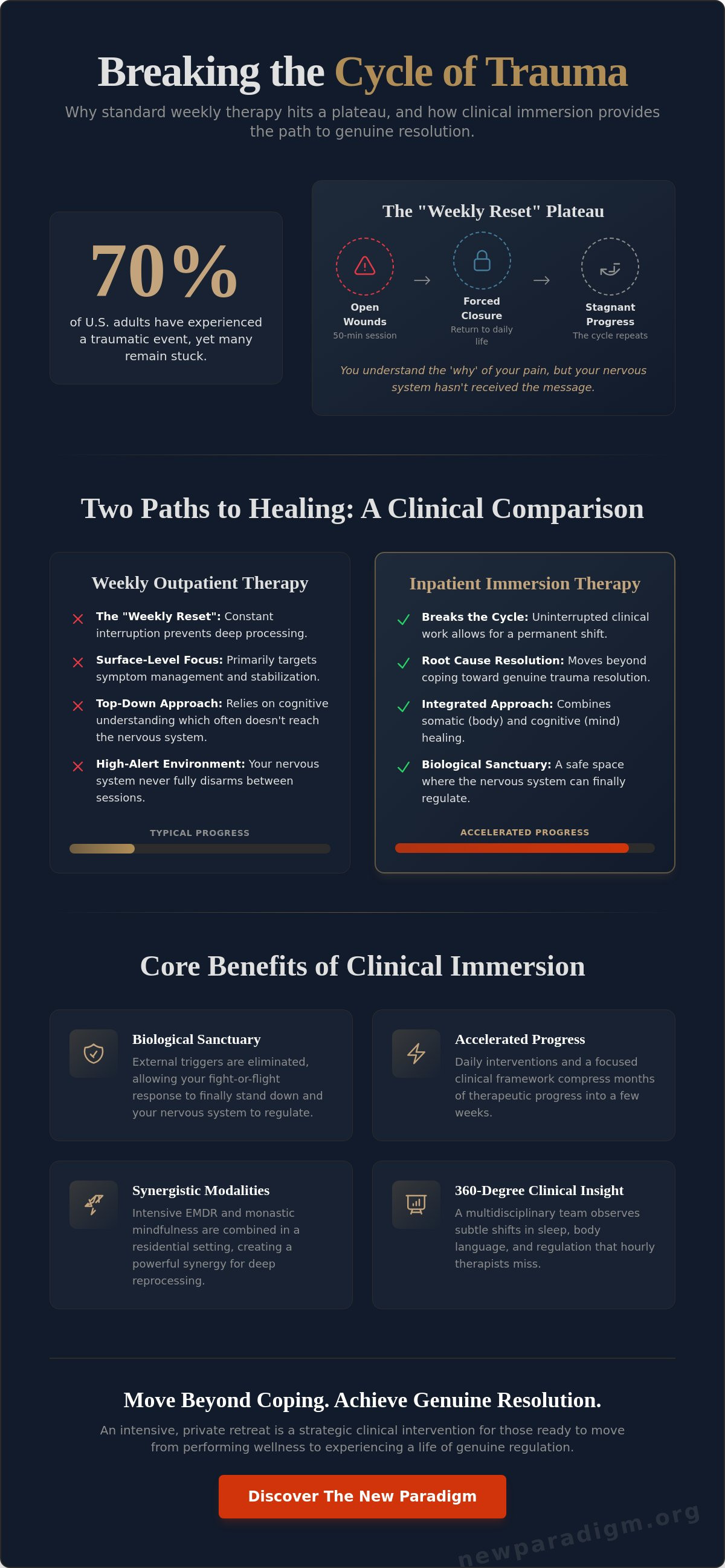
The benefits of inpatient trauma therapy go beyond simple safety; they provide a profound physiological containment. In a standard outpatient setting, your nervous system remains on high alert, scanning for emails, managing family dynamics, or navigating traffic. In a residential sanctuary, these external triggers are eliminated. This allows your brain to shift from a state of hyper-vigilance to a state of deep reprocessing. It's the difference between trying to heal while your environment is actively demanding your attention and stepping into a space where your only responsibility is your own recovery.
Achieving months of progress in just a few weeks is a primary outcome of intensive therapeutic momentum. When you are in a private environment, you aren't just attending sessions; you are living within a clinical framework. Our multidisciplinary team provides 360-degree observation, noticing the subtle shifts in your body language, sleep patterns, and emotional regulation that an hourly therapist might miss. According to the National Center for PTSD, specialized and focused care is often necessary for those who have found little relief in traditional settings. By engaging in daily interventions, you prevent the emotional "leaking" that happens when you have to return to a stressful home life every evening.
Neuroplasticity and the Intensive Recovery Model
Intensive EMDR therapy sessions benefit significantly from the "incubation" period provided by a residential stay. When you process a traumatic memory, your brain continues to work on that data long after the session ends. In a secluded setting, this neuroplasticity is nurtured by silence, mindfulness, and rest. Without the noise of daily obligations, your brain can more effectively create new neural pathways, moving you toward a permanent shift in emotional processing. If you feel ready to begin this work, you can connect with our clinical team to discuss a personalized plan.
24/7 Clinical Support vs. Emotional Isolation
One of the most vital aspects of New Paradigm Mental Health Retreat is the immediate availability of professional support. Traumatic memories don't follow a schedule; they often surface at 3:00 AM or during a quiet meal. In our private environment, which is limited to a maximum of four clients, you are never left to navigate a difficult "after-hours" moment alone. This safety net prevents re-traumatization by providing somatic grounding exercises the moment they are needed. It ensures that the deep work of recovery is always balanced by expert containment and compassionate presence.
Evaluating Inpatient Care: Safety, Intensity, and Environment
A sterile hospital corridor is often the opposite of what a dysregulated nervous system needs. When you're evaluating the benefits of inpatient trauma therapy, the physical environment must be viewed as a clinical variable rather than a luxury. A crowded, clinical setting can unintentionally trigger the same hyper-vigilance you're trying to heal. In contrast, a sanctuary provides the psychological safety required for your brain to lower its defenses. This shift is essential for understanding PTSD symptoms and treatment on a visceral level, moving beyond the intellectual understanding that has kept you stuck in a plateau.
The intensity of a program is defined by the quality of its focus. Many facilities rely heavily on large group sessions to manage costs, but high-functioning individuals require a high ratio of one-on-one attention. We maintain a maximum of four clients to ensure that every hour of care is tailored to your specific history and nervous system needs. This level of privacy isn't about exclusivity; it's about the clinical depth that only a small, focused environment can sustain. By blending evidence-based trauma care with monastic mindfulness, we create a rhythmic, steady pace for recovery that mirrors a deep therapeutic session rather than a busy medical facility.
What to Look for in a Trauma-Informed Residential Program
Effective recovery requires a clinical team that specializes exclusively in trauma rather than general behavioral health. You should look for facilities that integrate multiple evidence-based modalities like EMDR, CBT, and somatic experiencing into a daily schedule. This multifaceted approach ensures that you aren't just talking about your pain, but actively reprocessing it. For a deeper look at what a comprehensive program entails, read our article Beyond Coping: The Definitive Guide to Residential Trauma Treatment.
Safety and Discretion for Professionals
If you're privately falling apart while maintaining a demanding career, anonymity is a clinical requirement. A secluded, peaceful location like Chiang Mai provides the literal and metaphorical distance needed to step out of your professional role and into your recovery. It's common to feel that taking time away is a risk, but it's actually a long-term investment in your capacity to lead and live. This "time out" allows you to recover from the inside out, ensuring that you return to your responsibilities with a regulated nervous system and a clear mind. To discuss how our private environment can support your specific needs, reach out to our clinical director today.
The New Paradigm: A Sanctuary for Deep Clinical Work
New Paradigm Mental Health Retreat is not a hospital, a crowded clinic, or a conventional rehab. It is a personal environment designed specifically for deep work. One of the most significant benefits of inpatient trauma therapy in our setting is the clinical synergy between intensive EMDR and monastic mindfulness. While many programs treat these as separate activities, we integrate them to create a rhythmic flow of reprocessing and rest. This approach moves you beyond the exhausting cycle of managing symptoms, allowing you to begin recovering from the inside out in a space that values depth over scale.
Recovery doesn't end when you leave our secluded sanctuary. We provide structured aftercare to ensure the shifts you achieve in Thailand translate into long-term stability at home. It is common for high-functioning individuals to fear that returning to their professional lives will lead to a relapse of old triggers. However, our program focuses on permanent nervous system regulation rather than temporary relief. By the time you complete your stay, you won't just have new coping skills; you'll have a fundamentally different relationship with your emotional processing and a resilient foundation for the future.
Why Chiang Mai is the Ideal Backdrop for Trauma Recovery
The physical location of a treatment center is a clinical tool. Chiang Mai offers a unique combination of nature and spiritual calm that actively assists in lowering cortisol levels. This environment helps your brain re-set its default mode network, which is often stuck in a loop of hyper-vigilance. Being geographically removed from your daily triggers provides the uninterrupted space necessary for your nervous system to fully disarm. You can Explore our Residential Trauma Treatment Program to see how this setting supports our evidence-based clinical work.
Your Path Forward: From Exhaustion to Renewal
The first step toward renewal is a compassionate, non-judgmental evaluation. Our intake process is designed to understand the specific weight you carry, acknowledging the gravity of your suffering without clinical coldness. Life after an intensive program is characterized by a sense of presence rather than performance. You will find that you no longer need to "mask" your pain because the underlying trauma has been resolved. If you are ready to move from being privately exhausted to being genuinely regulated, Contact our clinical team for a private consultation. We are here to lead you back to the light.
Reclaiming Your Nervous System Through Deep Resolution
The "weekly reset" of outpatient care often leaves you intellectually enlightened but physically stuck. One of the primary benefits of inpatient trauma therapy is the ability to stay within the clinical work until genuine resolution occurs. This isn't about learning to cope more elegantly; it's about shifting your internal landscape so that the triggers of the past no longer dictate the reactions of the present. By choosing a biological sanctuary over a sterile clinic, you give your brain the uninterrupted space it needs to reprocess pain and restore peace.
You don't have to navigate the darkness of unresolved trauma alone. At New Paradigm, our clinicians bring over 25 years of experience to a strictly private environment limited to a maximum of four clients. We specialize in the integration of intensive EMDR and monastic mindfulness to ensure your recovery is both clinically rigorous and spiritually grounded. If you are tired of being high-functioning on paper while privately falling apart, it's time to invest in your own renewal. Discover a private path to recovery at New Paradigm and begin the journey of recovering from the inside out. You deserve a life defined by presence rather than survival.
Frequently Asked Questions
Is inpatient trauma therapy only for people in crisis?
No, inpatient care is a strategic clinical intervention for anyone stuck in a therapeutic plateau. While it serves those in crisis, it's also designed for high-functioning individuals who are privately falling apart. Research from May 2026 shows that while 65% of inpatient patients score high for PTSD, only 7.6% have a formal diagnosis. This suggests many people need the specialized benefits of inpatient trauma therapy long before a total breakdown occurs.
How long does a typical residential trauma treatment program last?
Most intensive programs require a 30 day commitment to achieve genuine nervous system regulation. This duration allows enough time to move past surface-level coping and into deep emotional processing. Current industry data indicates that a comprehensive 30 day program typically ranges from $20,000 to $65,000. This investment ensures you have the uninterrupted time necessary for the brain to form new, healthy neural pathways without the interference of daily life.
Can I continue to work remotely while in a trauma treatment program?
We strongly advise against maintaining professional responsibilities during your stay. The clinical goal is to step out of your environment to disarm the fight-or-flight response. If you're managing emails or meetings, your nervous system remains tethered to the triggers that cause exhaustion. A true sanctuary requires an uninterrupted focus on your recovery. This "time out" is a long-term investment that ensures you return to work with a regulated and resilient mind.
What is the difference between a trauma retreat and clinical inpatient therapy?
The primary difference lies in clinical authority and the use of evidence-based modalities. A trauma retreat often focuses on general wellness and relaxation, whereas inpatient therapy is a medical intervention led by experienced clinicians. Clinical programs provide 24/7 support, psychiatric oversight, and specialized tools like intensive EMDR. While retreats offer a temporary escape, clinical inpatient care provides the structural depth required for a permanent shift in how you process unresolved pain.
Will I be re-traumatised by talking about my past in an intensive setting?
No, because intensive clinical work is carefully titrated to stay within your window of tolerance. We don't simply "talk" about the past; we reprocess it using somatic and cognitive techniques that prevent the nervous system from becoming overwhelmed. By maintaining a maximum of four clients, we ensure our team has the capacity for constant, 360-degree observation. This level of containment makes the intensive process safer and more effective than sporadic outpatient sessions.
What happens if I feel overwhelmed during the intensive EMDR sessions?
Our clinicians are trained to provide immediate somatic grounding the moment you feel overwhelmed. You are never left alone to navigate a difficult emotional wave. Because we operate as a private sanctuary with 24/7 support, we can pivot from processing to regulation instantly. This immediate access to professional care ensures that even the most difficult sessions lead to resolution rather than distress. We use mindfulness and grounding to keep you anchored throughout the work.

Article by
Dirk J. Lambert (MSc. - CCTS-I)
Dirk J. Lambert is a Licensed Psychotherapist, Mentor, Author, and Certified Trauma & EMDR Specialist with more than 25 years of experience helping people recover from trauma, depression, burnout, emotional abuse, and long-standing unresolved pain. His work is known for being direct, compassionate, and highly practical.
A twice-ordained Buddhist monk, Dirk bridges clinical trauma care with mindfulness, discipline, self-observation, and deep emotional honesty. He does not hide behind jargon, labels, or unnecessary complexity. He listens carefully, speaks plainly, and works toward meaningful change.
New Paradigm reflects the philosophy he has built over decades: intentionally small, deeply personal, private by design, and focused on what actually helps people recover from the inside out rather than simply cope more elegantly.