You were told the procedure went well. The surgeon was pleased. The test results came back and the medical team moved on to the next patient. By every clinical measure, you survived. And yet something has not been right since. You flinch at the smell of antiseptic. You put off follow-up appointments until the last possible moment, and sometimes beyond. You wake from dreams that put you back in that room, in that gown, in that particular quality of helplessness. You feel, in ways you cannot quite explain to people who were not there, that something happened to you that has not finished happening.
Trauma from medical procedures is real, clinically recognised, and one of the most consistently minimised forms of post-traumatic stress. This article is for the people who survived the procedure and are still living inside it.
When Surviving Is Not the Same as Being Okay
The medical system is designed to measure physical outcomes. Survival rates. Complication rates. Recovery timelines. These are important measures, and the people who work within that system are, in the vast majority of cases, doing their best to preserve life and restore physical function. But the psychological aftermath of what a patient experiences on the table, in the ward, or in the moment of diagnosis is rarely measured at all.
The result is a significant gap between physical recovery and psychological recovery - one that patients are often left to navigate alone, without language for what they are experiencing and without a clear path to treatment. Many minimise their own distress: "Other people have it so much worse." "I should be grateful I made it." "It was necessary, so I just have to get over it." These are the same minimising thoughts that delay treatment for every form of trauma, and they are no more accurate here than anywhere else.
The distress is real. It deserves to be treated as such.
What Medical Procedure Trauma Actually Is
Medical procedure trauma - sometimes called iatrogenic trauma or medical PTSD - occurs when a medical event overwhelms a person's capacity to cope and produces a lasting traumatic stress response. It meets the same clinical criteria as PTSD arising from any other source: a threatening or distressing event, followed by intrusive re-experiencing, avoidance, negative changes in mood and cognition, and physiological hyperarousal.
The core mechanisms are helplessness, pain, and loss of control. During a medical procedure, a person typically surrenders their body to others, is unable to leave, may be in significant pain or fear, and may have limited ability to communicate what they are experiencing. For many people, particularly those with prior trauma histories, this constellation of experiences is sufficient to produce a full traumatic stress response.
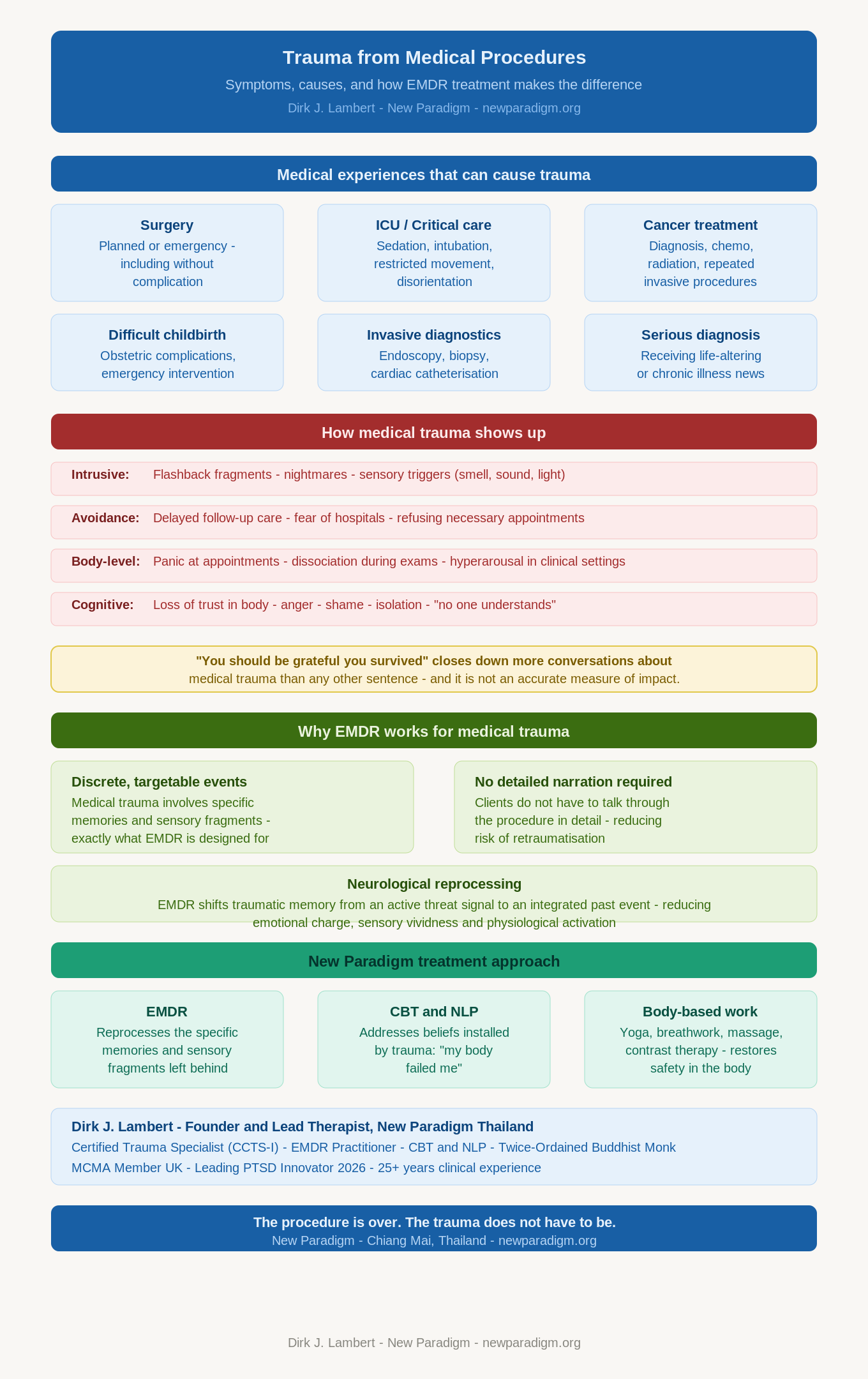
It is important to understand the range of experiences that can cause this. Medical trauma is not limited to dramatic emergencies. It can arise from:
- Major surgery, including planned procedures carried out without complication
- Time in intensive care, particularly where sedation or intubation was involved
- Difficult or traumatic childbirth
- Cancer diagnosis and treatment, including chemotherapy and radiation
- Invasive diagnostic procedures such as endoscopy, biopsy, or cardiac catheterisation
- Dental procedures, particularly for people with prior dental phobia or traumatic dental history
- Receiving a serious or life-altering diagnosis
- Repeated medical procedures over a sustained period
The event does not have to have been objectively life-threatening to produce a traumatic response. What matters is the subjective experience of the person who went through it.
Symptoms - What Medical Trauma Looks Like After the Procedure
Because medical trauma does not always look like the popular image of PTSD, it frequently goes unrecognised - by patients, by GPs, and by the treating medical team. The symptoms tend to be specific, sensory, and tightly linked to the medical context.
Intrusive Symptoms
Flashbacks to the procedure - not necessarily full cinematic re-experiences, but intrusive fragments: the sensation of the anaesthetic mask, the sound of monitors, the quality of the light in the room, the feeling of being moved without being able to respond. Nightmares that recreate elements of the experience. Intrusive thoughts about what happened, or what could have happened, that arrive unbidden and are difficult to interrupt. These intrusions are not the product of a weak mind or excessive anxiety. They are the nervous system's attempt to process an experience it has not yet been able to integrate.
Avoidance
Avoidance is among the most clinically significant consequences of medical trauma because it directly interferes with ongoing healthcare. People delay or cancel follow-up appointments. They avoid conversations about health - their own and other people's. They change routes to avoid passing the hospital where the procedure was performed. They find reasons not to attend screening appointments they know are important. In some cases, this avoidance leads to genuinely dangerous delays in necessary medical care - a secondary consequence of trauma that can have serious physical health implications.
Hyperarousal and Body-Level Fear
Panic responses at medical appointments that would previously have been routine. Dissociation during physical examinations - a sense of leaving the body or watching from a distance that is protective but disorienting. A generalised physiological vigilance that is activated by anything associated with the medical context: waiting rooms, the smell of a hospital, the particular sound of an automated blood pressure cuff. The body has encoded a threat association that fires before the rational mind has had a chance to intervene.
Emotional and Cognitive Impact
A loss of trust in the body - a sense that it is unreliable, fragile, or capable of betrayal - is one of the most distressing and least-discussed consequences of medical trauma. Alongside this, many people experience anger that they cannot fully direct or explain, shame about their ongoing distress, and a sense of isolation because the people around them consider the medical event to be over. The procedure is finished. The patient is recovered. The psychological reality of the person who went through it is another matter entirely.
Why Medical Trauma Goes Unrecognised and Untreated
"You should be grateful you survived." This is the sentence that closes down more conversations about medical trauma than any other. It is said with genuine warmth, by people who love the person they are saying it to, and it is profoundly unhelpful. Gratitude for survival and distress about what the survival required are not mutually exclusive. They coexist in the same person, and the presence of one does not negate the legitimacy of the other.
Patients themselves are often the first to minimise. Comparison to those who had more serious procedures, longer hospitalisations, or worse prognoses is a consistent barrier to seeking help. "I was only in for a day." "Other people have been through so much worse." These comparisons are not accurate measures of psychological impact. Trauma is not ranked by objective severity. It is determined by the subjective experience of the person who lived through it.
The medical system contributes to the problem through its structure. Physical recovery is monitored and measured. Psychological recovery is rarely assessed as part of standard follow-up care, even after procedures known to carry a significant risk of traumatic stress response - cardiac surgery, cancer treatment, obstetric complications. Patients who do report psychological distress after medical procedures are often told this is anxiety, prescribed medication, and not referred for the trauma-specific treatment that would actually address the cause.
The result is that medical trauma frequently presents in GP and therapy settings years after the original event, by which point the patient has often developed significant secondary problems: healthcare avoidance that has compromised their physical health, relationship difficulties, and a chronic anxiety that has generalised well beyond the medical context.
Why EMDR Is Particularly Effective for Medical Trauma
EMDR - Eye Movement Desensitisation and Reprocessing - is one of the most robustly evidenced treatments for PTSD and is particularly well-suited to medical trauma for a specific reason: medical trauma tends to involve discrete, identifiable events with clear sensory components, and these are precisely the kind of traumatic memories that EMDR is designed to target.
When a traumatic memory has not been adequately processed, it is stored in the nervous system in a way that differs from ordinary memory. Rather than being integrated into the person's broader narrative of their life, it remains raw - retaining its original emotional charge, sensory vividness, and physiological activation. When something triggers it, the person does not simply remember the procedure. At a neurological level, they are partially re-experiencing it.
EMDR works by activating the traumatic memory while simultaneously engaging bilateral sensory stimulation - typically eye movements, but also taps or tones. This dual attention process appears to facilitate the reprocessing and integration of the traumatic material, reducing its emotional charge and shifting it from an active threat signal to a processed memory. Research has consistently demonstrated EMDR's effectiveness for PTSD across a wide range of trauma types, with a growing body of evidence specifically for medical and procedural trauma.
At New Paradigm, EMDR is delivered as part of a broader integrated programme rather than as a standalone intervention. The somatic and body-based components of the programme - yoga, breathwork, Thai massage, and contrast therapy - work directly with the physiological dimensions of medical trauma: the body-level fear response, the loss of felt safety in one's own physical self, and the hyperarousal that standard outpatient therapy often does not fully reach. Understanding what a typical day at New Paradigm looks like gives a clear picture of how these elements are sequenced and integrated within the therapeutic day.
How New Paradigm Treats Medical Trauma
At New Paradigm, Dirk J. Lambert works individually with every client throughout the programme. For medical trauma specifically, the treatment draws on three interlocking approaches.
EMDR provides the core reprocessing work - targeting the specific memories, sensory fragments, and associated beliefs that the medical experience has left behind. This might be the moment of going under anaesthetic, the experience of waking in the ICU, the exact words of a diagnosis, or the accumulation of a long treatment process. EMDR does not require the client to talk through the experience in detail, which is itself significant for people who have found that talking about it produces the same level of distress as the original event.
CBT and NLP address the cognitive layer - the beliefs that medical trauma installs about the body, about safety, about control, and about the trustworthiness of healthcare. "My body failed me." "I am permanently damaged." "I cannot trust what medical professionals tell me." These are not irrational thoughts. They are conclusions drawn from real experience. Therapy helps examine them as conclusions rather than facts, and begins the work of building a more accurate and less terrifying understanding of what happened and what it means.
Body-based practices address the somatic dimension that is particularly central in medical trauma. The body was the site of the event. It carries the trauma in a direct and immediate way - in the flinch response, the dissociation during physical contact, the hyperarousal in clinical environments. Yoga, guided breathwork, and Thai massage gently rebuild a felt sense of safety in the body that the medical experience disrupted. Contrast therapy - Finnish sauna and cold water - works with the autonomic nervous system at a physiological level, restoring the capacity for regulation that sustained hyperarousal erodes.
Clients who come to New Paradigm for medical trauma consistently report a shift that goes beyond symptom reduction. A restoration of trust in their own body. The ability to attend medical appointments without the dread that had been building for months or years. A sense that the event, while real and significant, belongs to the past rather than continuing to organise the present. If you are weighing whether an intensive programme is the right approach, our clinician's guide to choosing a trauma retreat covers exactly what to look for - and what to walk away from. And if you are still asking whether this level of intervention is genuinely worth it, we have answered that question honestly at are mental health retreats actually worth it.
New Paradigm offers both inpatient and outpatient programmes in Chiang Mai, Thailand. Both formats are built around intensive one-to-one work with Dirk, with a maximum of four clients in residence at any one time. Referrals from treating clinicians are welcomed - the clinical framework is designed to support collaboration with existing treating teams.
You Do Not Have to Keep Managing This Alone
Medical trauma is not a sign that you are too sensitive, too fragile, or insufficiently grateful for your survival. It is a recognised clinical condition that responds well to the right treatment - specifically, to EMDR and integrated trauma therapy delivered by qualified specialists.
The procedure is over. The trauma does not have to be. Recovery is possible, and it does not require you to simply push through or wait for time to do what time has not yet done.
Contact New Paradigm today for a confidential conversation about your experience and what a programme might look like for you.
About the Author
Dirk J. Lambert is the founder and lead therapist at New Paradigm, a private mental health retreat in Chiang Mai, Thailand. He is a Certified Trauma Specialist (CCTS-I), EMDR practitioner, CBT and NLP specialist, and twice-ordained Buddhist monk with more than 25 years of clinical experience working with complex trauma, PTSD, depression, and attachment disorders. Dirk founded Thailand's first alternative recovery centre in 1999 and established New Paradigm in 2016. He is a recognised specialist in the treatment of sexual abuse survivors, an endorsed provider through the Victims of Crime Assistance Tribunal in Melbourne, Australia, a member of the Complementary Medical Association UK (MCMA), and was named Leading PTSD Innovator in 2026 by Global Health and Pharma. He works personally with every client who enters the programme.