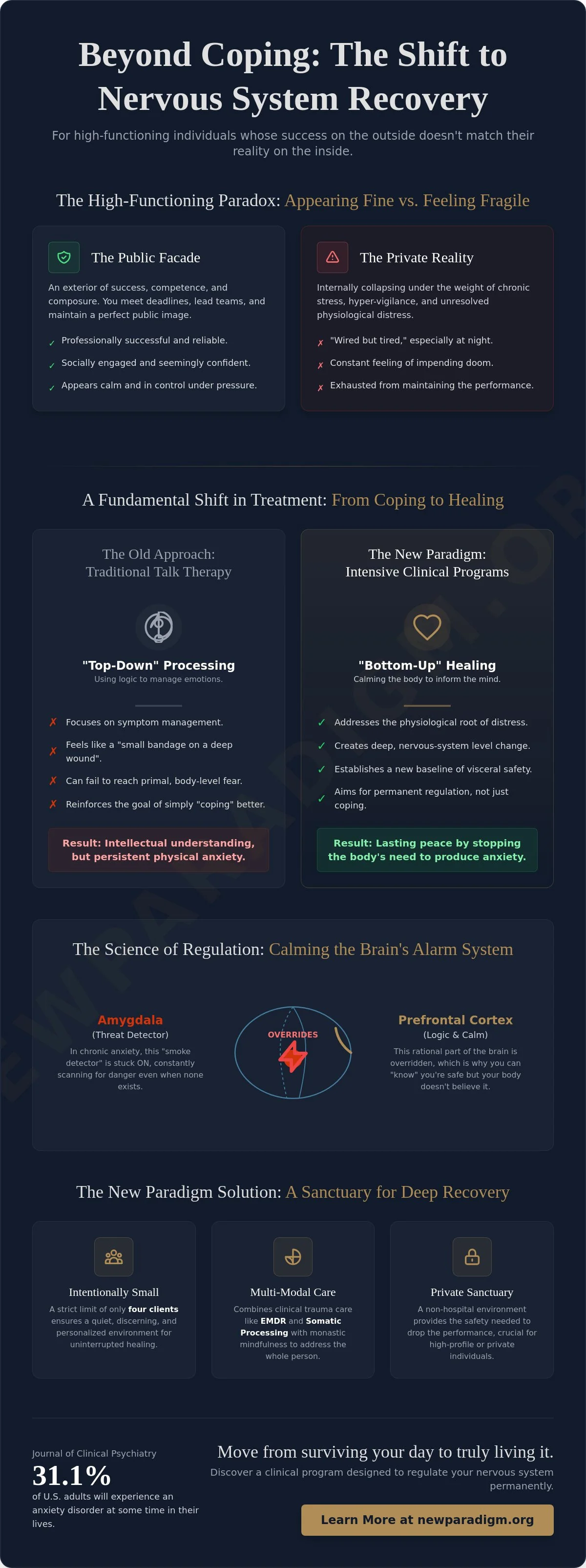
What if the goal isn't to manage your anxiety more elegantly, but to stop your body from needing to produce it in the first place? You likely understand your triggers intellectually. You've read the books and practiced the breathing. Yet, you still feel "wired but tired" at 3:00 AM, maintaining a perfect public facade while privately falling apart. Finding a specialized anxiety treatment program that addresses these physical sensations is the difference between surviving your day and actually living it.
We agree that simply "coping" with high-functioning anxiety is no longer enough. Data from the Journal of Clinical Psychiatry shows that while 31.1% of adults will face an anxiety disorder, most traditional approaches focus on surface-level symptoms rather than physiological roots. This article explores how a clinical anxiety treatment program can help you move beyond temporary fixes to achieve deep, nervous system-level recovery. We'll examine the shift from intellectual understanding to visceral safety, providing a roadmap to regulate your nervous system permanently and move from a state of constant survival into genuine, lasting peace.
Key Takeaways
- Understand why standard weekly therapy often falls short for deep-seated anxiety and how a multi-modal approach addresses chronic dysregulation at its source.
- Explore the science of nervous system regulation, shifting focus from "top-down" intellectualizing to "bottom-up" healing of the amygdala and prefrontal cortex.
- Recognize the transition point where being high-functioning on paper is no longer enough and a specialized anxiety treatment program becomes essential for internal recovery.
- Discover the profound benefits of an intentionally small, sanctuary-like environment that blends clinical trauma care with monastic mindfulness for uninterrupted healing.
What is a Clinical Anxiety Treatment Program? (Beyond Traditional Talk Therapy)
For many, living with an Anxiety disorder isn't just a series of worried thoughts; it's a persistent, physical state of being. You might find that standard weekly therapy sessions feel like placing a small bandage on a deep, internal wound. While talking helps you intellectually understand your history, it often fails to reach the primal parts of your brain stuck in survival mode. A specialized anxiety treatment program provides an intensive, multi-modal intervention for those living with chronic dysregulation who feel they're falling apart despite their best efforts. An anxiety treatment program is a structured clinical environment designed to reset the body's stress response.
The Difference Between General Counseling and Intensive Programs
General counseling typically focuses on cognitive management, teaching you to challenge distorted thoughts. In contrast, intensive programs target the physiological root of the distress. By stepping into an immersive environment, you break the repetitive anxiety loop of your daily life. A specialized anxiety treatment program requires a shift from "doing" to "being," allowing your body to finally feel safe enough to let go of its hyper-vigilance. This approach prioritizes evidence-based nervous system regulation over simple symptom management.
Addressing the High-Functioning Facade
The Science of Recovery: How Modern Programs Regulate the Nervous System
Anxiety isn't a character flaw or a lack of willpower; it's a physiological response that has hijacked your biological safety system. In a high-quality anxiety treatment program, the focus moves away from just managing thoughts and toward the neurobiology of the threat response. The amygdala acts as an internal smoke detector, constantly scanning for danger. When it stays in a state of high alert, it overrides the prefrontal cortex, the part of your brain responsible for logic and calm. This creates a cycle where you might "know" you're safe, but your body refuses to believe it.
Data from the National Institute of Mental Health confirms that anxiety disorders involve these persistent, often debilitating physiological patterns. Traditional talk therapy often uses top-down processing, trying to use the mind to change the body. While helpful, it's frequently insufficient for those who are privately falling apart. True recovery in 2026 requires bottom-up processing, which prioritizes calming the nervous system first so the mind can eventually follow.
EMDR and Somatic Processing for Anxiety
Eye Movement Desensitization and Reprocessing (EMDR) helps clear the "stuck" memories that fuel chronic worry. It isn't just about talking; it's about re-filing traumatic data so it no longer triggers a fight-or-flight response. This is a cornerstone of modern residential trauma treatment, where the goal is to resolve the root cause rather than masking symptoms. Somatic experiencing complements this by releasing the physical tension trapped in the tissues. You can't think your way out of a tight chest or a racing heart; you have to process those sensations through the body. Intellectual understanding is not the same as physiological healing.
Nervous System Regulation and Neurobiology
A sophisticated anxiety treatment program works to expand your "window of tolerance." This is the zone where you can handle stress without spiraling into panic or shutting down into numbness. Chronic cortisol production, often seen in high-functioning individuals, can lead to long-term physical health issues if left unaddressed. By practicing specific regulation techniques, you learn to move from a sympathetic (fight or flight) state to a parasympathetic (rest and digest) state with intention. At New Paradigm, we limit our care to a maximum of four clients to ensure this deep, regulatory work is never rushed or overlooked. If you're ready to move beyond just coping, you can reach out to our team to discuss a personalized path forward.
Recognizing When You Need Intensive Clinical Intervention
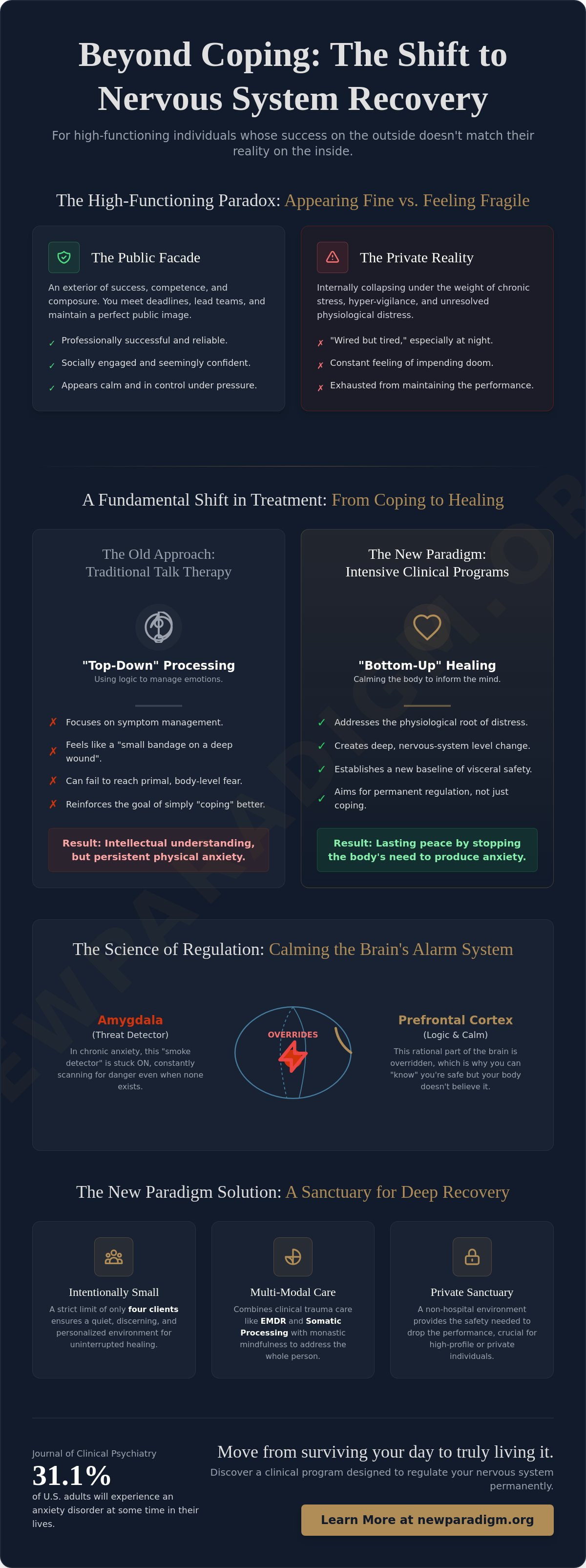
You might tell yourself that you're managing. You meet your deadlines, you attend the dinners, and you keep the house running. But if you're honest, the effort required to maintain this facade is becoming unsustainable. Many people delay entering an intensive anxiety treatment program because they believe they aren't sick enough yet. This is a dangerous metric. You don't need to wait for a total collapse to deserve a higher level of care. There is a quiet, devastating moment when 'coping' transforms into a full-time job that prevents you from actually living your life.
The physical cost of chronic anxiety is not just a mental burden; it is a physiological debt. Constant cortisol spikes and a stuck "fight or flight" response affect your nervous system in ways that lead to secondary health issues. These often manifest as burnout, persistent inflammation, or cardiac strain. When outpatient therapy once a week no longer provides the stability you need, it's a sign that your system requires a more secluded, intensive environment for real repair.
Signs Your Anxiety Has Reached a Crisis Point
It's easy to intellectualize your pain, but your body and your lifestyle often reveal the truth before your mind does. Consider these indicators:
- A Narrowing of Life: You've started declining social or professional opportunities, not because you're busy, but because the "energy cost" of managing your anxiety in those spaces is too high.
- Physical Resilience Failure: You experience persistent sleep disturbances, digestive issues, and chronic fatigue that don't respond to standard "wellness" fixes like better diet or exercise.
- The High-Functioning Mask: You feel privately exhausted and like you're falling apart, even though your colleagues and friends think you're performing at a high level.
The Myth of the 'Wellness Spa' vs. Clinical Recovery
There's a significant difference between a luxury retreat and a boutique clinical sanctuary. A wellness spa might offer temporary relief through massages and scenery, but it lacks the clinical oversight required for lasting change. Without evidence-based emotional processing and nervous system regulation, the "zen" you feel at a resort will evaporate the moment you return to your daily life.
True recovery requires a structured environment that is neither a cold, medical institution nor a superficial spa. At New Paradigm, our 25 years of clinical experience have shown that deep work happens best in a private, secluded setting limited to a maximum of four clients. This ensures the focus remains on your specific trauma and recovery. Lasting progress also depends on structured aftercare to bridge the gap between the sanctuary and the real world. If you're ready to stop managing symptoms and start healing from the inside out, contact our team to discuss your private recovery plan.
The New Paradigm: A Sanctuary for Deep Anxiety Recovery
Most individuals seeking an anxiety treatment program have already tried traditional talk therapy, various medications, or generic wellness retreats. They're often high-functioning on paper but privately exhausted. At New Paradigm, we replace the clinical coldness of a hospital with a philosophy where clinical excellence meets monastic mindfulness. Our program is intentionally small. We limit our intake to a maximum of four clients at any given time. This isn't about exclusivity for its own sake. It's about safety. An overactive nervous system cannot heal in a crowded, noisy environment. By keeping the group small, we ensure that every interaction is therapeutic and every moment is focused on your specific path to regulation.
Why Chiang Mai Offers a Unique Healing Context
Chiang Mai provides more than just a beautiful backdrop. It offers a geographical cure that allows you to put physical distance between yourself and the triggers of your daily life. The local culture is deeply rooted in Buddhist philosophy and mindfulness. We integrate these ancient traditions into our modern clinical trauma care. Here, nature isn't just scenery; it's an active component of the clinical program. The seclusion of our facility allows your nervous system to finally drop its guard. You aren't just learning to manage symptoms. You're using the silence and the setting to do the deep introspection required for lasting change.
Taking the First Step Toward Inside-Out Recovery
Recovery begins with an honest, private consultation to assess your history and current needs. We don't believe in one-size-fits-all solutions. Within the first 72 hours of entering our intensive anxiety treatment program, the focus is on stabilization and felt safety. You'll move from a state of constant high alert to one of supported reflection. Our team, anchored by over twenty-five years of clinical experience, guides you from intake through to a structured transition back to daily life. We provide a personalized integration plan to ensure the work done in seclusion translates to your home environment. The ultimate promise is a life no longer dictated by the search for safety. You can find more information about our approach at https://www.newparadigm.org/.
Returning to a Regulated Self
You don't have to settle for a life spent managing the symptoms of an overactive nervous system. True recovery isn't found in learning to cope more elegantly with exhaustion; it's found in the deep, clinical work of nervous system regulation. This transition moves you beyond traditional talk therapy and into a space where your body finally feels the safety your mind has been trying to convince it of for years. We aren't a crowded clinic or a sterile hospital; we are a personal sanctuary for deep, uninterrupted work.
New Paradigm offers a distinct kind of anxiety treatment program that prioritizes depth over scale. Our founders bring more than 25 years of clinical experience to every session, utilizing evidence-based EMDR and trauma-informed protocols to address the root of your distress. We intentionally limit our capacity to a maximum of 4 clients to protect your privacy and provide the focus you deserve. If you're tired of being high-functioning on paper while privately falling apart, it's time to step into a space designed for your recovery. You've carried this weight long enough.
Begin your journey toward a regulated nervous system at New Paradigm
The peace you've been searching for is closer than it feels today.
Frequently Asked Questions
Is an anxiety treatment program the same as a psychiatric hospital?
An anxiety treatment program like New Paradigm is a private sanctuary for deep work, not a psychiatric hospital. While hospitals focus on stabilization and crisis management, our environment prioritizes nervous system regulation in a secluded, non-clinical setting. We limit our intake to a maximum of four clients. This ensures your recovery happens in a space that feels like a home rather than a ward. You aren't just a patient file; you're an individual seeking a path back to yourself.
Can EMDR therapy really help with generalized anxiety disorder?
EMDR therapy is highly effective for generalized anxiety because it addresses the physiological roots of your distress. Research from the EMDR Institute indicates that 84 percent to 90 percent of single-trauma victims no longer have PTSD after only three 90-minute sessions. For high-functioning individuals who are privately exhausted, this method bypasses the intellectual mind. It allows the nervous system to release stored tension that traditional talk therapy often misses. You stop just understanding your anxiety and start feeling it dissipate.
How long does a typical intensive anxiety program last?
A typical intensive anxiety treatment program spans between 30 and 90 days, depending on the depth of the unresolved pain. This timeframe allows for the 21 to 66 days it takes to form new neural pathways, according to research from University College London. We don't rush the process of emotional processing. True regulation requires time to move from a state of being "always on" to a state of grounded peace. This duration ensures your transformation is sustainable once you return to your daily life.
What happens if I feel I am 'too' high-functioning for a residential program?
You aren't too high-functioning for help if you're successful on paper but privately falling apart. Most of our clients are executives, parents, or leaders who manage complex lives while their internal world is in chaos. We designed this sanctuary specifically for those who don't fit the profile of a standard rehab. Since we only host four clients at a time, you'll find a peer group that matches your intellectual and professional depth. Your capability doesn't disqualify your suffering.
How much of the program is clinical versus holistic or mindfulness-based?
Our curriculum is a balanced blend of 50 percent evidence-based clinical care and 50 percent monastic mindfulness. We combine rigorous trauma protocols with Buddhist-influenced practices like self-observation and disciplined meditation. This dual approach ensures you aren't just "coping" with symptoms. Instead, you're healing from the inside out using both modern science and ancient wisdom. It's a sophisticated framework designed to restore order to a dysregulated nervous system through clinical expertise and spiritual grounding.
Is there aftercare support once I return home from the facility?
Support continues long after you leave our physical sanctuary through a structured 12-month aftercare plan. We provide a roadmap that includes weekly check-ins and continued nervous system monitoring to ensure long-term stability. Statistics show that individuals with a formal aftercare plan are 40 percent more likely to maintain recovery than those without one. We don't expect you to navigate the transition alone. Our team remains a quiet, steady presence as you integrate your new tools into your professional and personal world.
Article by
Dirk J. Lambert (MSc. - CCTS-I)
Dirk J. Lambert is a Licensed Psychotherapist, Mentor, Author, and Certified Trauma & EMDR Specialist with more than 25 years of experience helping people recover from trauma, depression, burnout, emotional abuse, and long-standing unresolved pain. His work is known for being direct, compassionate, and highly practical.
A twice-ordained Buddhist monk, Dirk bridges clinical trauma care with mindfulness, discipline, self-observation, and deep emotional honesty. He does not hide behind jargon, labels, or unnecessary complexity. He listens carefully, speaks plainly, and works toward meaningful change.
New Paradigm reflects the philosophy he has built over decades: intentionally small, deeply personal, private by design, and focused on what actually helps people recover from the inside out rather than simply cope more elegantly.