Every training programme for therapists, counsellors, and trauma specialists covers the importance of self-care. Supervision is recommended. Boundaries are emphasised. The literature is clear that working with traumatised clients carries a professional risk. And yet, in clinical rooms around the world, practitioners are sitting with secondary traumatic stress they have not named, compassion fatigue they are pushing through, and a slow transformation of their inner world that they are attributing to everything except what it actually is.
Vicarious trauma in mental health practitioners is real, clinically recognised, and profoundly underaddressed - in part because the profession that is best placed to identify it is the same profession trained to look outward rather than inward. This article is for the practitioners who recognise something of themselves in that sentence.
The Cost of Bearing Witness
There is something that happens when you sit with someone in genuine pain. Not the managed distance of a professional observing a clinical presentation, but the full contact of empathic engagement - of actually allowing another person's suffering to land. This is what good trauma therapy requires. It is also what makes vicarious trauma inevitable for practitioners who are doing their work properly.
The cost of bearing witness is not a failure of professional technique. It is the other side of therapeutic presence. The same capacity for attunement and empathy that makes a therapist effective is the capacity that makes them vulnerable to the cumulative weight of their clients' traumatic material. Acknowledging this is not a weakness. Refusing to acknowledge it is the risk.
In a profession that rightly places the client's experience at the centre, the practitioner's inner life is easily sidelined. Supervision addresses it in part. But many practitioners reach mid-career - or beyond - carrying the accumulated impact of years of trauma work without having addressed it at anything like the depth it deserves.
What Vicarious Trauma Actually Is
Vicarious trauma - sometimes called secondary traumatic stress - was first described by Pearlman and Saakvitne in the 1990s to account for something that compassion fatigue and burnout did not fully capture: a fundamental transformation in the practitioner's inner world as a result of empathic engagement with traumatised clients.
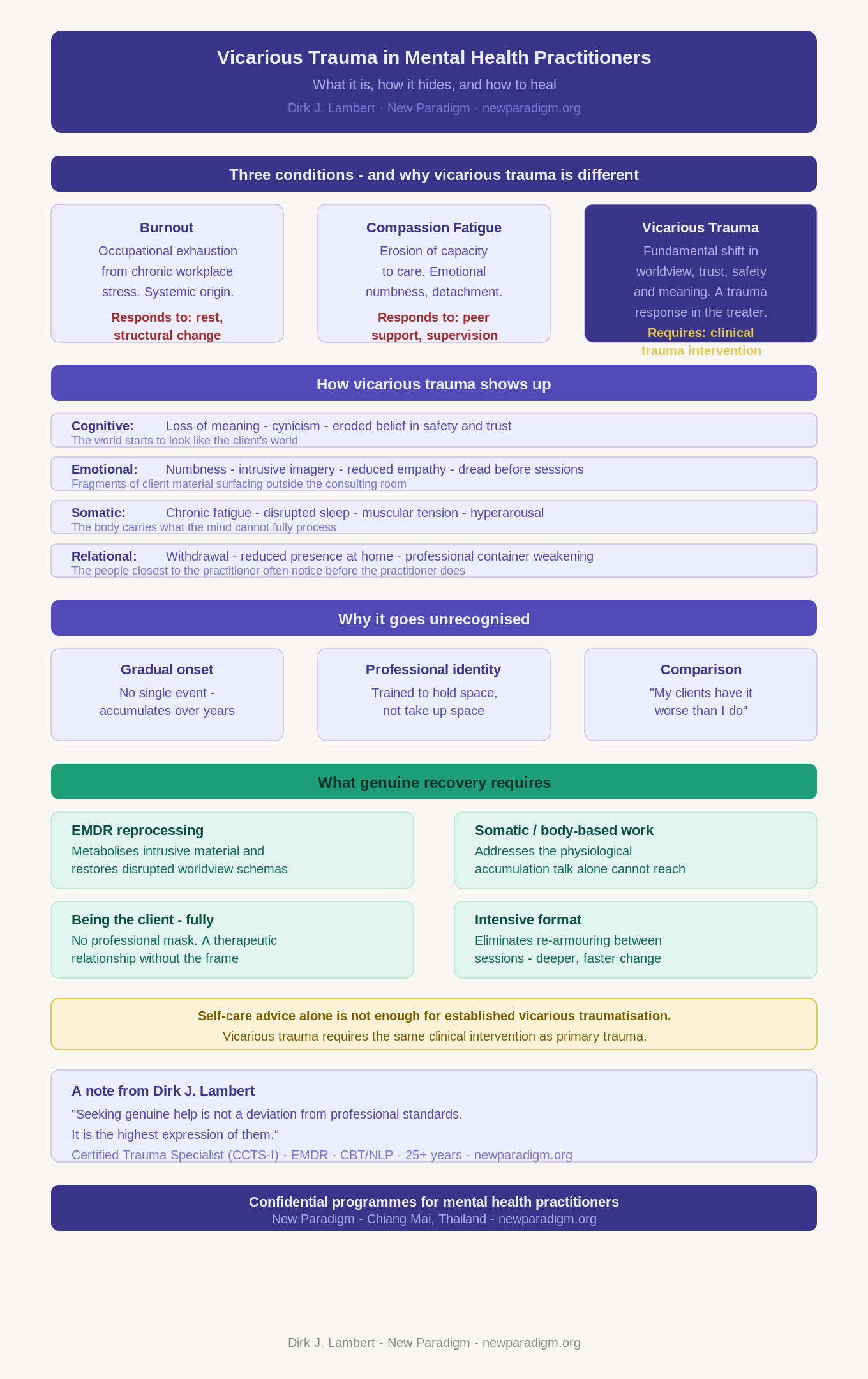
This distinction matters. Burnout is a state of exhaustion produced by chronic workplace stress - it is occupational, and it responds to rest, reduced workload, and systemic change. Compassion fatigue is the gradual erosion of the capacity to care, often experienced as emotional numbness or detachment. Vicarious trauma goes deeper than either. It changes how the practitioner sees the world, other people, and themselves. It disrupts their fundamental beliefs about safety, trust, meaning, and human goodness - the same cognitive schemas that primary trauma disrupts in survivors.
This means that a practitioner experiencing vicarious trauma is not simply tired or burned out. They are, in a clinically meaningful sense, traumatised. And they require the same level of genuine therapeutic intervention that they would recommend to their own clients - not a week off and a mindfulness app.
It is also worth being explicit about one thing: vicarious trauma is not a sign that a practitioner is doing their job badly. It is, in most cases, a sign that they are doing it well. Empathic engagement is the mechanism through which vicarious trauma develops. A therapist who remains entirely unaffected by sustained exposure to traumatic material is not a resilient therapist. They are a disconnected one.
How It Develops - and Why It Goes Unrecognised
Vicarious trauma does not arrive suddenly. It accumulates. A single session with a trauma survivor does not produce it. Months and years of sustained exposure, session after session, without adequate processing and support - that is the environment in which it develops.
The gradual onset is one reason it goes unrecognised for so long. There is no clear before and after, no identifiable event to point to. The practitioner does not notice a moment of change - they notice, eventually, that things feel different from how they used to. The world seems less safe. Relationships feel more effortful. The work that once felt meaningful has begun to feel like an obligation to survive rather than a vocation to inhabit.
The professional identity of the therapist compounds this. Practitioners are trained to hold space, not take up space. To attend to the client's experience, not their own. To be the stable, regulated presence in the room. This is not wrong - it is what the work requires. But it can also produce a practitioner who applies their professional skills to their own distress: containing it, managing it, reframing it, and presenting as fine to colleagues and supervisors while the inner accumulation continues.
There is also a parallel worth noting. The same mechanisms that produce silence in trauma survivors - the sense that one's experience is not serious enough, the comparison to those who have it worse, the trained stoicism that was adaptive in the original environment - can appear in practitioners who have absorbed these patterns through years of immersive clinical work. The therapist who treats survivors of childhood trauma and its relational effects may find, over time, that their own relational world has quietly contracted in ways they have not examined.
Symptoms - What Vicarious Trauma Looks Like in Practice
The symptoms of vicarious trauma map closely onto those of complex trauma in survivors - which is both clinically logical and one of the reasons practitioners miss them in themselves. They know what trauma looks like. They do not always recognise it when it is theirs.
Cognitive and Worldview Shifts
The most defining feature of vicarious trauma - the one that distinguishes it from burnout - is the shift in how the practitioner makes sense of the world. A previously held belief that the world is broadly safe gives way to a pervasive sense of threat. Trust in other people erodes. The practitioner begins to see potential harm in situations where they would not previously have looked for it. A sense of meaning or purpose in the work diminishes and is replaced by a flatness that can be hard to explain.
Some practitioners describe a loss of hope - not just about individual clients, but about human suffering in general. A sense that the weight of what they witness daily has exceeded what can be metabolised. Others notice a growing cynicism about institutions, systems, and the capacity for genuine change that sits at odds with the values that brought them into the field.
Emotional and Somatic Symptoms
Intrusive imagery - fragments of a client's account that surface unbidden outside of session - is common and often alarming the first time it happens. Emotional numbness and a reduced capacity to be present in personal relationships are also consistent features. The practitioner becomes skilled at performing engagement while feeling increasingly disconnected from it.
Physical symptoms are frequent and frequently unattributed: chronic fatigue that does not resolve with rest, disrupted sleep, muscular tension particularly across the shoulders and chest, and a general state of low-level physiological activation that mirrors the hyperarousal of the clients they are treating. The body of the trauma practitioner, over time, can begin to carry the somatic signature of sustained exposure to traumatic material.
Relational and Professional Impact
Withdrawal from personal relationships - a preference for solitude that is actually avoidance - is a consistent pattern. The practitioner who spends their days in deep relational engagement often has very little capacity left for connection outside of work. Family members and partners notice the distance before the practitioner does.
In the consulting room, the signs may include a reduced capacity for empathy, a subtle dread before sessions with particular clients, a growing difficulty tolerating traumatic material that was previously manageable, or a tendency to become over-involved - to carry clients' pain home - as the professional container weakens. Effective supervision can catch some of this. But supervision that addresses the systemic rather than the personal will miss what vicarious trauma requires: direct, clinical attention to the practitioner's own inner world.
Why Self-Care Advice Misses the Point
The standard advice for vicarious trauma prevention reads like a wellness brochure: regular supervision, peer support, exercise, time off, hobbies outside of work, good sleep. None of this is wrong. All of it is insufficient for a practitioner who is already experiencing significant vicarious traumatisation.
The problem is categorical. Vicarious trauma is not a stress management problem. It is a trauma response - one that has produced real changes in the nervous system, in cognitive schemas, and in the practitioner's fundamental orientation to safety, trust, and meaning. These changes do not resolve through rest and peer support any more than primary trauma resolves through rest and a change of environment.
What vicarious trauma requires is what any trauma requires: genuine, skilled therapeutic intervention at the level where the impact lives. Body-based work to address the somatic accumulation. EMDR or equivalent processing to metabolise the intrusive material and the worldview disruption. A therapeutic relationship in which the practitioner can be the client - fully, without the professional mask. And, ideally, an intensive format that allows the work to go deep enough to produce real change rather than symptom management.
The reluctance of many practitioners to seek this level of support is understandable. Stigma within the profession remains real. There is a persistent belief that a competent therapist should be able to manage their own responses. And the logistical demands of clinical practice - caseloads, waiting lists, financial pressures - make it easy to defer. But deferring the treatment of vicarious trauma is not a neutral act. It has consequences for the practitioner, for the therapeutic relationships they hold, and for the clients in their care.
What Genuine Recovery Looks Like for Practitioners
Recovery from vicarious trauma follows the same principles as recovery from primary trauma - because, in the ways that matter clinically, it is primary trauma. The nervous system does not discriminate between first-hand and empathically absorbed traumatic material at the level of its response.
Intensive treatment is consistently more effective than incremental symptom management for established vicarious traumatisation. The same neurobiological argument that supports intensive formats for trauma survivors applies here: the re-armouring that occurs between weekly sessions is a significant barrier to progress, and immersive formats that eliminate this gap allow the work to go deeper and produce more durable change.
EMDR is highly effective for vicarious trauma. The intrusive imagery, the hyperarousal, the disrupted schema - these respond to the same reprocessing that resolves primary traumatic material. Somatic approaches address the body-level accumulation that talk therapy reaches only partially. And working with a specialist who understands the specific dynamics of practitioner trauma - the professional identity issues, the complexity of being the client rather than the clinician, the particular patterns that develop in people whose work requires sustained empathic immersion - accelerates the process considerably.
At New Paradigm, we work with mental health practitioners as well as direct trauma survivors. The programme is private, confidential, and designed around intensive one-to-one work with Dirk J. Lambert. Practitioners who come are held to exactly the same standard of clinical care they would want for their own clients - and many report that the experience of being the client, fully and without reserve, is itself a significant part of what shifts. If you are a practitioner evaluating what a genuine clinical programme looks like, the clinician's guide to choosing a trauma retreat covers the criteria in detail. And if you want to understand the structure of the programme itself, what a typical day at New Paradigm looks like is laid out in full.
A Note From Dirk
In more than 25 years of working with trauma survivors - people who have lived through abuse, loss, violence, and the particular damage that institutions and close relationships can do - I have been changed by this work. That is not something I say lightly or confessionally. It is simply true, and I think honesty about it matters.
The practitioners I most respect are the ones who take their own inner world as seriously as they take their clients'. Not because the work is about them, but because a therapist who is carrying unprocessed vicarious trauma is not fully present - and full presence is what the work requires. Seeking genuine help is not a deviation from professional standards. It is the highest expression of them.
If you are a practitioner and something in this article has named something you have been living with, I would welcome a conversation.
Reach out to New Paradigm for a confidential discussion about what support might look like for you.
About the Author
Dirk J. Lambert is the founder and lead therapist at New Paradigm, a private mental health retreat in Chiang Mai, Thailand. He is a Certified Trauma Specialist (CCTS-I), EMDR practitioner, CBT and NLP specialist, and twice-ordained Buddhist monk with more than 25 years of clinical experience working with complex trauma, PTSD, depression, and attachment disorders. Dirk founded Thailand's first alternative recovery centre in 1999 and established New Paradigm in 2016. He is a recognised specialist in the treatment of sexual abuse survivors, an endorsed provider through the Victims of Crime Assistance Tribunal in Melbourne, Australia, a member of the Complementary Medical Association UK (MCMA), and was named Leading PTSD Innovator in 2026 by Global Health and Pharma. He works personally with every client who enters the programme.