If you are searching for intensive EMDR treatment in Thailand, you are likely past the research stage. You know what EMDR is. You may have already tried weekly sessions, or you may have decided from the outset that you want concentrated, immersive treatment rather than years of incremental progress. What you are looking for now is a qualified, credentialled specialist who can deliver the real thing - not wellness tourism dressed in clinical language.
New Paradigm, based in Chiang Mai, Thailand, is one of the very few programmes in Southeast Asia that delivers genuine intensive EMDR as the clinical core of an integrated trauma treatment programme. This article explains what intensive EMDR treatment involves, what to look for when choosing a provider, and exactly what New Paradigm offers.
Why People Search for Intensive EMDR in Thailand
The demand for intensive trauma treatment in Thailand has grown significantly over the past decade, and it comes from several distinct groups of people.
Some are expats or long-term residents in Southeast Asia who have limited access to qualified EMDR specialists in their immediate location. Others are medical tourists making a deliberate decision to combine serious therapeutic work with time away from their ordinary environment - a choice that the research increasingly supports. Still others have been in weekly outpatient therapy for months or years and have decided they want a more concentrated intervention to move the work forward.
Thailand appeals for a combination of reasons: the availability of high-quality, affordable care; the privacy that comes with distance from home; and the therapeutic value of a genuinely different environment for intensive psychological work. For people from the UK, Australia, Europe, or North America, the cost of a residential programme in Chiang Mai is often comparable to or less than a month of weekly private therapy at home - with considerably more clinical intensity.
What Makes EMDR "Intensive" - and Why It Matters
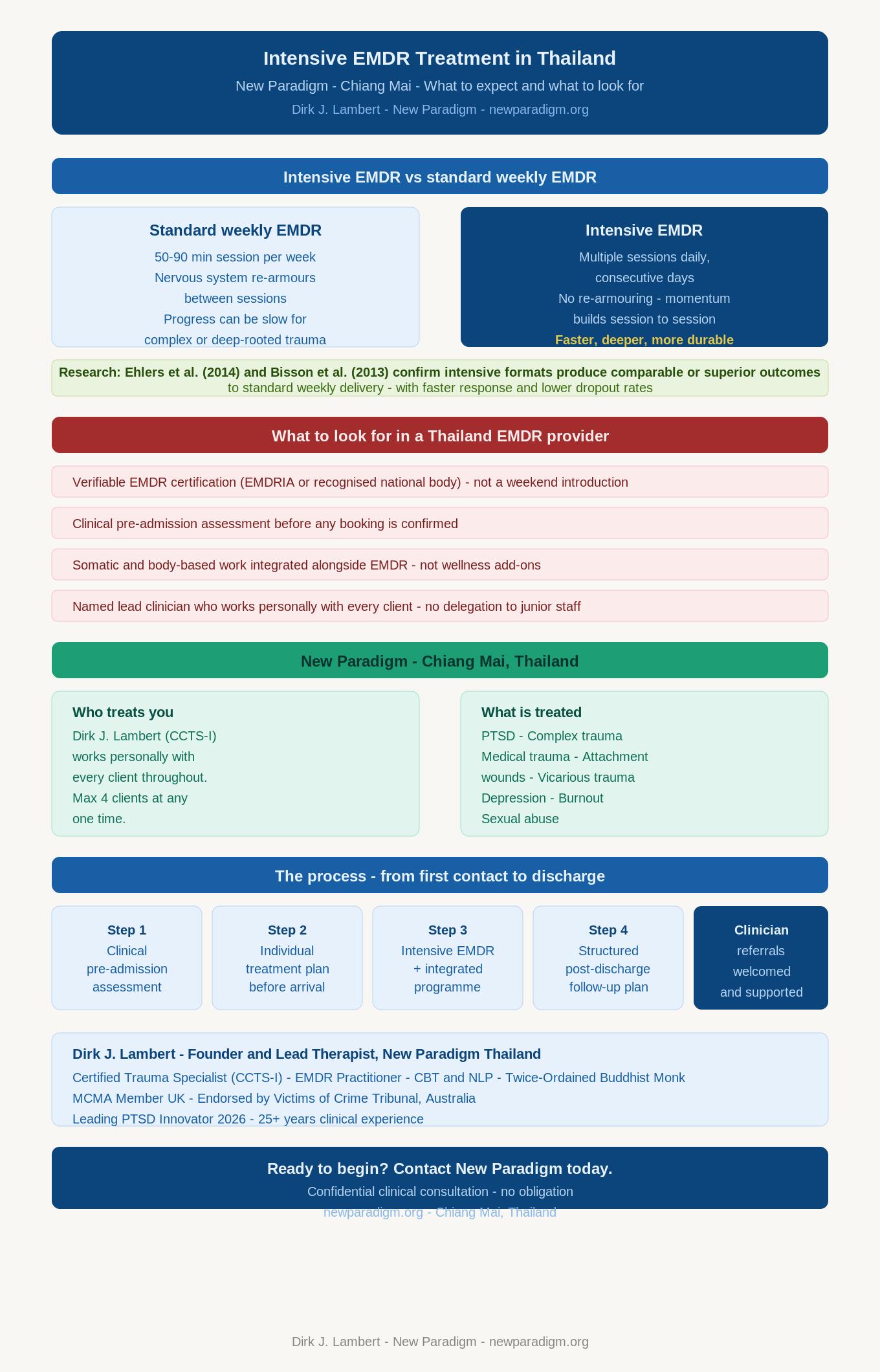
Standard EMDR is delivered in weekly or fortnightly sessions of 50 to 90 minutes. Intensive EMDR concentrates multiple sessions across consecutive days, allowing the reprocessing work to build momentum rather than being interrupted by a week of ordinary life between appointments.
The neurobiological case for this is well-established. Memory reconsolidation - the process by which traumatic memories are updated and integrated - is enhanced when the therapeutic environment remains consistent. In weekly therapy, the nervous system returns to its habitual stress context between sessions and re-armours: the defensive structures that trauma has installed reassert themselves, and significant energy at the next session goes toward re-establishing the therapeutic ground that was reached the week before. Intensive formats largely eliminate this dynamic.
The research supports what the neuroscience predicts. Ehlers et al. (2014) found that intensive cognitive therapy for PTSD produced substantial symptom reduction within one to two weeks. Studies by Bisson et al. (2013) confirmed that concentrated trauma-focused approaches were at least as effective as standard delivery - and in many cases produced faster and more durable outcomes. For complex trauma in particular, where the therapeutic relationship and sustained momentum are both critical, intensive formats offer advantages that weekly delivery structurally cannot match.
What to Look for in an EMDR Provider in Thailand
Thailand has a growing number of retreat programmes that use the language of trauma treatment and EMDR in their marketing. Not all of them are delivering what the language implies. Before committing to any programme, the following criteria are non-negotiable.
The lead clinician should hold verifiable EMDR certification from a recognised body - the EMDR International Association (EMDRIA) or an equivalent national accrediting body. EMDR is a specific, structured protocol that requires formal training and supervised practice hours to deliver competently. A practitioner who has attended a weekend introduction is not an EMDR therapist.
The programme should include a thorough clinical pre-admission assessment. A credible intensive EMDR provider will not accept clients without understanding their clinical presentation, history, and any contraindications. If you can book and pay without any clinical conversation, walk away.
Look for integration of somatic and body-based approaches alongside the EMDR work. Trauma is held in the body as well as in the cognitive and narrative layers, and EMDR alone - while highly effective - is more powerful when delivered within a programme that also addresses physiological regulation directly. Our clinician's guide to choosing a trauma retreat covers each of these criteria in detail and is a useful framework for evaluating any programme.
New Paradigm - Intensive EMDR Treatment in Chiang Mai
New Paradigm was founded by Dirk J. Lambert in Chiang Mai, Thailand. Dirk is a Certified Trauma Specialist (CCTS-I), a qualified EMDR practitioner, a CBT and NLP specialist, and a twice-ordained Buddhist monk with more than 25 years of clinical experience working with complex trauma, PTSD, depression, and attachment disorders. He is a member of the Complementary Medical Association UK (MCMA), an endorsed provider through the Victims of Crime Assistance Tribunal in Melbourne, Australia, and was named Leading PTSD Innovator in 2026 by Global Health and Pharma.
Dirk works personally with every client throughout the programme. There are no junior staff delivering the clinical sessions. The maximum intake is four clients at any one time, which means the programme is genuinely individualised rather than group-based with individual sessions bolted on.
EMDR sessions at New Paradigm run 60 to 90 minutes and are typically delivered on consecutive days throughout the programme, with the pace and intensity adjusted daily as the work unfolds. There is no fixed script. The targets, the approach to each session, and the balance between processing and stabilisation are calibrated to the individual client's responses, history, and capacity on any given day.
New Paradigm treats a wide range of presentations through intensive EMDR:
- PTSD and complex PTSD from childhood, relational, or acute trauma
- Trauma from medical procedures, surgery, ICU stays, and serious diagnosis
- Attachment wounds and the relational effects of early trauma
- Vicarious trauma in mental health practitioners and first responders
- Depression and anxiety with a trauma component
- Burnout where trauma or chronic stress is a contributing factor
- Sexual abuse and assault
Both inpatient (fully residential) and outpatient (day attendance, return to accommodation each evening) formats are available. For people travelling from overseas, the inpatient format provides the most contained and immersive experience. For those based in or near Chiang Mai, the outpatient format offers the same clinical intensity with greater flexibility.
What the Process Looks Like From First Contact to Discharge
The process at New Paradigm begins before you arrive. Every client has a clinical conversation with Dirk prior to admission - not a sales call, but a genuine clinical assessment that covers your history, your current presentation, any contraindications, and what you are hoping to achieve. This conversation informs the individualised treatment plan that is in place before your first session.
During the programme, the therapeutic day is structured to support the EMDR work at every level. Morning sessions establish physiological regulation before the intensive clinical work begins. Individual therapy with Dirk - drawing on EMDR, CBT, and NLP - forms the clinical core of each day. Body-based practices including yoga, Thai massage, guided breathwork, and contrast therapy address the somatic dimensions of trauma that talk therapy reaches only partially. Meditation practice, drawn from Dirk's Theravada Buddhist training, builds the capacity for stillness and self-compassion that underpins integration. Evening reflection and psychoeducation consolidate what each day's work has opened. If you want a detailed picture of how the day is structured, what a typical day at New Paradigm looks like is laid out in full.
At discharge, every client receives a structured follow-up plan: scheduled check-ins, recommendations for ongoing therapy, and a named point of contact if difficulties arise in the weeks after the programme. The period following intensive work is one of integration and consolidation, and New Paradigm treats post-discharge support as a clinical responsibility rather than an optional extra.
Clinician referrals are welcomed. Dirk is happy to liaise with referring therapists before, during, and after the programme, and clients are encouraged to maintain their existing therapeutic relationship alongside the retreat where possible. If you are still weighing whether an intensive programme represents genuine value, we have answered that question honestly at are mental health retreats actually worth it.
About the Author
Dirk J. Lambert is the founder and lead therapist at New Paradigm, a private mental health retreat in Chiang Mai, Thailand. He is a Certified Trauma Specialist (CCTS-I), EMDR practitioner, CBT and NLP specialist, and twice-ordained Buddhist monk with more than 25 years of clinical experience working with complex trauma, PTSD, depression, and attachment disorders. Dirk founded Thailand's first alternative recovery centre in 1999 and established New Paradigm in 2016. He is a recognised specialist in the treatment of sexual abuse survivors, an endorsed provider through the Victims of Crime Assistance Tribunal in Melbourne, Australia, a member of the Complementary Medical Association UK (MCMA), and was named Leading PTSD Innovator in 2026 by Global Health and Pharma. He works personally with every client who enters the programme.
Ready to Begin?
If you are ready to explore what intensive EMDR treatment in Thailand might look like for your specific situation, the first step is a confidential clinical conversation with Dirk. There is no obligation, and the conversation itself is a genuine clinical discussion - not a sales process.
Contact New Paradigm today to arrange your pre-admission consultation.