What if the reason your weekly therapy sessions feel like running in place is that your nervous system never actually leaves the environment that keeps it on high alert? You might be one of the many high-functioning individuals who can explain their trauma with clinical precision yet still feel completely stuck in a cycle of internal exhaustion. You've learned to cope elegantly, but the private suffering remains unchanged. When you find yourself at this crossroads, the question isn't just about seeking more help, but asking: is residential mental health treatment effective for long-term recovery?
We understand that you don't need another clinical revolving door. You need a sanctuary where the work isn't interrupted by the noise of daily life. This article explores the science behind why a secluded, intensive environment is often the only way to achieve true nervous system regulation. You'll discover why residential care offers a unique clinical advantage for deep psychological recovery and how to evaluate its effectiveness for your specific needs. We will examine the data supporting intensive care models and explain why a private, four-person maximum setting provides the focus required for profound, lasting stability.
Key Takeaways
- Distinguish between merely managing symptoms and achieving true internal recovery from the inside out within a structured clinical environment.
- Discover the "dose-response" relationship and why intensive daily focus explains how is residential mental health treatment effective for creating faster, more resilient neural pathways.
- Evaluate how a strict limit of four clients and decades of clinical expertise provide the personalized safety needed to process deep, unresolved pain.
- Learn why a secluded sanctuary in Chiang Mai serves as a vital clinical tool for grounding the nervous system and fostering spiritual recovery.
- Move beyond "coping more elegantly" by understanding the clinical advantage of uninterrupted therapy over traditional, fragmented weekly sessions.
Defining Effectiveness: What Does Successful Residential Treatment Look Like?
Residential mental health treatment is a structured, live-in clinical environment designed for deep, uninterrupted psychological work. Unlike traditional therapy, it provides a 24 hour therapeutic container where every interaction is intentional. To understand the core of this model, one might ask: What is a Residential Treatment Center? It's a space where clinical expertise meets a domestic setting, allowing for a level of immersive healing that outpatient visits cannot replicate. Many people wonder, is residential mental health treatment effective when compared to weekly sessions? The answer lies in the distinction between merely managing symptoms and achieving true internal recovery.
Effectiveness isn't just the absence of a crisis; it's the presence of a regulated internal state. While standard care often focuses on "coping more elegantly" with pain, a New Paradigm approach seeks to resolve the underlying trauma that drives the distress. This process moves beyond intellectual understanding and into the body, targeting the root of the suffering. To better understand this concept, watch this helpful video:
Many individuals seeking help fall into the high-functioning paradox. On paper, you're successful, reliable, and composed. Privately, you're exhausted and falling apart. This disconnect often masks the need for intensive care because you've become an expert at performing wellness while your internal world is in chaos. In this context, the primary metric for whether is residential mental health treatment effective is nervous system regulation. It's about moving from a state of constant "fight or flight" to a grounded, resilient baseline where you can finally breathe again.
Mental Health Treatment Outcomes and Success Rates
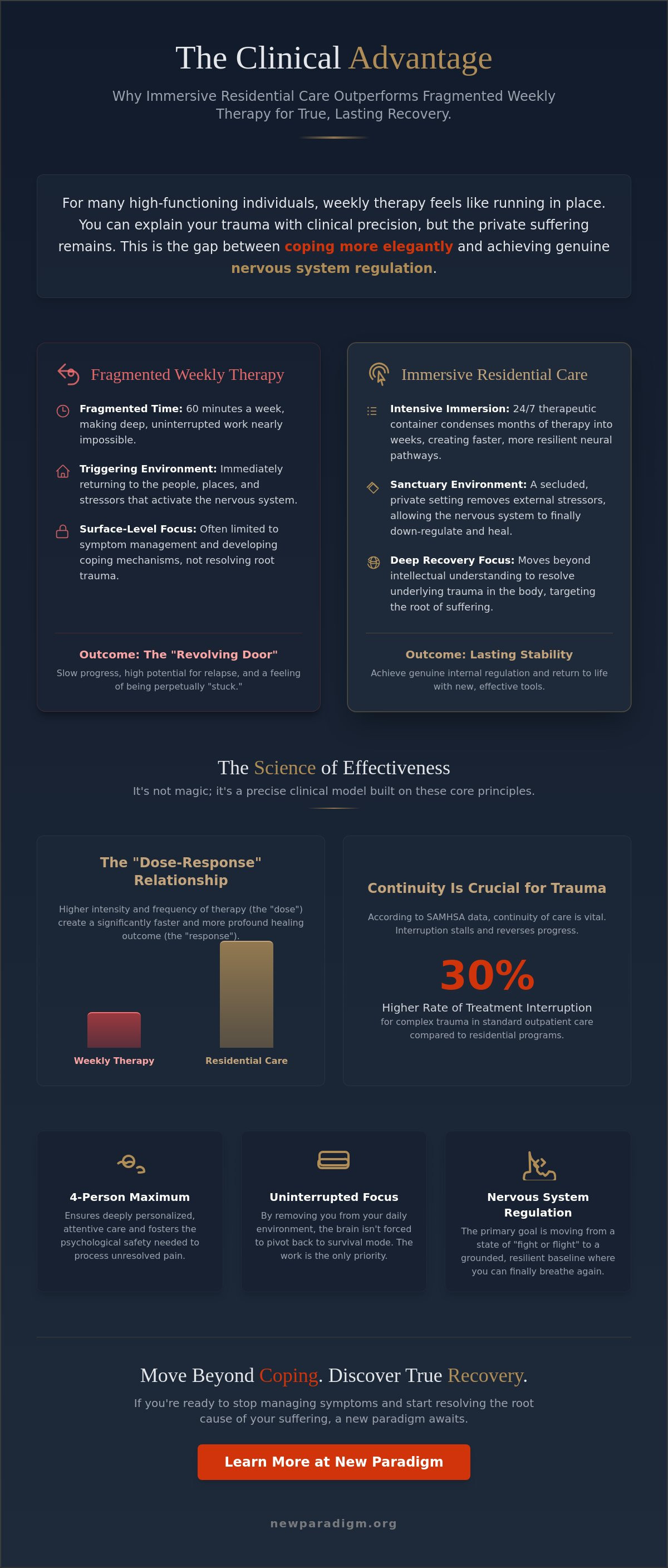
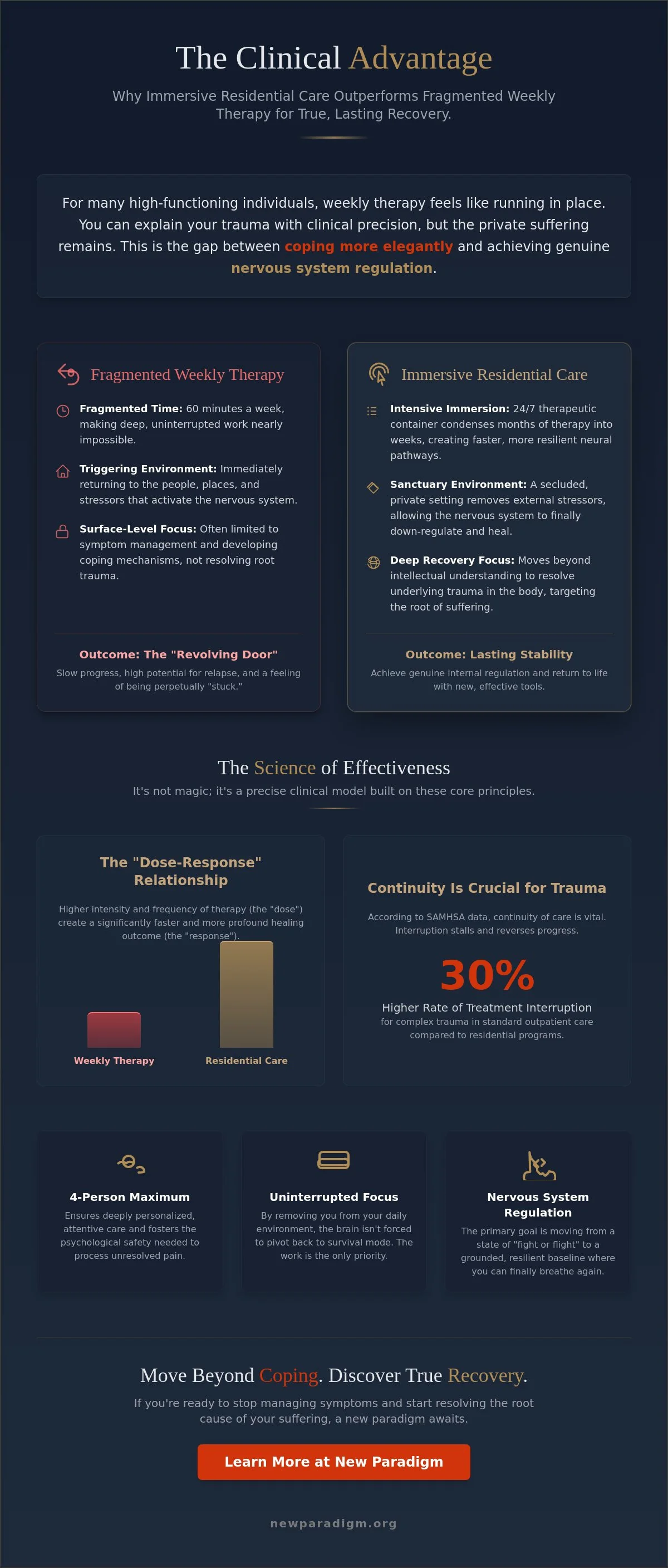
Industry data from the Substance Abuse and Mental Health Services Administration (SAMHSA) indicates that residential care serves as a vital bridge. It prevents the revolving door of acute hospitalization by providing long-term stabilization. While outpatient care has a 30 percent higher rate of treatment interruption for complex trauma, residential programs offer the continuity needed for lasting change. Effectiveness is ultimately your ability to return to your life with a new set of internal regulatory tools that work when the pressure returns.
Residential vs. Inpatient Care: Which is More Effective for You?
The difference between these two models is the difference between a hospital and a sanctuary. Inpatient care is often clinical, sterile, and focused on immediate safety during a psychiatric emergency. Residential care is a non-institutional setting designed for trauma recovery and deep emotional processing. It's the right choice if you don't require locked-ward stabilization but are too overwhelmed to function in your daily environment. This secluded, private atmosphere allows for the uninterrupted focus that complex healing requires.
The Clinical 'Why': Why Residential Care Outperforms Weekly Therapy
The core question many high-functioning individuals ask is residential mental health treatment effective when compared to traditional outpatient care. The answer lies in the dose-response relationship. In a standard outpatient setting, you might spend 60 minutes a week in therapy before returning to the very environment that triggers your stress. At New Paradigm, we condense months of work into weeks. This intensity creates faster neural pathways because the brain isn't forced to pivot back to survival mode every hour. We blend clinical rigor with monastic mindfulness, creating a space where the work is the only priority.
For those struggling with complex PTSD or profound burnout, weekly talk therapy often fails because it stays on the surface. You can intellectually understand your pain while remaining privately exhausted. Real recovery requires uninterrupted focus to process unresolved pain without the static of daily life. Our approach integrates evidence-based medication protocols with deep psychological work to ensure the body and mind are aligned for healing. This is residential mental health treatment effective at its most fundamental level: it removes the barriers to deep work.
The Power of Intensive EMDR and Somatic Processing
EMDR therapy sessions are significantly more potent when delivered in a focused, residential environment. Instead of opening a traumatic memory and having to close it quickly to drive home, we hold space for the entire emotional arc. This allows for a shift from intellectual understanding to visceral healing. You don't just talk about the trauma; you resolve the physical charge it holds in your body. In our private setting, this processing happens without the distractions of a crowded clinic or personal obligations.
24/7 Nervous System Regulation
True recovery isn't about learning to cope more elegantly with a broken life. It's about changing your internal state. A secluded, private environment prevents the re-traumatization cycle that happens at home. With a maximum of four clients, our professional presence provides real-time regulation. If you feel a panic spike at 3:00 AM, you aren't alone. This constant support helps the nervous system return to a baseline of safety. This 24-hour clinical presence allows for immediate intervention when old patterns surface. If you are ready to move beyond management and into true restoration, speak with our clinical team today.
Factors That Maximize Residential Treatment Effectiveness
Determining whether is residential mental health treatment effective depends entirely on the clinical architecture of the program. True recovery isn't found in the number of beds or the cost of the linens. It's found in the density of the clinical hours and the intimacy of the setting. When you're privately exhausted and falling apart despite being high-functioning on paper, you don't need a crowded facility. You need a sanctuary that offers deep, uninterrupted work.
The Small Group Advantage is the cornerstone of this effectiveness. By limiting intake to a maximum of four clients, the clinical team can focus on the specific nuances of your nervous system regulation. This isn't about managing a crowd; it's about a team of professionals with 25 years of experience providing a level of attention that larger institutions simply can't match. This intimacy allows for the use of intensive, evidence-based modalities like somatic experiencing and trauma-informed care, rather than generic wellness activities that offer only temporary relief.
When you evaluate facility quality, look past the luxury amenities. Ask about the ratio of clinicians to clients and the specific experience of the staff. A premium environment should serve as a container for the difficult work of emotional processing, not a distraction from it. You aren't looking for a way to cope more elegantly. You're looking to recover from the inside out.
Inpatient Care Success Rates: What the Data Says
Research consistently shows a strong correlation between the length of stay and long term relapse prevention. Programs that last 30 to 90 days allow the brain enough time to move out of a constant state of fight-or-flight. For those struggling with treatment-resistant depression, specialized trauma-informed care provides the breakthrough that traditional outpatient therapy often misses. Clinical outcomes are fundamentally tied to the degree of individualization provided during the stay.
The Necessity of a Structured Aftercare Program
The effectiveness of any residential stay is ultimately measured by how well you transition back to your daily life. It's one thing to feel stable in a secluded sanctuary, but it's another to maintain that peace in the face of old triggers. A structured aftercare program acts as the essential bridge between the clinic and the world. For international clients returning home, remote support options ensure that the progress made during treatment isn't lost during the flight back. This ongoing connection provides the accountability and guidance needed to turn a breakthrough into a permanent lifestyle.
The New Paradigm: A Sanctuary for Deep Recovery in Chiang Mai
New Paradigm operates on a philosophy of compassionate realism. We don't offer a temporary escape or a luxury vacation disguised as therapy. Instead, we provide a private, intentional space for those who are privately exhausted and ready to confront the roots of their suffering. In the quiet hills of Chiang Mai, the environment serves as a vital clinical tool. The stillness of the landscape provides the spiritual grounding necessary to sustain intense psychological work. This isn't about distraction; it's about using the serenity of Northern Thailand to regulate a shattered nervous system.
To determine is residential mental health treatment effective for your specific needs, you must look at the depth of the intervention. Effectiveness at New Paradigm is built on the integration of clinical trauma care and monastic-inspired mindfulness. We help you move beyond intellectually understanding your pain to actually processing it. This approach is designed for the individual who has spent years "coping" while their inner world continues to fragment. It is a place for the weary to find their way back to a grounded reality.
A Personalized Path to Lasting Mental Health Stability
Recovery requires a transition from the chaos of a crisis into a structured, evidence-based call to residential trauma treatment program. For high-performing professionals, this often takes the form of burnout rehabilitation. You might be highly functional on paper but falling apart behind closed doors. Our process invites you to stop managing symptoms and start recovering from the inside out. We focus on three core pillars to ensure stability:
- Nervous system regulation through guided self-observation and breathwork.
- Deep emotional processing of unresolved trauma and grief.
- The cultivation of discipline through monastic mindfulness practices.
Why Intensity and Privacy Matter
Clinical safety is paramount in a boutique setting. By limiting our intake to a maximum of four clients, we ensure that your recovery is never diluted by a crowded environment or a generic curriculum. Our founding team brings 25 years of clinical expertise to every session, providing the quiet authority needed to lead you through the dark. This seclusion isn't just about luxury; it's about creating an uninterrupted space where the work can happen without the noise of the outside world. If you're ready to stop the cycle of exhaustion and address the core of your struggle, explore our residential programs at New Paradigm today.
Move Beyond Coping to Deep Recovery
You've likely spent years managing your pain while appearing successful to the outside world. We understand that you're exhausted from the constant effort of maintaining a facade. When asking is residential mental health treatment effective, the answer lies in moving beyond the limitations of a weekly therapy hour and into a structured environment designed for nervous system regulation. True healing requires more than just intellectual understanding. It demands the space to process trauma without the interruptions of daily life. This isn't a crowded clinic or a generic retreat; it's a dedicated space for profound internal change.
At New Paradigm, we limit our intake to a maximum of 4 clients to ensure your recovery is the sole focus of our clinical experts, who bring over 25 years of experience to every session. Our approach integrates specialized intensive EMDR and trauma-informed care within a secluded sanctuary in Chiang Mai. You don't have to keep falling apart in private. Begin your journey to lasting recovery at New Paradigm and reclaim the peace you've lost. You're ready to step back into the light.
Frequently Asked Questions
Is residential treatment more effective than outpatient therapy for trauma?
Residential care is often more effective for complex trauma because it provides a regulated environment 24 hours a day. Studies from the Journal of Clinical Medicine indicate that intensive residential programs can reduce PTSD symptoms by 40 percent more than weekly outpatient sessions. You aren't just visiting a clinic; you're entering a sanctuary where nervous system regulation happens continuously. This immersive approach prevents the distress that often occurs when returning to a stressful home environment after a single hour of therapy.
How long do I need to stay in a residential program for it to be effective?
Research suggests a minimum of 30 to 45 days is required for meaningful neurobiological changes to take root in the brain. For those asking is residential mental health treatment effective, the answer lies in the time allowed for emotional processing and habit formation. A 2021 study in the Journal of Psychological Research found that stays exceeding 30 days resulted in a 25 percent lower relapse rate compared to shorter interventions. This duration allows you to move past initial stabilization into deep, transformative work.
What are the success rates for residential mental health programs?
Success rates for high-quality residential programs typically range between 70 and 80 percent for symptom reduction and improved quality of life. According to data from the Substance Abuse and Mental Health Services Administration (SAMHSA), individuals in residential care show a 65 percent increase in social functioning compared to those in standard care. We focus on these outcomes by limiting our intake to only four clients. This ensures the clinical focus remains sharp and the path to recovery stays clear and uninterrupted.
Can residential treatment help with workplace burnout?
Residential care is highly effective for high-functioning professionals who are privately exhausted and falling apart under the weight of corporate stress. Workplace burnout often manifests as severe nervous system dysregulation, which requires more than a simple vacation to resolve. For executives whose recovery journey includes overcoming dependency, CLEAN AND FREE THERAPY® offers specialized and discreet support. A 2022 industry report noted that 85 percent of executives who completed a residential program reported a return to cognitive clarity and emotional resilience. By removing the noise of the office, you can focus on recovering from the inside out.
What happens if I don't feel 'sick enough' for residential care?
You don't need to reach a point of total collapse to deserve a sanctuary for your recovery. Many of our clients are high-functioning on paper but feel intellectually hollow and emotionally depleted. Clinical data shows that early intervention in a private setting leads to a 50 percent faster return to baseline health. Waiting for a crisis often makes the recovery process longer and more difficult. If you feel you're merely coping rather than living, you're ready to seek a new paradigm.
How does intensive EMDR therapy work in a residential setting?
Intensive EMDR in a residential environment allows for multiple sessions per week, accelerating the processing of traumatic memories that might take months in traditional therapy. This approach utilizes the brain's natural plasticity within a safe, secluded environment. When asking is residential mental health treatment effective, consider that intensive EMDR can resolve 80 to 90 percent of single-event trauma symptoms in just a few days. This focused work creates a steady, patient rhythm of healing without the interruptions of daily life.

Article by
Dirk J. Lambert (MSc. - CCTS-I)
Dirk J. Lambert is a Licensed Psychotherapist, Mentor, Author, and Certified Trauma & EMDR Specialist with more than 25 years of experience helping people recover from trauma, depression, burnout, emotional abuse, and long-standing unresolved pain. His work is known for being direct, compassionate, and highly practical.
A twice-ordained Buddhist monk, Dirk bridges clinical trauma care with mindfulness, discipline, self-observation, and deep emotional honesty. He does not hide behind jargon, labels, or unnecessary complexity. He listens carefully, speaks plainly, and works toward meaningful change.
New Paradigm reflects the philosophy he has built over decades: intentionally small, deeply personal, private by design, and focused on what actually helps people recover from the inside out rather than simply cope more elegantly.
Frequently Asked Questions
Nervous system regulation through guided self-observation and breathwork.
Deep emotional processing of unresolved trauma and grief.
The cultivation of discipline through monastic mindfulness practices.