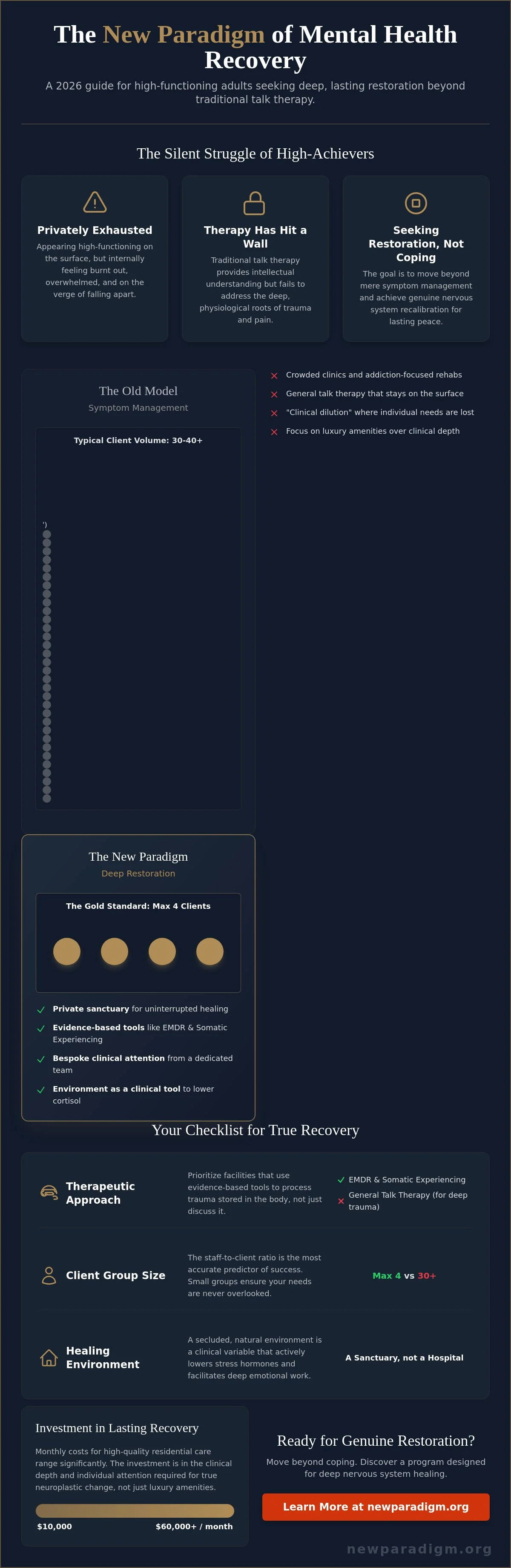
Recovery is not a matter of how many months you spend in a facility; it is about how deeply your nervous system is allowed to rest. You may be high functioning on paper, yet you are privately exhausted and feel as though you are falling apart. When you search for long term residential mental health facilities for adults, you are often met with crowded clinics or addiction-focused rehabs that don't address your specific trauma. You deserve a sanctuary, not a hospital bed.
It is common to feel skeptical of traditional talk therapy when it has failed to reach the root of your pain. You want to move beyond mere coping and achieve a state of genuine restoration. This 2026 guide explains how to identify programs that prioritize deep emotional processing over simple symptom management. We will examine the current costs of care, which now range from $10,000 to over $60,000 per month, and the shift toward small scale environments that offer the privacy you need for uninterrupted healing.
Key Takeaways
- Understand why true nervous system recalibration depends on the science of neuroplasticity and requires more than just a brief stay to achieve lasting change.
- Learn to evaluate long term residential mental health facilities for adults by prioritizing evidence-based tools like EMDR and somatic experiencing over general talk therapy.
- Discover how a secluded, natural environment acts as a clinical variable to lower cortisol levels and facilitate deep emotional processing.
- Identify why a maximum of four clients is the essential threshold for ensuring you receive the bespoke, uninterrupted clinical attention your recovery demands.
Understanding Long Term Residential Mental Health Facilities for Adults
A residential treatment environment is more than a place to stay; it is a 24/7 therapeutic container designed for intensive psychological work. Unlike a traditional psychiatric ward that focuses on short term stabilization, long term residential mental health facilities for adults provide the time necessary for true neuroplastic change. To understand the history and clinical foundation of these settings, you might ask: What is a Residential Treatment Center? While the term is broad, the 2026 standard for deep recovery has shifted toward specialized, mental health first environments. These are clinical sanctuaries rather than hospitals, offering a private space where you aren't just a number in a crowded clinic.
To better understand the structure of a modern recovery environment, watch this helpful video:
The science of neuroplasticity suggests that the brain requires significant time and repetition to overwrite old trauma patterns. This is why duration matters. Many facilities see a 93% utilization rate of their beds because the demand for deep, immersive care is rising. Choosing a facility that specializes in mental health rather than addiction is crucial for those who don't require medical detox but are privately falling apart from unresolved pain. At New Paradigm Mental Health Retreat, the focus is on a maximum of four clients to ensure that this deep work is never interrupted by the chaos of a large group setting.
Who is Long-Term Residential Care For?
This level of care is designed for high functioning professionals who have hit a wall of burnout or chronic stress that outpatient therapy cannot reach. It's for individuals with complex PTSD or treatment resistant depression who find themselves intellectually understanding their pain but unable to feel better. When weekly sessions no longer provide the stability you need, an immersive environment becomes the only logical path forward.
The Clinical Shift: From Coping to Processing
Traditional talk therapy often stays on the surface, helping you "cope" with symptoms without addressing the physiological roots of trauma. In a residential setting, daily interventions like EMDR and somatic work allow for deep emotional processing. Nervous system regulation is the intentional process of shifting the body from a state of chronic threat to one of physiological safety and social engagement. This shift is what transforms a person from being "stable" to being truly recovered.
Evaluating Facilities: A Buying Guide for Adult Residential Care
Choosing between long term residential mental health facilities for adults requires looking past the surface. Many high-end centers market themselves through luxury pools or gourmet chefs. While comfort is necessary to create a sense of safety, it does not heal trauma. You must evaluate the clinical core of the program to ensure you aren't just paying for a high-end stay without a clinical breakthrough. True recovery is found in the quality of the therapeutic work, not the thread count of the linens.
The Importance of Clinical Intimacy
Large institutions often struggle with what we call clinical dilution. When selecting long term residential mental health facilities for adults, the staff-to-client ratio is the most accurate predictor of success. When a facility houses 30 or 40 residents, the individual becomes a number. Deep recovery requires a sense of sanctuary that only a small client cohort can provide. Programs like New Paradigm limit their intake to just four individuals. This intentionally small scale ensures that the clinical team remains intimately familiar with your nervous system's specific triggers and progress. Resources like the American Residential Treatment Association can help you identify accredited programs that meet these high standards of care.
Evidence-Based vs. Holistic Approaches
True restoration happens when you stop trying to talk your way out of pain. Look for facilities that integrate somatic experiencing and EMDR therapy sessions. These evidence-based tools target the physical storage of trauma in the body. If you're high-functioning on paper but privately falling apart, you likely have an intellectual understanding of your issues but lack emotional relief. A rigorous clinical program balances these deep interventions with mindfulness and discipline. It's about recovering from the inside out, not just learning to cope more elegantly with your symptoms. This clinical rigor is what allows for the recalibration of a dysregulated nervous system.
Finally, ask about the longevity of the clinical leadership. In an industry where the average monthly cost ranges from $15,000 to over $60,000, you deserve a team with decades of experience. Ensure their aftercare program provides a structured bridge back to your daily life rather than just a discharge date. If you're ready to explore a bespoke path to healing, you can speak with a clinical advisor to discuss your specific needs.
The Role of Environment and Duration in Deep Recovery
The physical space where you choose to heal is not merely a backdrop for therapy; it is a clinical variable that directly impacts your physiology. Many traditional long term residential mental health facilities for adults are situated in sterile, hospital-like settings that can inadvertently keep the nervous system in a state of high alert. True restoration requires a sanctuary that actively lowers cortisol levels through seclusion and natural beauty. When you remove the constant triggers of your daily environment, your brain finally has the bandwidth to focus on the demanding work of emotional processing.
Duration is the second pillar of this process. The science of behavioral change suggests that 30, 60, and 90 days are not arbitrary numbers but essential milestones for neuroplasticity. While the first month often focuses on stabilization and breaking the cycle of burnout, the subsequent months allow for the deep, repetitive work required to overwrite decades of trauma. It's about moving past the point of just feeling better and reaching the point where your internal state is fundamentally transformed.
Why Chiang Mai for Mental Health?
Chiang Mai, Thailand, has emerged as a global hub for clinical excellence because it offers a unique blend of spiritual calm and sophisticated trauma care. In Northern Thailand, the cultural groundedness and slower pace of life provide an immediate sense of safety that is difficult to replicate in Western cities. You can access international standards of care, including advanced EMDR and somatic work, in a setting that feels like a private home rather than a clinic. To understand why this region has become the gold standard for those who are privately falling apart, read our Mental Health Facility Thailand: A Clinical Guide to Residential Recovery in 2026.
The Nervous System and the Environment
A non-clinical, home-like environment is essential for reducing the stigma and shame often associated with psychiatric care. When you are surrounded by silence, nature, and physical space, your body receives the signal that it is no longer under threat. This allows for a deeper level of vulnerability during clinical sessions. The environment acts as a silent co-therapist, providing the physiological safety required for the nervous system to finally let down its guard and begin the work of recalibration. If you're ready to step into a space designed for your specific recovery, you can reach out to our clinical team today.
The New Paradigm: Why Small-Scale Care is the Gold Standard
Large-scale institutions often argue that a wide variety of programs is the key to success. However, for the individual who is privately falling apart, a crowded campus can feel like another source of noise and overwhelm. The most effective long term residential mental health facilities for adults understand that depth is superior to scale. By maintaining a maximum of four clients, a facility ensures that your clinical team is never distracted or spread too thin. This intimacy allows for a level of bespoke attention where every session is tailored to your specific nervous system regulation needs, rather than a generic curriculum.
Compassionate Realism is the clinical philosophy that grounds this work. It acknowledges the gravity of your suffering without offering the hollow promises of toxic positivity. We don't want you to just learn how to cope more elegantly with your anxiety or depression. The goal is to recover from the inside out. This requires an honest, direct, and sometimes somber approach to the unresolved pain that has kept you stuck for years. It's a journey that moves beyond clinical jargon and into the heart of lived experience.
Private Recovery for the High-Functioning Adult
High-functioning adults often carry a unique burden of "hidden" burnout. On paper, your life looks successful, yet internally you feel exhausted and depleted. You've likely spent years managing your symptoms while your internal state continues to deteriorate. Choosing a facility with a 25-year clinical legacy in trauma recovery means you're working with mentors who understand these depths. For a deeper look at this approach, read Beyond Coping: The Definitive Guide to Residential Trauma Treatment in 2026.
Ready for a New Paradigm?
Deep residential work requires a significant commitment of time and emotional energy. It's an investment in your future self that pays dividends in peace and stability. When evaluating long term residential mental health facilities for adults, choose a setting that feels like a sanctuary rather than a clinic. You deserve a private environment where your healing process is the only priority, free from the interruptions of the outside world. If you're ready to step out of the darkness and into a structured path of restoration, begin your private recovery journey with our clinical team today.
Reclaiming Your Internal Peace
True recovery is never about learning to cope more elegantly; it is about resolving the pain that lives within your nervous system. You have learned that the environment acts as a co-therapist and that neuroplastic change requires the gift of time. When evaluating long term residential mental health facilities for adults, remember that your healing thrives in intimacy rather than institutional scale. You deserve a space where you aren't just another number in a crowded clinic.
At New Paradigm, we maintain a maximum of four clients to ensure total clinical focus on your journey. Our founder brings 25 years of experience to every case, utilizing specialized EMDR and somatic interventions to reach the roots of trauma and burnout. We provide a secluded sanctuary designed for those who are privately exhausted and ready for an uninterrupted path back to the light. It's time to stop managing your symptoms and start recovering from the inside out. You can Request a Private Consultation for Residential Trauma Care to discuss your specific path forward. You don't have to carry this weight alone anymore; there is a practical way through the darkness.
Frequently Asked Questions
How long do adults typically stay in residential mental health facilities?
A stay of 30 to 90 days is the standard for long term residential mental health facilities for adults. While some programs offer 21 day stabilization, the science of neuroplasticity requires at least 60 days to overwrite deep trauma patterns. In 2020, 93% of residential beds in the U.S. were utilized because individuals recognized that lasting restoration requires this extended, immersive focus.
What is the difference between residential mental health care and a psychiatric hospital?
Psychiatric hospitals focus on short term crisis stabilization, whereas residential facilities provide a long term therapeutic environment. Hospitals are clinical, medical settings designed to prevent immediate harm over a few days. In contrast, a residential sanctuary offers a private, home-like space for months of intensive emotional processing and nervous system regulation.
Will insurance cover long-term residential mental health facilities for adults?
Coverage varies by provider, but recent federal shifts like the "One Big Beautiful Bill Act" of July 2025 have reduced Medicaid funding by 15%. Private insurers may cover portions of the $15,000 to $60,000 average monthly cost. It's vital to verify your benefits, especially since the administration announced in May 2025 it would not enforce certain mental health parity regulations.
Can I work remotely while staying at a residential treatment center?
You are generally discouraged from working while in treatment to ensure your healing remains uninterrupted. Bringing professional triggers into a secluded sanctuary can stall the process of nervous system regulation. True recovery requires you to step away from the demands of being high functioning so you can focus entirely on your internal recalibration.
What specific therapies are most effective in a residential setting?
EMDR and somatic experiencing are the gold standards for resolving deep-seated trauma and chronic burnout. These evidence based tools address how the body stores stress, moving beyond the limits of traditional talk therapy. In a residential setting, these interventions are applied daily, allowing for a level of emotional processing that weekly outpatient sessions simply cannot achieve.
How do I know if I need residential care or just intensive outpatient therapy?
You likely need residential care if you feel like you're privately falling apart despite appearing successful on paper. Intensive outpatient therapy is appropriate for those who can still manage their daily triggers at home. Long term residential mental health facilities for adults are necessary when you require a 24/7 therapeutic container to achieve true restoration rather than just more elegant coping.

Article by
Dirk J. Lambert (MSc. - CCTS-I)
Dirk J. Lambert is a Licensed Psychotherapist, Mentor, Author, and Certified Trauma & EMDR Specialist with more than 25 years of experience helping people recover from trauma, depression, burnout, emotional abuse, and long-standing unresolved pain. His work is known for being direct, compassionate, and highly practical.
A twice-ordained Buddhist monk, Dirk bridges clinical trauma care with mindfulness, discipline, self-observation, and deep emotional honesty. He does not hide behind jargon, labels, or unnecessary complexity. He listens carefully, speaks plainly, and works toward meaningful change.
New Paradigm reflects the philosophy he has built over decades: intentionally small, deeply personal, private by design, and focused on what actually helps people recover from the inside out rather than simply cope more elegantly.