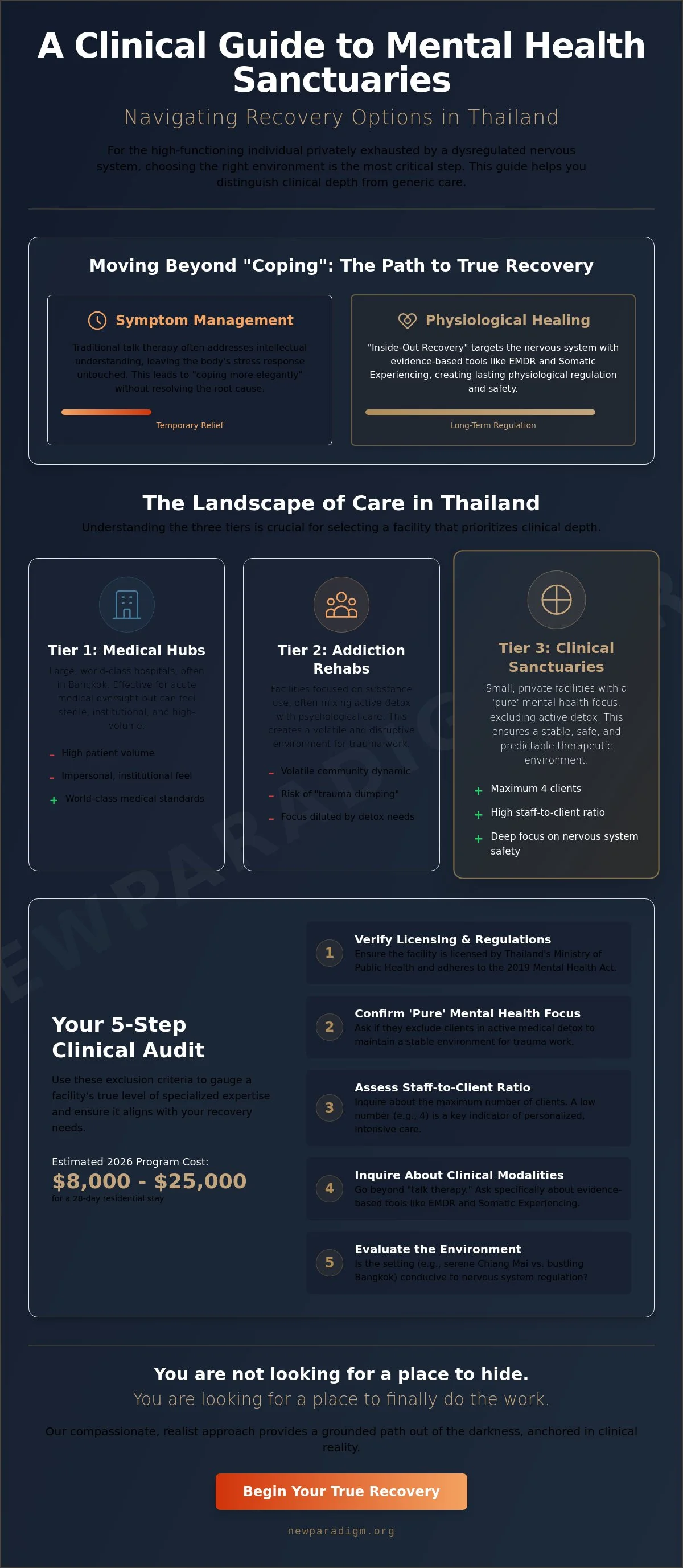
The most effective recovery isn't found in a crowded hospital ward or a generic addiction rehab; it happens in the quiet space of a clinical sanctuary. You might be high-functioning on paper, yet you're privately exhausted from a nervous system that never settles. In a country where over 13 million people are currently navigating psychological disorders, finding a dedicated mental health facility Thailand offers for clinical depth is essential for true healing. You aren't looking for a place to hide. You're looking for a place to finally do the work.
It's exhausting to keep "coping" when you're actually falling apart inside. We understand that anxiety about international clinical standards is real, especially when residential program costs in 2026 range from $8,000 to $25,000 for a 28-day stay. This guide will show you how to move beyond temporary relief to access intensive, evidence-based trauma recovery. We will examine how to verify Ministry of Public Health licensing, understand the impact of the 2019 Mental Health Act amendments, and identify why a small, private environment is the only way to achieve long-term nervous system regulation.
Key Takeaways
- Distinguish between the three tiers of care in Thailand to ensure you select a facility that prioritizes clinical depth over high-volume residency.
- Move beyond "coping more elegantly" by understanding how evidence-based trauma care targets the physiological roots of your exhaustion.
- Apply a 5-step audit to any mental health facility Thailand, using exclusion criteria to gauge the true level of specialized expertise.
- Explore the strategic advantage of Chiang Mai as a sanctuary for recovery, where clinical trauma work meets a grounded culture of mindfulness.
- Learn how to identify programs that focus on long-term nervous system regulation rather than simply managing symptoms in a hospital-like setting.
The Landscape of Mental Health Facilities in Thailand
Thailand has evolved into a global center for psychiatric care by blending rigorous clinical expertise with a cultural baseline of deep compassion. It's no longer just a destination for wellness retreats; it's a sophisticated medical landscape where international standards are the baseline. When searching for a mental health facility Thailand offers, you'll encounter three distinct tiers: massive medical hubs in Bangkok, high-volume addiction rehabs, and boutique clinical sanctuaries. A "pure" mental health facility is defined as one that excludes active medical detoxification to maintain a stable, predictable therapeutic environment for those focused on psychological healing.
The country's reputation as a premier destination for recovery is backed by substantial infrastructure. According to current data on Health in Thailand, the nation maintains over 20 public psychiatric hospitals and 122 outpatient facilities. For the international client, this means accessing a system that is regulated, professional, and deeply experienced in handling complex cases. Yet, for those who are high-functioning on paper but privately falling apart, the choice between an institution and a sanctuary is the most critical decision they'll make.
To better understand this concept, watch this helpful video:
Boutique vs. Institutional Care
Large hospitals in Bangkok provide world-class medical oversight, but they often feel sterile and high-volume. For an individual in crisis, these institutional settings can feel like being just another number in a system. In contrast, the secluded sanctuaries of the North offer a different path. A maximum of four clients ensures a high staff-to-client ratio, which is vital for establishing nervous system safety. This level of privacy and focused attention is essential for deep work, providing a secluded environment where you can step away from the frantic energy of daily life and focus entirely on your recovery.
Why a 'Pure' Mental Health Focus Matters
Mixing trauma recovery with active drug and alcohol rehab creates a volatile community dynamic. Trauma survivors often face the risk of "trauma dumping" in mixed settings, where the chaos of early-stage detox disrupts the peace needed for emotional processing. A dedicated focus on burnout, anxiety, and depression allows for a more refined community. It's about moving past the idea of coping more elegantly. We use a "Compassionate Realist" approach. We don't offer flowery promises or toxic positivity. Instead, we offer a grounded path out of the darkness, anchored in the clinical reality of your experience and the practical steps needed to lead you back to the light.
Clinical Standards: Beyond Traditional Talk Therapy
For many high-functioning professionals, the problem isn't a lack of insight. You might already intellectually understand why you feel this way. Yet, your body remains in a state of high alert, privately exhausted and unable to find rest. Traditional outpatient talk therapy often fails because it addresses the mind while leaving the nervous system untouched. A premium mental health facility Thailand provides the intensive environment needed to move past "coping more elegantly" and toward what we call Inside-Out Recovery. This is the transition from managing symptoms to achieving actual physiological healing.
In 2026, the benchmark for care is exceptionally high. As highlighted in the WHO-AIMS Report on Mental Health, the Thai system has matured to support sophisticated private sanctuaries that integrate advanced clinical modalities. This evolution is central to maintaining Thailand mental health quality at an international level. True healing requires more than just a beautiful setting; it requires a disciplined application of evidence-based tools like EMDR, somatic experiencing, and mindfulness.
The Role of Intensive EMDR Therapy
EMDR (Eye Movement Desensitization and Reprocessing) is the gold standard for residential trauma treatment. While weekly outpatient sessions can take months to show results, the intensive model used in a dedicated mental health facility Thailand accelerates the process. By engaging in multiple sessions per week, traumatic memories are reprocessed into a "stored" state. This reduces active triggers and stops the past from constantly intruding on the present. It's a clinical way to clear the emotional debris that keeps you stuck in a loop of unresolved pain.
Nervous System Regulation and Somatic Healing
You can't think your way out of a physiological response. Somatic healing focuses on how the body holds onto trauma, even when the mind tries to move on. We bridge the gap between modern neuroscience and monastic mindfulness. It's about daily discipline, self-observation, and learning to feel safe in your own body again. This grounded approach ensures you don't just feel better temporarily; you learn to regulate your own nervous system for the long term. If you're ready to stop managing symptoms and start healing from the inside out, reach out to our clinical team to discuss a personalized path forward.
The Selection Framework: How to Evaluate a Facility
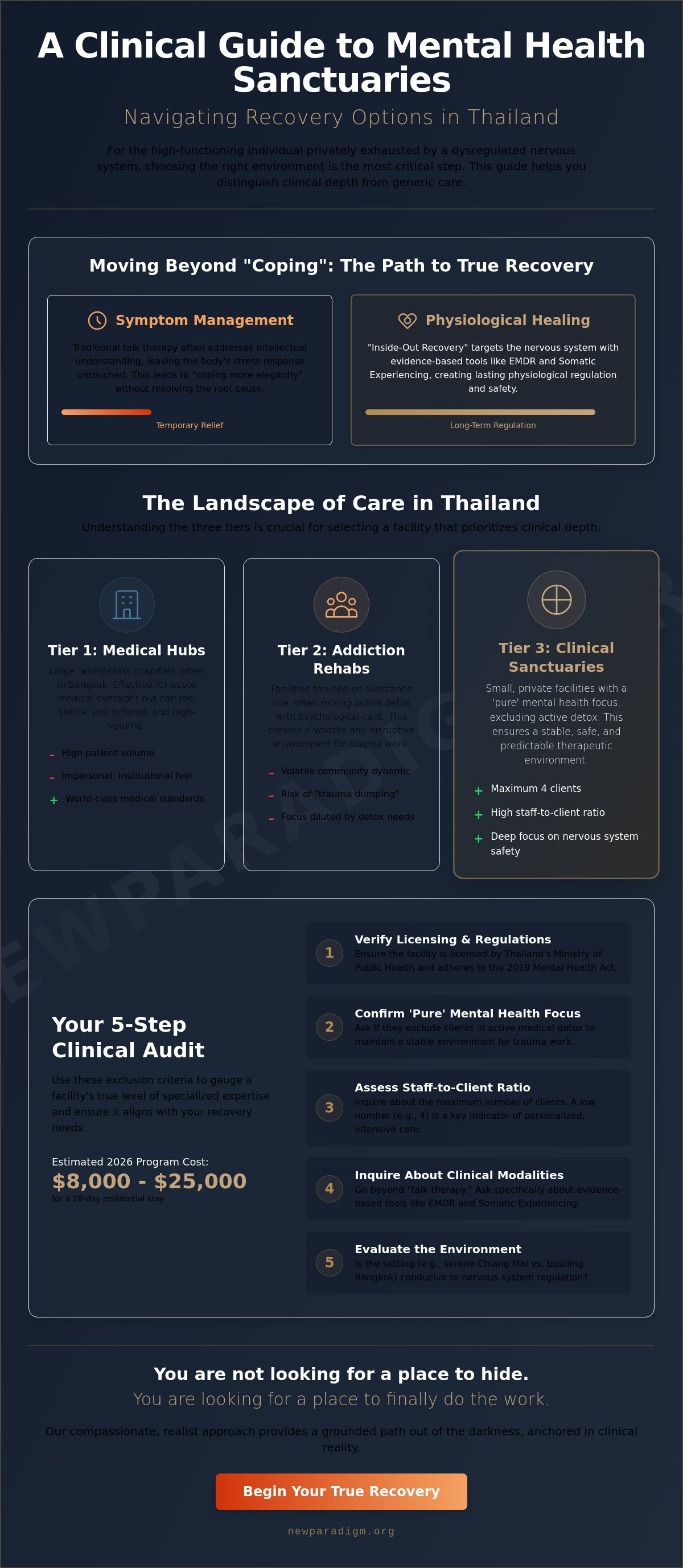
Selecting a mental health facility Thailand isn't about finding the best spa; it's about finding the right clinical fit. When you're high-functioning but privately falling apart, the stakes are too high for a generic wellness retreat. You need a rigorous way to filter through the noise. We recommend a 5-step audit to ensure the facility can actually handle the weight of your experience:
- Team Credentials: Verify specialized certifications like EMDRIA for trauma work.
- Client-to-Staff Ratio: A maximum of four clients ensures you aren't just a number.
- Exclusion Criteria: This is the most honest indicator of quality.
- Aftercare Planning: Recovery doesn't end when you leave the sanctuary.
- Environment: The physical space must support nervous system regulation.
Exclusion criteria are vital. If a facility claims to treat everyone—from active drug detox to general burnout—they likely specialize in nothing. A dedicated focus on mental health ensures the community dynamic remains stable and safe for deep emotional work. This level of specialization is supported by the legal framework of Thailand's Mental Health Act, which establishes the standards for patient rights and clinical oversight. While "cheap" rehabs might seem attractive, they often lack the clinical depth required for complex trauma. You're investing in a path out of the darkness, not just a temporary escape.
Auditing the Clinical Team
Don't be afraid to ask the hard questions. You should know exactly who your primary therapist will be and how many years of experience they have. A founder-led facility with over 25 years of experience provides a level of stability that corporate clinics can't match. Look for advanced degrees in clinical psychology and specific training in evidence-based modalities. In a high-quality mental health facility Thailand, you should have frequent, direct access to senior clinicians, not just junior support staff.
Evaluating the Environment as Medicine
There's a significant difference between seclusion and isolation. A true sanctuary feels like a monastic retreat where nature and spiritual calm work together to lower cortisol levels. High-functioning professionals need uninterrupted time to fall apart safely. This requires a private, secluded setting where the frantic energy of the world cannot reach you. It's about creating a space where you can finally stop performing and start the honest work of recovery. If you're ready to begin this process, book a clinical consultation with our team to see if our environment is the right fit for your healing.
Why Chiang Mai is the Global Sanctuary for Recovery
Chiang Mai feels like the Soul of Thailand. It stands in direct contrast to the frantic energy of Bangkok or the transient crowds of the southern islands. This city offers a specific type of spiritual and energetic calm that complements clinical work in a way few other places can. When you choose a mental health facility Thailand based in the North, you aren't just choosing a location; you're choosing an environment designed for nervous system regulation. The recovery in Chiang Mai is unique because it bridges the gap between sophisticated Western psychology and a local culture rooted in deep mindfulness.
Our approach at New Paradigm is intentionally small. By limiting our intake to a maximum of four clients, we create an environment of total focus and safety. This isn't about exclusivity for its own sake. It's about ensuring that every individual who is privately falling apart receives the uninterrupted clinical attention they deserve. It's time to stop trying to cope more elegantly and start the process of recovering from the inside out.
The Chiang Mai Clinical Advantage
The region has become a magnet for world-class therapists who have relocated here for the quality of life, bringing with them decades of international experience. In the Mae Rim valley, we utilize the natural environment as a clinical adjunct. We integrate practices like forest bathing and traditional massage to support somatic healing. This specific micro-location provides the seclusion necessary for deep trauma work, allowing the body to settle into a state of safety that is rarely achievable in a city-based mental health facility Thailand.
The Path Forward: Admission and Transition
The first 72 hours of residential care are dedicated to stabilization and safety. It's a period of decompression where you can finally stop performing and begin to breathe. As you move through the program, the focus shifts toward building the skills needed for the "real world." Our aftercare programs are designed to bridge the gap between the sanctuary and your daily life, ensuring the progress you make here is sustainable. If you're tired of being high-functioning on paper while feeling unresolved pain every day, we invite you to reach out for a confidential assessment. There is a way back to the light, and it begins with a single, honest conversation.
Begin Your Path to Inside-Out Recovery
You've spent long enough intellectually understanding your pain without actually feeling safe in your body. True healing requires moving beyond the sterile environment of a hospital or the noise of a high-volume rehab. By choosing a dedicated mental health facility Thailand that prioritizes nervous system regulation over mere symptom management, you create the space necessary for deep work. We've explored how a strictly private, small-group setting in Chiang Mai allows for the intensive, evidence-based processing that complex trauma demands.
Our founder-led team brings over 25 years of trauma experience to every session. We limit our intake to a maximum of four clients to ensure your recovery is uninterrupted and entirely personalized. With specialized EMDR Intensive programs, we focus on clearing the emotional debris that keeps you stuck in a loop of exhaustion. You don't have to keep falling apart in private.
Take the first step toward recovery; book a confidential assessment with our clinical team.
There is a practical way through the darkness, and you don't have to walk it alone. We are ready when you are.
Frequently Asked Questions
Is a mental health facility in Thailand as good as one in the US or Europe?
Yes, international standards are the baseline for premium care here. Many lead clinicians hold advanced degrees from Western institutions, bringing those rigorous protocols into a more compassionate, small-scale setting. A mental health facility Thailand offers allows for a level of focused, one-on-one attention that is often impossible in the high-volume medical systems of the US or Europe. It's about depth rather than scale.
Do I need a referral from my doctor to enter a private Thai facility?
You don't need a formal referral from a GP to begin the intake process. Most private clinical sanctuaries perform their own comprehensive assessment to ensure the program is the right fit for your specific trauma or burnout needs. This direct approach allows you to step out of your daily life and into a safe environment without the delays or paperwork of a traditional medical bureaucracy.
Will I be in a group with people struggling with drug addiction?
No, a dedicated mental health facility Thailand maintains strict exclusion criteria for active drug and alcohol detoxification. This keeps the therapeutic space predictable and grounded. When you're recovering from trauma or burnout, you need a stable environment where you aren't exposed to the chaos of early-stage addiction recovery. You'll be with peers who are also high-functioning yet privately falling apart.
How long is the typical stay for burnout or trauma recovery?
A typical residential program lasts 28 days, though complex trauma often requires a longer commitment for deep physiological healing. This timeframe allows for multiple cycles of EMDR and somatic processing, which are necessary to move past intellectual understanding into actual felt safety. Longer stays of 60 to 90 days are common for those needing significant nervous system recalibration after years of unresolved pain.
Can the facility help with my specific medication management?
Licensed facilities work with psychiatrists to manage and review your current medication protocols. While the focus is on evidence-based therapeutic work, clinical oversight ensures your prescriptions are optimized for your recovery. We often collaborate with your home physician to ensure a seamless transition back to your daily life, maintaining the stability and emotional processing you achieved during your residential stay.
What happens if I need to work occasionally while in treatment?
We recognize that total disconnection isn't always possible for high-functioning individuals. While we prioritize uninterrupted time for deep work, we can schedule specific windows for essential professional obligations. However, we'll work with you to ensure these tasks don't trigger the very burnout you're here to heal. The goal is to move beyond the habit of constant performance and toward long-term nervous system regulation.
Article by
Dirk J. Lambert (MSc. - CCTS-I)
Dirk J. Lambert is a Licensed Psychotherapist, Mentor, Author, and Certified Trauma & EMDR Specialist with more than 25 years of experience helping people recover from trauma, depression, burnout, emotional abuse, and long-standing unresolved pain. His work is known for being direct, compassionate, and highly practical.
A twice-ordained Buddhist monk, Dirk bridges clinical trauma care with mindfulness, discipline, self-observation, and deep emotional honesty. He does not hide behind jargon, labels, or unnecessary complexity. He listens carefully, speaks plainly, and works toward meaningful change.
New Paradigm reflects the philosophy he has built over decades: intentionally small, deeply personal, private by design, and focused on what actually helps people recover from the inside out rather than simply cope more elegantly.