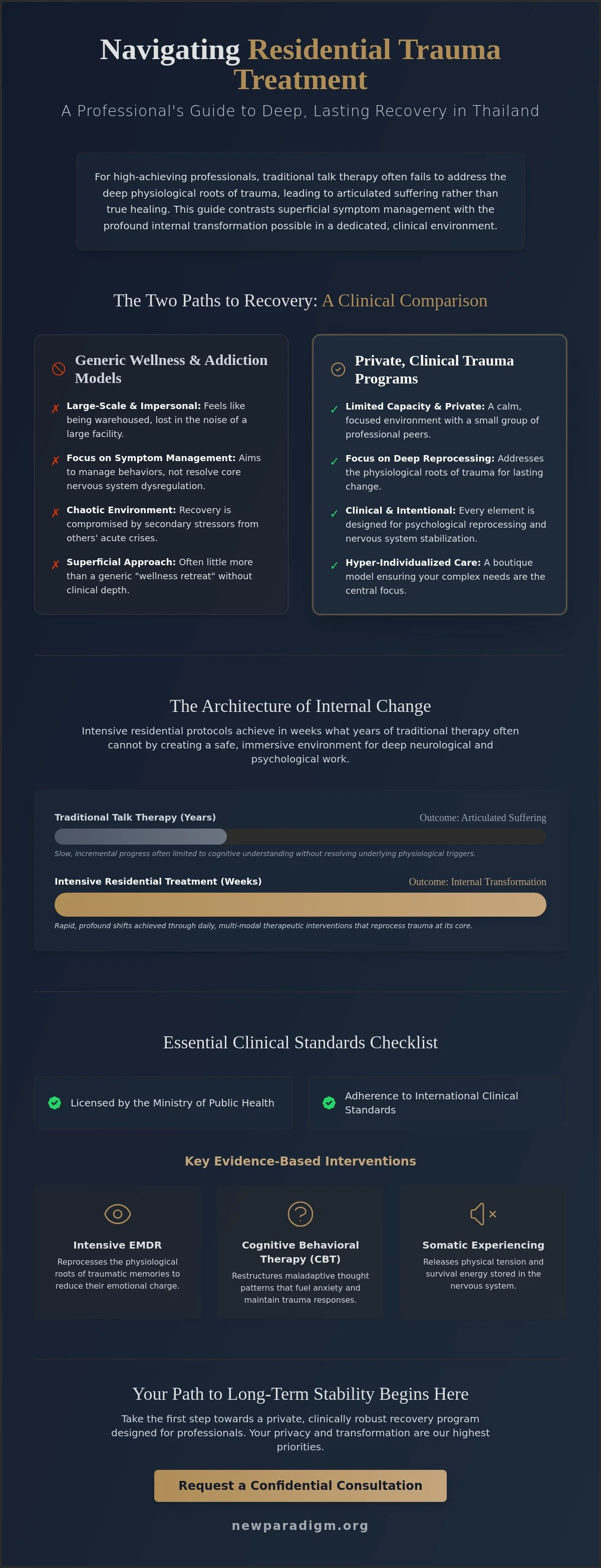
You cannot think your way out of a physiological survival response. For many high-achieving professionals, years of traditional talk therapy have only resulted in a more articulate way to describe their suffering, leaving the underlying nervous system dysregulation untouched. You might present a composed face to the world while living with a quiet, bone-deep exhaustion that refuses to lift. Seeking residential trauma treatment Thailand shouldn't mean being warehoused in a large-scale addiction facility or lost in the noise of a generic wellness retreat. It requires a space that is private, clinical, and profoundly intentional.
It's understandable to feel hesitant about choosing a program when you value privacy and clinical depth above all else. This guide serves as a professional resource to help you navigate the complexities of intensive recovery. You'll learn how to distinguish between superficial symptom management and true internal transformation, ensuring you find a safe, limited-capacity environment for deep psychological reprocessing. We will examine the clinical essentials for long-term stability, from EMDR protocols to the necessity of a focused setting that respects your need for isolation from external noise.
Key Takeaways
- Learn why the clinical landscape of residential trauma treatment Thailand is evolving away from large-scale addiction models toward private, high-intensity mental health stabilization.
- Identify the essential clinical markers of a professional program, including international licensing and the integration of evidence-based tools like EMDR and CBT.
- Understand the science of intensive reprocessing and how daily therapeutic interventions achieve in weeks what years of traditional talk therapy often cannot.
- Streamline your path to recovery with a clear roadmap of the admissions process, covering everything from initial clinical assessments to the logistics of international visas.
The Landscape of Residential Recovery in Thailand for 2026
The global perspective on mental health is shifting. It's no longer enough to just manage symptoms with a weekend getaway or a generic talk therapy session once a week. For those experiencing a profound internal collapse, the search for residential trauma treatment Thailand represents a need for something far more substantial than a holiday. It's about finding a clinical environment where the noise of the world is replaced by the quiet, intentional work of reprocessing. You aren't looking for a distraction from your life; you're looking for a way to return to it with a sense of stability that has been missing for a long time.
Gaining a deeper understanding of trauma and PTSD is often the first step toward realizing that your exhaustion isn't a failure of will; it's a physiological state that requires a specialized setting to resolve. To better understand how a dedicated environment supports this journey, watch this video:
Mental Health Sanctuary vs. Addiction Rehab
A true clinical facility is not a drug rehab. It's not a place where you'll be surrounded by the chaotic energy often found in large-scale addiction centers. When you're a high-functioning professional, you need a Mental Health Facility Thailand that understands your intellectualized pain. Choosing a dedicated program for residential trauma treatment Thailand ensures that your recovery isn't compromised by the secondary stressors often found in generalist facilities. You shouldn't have to navigate others' acute substance crises while trying to stabilize your own nervous system. Instead, recovery happens best among a small group of peers who mirror your own professional and intellectual background, ensuring the environment remains calm and focused.
For professionals who prioritize this high standard of privacy and calm, even outside of a clinical setting, an adults-only sanctuary like Shantara Resort Port Douglas provides a similar level of exclusive tranquility for rest and rejuvenation.
The Evolution of Trauma Care in Chiang Mai
Chiang Mai has emerged as a global hub for specialized care because it offers a rare intersection of high-level clinical expertise and ancient contemplative traditions. With Thailand's medical tourism revenue estimated at over $4 billion annually in 2026, the region has matured into a sophisticated destination for those seeking more than elective procedures. It's a place where evidence-based protocols meet a culture of profound patience. This environment is ideal for Recovery in Chiang Mai, providing the isolation and peace necessary for intensive work. To complement these clinical efforts, many individuals explore holistic tools like the natural tinctures from Mental Compass to support emotional grounding. It isn't a luxury spa stay; it's a protective space designed for those who have reached the limit of what outward success can sustain. This is a grounded, realistic path back to yourself that acknowledges the gravity of your struggle without being consumed by it.
Evaluating Clinical Standards for Trauma Programs
Selecting a facility for residential trauma treatment Thailand requires a discerning eye. It isn't enough to choose based on aesthetics or hospitality. When the internal architecture of your life feels like it's collapsing, you need a clinical foundation that can hold the weight of your recovery. This begins with verifying that a facility is licensed by the Ministry of Public Health and adheres to international standards. You're looking for a professional environment where the staff's expertise is as deep as the suffering you're experiencing.
A robust clinical checklist for trauma should include evidence-based interventions that address both the mind and the body. These include:
- Intensive EMDR sessions to reprocess the physiological roots of traumatic memories.
- Cognitive Behavioral Therapy (CBT) for restructuring maladaptive thought patterns that fuel anxiety.
- Somatic experiencing to release the physical tension and survival energy stored in the nervous system.
In a residential setting, the synergy between psychiatry and psychology is vital. While psychiatry provides the medical oversight necessary for stabilization, psychology offers the deep, relational work required for change. Unlike large-scale facilities where you might feel like just another number, a boutique model for residential trauma treatment Thailand is a clinical necessity. It allows for the hyper-individualized focus that complex trauma demands, ensuring that your specific history is never overlooked.
The Clinical Infrastructure of Excellence
High-functioning individuals often mistake a high price tag for high-quality care. True excellence is found in the staff-to-client ratio. At New Paradigm, the focus remains on depth rather than scale. A trauma-informed environment must prioritize nervous system regulation above all else. This means the physical space and the daily rhythm are intentionally designed to prevent overwhelm; providing the safety needed for deep psychological reprocessing. If you feel ready to discuss a tailored approach to your stabilization, you can reach out to our clinical team for a private consultation.
International Standards in a Thai Context
It's a common misconception that seeking care abroad means compromising on quality. In reality, Thai facilities often exceed Western benchmarks for personalized attention. The WHO Report on Thailand's Mental Health System highlights the country's commitment to evolving its mental health infrastructure. This regulatory rigor ensures that your care is grounded in evidence-based practice. For a more detailed look at these benchmarks, you can explore our guide on Thailand Mental Health Quality.
Intensive Protocols: The Architecture of Internal Change
For the high-achieving individual, the intellect is often both a professional asset and a therapeutic barrier. You may have spent years in talk therapy, expertly analyzing your history while your body remains trapped in a state of hyper-vigilance or collapse. This is intellectualized pain; a condition where you can explain your trauma but cannot escape its physiological grip. True residential trauma treatment Thailand requires moving beyond the limitations of the spoken word to address the nervous system directly. It isn't about learning new ways to describe your fatigue; it's about altering the internal architecture that maintains it.
Effective recovery demands an environment that is steady, patient, and clinically rigorous. It requires a departure from the noise of daily life into a space where the primary focus is the deep, internal work of stabilization. This process involves a deliberate integration of clinical methodology with contemplative somatic practices, ensuring that the mind and body are addressed as a single, functioning unit. For readers seeking to explore how life force energy can complement their journey toward internal balance, you can learn more about Ray Maor and his expertise in pranic living.
Specialized EMDR and Trauma Reprocessing
In a residential setting, the frequency of intervention is a catalyst for change. While outpatient care often struggles to maintain momentum, intensive EMDR therapy sessions allow for daily reprocessing. This high-frequency format prevents the "fragmentation" that occurs when you have to return to a stressful career between weekly appointments. EMDR facilitates the bilateral stimulation of the brain to desensitize and reprocess traumatic memories, effectively rewiring neural pathways that have been locked in a state of hyperarousal. However, this intensity must be balanced with a compassionate groundedness. Without proper clinical containment and somatic support, high-frequency work risks retraumatization. We prioritize a pace that respects your capacity for integration, ensuring that the work is deep but never reckless.
Beyond Coping: Deep Internal Transformation
Most outpatient settings focus on symptom management; teaching you how to survive your anxiety or manage your burnout. Residential care is different. It provides the containment necessary to move toward root cause resolution. By isolating yourself from external triggers, you create the psychological safety required to face the core wounds that talk therapy hasn't touched. This is the difference between learning to live with a burden and finally setting it down. You can learn more about this process in our guide to Residential Trauma Treatment. If you're ready to move beyond managing your pain and begin the work of resolving it, speak with a clinical coordinator today to discuss your path forward.
Practical Resources for Planning Your Recovery
The transition into residential trauma treatment Thailand is more than a geographical move. It is a deliberate shift from a life of high-pressure performance into a protective container designed for stabilization. Planning this journey requires addressing the logistical friction that often prevents high-achieving individuals from seeking help. The process begins with a comprehensive clinical assessment to ensure the program aligns with your specific needs. This isn't a simple registration; it's a professional consultation to establish the foundation for your recovery.
Logistically, Thailand remains one of the world's most accessible hubs for international care. With the country projected to receive an estimated four million medical tourists in 2026, the systems for visas and medical coordination are sophisticated and reliable. You'll find that the administrative path is clear, allowing you to focus entirely on your internal state. During the first 30 days, we emphasize the necessity of isolation from external noise. This isn't about punishment. It's about providing your nervous system the silence it needs to begin reprocessing years of accumulated stress without the constant intrusion of daily triggers.
Preparing for the Journey
When packing for your stay, prioritize comfort over social appearances. You're entering a space for deep psychological work, not a networking event. We often suggest a managed connectivity approach regarding professional obligations. While a total digital detox is ideal, we understand the realities of your career. We help you establish boundaries that protect your clinical hours while ensuring your professional world doesn't collapse in your absence. When discussing your departure with family or colleagues, honesty regarding your need for a medical sabbatical often provides the most direct and respected path. Additionally, resolving logistical concerns like animal care through a trusted provider such as Tails On Trails Pet Resort ensures you can enter treatment without lingering distractions.
Ensuring Long-Term Stability
The intensity of a residential program creates profound change, but that change must be sustained. An Aftercare Program serves as the essential bridge between the sanctuary of treatment and the complexities of daily life. It provides the structure needed to prevent a slide back into old, maladaptive patterns. True recovery isn't a destination; it's a state of stability that requires ongoing, intentional support. If you're ready to begin this transition, you can contact New Paradigm for a confidential clinical assessment and take the first step toward reclaiming your internal peace.
Reclaiming Your Internal Narrative
True recovery is not found in the temporary relief of a wellness retreat or the chaotic environment of a large-scale rehab. It is found in the quiet, focused work of physiological stabilization and neural reprocessing. By prioritizing a clinically-led boutique facility, you ensure that your history is met with the depth and individual focus it requires. You've moved beyond the need for more talk therapy; you are now ready for the intensive architecture of change provided by specialized EMDR and trauma protocols.
Choosing residential trauma treatment Thailand is a commitment to depth over distraction. It's a realization that your hidden exhaustion can be resolved through a strictly limited capacity environment that respects your need for privacy. This is the path toward long-term mental health stability and a return to a life that feels sustainable. If you're ready to move from intellectualized pain to genuine internal peace, begin your journey to recovery with a private assessment at New Paradigm. You don't have to carry the weight of your survival responses alone. A grounded, practical methodology for healing is within your reach.
Frequently Asked Questions
Is residential recovery in Thailand safe for international clients?
Thailand is a global leader in medical tourism, receiving an estimated four million international patients in 2026. Private facilities are strictly regulated and must be licensed by the Ministry of Public Health (MOPH). This clinical oversight, combined with a sophisticated hospitality infrastructure, provides a secure and professional environment for those in crisis. It's a setting that prioritizes your physical safety so you can focus entirely on your internal stabilization.
How is trauma treatment different from standard addiction rehab?
A dedicated program for residential trauma treatment Thailand focuses on nervous system regulation and memory reprocessing rather than substance abstinence. Standard rehabs often cater to large, diverse groups with acute detoxification needs, which can create a chaotic atmosphere. Our clinical focus is on resolving the root causes of psychological pain in a calm, limited-capacity setting that avoids the second-hand trauma often found in addiction-first facilities.
Can I continue to work remotely while in a residential program?
We support a model of managed connectivity that respects your professional obligations without compromising your clinical progress. While we don't recommend a full workload, we help you establish specific boundaries for essential communication. This balance ensures you can stabilize your mental health without the added stress of a total professional disconnect or the anxiety of a career collapse.
What is the typical duration of an intensive trauma program in Thailand?
Most intensive programs require a minimum commitment of 30 days to achieve meaningful stabilization. This timeframe allows for the high-frequency EMDR sessions and somatic work necessary to move beyond superficial coping. Some individuals choose to extend their stay or transition into a structured aftercare program to ensure their new internal architecture remains stable once they return home.
Is language a barrier when seeking mental health care in Chiang Mai?
Language is not a barrier in professional clinical settings. International centers in Chiang Mai operate entirely in English, employing Western-trained clinicians and English-speaking support staff. This ensures that the nuances of your intellectualized pain and the complexity of your professional life are fully understood and addressed during your intensive therapeutic sessions.
How do I know if I need residential care or just a wellness retreat?
A wellness retreat is designed for temporary relaxation, while residential care is a clinical necessity for psychological reprocessing. If you're experiencing bone-deep exhaustion, hyper-vigilance, or pain that talk therapy hasn't touched, a spa stay won't be enough. Residential treatment provides the containment and expert intervention required to resolve the physiological survival responses that a holiday simply cannot reach.
Article by
Dirk J. Lambert (MSc. - CCTS-I)
Dirk J. Lambert is a Licensed Psychotherapist, Mentor, Author, and Certified Trauma & EMDR Specialist with more than 25 years of experience helping people recover from trauma, depression, burnout, emotional abuse, and long-standing unresolved pain. His work is known for being direct, compassionate, and highly practical.
A twice-ordained Buddhist monk, Dirk bridges clinical trauma care with mindfulness, discipline, self-observation, and deep emotional honesty. He does not hide behind jargon, labels, or unnecessary complexity. He listens carefully, speaks plainly, and works toward meaningful change.
New Paradigm reflects the philosophy he has built over decades: intentionally small, deeply personal, private by design, and focused on what actually helps people recover from the inside out rather than simply cope more elegantly.