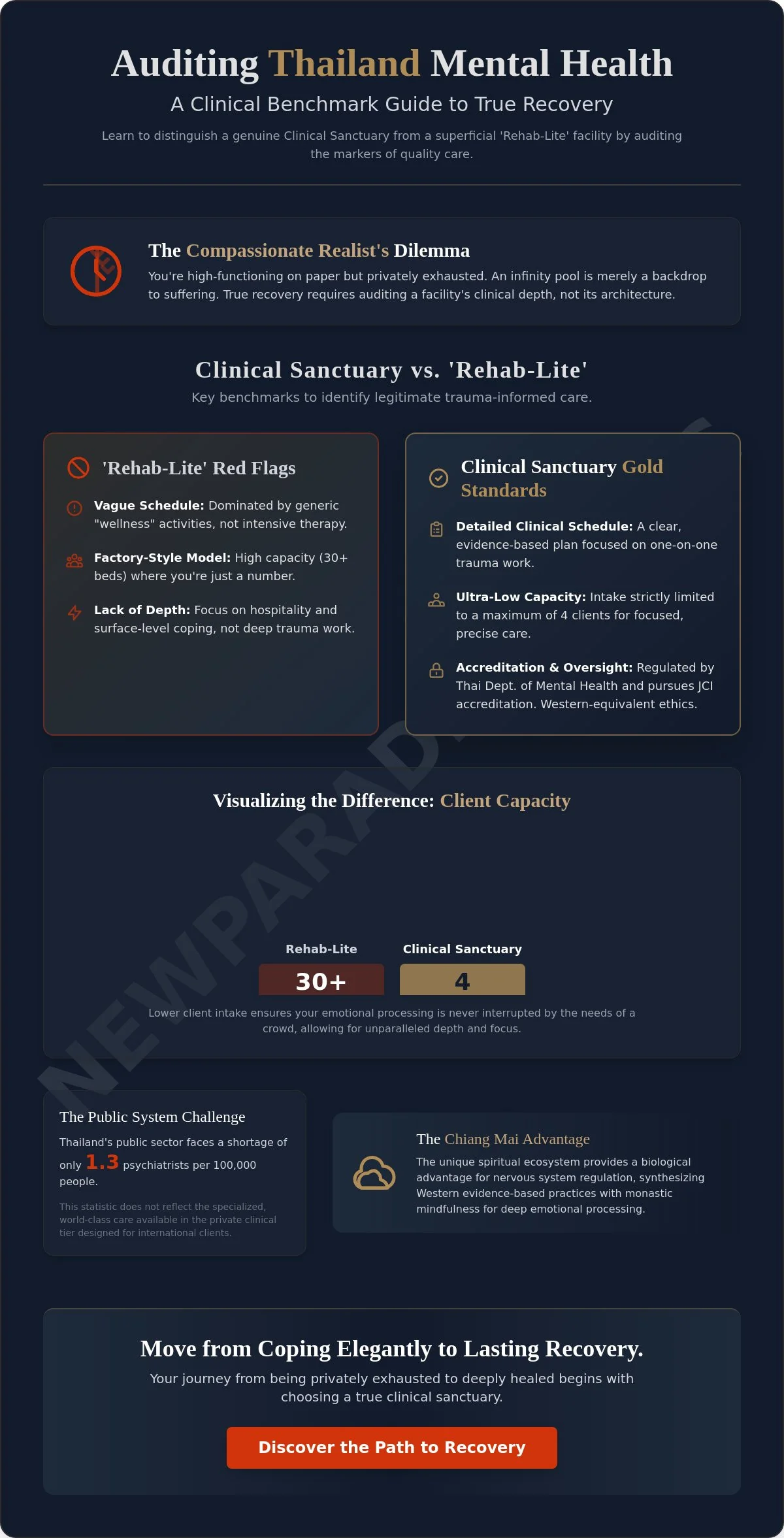
You are likely high-functioning on paper but privately falling apart, and the thought of traveling across the world for a wellness retreat feels dangerously insufficient for the weight of your trauma. It is exhausting to spend years in traditional talk therapy only to realize you are merely coping more elegantly rather than recovering from the inside out. You deserve to know if Thailand mental health quality meets the clinical rigors required for complex nervous system regulation, especially when January 2026 data shows a national shortage of only 1.3 psychiatrists per 100,000 people. This shortage often leaves the public sector overwhelmed, making it vital to distinguish between generic hospitality and specialized clinical care.
We understand the fear that a tropical setting might lack medical depth or professional oversight. This article will help you verify international clinical standards and provide a concrete framework to evaluate Thai facilities for trauma, PTSD, and depression. You'll discover an evidence-based path to recovery that moves beyond the standard $100 per hour talk therapy session toward a model of deep, uninterrupted healing in a private sanctuary. We will explore the latest 2026 medical landscape and the specific markers of a clinical environment that prioritizes depth over scale.
Key Takeaways
- Learn to distinguish between generic wellness retreats and clinical sanctuaries by understanding how Thailand mental health quality integrates Western evidence-based practices with monastic mindfulness.
- Identify the clinical red flags of "rehab-lite" facilities by auditing staff-to-client ratios and prioritizing environments that limit intake to a maximum of four individuals.
- Discover why the unique spiritual ecosystem of Chiang Mai provides a biological advantage for nervous system regulation and deep emotional processing.
- Gain a practical framework for transitioning from being privately exhausted to achieving lasting recovery through structured aftercare and intensive trauma work.
Evaluating Thailand Mental Health Quality: The Public vs. Private Landscape
When you look at the landscape of care, it's easy to be misled by broad national statistics. In April 2026, reports indicate that 13.4 million Thais experience psychiatric disorders, yet 89% of this population did not access formal services in the past year. These figures reflect a public system under immense pressure, but they don't represent the specialized tier of private clinics designed for international clientele. Understanding Mental Health in Thailand requires looking beyond the general treatment gap to see the world-class clinical infrastructure that has emerged in the private sector.
Thailand mental health quality is a synthesis of clinical evidence and monastic calm. It represents a unique evolution in global healthcare where the precision of Western-trained specialists meets the contemplative depth of Eastern philosophy. This isn't just about escaping your life; it's about doing the heavy lifting of emotional processing in a setting that supports nervous system regulation. While the public sector struggles with a ratio of 1.3 psychiatrists per 100,000 people, the private clinical tier bypasses these systemic shortages to offer immediate, intensive intervention.
To better understand the challenges and the context of care in this region, watch this helpful video:
The Infrastructure of Private Clinical Care
Private facilities in Thailand now serve as a global hub for trauma intervention, attracting Western-trained psychologists who seek a more holistic environment than the sterile hospital settings of London or New York. The focus has shifted away from the "luxury rehab" model of the early 2000s toward intensive clinical trauma intervention. These centers operate under the regulatory oversight of the Thai Department of Mental Health and often pursue Joint Commission International (JCI) accreditation. This ensures that the clinical schedule is built on safety, evidence-based protocols, and rigorous medical licensing rather than just hospitality.
Why International Standards Matter for Expats and Travellers
For those who are high-functioning on paper but privately falling apart, a language barrier is a clinical risk. High-quality private care in Thailand ensures English-speaking clinical teams are the standard, not the exception. This guarantees that nuance in emotional processing isn't lost in translation. These facilities uphold Western-equivalent ethics and confidentiality protocols, providing a secure sanctuary where you can address unresolved pain without the fear of systemic exposure. Thailand’s medical tourism heritage provides the psychiatric infrastructure needed to support complex recovery, making it a viable alternative to Western facilities that are often overbooked and understaffed.
Clinical Benchmarks: How to Audit a Mental Health Facility in Thailand
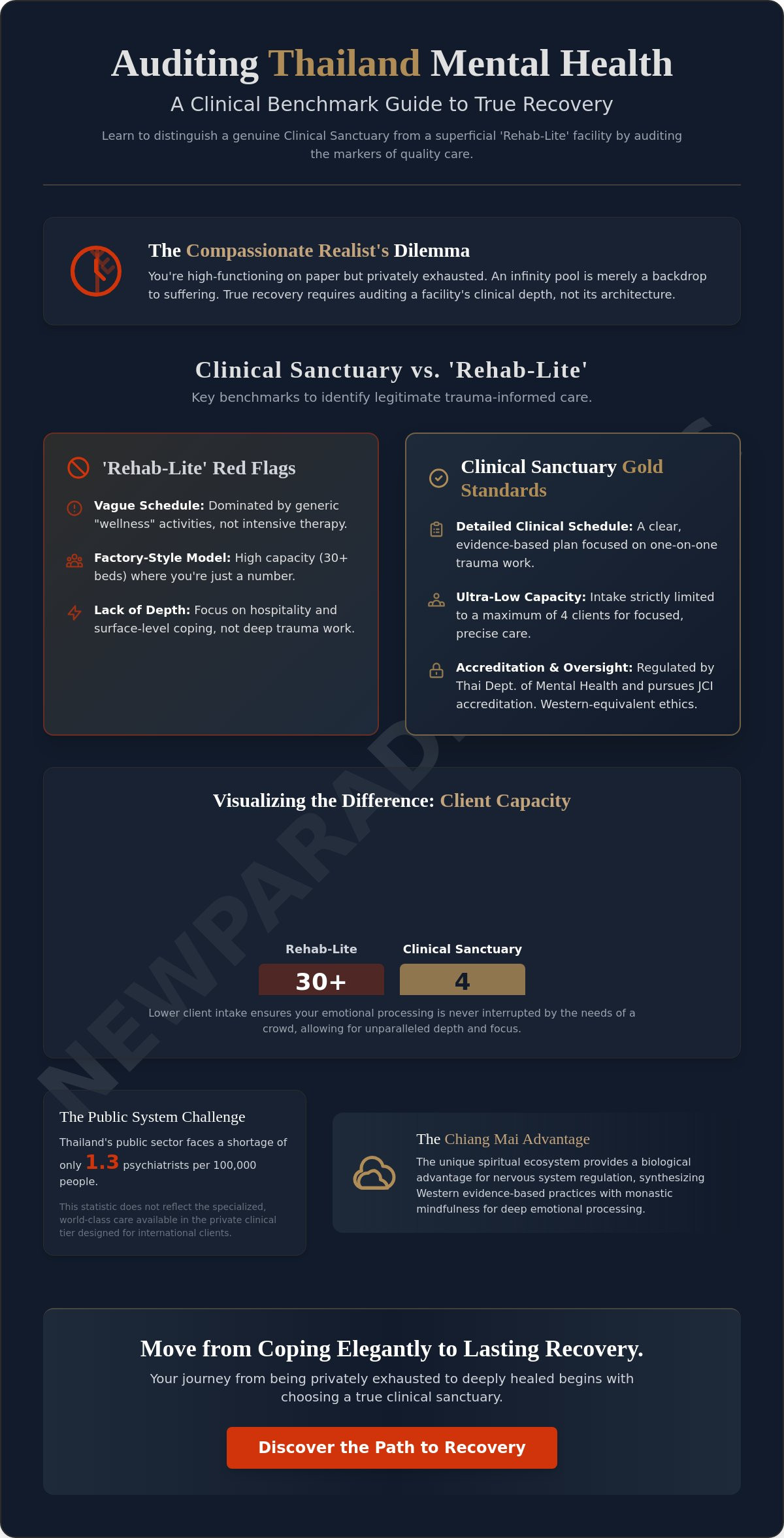
Don't be seduced by the architecture of a facility. When you are privately falling apart and exhausted by the weight of unresolved pain, an infinity pool is merely a backdrop to your suffering. Auditing Thailand mental health quality requires you to look past the marketing fluff and examine the clinical bones of the program. You must adopt the stance of a Compassionate Realist. This means asking for a detailed clinical schedule before you commit. If the day is filled with generic wellness activities rather than intensive, one-on-one trauma work, the facility lacks the depth required for true recovery.
A hallmark of high-quality care is the staff-to-client ratio. In a factory-style rehab with thirty beds, you are just a number. In a true clinical sanctuary, the intake is strictly limited. A maximum of four clients is the gold standard for quality and focus. This small scale ensures that your emotional processing is never interrupted by the needs of a crowd. It allows a multidisciplinary team of psychiatrists, clinical psychologists, and trauma therapists to coordinate your care with surgical precision. According to Thailand's Mental Health Policy, the country has historically navigated significant staffing shortages in the public sector; therefore, verifying that a private facility has a dedicated, full-time clinical team is your primary safety check.
The Evidence-Based Requirement: EMDR and Trauma Care
Clinical quality is defined by the modalities used. Intensive EMDR therapy sessions are the gold standard for processing complex trauma. You should verify that therapists aren't just "trauma-informed" but are fully certified in evidence-based practices like CBT and Somatic Experiencing. There is a vast difference between a wellness activity, which might offer temporary relief, and a clinical intervention designed to rewire the brain's response to trauma. Always ask for the specific credentials and Western-equivalent licensing of the primary clinical team to ensure they meet international standards.
Nervous System Regulation as a Quality Metric
High-quality clinical care focuses on nervous system regulation rather than just symptom management. If a program promises to help you "cope more elegantly," it's a red flag. True recovery happens from the inside out, addressing the root causes of complex PTSD and treatment-resistant depression. This requires somatic healing techniques that help you move past intellectually understanding your pain to actually releasing it from your body. If you are seeking a deeper level of clinical scrutiny, you can request a private clinical assessment to see if a specialized program aligns with your specific recovery needs.
The Chiang Mai Advantage: Why Geography Impacts Recovery Quality
Recovery doesn't happen in a vacuum. While Bangkok serves as the nation's medical center, Chiang Mai has emerged as a specialized healing hub where the environment itself acts as a clinical co-therapist. This northern region offers a specific type of spiritual calm that is essential for nervous system regulation. When you are intellectually understanding your trauma but still feeling its physical grip, the secluded nature of the north provides the uninterrupted space needed to bridge that gap. The Thailand mental health quality found in these foothills isn't just about the scenery; it's about a unique spiritual and clinical ecosystem that supports deep, monastic mindfulness alongside rigorous trauma work. In a 2025 report, 40% of Thais identified stress as the country's primary health concern, and this widespread recognition has fueled the growth of specialized regions designed specifically for profound emotional processing.
Environmental Psychology in Trauma Recovery
A sterile hospital setting often triggers the very hyper-vigilance you are trying to heal. In contrast, a sanctuary environment in the mountains of Northern Thailand allows the brain to shift from survival mode to processing mode. This is the core of Recovery in Chiang Mai: A Clinical Guide. By integrating the quiet discipline of a secluded location with modern clinical interventions, you create a container for recovery that can't be replicated in a crowded urban clinic. This environment supports the heavy lifting of trauma, PTSD, and depression by removing the constant sensory noise of modern life.
Accessing World-Class Care in a Secluded Setting
Seeking care in Mae Rim or the surrounding hills is a strategic choice for those who are high-functioning on paper but privately falling apart. It offers a level of privacy that city facilities simply cannot provide. You aren't just hiding; you are creating a tactical distance from the triggers of your daily life. This seclusion doesn't mean isolation from medical standards. High-tier facilities in this region balance their secluded nature with direct access to Chiang Mai's top psychiatric infrastructure, ensuring that Thailand mental health quality remains consistent across all levels of care. If you're ready to step into a space designed for deep work, inquire about our private Chiang Mai sanctuary.
Choosing Quality: Moving from Burnout to Lasting Recovery
High-functioning individuals often wait until they are privately falling apart before seeking the level of care they truly need. You might believe that your professional success protects you from the weight of your trauma, but by April 2026, data on rising suicide rates among those aged 45 to 59 suggests that intellectualizing your pain is no longer enough. Thailand mental health quality is defined by its ability to provide a definitive exit from this cycle of exhaustion. True recovery is not a temporary reprieve; it's a transition from intensive, secluded work to a structured aftercare program that bridges the gap between the sanctuary and your daily life.
Identifying a facility that offers recovery from the inside out requires a discerning eye. You aren't looking for a vacation from stress, but a fundamental shift in your nervous system regulation. When evaluating your options, use this final checklist to ensure the facility meets international clinical benchmarks:
- Staff: Are the providers Western-trained trauma specialists with a multidisciplinary background?
- Scale: Does the facility intake dozens of people, or do they maintain a strict maximum of four clients?
- Specialty: Is the program built on evidence-based clinical interventions like EMDR and somatic processing?
- Sanctuary: Does the environment provide the uninterrupted peace necessary for deep, emotional work?
The Boutique Advantage at New Paradigm Mental Health Retreat
We intentionally reject the hospital model and the crowded clinic atmosphere. A generic rehab cannot provide the level of intimacy required to address deep, unresolved pain. At New Paradigm Mental Health Retreat, our maximum of four clients ensures that every session is tailored to your specific history of trauma, PTSD, and depression. This boutique approach allows us to blend twenty-five years of clinical expertise with the monastic discipline of mindfulness. It creates a grounded, realistic environment where you can stop trying to cope more elegantly and start actually healing.
Your Path Forward: Beyond Traditional Talk Therapy
If traditional talk therapy has failed you, it's because your trauma is held in your body, not just your thoughts. High-quality residential trauma treatment addresses the physiological roots of your distress. This is the hallmark of premium Thailand mental health quality: the capacity to lead you back to the light through discipline, self-observation, and clinical precision. You don't have to navigate the darkness alone. Reach out for a private consultation with our clinical team and begin the process of reclaiming your life from the inside out.
Reclaiming Your Life from the Inside Out
You don't have to settle for merely coping more elegantly. We've explored how Thailand mental health quality is defined by a rigorous synthesis of clinical trauma care and monastic mindfulness. Whether you are navigating the systemic shortages of the public sector or auditing private facilities for evidence-based benchmarks, the goal remains the same: deep, uninterrupted healing. By prioritizing a maximum of four clients, we ensure that your recovery is the sole focus of a team anchored by 25 years of clinical experience.
It's time to move beyond the exhaustion of being high-functioning on paper while privately falling apart. You deserve a sanctuary that offers specialized EMDR and trauma interventions designed for lasting nervous system regulation. The path out of the darkness is practical, grounded, and available to you right now. Begin your recovery journey with a private clinical consultation. You've carried the weight of unresolved pain long enough; let us lead you back to the light.
Frequently Asked Questions
Is the quality of mental health care in Thailand safe for Westerners?
Yes, the private clinical sector is safe and strictly regulated under the Mental Health Act B.E. 2551, which was updated in 2019. While the public system faces a shortage of 1.3 psychiatrists per 100,000 people, private sanctuaries bypass these systemic bottlenecks. You should verify that a facility is licensed by the Thai Department of Mental Health and adheres to international ethics protocols to ensure your safety during deep emotional processing.
How do Thai mental health facilities compare to those in the UK or USA?
Thai private care often exceeds Western standards by offering a level of intimacy that's no longer sustainable in the UK or USA. While Western systems are frequently crowded or insurance-driven, Thailand mental health quality in the boutique sector focuses on a maximum of four clients. This small scale allows for deeper, uninterrupted work compared to the 28-day factory models common in more expensive Western markets.
What qualifications should I look for in a Thai mental health clinical team?
Look for Western-trained clinical psychologists and trauma specialists with at least 15 to 25 years of experience. A high-quality clinical team must be multidisciplinary, including psychiatrists and experts in nervous system regulation. Always verify their licensing and ensure they are proficient in English to prevent clinical nuance from being lost during your sessions when you are already privately exhausted.
Can I receive evidence-based treatments like EMDR in Thailand?
Yes, evidence-based treatments such as EMDR, CBT, and Somatic Experiencing are the foundations of high-quality trauma care in Thailand. These modalities are essential for those who are falling apart and need more than traditional talk therapy. Ensure the facility provides intensive, one-on-one sessions rather than generic group activities to facilitate true recovery from the inside out rather than just temporary relief.
What is the cost of high-quality mental health care in Thailand?
A single psychotherapy session typically costs between $100 and $200, while a 28-day luxury residential program ranges from $8,000 to $20,000. Online psychiatric consultations with top specialists start at approximately $150 for a 60-minute session. These costs reflect a premium tier of care that provides significantly more clinical contact hours than comparable programs in the US or Europe.
What happens if I need medical detoxification during my stay?
If you require medical detoxification, top-tier clinical sanctuaries coordinate your care with accredited private hospitals to ensure 24/7 medical supervision. Once you're physically stable, you transition back to the private environment for the deep psychological work of recovery. This integrated approach ensures that withdrawal is managed safely before you begin the intensive process of nervous system regulation and trauma processing.

Article by
Dirk J. Lambert (MSc. - CCTS-I)
Dirk J. Lambert is a Licensed Psychotherapist, Mentor, Author, and Certified Trauma & EMDR Specialist with more than 25 years of experience helping people recover from trauma, depression, burnout, emotional abuse, and long-standing unresolved pain. His work is known for being direct, compassionate, and highly practical.
A twice-ordained Buddhist monk, Dirk bridges clinical trauma care with mindfulness, discipline, self-observation, and deep emotional honesty. He does not hide behind jargon, labels, or unnecessary complexity. He listens carefully, speaks plainly, and works toward meaningful change.
New Paradigm reflects the philosophy he has built over decades: intentionally small, deeply personal, private by design, and focused on what actually helps people recover from the inside out rather than simply cope more elegantly.