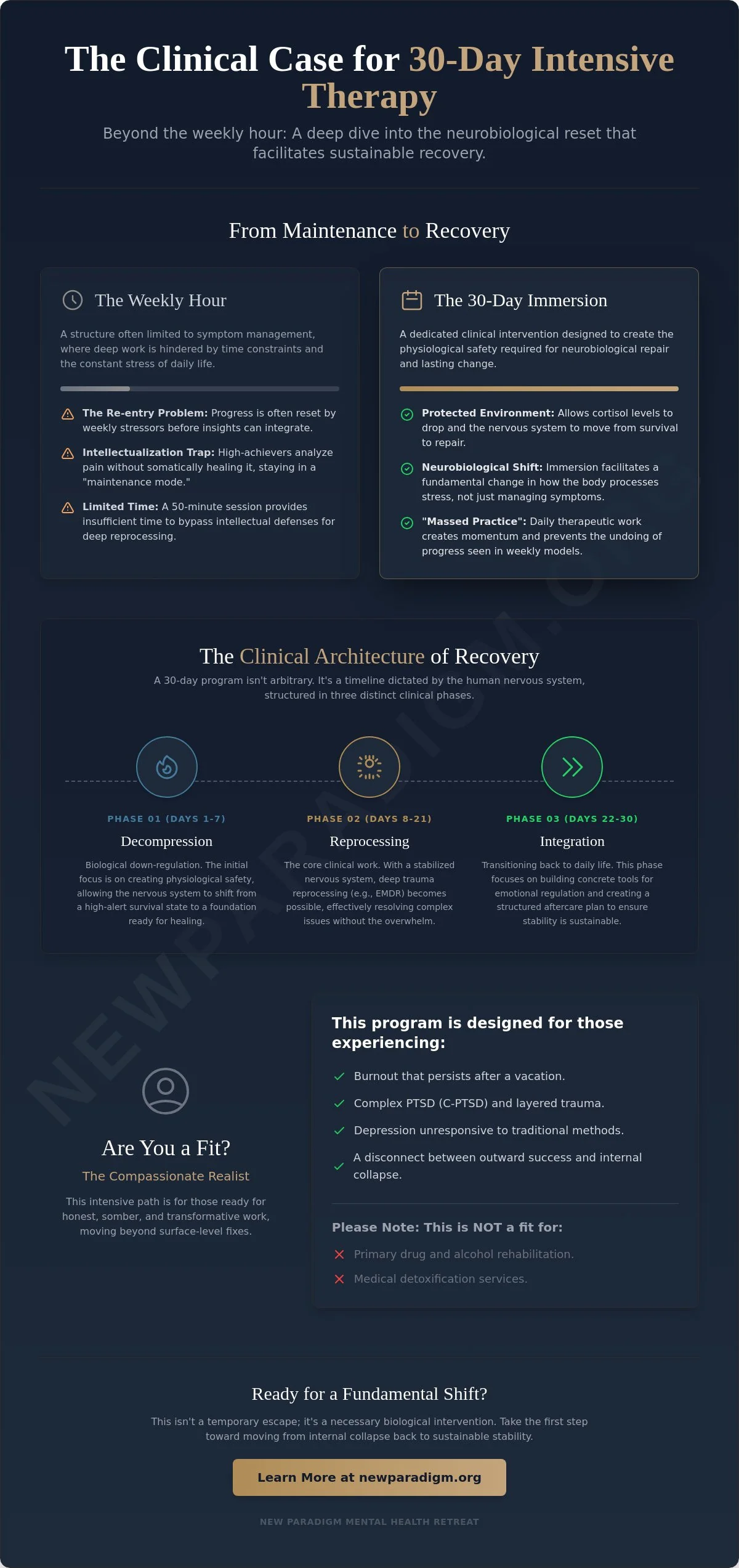
You've built a life that looks exceptional from the outside, yet you're quietly drowning in a fatigue that sleep cannot touch. You've likely spent years in traditional talk therapy, intellectualizing your pain without ever truly feeling safe in your own body. It's a common frustration for those who've mastered the art of the outward mask while their internal world feels increasingly fragile. Many now seek 30-day intensive therapy programs because they realize they aren't failing at therapy; they're simply hitting the clinical limits of what a weekly hour can achieve.
You might wonder if a month is truly enough time to undo decades of layered trauma. The clinical reality is that an intensive is not a temporary escape, but a necessary biological intervention designed to bypass the protective barriers of the mind. By stepping away from the noise of daily life, you allow your brain to move from a state of survival into deep, neurobiological repair. This is about more than just managing symptoms; it's about a fundamental shift in how your body processes stress and recovers its natural equilibrium.
In 2026, with nearly one in four adults facing a diagnosable mental health condition, the need for depth over scale has never been more urgent. This article explores how focused residential work facilitates a neurological reset and provides concrete tools for emotional regulation. We'll examine the evidence-based path that leads from internal collapse back to sustainable stability.
Key Takeaways
- Learn why 30-day intensive therapy programs provide the necessary immersion to move beyond the "maintenance mode" of weekly sessions into active neurobiological recovery.
- Understand the clinical architecture of a residential stay, including how EMDR facilitates the transition from initial decompression to deep trauma reprocessing.
- Discover a framework for evaluating programs based on their clinical depth and commitment to a limited, intentional capacity rather than superficial amenities.
- Identify the essential steps for a successful transition back to daily life, ensuring the stability gained during an intensive program remains sustainable through structured aftercare.
Beyond the Hourly Session: Defining 30-Day Intensive Therapy Programs
You have built a life that looks exceptional from the outside, yet you are quietly navigating a bone-deep exhaustion that sleep cannot touch. This disconnect between outward success and internal collapse is more than just stress. It is a physiological signal that your nervous system is overwhelmed. While traditional therapy offers a helpful space for reflection, 30-day intensive therapy programs are designed for something more profound. They are concentrated clinical interventions focused on deep trauma reprocessing, moving you out of the "maintenance mode" of weekly sessions and into a dedicated "recovery mode."
In a standard 50-minute session, you spend the first twenty minutes just arriving and the last ten minutes bracing for your next meeting. There is rarely enough time to bypass your intellectual defenses. A 30-day window provides the necessary duration for your cortisol levels to drop and your amygdala to stop scanning for threats. It is the industry standard for stabilizing the nervous system, creating the physiological foundation required before any deep trauma work can truly take hold.
To better understand the structure and atmosphere of this level of care, watch this helpful video:
The Limitations of Traditional Talk Therapy
High-achievers often fall into the intellectualization trap. You can explain your history, analyze your triggers, and rationalize your pain, but understanding is not the same as healing. We call this the re-entry problem. In weekly therapy, the immediate stress of daily life resets your nervous system before the session's insights can integrate. Whether you are in a residential setting or an Intensive Outpatient Program (IOP), healing requires a protected environment. You need a space where somatic safety is a constant reality, not a fleeting hour once a week.
Who is a Fit for a 30-Day Intensive?
This path is for the person we describe as a Compassionate Realist. You are ready for honest, somber, and transformative work. This program is designed for those experiencing burnout that persists after a vacation, complex PTSD, or depression that has not responded to traditional methods. It is important to define what this environment is not. We do not provide medical detoxification or drug and alcohol rehab programs. Instead, New Paradigm Mental Health Retreat offers a clinical sanctuary for internal transformation. You are not here to be managed; you are here to be restored.
The Clinical Architecture of the 30-Day Recovery Window
A month is not a length of time chosen for convenience or insurance billing. It is a timeline dictated by the human nervous system. In 30-day intensive therapy programs, the month is divided into three distinct clinical phases: decompression, reprocessing, and integration. This structure acknowledges that you cannot heal a brain that is still in a state of high-alert survival. The first seven days are dedicated to biological down-regulation. You arrive with a nervous system primed for high-stakes performance; this initial phase allows your physiological systems to recognize they are finally in a protected environment.
Once stabilized, the work shifts to reprocessing. This is where "massed practice" becomes a catalyst for change. By engaging in daily therapeutic work rather than fragmented weekly sessions, you prevent the "re-entry" stress of daily life from undoing your progress. This concentrated focus is supported by research into Clinical Issues in Intensive Outpatient Treatment, which emphasizes how immersion can resolve complex trauma more effectively than traditional, spaced-out care. We address the common fear of being overwhelmed through careful clinical titration. We monitor your capacity daily, ensuring the work is challenging but always safe.
The Role of Specialized EMDR Therapy
At the center of this clinical architecture are EMDR therapy sessions. This methodology reprocesses traumatic memories into a functional narrative, stripping away the visceral emotional charge that keeps you stuck in the past. Intensive EMDR allows the brain to move through years of stagnation in a matter of weeks by maintaining the neural state of safety required for reprocessing. It isn't about reliving the pain. It's about moving the memory from the reactive part of the brain to the logical part where it can finally rest.
Somatic Healing and Nervous System Regulation
True recovery requires a "bottom-up" approach. We move beyond simply talking about your exhaustion to identifying where that collapse resides in your body. Isolation from external noise is not a luxury; it's a clinical requirement for neuroplasticity. Without the constant pings of digital obligations and social expectations, your brain can finally forge new, healthier pathways. This integration of contemplative practices with evidence-based psychology ensures that your nervous system reset is both deep and lasting. If you feel ready to step into this intentional space, you can reach out to our clinical team to begin a dialogue about your recovery.
Buying Guide: How to Evaluate 30-Day Intensive Programs
Choosing between 30-day intensive therapy programs can feel overwhelming when you are already navigating a state of internal collapse. You aren't looking for a temporary escape or a distraction; you are looking for a way back to yourself. It is essential to look past the aesthetic appeal of a facility and focus on its clinical architecture. A program shouldn't be judged by the quality of its amenities, but by its ability to facilitate deep neurobiological change. If a facility prioritizes leisure over clinical intervention, it's likely a wellness retreat rather than a treatment center.
A true intensive is not a general leisure spa stay. It is a somber and focused environment designed for difficult, transformative work. You need to know that the practitioners across the table have the expertise to hold your story with both clinical authority and deep, compassionate humanity. Before committing your time and resources, you must verify the depth of the program's methodology and its commitment to individualized care.
Clinical Depth vs. Wellness Retreats
There is a fundamental difference between "coping skills" and "root-cause resolution." Many programs offer tools to help you manage your symptoms, which merely keeps you in a state of high-functioning distress. A clinical intensive focuses on the neurobiological roots of your trauma. When evaluating a program, use this checklist to ensure it meets the standard for a Residential Trauma Treatment Program:
- Does the program have licensed clinical staff with specialized training in trauma and EMDR?
- Are there daily 1-1 sessions, or is the schedule dominated by large group activities?
- Is there a structured aftercare plan to help you integrate your progress back into your daily life?
The Importance of a Private, Supportive Environment
Large, institutional facilities often feel cold and impersonal, which can be counterproductive for trauma recovery. A "boutique" setting with a strictly limited capacity-ideally fewer than 10 clients-is a clinical necessity. This intentional scale ensures that your treatment plan is not a template, but a bespoke map of your specific needs. It provides a sense of safety that is impossible to achieve in a crowded environment.
Sometimes, healing requires you to "leave the scene of the crime." Geographic distance from your daily triggers creates the psychological buffer needed for neuroplasticity to occur. The New Paradigm Mental Health Retreat facility in Chiang Mai provides the spiritual calm and isolation from external noise required for this work. It balances international clinical standards with the local tranquility of northern Thailand, offering a premium, protective atmosphere for your recovery. If you are ready to prioritize clinical depth over superficial comfort, speak with our admissions team today to explore your options.
Sustainable Recovery: Integrating the Intensive Experience
The most common fear isn't the work itself, but the return to the environment that facilitated the initial collapse. You wonder if the peace you found in 30-day intensive therapy programs will evaporate the moment you step back into the demands of your professional life. It is a valid concern. Real healing isn't about finding a temporary bubble of safety. It's about building a foundation that can withstand the weight of your reality. We don't view the end of a residential stay as the completion of your journey; it is simply the point where the focus shifts from stabilization to integration.
A 30-day intensive provides the structural integrity for your recovery, but it is not the entire building. Think of it as the deep architectural work that allows the rest of your life to be reconstructed. By prioritizing a gradual transition, you ensure that the neurobiological progress made in isolation translates into sustainable stability. The goal is to move you from a state of being protected by a facility to being protected by your own internal boundaries and regulation tools.
Moving from Residential to Outpatient Care
The transition from 24/7 clinical support to the complexity of daily life requires a bridge, not a jump. This is why moving into an Outpatient Treatment Program or utilizing a structured Aftercare Program is a vital safety net. Relapse prevention is not a reactive hope; it's a proactive strategy. You'll move from the immersive environment of the intensive into a phase of remote therapeutic guidance. This allows you to test your new regulation tools in real-time while still having a secure line back to your clinical team. It ensures that when the old noise returns, you have a professional mirror to help you navigate it.
Building a Life After Intensive Therapy
For high-achievers, professional re-entry is often the most significant trigger for old patterns of exhaustion. You cannot simply return to the same pace and expect different results. Integration involves setting rigid boundaries around your time and energy that didn't exist before. It means maintaining the contemplative practices and somatic awareness you developed during your stay. You aren't returning as the person who left. You are returning as someone who finally has the internal resources to discern between true obligations and the performative pressure of the mask. If you are ready to begin this journey, explore our 30-day residential trauma treatment options to see how we can help you build a life that is as healthy on the inside as it looks on the outside.
Reclaiming Your Internal Narrative
You have likely spent years managing a hidden exhaustion that intellectualizing your pain hasn't fixed. As we have explored throughout this guide, true recovery isn't found in a weekly hour or a superficial wellness retreat. It is found in the dedicated, clinical architecture of 30-day intensive therapy programs. By prioritizing a biological reset and somatic safety, you can finally move from a state of internal collapse to sustainable stability. This work is somber and demanding; however, it's the only path that addresses the neurobiological root of your suffering.
New Paradigm Mental Health Retreat is a clinical facility founded by mental health professionals who understand that depth cannot be scaled. Our specialized EMDR and somatic trauma modalities are delivered within an environment of extremely limited capacity. This intentional focus ensures your recovery isn't a template, but a focused and personal intervention designed for your specific nervous system. Begin your recovery journey with New Paradigm Mental Health Retreat today. You don't have to maintain the mask of success any longer. There is a grounded, evidence-based path back to yourself.
Frequently Asked Questions
Is 30 days enough time to treat long-term trauma?
Thirty days is a clinical window designed to facilitate a neurological reset rather than a total resolution of all life's complexities. By utilizing 30-day intensive therapy programs, you move through the critical phases of decompression and reprocessing that often take years in weekly sessions. It is the time required to stabilize the nervous system and build a functional narrative for your trauma, providing the essential foundation for long-term integration.
What is the difference between a 30-day intensive and a standard rehab?
The primary distinction lies in the clinical focus and the intentional environment. We are not a drug and alcohol rehab program, nor do we offer medical detoxification. While standard rehabs often focus on behavioral sobriety, an intensive therapy program targets the neurobiological roots of trauma, depression, and burnout. It is a personal environment for deep internal work rather than a large-scale institutional setting for addiction management.
Will I be able to work or use my phone during the 30-day program?
Isolation from external noise is a clinical requirement for neuroplasticity and deep recovery. While we understand the pressures of your professional life, constant digital connectivity prevents the nervous system from down-regulating. We facilitate a structured approach to communication that allows for essential contact while prioritizing the mental space needed for your recovery. This is not a general leisure stay; it is a dedicated time for internal transformation.
Does a 30-day intensive therapy program include family sessions?
Family involvement is integrated into the later stages of the program to support sustainable stability. We recognize that your internal shifts will inevitably impact your personal ecosystem. A 30-day intensive therapy program often includes structured sessions to help your loved ones understand your recovery process and to establish healthy boundaries. This ensures that the progress you make in our protected environment is supported when you return home.
What happens if I need more than 30 days of treatment?
If clinical assessment suggests a need for continued support, we transition you into our Outpatient Treatment Program or a structured Aftercare Program. Healing is rarely linear, and some individuals require a longer bridge between residential care and full re-entry. Our goal is to ensure you never feel abandoned during the integration phase. We work with you to determine the most effective path from stabilization to long-term resilience.
How do I know if I am "sick enough" for a residential intensive program?
You don't need to reach a point of total functional failure to deserve deep clinical support. If you are exhausted from maintaining an outward mask of success while feeling internally stuck or burnt out, you are an appropriate candidate. Many of our clients are high-achievers whose somatic symptoms of burnout and intellectualized pain have become unsustainable. If your internal world feels fragile despite your external accomplishments, you are ready for this work.

Article by
Dirk J. Lambert (MSc. - CCTS-I)
Dirk J. Lambert is a Licensed Psychotherapist, Mentor, Author, and Certified Trauma & EMDR Specialist with more than 25 years of experience helping people recover from trauma, depression, burnout, emotional abuse, and long-standing unresolved pain. His work is known for being direct, compassionate, and highly practical.
A twice-ordained Buddhist monk, Dirk bridges clinical trauma care with mindfulness, discipline, self-observation, and deep emotional honesty. He does not hide behind jargon, labels, or unnecessary complexity. He listens carefully, speaks plainly, and works toward meaningful change.
New Paradigm reflects the philosophy he has built over decades: intentionally small, deeply personal, private by design, and focused on what actually helps people recover from the inside out rather than simply cope more elegantly.