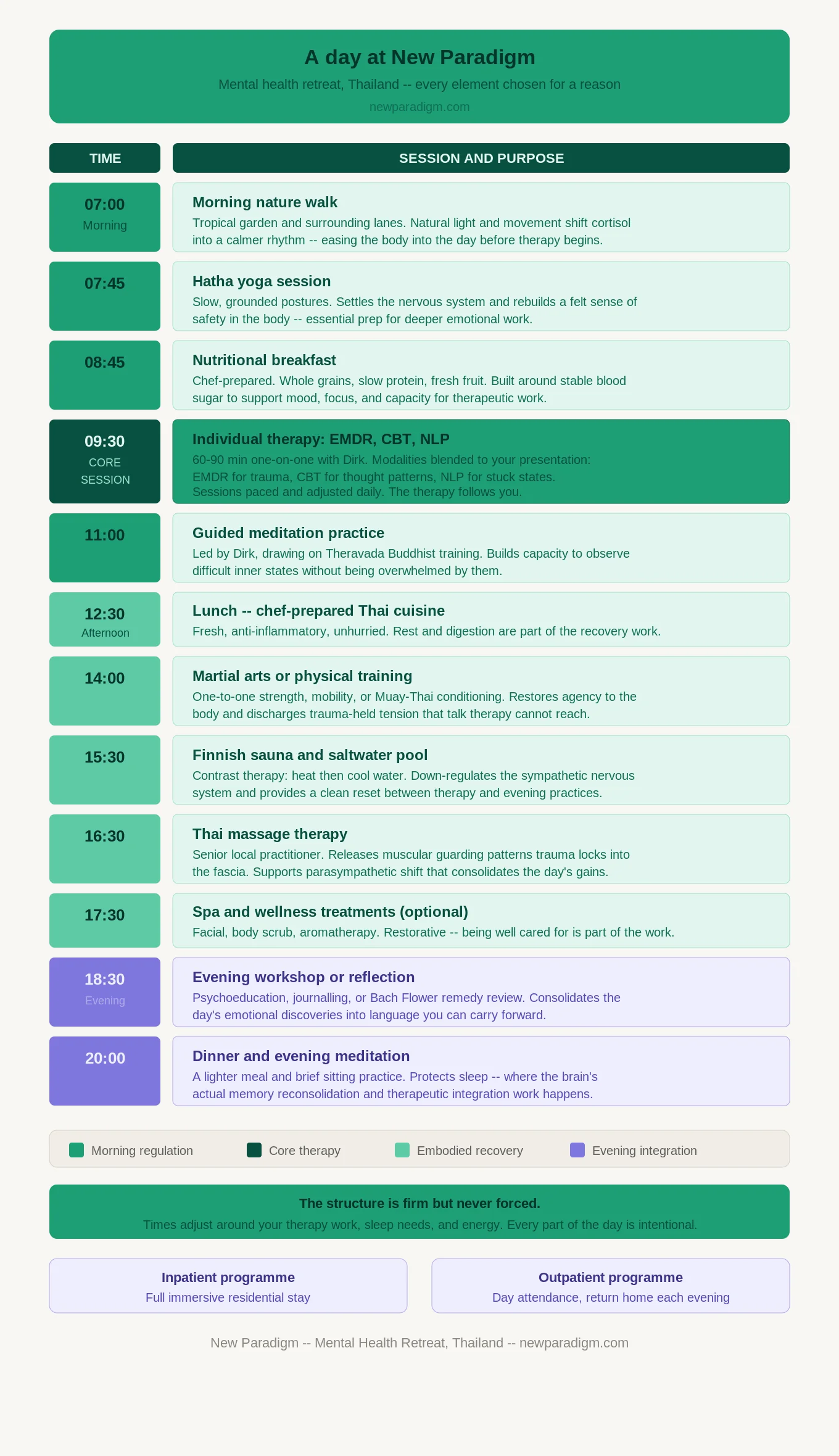
Most people do not know what to picture. You have decided you want to go -- or you are seriously considering it -- but when you try to imagine what the days actually look like, you draw a blank. Is it like being in a clinic? Will you be in group therapy all day? Will you have any time to yourself? The uncertainty is one of the main things that stops people from taking the step. So let us walk through what a day at New Paradigm actually looks like -- in real, specific terms.
The structure is firm but never forced. Times are indicative -- we adjust around your therapy work, sleep needs, and energy. What stays constant is the rhythm: nervous-system regulation in the morning, deep therapeutic work mid-day, embodied recovery in the afternoon, and a contemplative close to the evening. Every part of the day is intentional. Nothing is filler.
07:00 -- Morning Nature Walk
The day begins gently. A walk through the tropical garden and surrounding lanes -- daylight, movement, quiet conversation if you want it. This is not just a pleasant start to the morning. Exposure to natural light and gentle physical movement shifts cortisol into a calmer rhythm, easing the body out of the stress state that sleep can sometimes leave behind. By the time you return, you are ready -- physiologically, not just mentally -- for what comes next.
07:45 -- Hatha Yoga Session
Slow, grounded postures with a focus on breath and proprioception. The goal here is not flexibility or fitness -- it is settling the nervous system and rebuilding a felt sense of safety in the body. For people carrying trauma or depression, the body is often experienced as unsafe or numb. This practice begins to change that, gently and without pressure. It is essential preparation for the deeper emotional work that follows.
08:45 -- Nutritional Breakfast
Chef-prepared and built around stable blood sugar -- whole grains, slow protein, fresh fruit, no added sugars. This is not incidental. What you eat affects your mood, your concentration, and your capacity to do difficult work. Dietary preferences, intolerances, and allergies are all accommodated. Breakfast is also a moment to land -- to come into the day, connect with the environment, and let the morning practices settle before therapy begins.
09:30 -- Individual Therapy: EMDR, CBT, and NLP
This is the core of the day. A 60 to 90 minute one-on-one session with Dirk, New Paradigm's lead therapist, drawing on whichever modalities best fit what you are working on.
EMDR (Eye Movement Desensitisation and Reprocessing) is used for trauma reprocessing -- helping the brain update memories and beliefs that became stuck in moments of overwhelming experience. CBT (Cognitive Behavioural Therapy) addresses the thought patterns driving depression, anxiety, or self-defeating behaviour. NLP (Neuro-Linguistic Programming) works with stuck states -- the internal representations and language patterns that keep people locked in the same loops regardless of how much they consciously want to change.
Sessions are paced and adjusted daily as the work unfolds. You are not on a fixed script. The therapy follows you.
11:00 -- Guided Meditation Practice
A sitting practice led personally by Dirk, drawing on his Theravada Buddhist training. This is not relaxation meditation -- it is something more precise than that. The practice builds the capacity to observe difficult inner states without being overwhelmed by them. To notice anxiety without becoming it. To feel grief without collapsing into it. This is one of the most transferable skills the retreat gives you, and it continues to pay back long after you leave.
12:30 -- Lunch
Fresh, anti-inflammatory cooking inflected by local Thai produce. The pace is unhurried on purpose. Digestion, rest, and easy conversation are part of the recovery work, not interruptions to it. The nervous system needs space between intensive therapeutic sessions to begin integrating what has been accessed. Lunch provides that space.
14:00 -- Martial Arts or Physical Training
One-to-one conditioning with a trainer -- strength work, mobility, or Muay-Thai-inspired training, depending on your fitness level and what you need. This is not about physical performance. It is about restoring agency to the body. Trauma held in the body as tension, as frozenness, as disconnection -- movement at this level discharges it in a way that talk alone cannot reach. It also rebuilds the physical confidence that depression and chronic stress quietly erode over time.
15:30 -- Finnish Sauna and Saltwater Pool
Contrast therapy: heat followed by cool water. This is not a luxury add-on -- it is a deliberate physiological intervention. The contrast down-regulates the sympathetic nervous system, supports cardiovascular recovery, and provides a clean reset between the day's therapeutic work and the evening practices ahead. It also feels extraordinary, which matters. Being well cared for is itself part of the process.
16:30 -- Thai Massage Therapy
Traditional Thai bodywork from a senior local practitioner. Trauma typically locks muscular guarding patterns into the fascia -- areas of chronic holding that have long since become invisible, simply part of how the body feels. Skilled bodywork releases this in a way that supports the parasympathetic shift that consolidates the day's gains. After a day of therapeutic work, this is where the body begins to settle what the mind has been processing.
17:30 -- Spa and Wellness Treatments (optional)
On selected days, additional treatments are available at extra cost -- facials, body scrubs, aromatherapy. These are restorative rather than therapeutic in the clinical sense. But rest, comfort, and being genuinely well cared for are themselves part of the work. You cannot do sustained inner work from a place of depletion. These treatments support the recovery that makes continued work possible.
18:30 -- Evening Workshop or Reflection
A short structured session to close the therapeutic day. This might be psychoeducation about what surfaced in today's sessions, journalling around insights that emerged, or a Bach Flower remedy review. The purpose is consolidation -- taking what has been emotionally accessed and beginning to put it into language, into a framework you can carry forward. The insights you access in therapy sessions can be fragile. This practice helps make them durable.
20:00 -- Dinner and Evening Meditation
A lighter evening meal followed by a brief sitting practice. The day closes with the same calm tone it began with. This is deliberate -- protecting the quality of sleep, which is where the brain's actual memory reconsolidation work happens. The therapeutic shifts accessed during the day are processed and integrated during sleep. A settled, unrushed close to the evening is not a soft choice. It is clinically informed.
What Changes Over the Days
The first day or two are often about orientation -- getting used to the rhythm, the environment, the quality of attention. There can be a strangeness to being somewhere that is simply designed around your wellbeing, with nowhere to rush to and nothing to perform. That strangeness passes.
By day three or four something usually shifts. The defences soften. The therapeutic work starts going somewhere that weekly outpatient sessions rarely reach -- because the conditions are finally right. Something that has been stuck for a long time begins to move.
By the end of the programme, most people describe a sense of clarity they did not have before. Not that everything is resolved -- that would be an unrealistic promise. But a different relationship to whatever they came in with. New tools. A felt sense that change is genuinely possible -- because they have already experienced it.
After You Leave
What happens after the retreat matters as much as what happens during it. The insights and shifts you have accessed need support as you return to ordinary life -- with its pressures, its familiar triggers, its old patterns waiting. New Paradigm does not simply wave you off at the end of the programme. There is a clear plan for what comes next: ongoing therapy, check-ins, and the continuation of practices you found useful. The retreat is a beginning, not a conclusion.
Ready to See What Your Days Could Look Like?
New Paradigm offers both inpatient and outpatient programmes in a carefully designed therapeutic environment in Thailand. Every element of the day -- from the morning nature walk to the evening meditation -- is chosen for a reason. If you have been wondering what it would actually feel like to have a full day structured entirely around your healing, we are happy to walk you through it.