You have been looking at retreats online for weeks. Some promise detox and facials. Others mention EMDR and trauma therapy. A few seem to offer both, and you cannot quite tell where the wellness holiday ends and the actual treatment begins. If you have ever closed a tab more confused than when you opened it, you are not alone. The spa versus mental health retreat question is one of the most common things people get stuck on -- and it matters more than most people realise.
Because choosing the wrong one is not just a waste of money. It can actually leave you feeling worse. You go expecting to do real work, you get a massage and some herbal tea, and you come home having scratched the surface of nothing. Or you go expecting relaxation and find yourself in group therapy sessions that you were not prepared for.
So let us be clear about what each actually is, what each actually does, and how to know which one you need.
What a Spa Is -- and What It Is Not
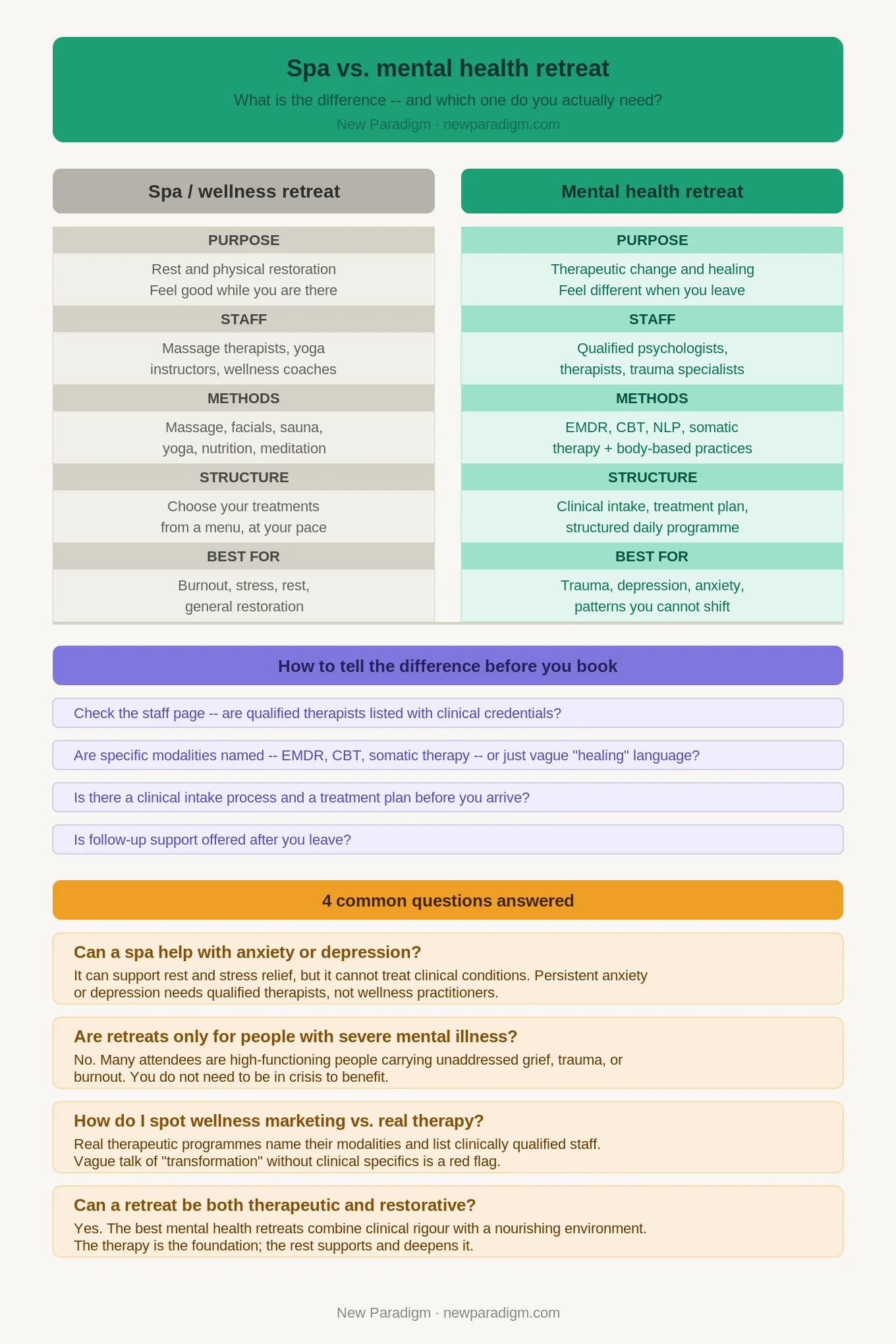
A spa, even a very good one, is designed to help you relax. That is its purpose. Treatments are typically centred around the body: massages, facials, hydrotherapy, saunas, beauty treatments. Some higher-end wellness spas will add meditation classes, yoga, nutrition workshops, or sleep coaching to the menu. These are genuinely beneficial things. Rest matters. Being in a beautiful environment matters. Taking time away from your phone and your to-do list matters.
But a spa is not a therapeutic environment. The staff are trained in wellness and hospitality, not clinical psychology. There is no diagnosis, no treatment plan, no therapeutic framework guiding what happens to you. The goal is for you to feel good while you are there -- and ideally to leave feeling refreshed.
That is entirely legitimate. If what you need is rest and restoration, a spa can deliver that. But if you are carrying something heavier -- unprocessed grief, a trauma history, depression that has been following you for years, anxiety that has become the background noise of your entire life -- a spa is not equipped to help with that. It was never designed to be.
What a Mental Health Retreat Actually Is
A mental health retreat is a therapeutic environment that happens to also care about your physical wellbeing. The distinction is important. At a quality mental health retreat, the clinical programme is the core of what you are doing. Everything else -- the yoga, the ice baths, the nature walks, the meditation -- supports and reinforces the therapeutic work, rather than being the main event.
That therapeutic work is delivered by qualified clinicians: psychologists, psychotherapists, trauma specialists. The modalities they use are evidence-based: EMDR for trauma processing, CBT to identify and shift thought patterns, NLP to work with how the mind encodes experience, somatic approaches to address what the body is holding. These are not interchangeable with massage or a sound bath. They require clinical training, ethical frameworks, and an ongoing relationship with what is happening inside you.
A mental health retreat also tends to have structure that a spa does not. Your days are organised around your therapeutic process. There is intention behind the sequence of activities. A morning ice bath is not just a wellness trend -- it is a deliberate practice for building nervous system resilience, which supports the deeper processing work happening in sessions. The yoga class is not filling time between treatments -- it is helping you re-inhabit your body, which is often where trauma and depression live.
The Overlap -- and Why It Is Confusing
The reason the distinction gets blurry is that good mental health retreats often look beautiful. They are set in peaceful environments. They include movement and body-based practices. They might have a pool. The photography on their websites can look almost identical to a luxury wellness resort.
And some spas have started incorporating therapy-adjacent language into their marketing -- "transformational", "healing", "mind-body reset" -- without the clinical substance to back it up. This is not malicious; it reflects a genuine cultural shift toward recognising that mental and physical health are connected. But it can make it hard to tell what you are actually paying for.
The clearest way to tell the difference: look at the staff page. If there are qualified therapists with clinical credentials listed -- psychologists, trauma-trained counsellors, EMDR practitioners -- you are looking at a therapeutic programme. If the team is made up exclusively of massage therapists, yoga instructors, and wellness coaches, you are looking at a spa, regardless of how the website describes itself.
Which One Do You Actually Need?
This is the question worth sitting with honestly.
If you are feeling burnt out, overstretched, or in need of physical restoration -- if the main thing you want is to sleep well, eat well, move your body, and come home feeling more like yourself -- a good spa or wellness retreat will serve you well.
If you are dealing with trauma -- whether recent or long-standing -- depression, anxiety, grief that has not resolved, relationship patterns you cannot seem to change, or a pervasive sense that something is not right even when life looks fine on the outside -- you need a therapeutic environment. You need people who are trained to work with what you are carrying, not just to make you comfortable while you carry it.
The honest truth is that for a lot of people who end up at a spa looking for something deeper, they already know on some level that they need more. The retreat is easier to justify because it sounds less clinical. There is still stigma around attending what feels like a treatment centre, even a holistic one. But the cost of that hesitation is real: another year of managing something that could have been worked on, processed, released.
What a Hybrid Approach Looks Like Done Well
The best mental health retreats do not feel like hospital wards. They are thoughtfully designed environments where clinical rigour and genuine care for the whole person coexist. The therapeutic work is central, but it is held within a programme that also nourishes the body, creates community, builds resilience, and leaves you with practices you can sustain.
At New Paradigm, the approach is built precisely on this integration. EMDR, CBT, and NLP are the clinical backbone. Yoga, meditation, ice baths, and martial arts are the practices that support and extend that work in the body and the nervous system. Workshops create context and community. The environment is designed to feel safe and human, not institutional.
The difference between this and a spa is not aesthetic -- it might look similar in some ways. The difference is intention, expertise, and outcome. One helps you rest. The other helps you change.
A Few Practical Things to Check Before You Book
Before committing to any programme -- whether it calls itself a spa, a wellness retreat, or a mental health retreat -- ask these questions. What are the clinical qualifications of the staff? What specific therapeutic modalities are used? What does a typical day actually look like? Is there a clinical intake process before you arrive? Is there follow-up support after you leave?
A programme with genuine therapeutic depth will answer all of these clearly. One that deflects, speaks only in generalities, or cannot name a single evidence-based treatment modality is telling you something important about what you will actually get.
You deserve to know what you are choosing before you choose it.
The Bottom Line
Spas are for rest. Mental health retreats are for change. Both have value, and neither should be dismissed. But they are not the same thing, and treating them as interchangeable can mean spending significant time and money on the wrong intervention.
If you are reading this and already sensing that what you need goes beyond rest -- trust that. The clarity you are looking for, the shift you have been hoping for, the understanding of why certain patterns keep repeating -- these things are possible. They just require the right environment and the right support to access them.
Ready to Do More Than Rest?
At New Paradigm, we offer both inpatient and outpatient programmes designed around real therapeutic work. Our team of qualified clinicians uses EMDR, CBT, and NLP alongside yoga, meditation, ice baths, martial arts, and therapeutic workshops -- because lasting change happens when the mind and body are treated together.
If you are unsure whether a retreat is right for you, or what kind of programme fits what you are carrying, we are happy to talk it through. No pressure, no commitment -- just an honest conversation.