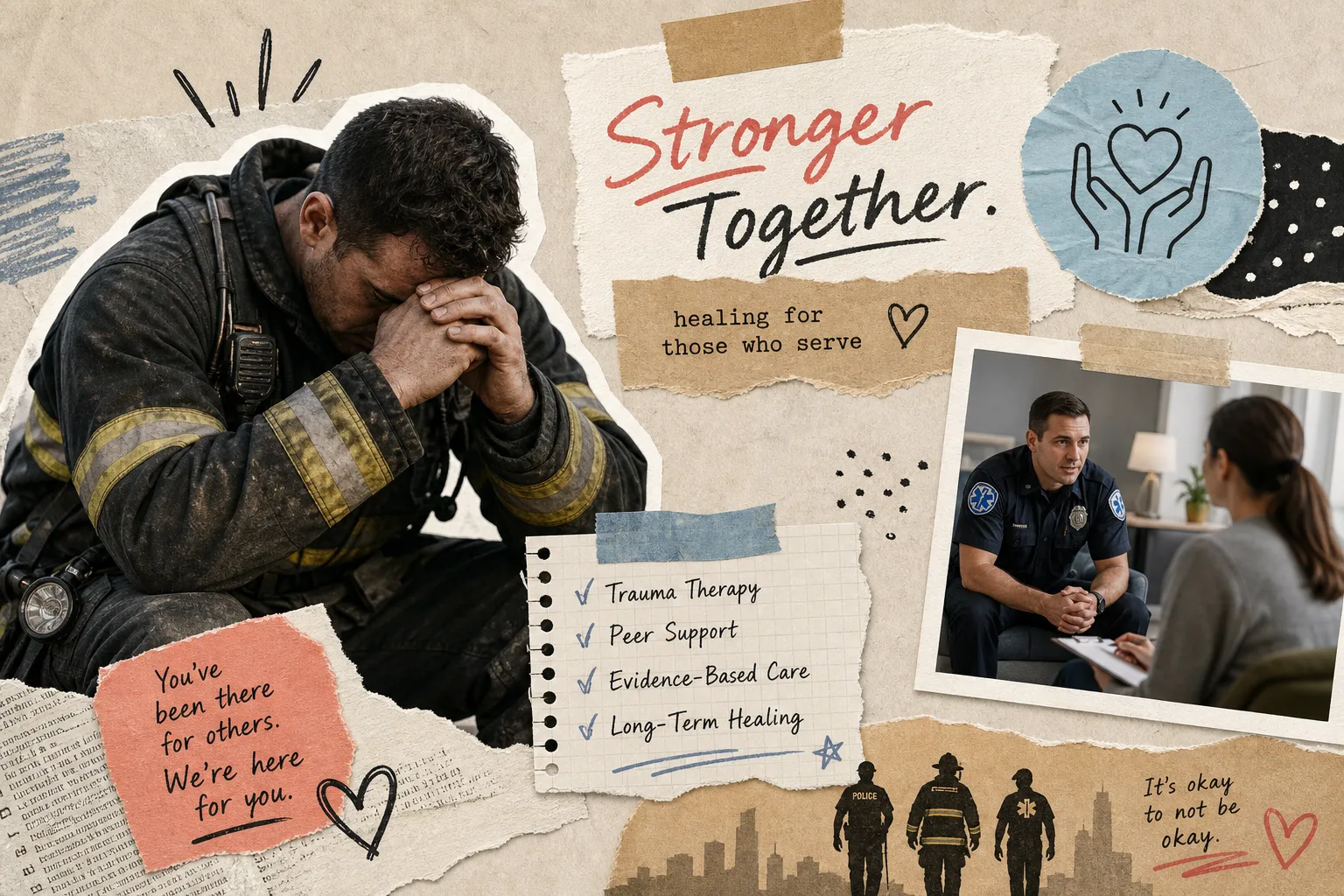
First responders don't experience one traumatic event and then move on. They experience dozens, sometimes hundreds, across a career, and they do it within a professional culture that treats distress as a liability. By the time a police officer, paramedic, or firefighter is sitting across from a clinician, they've usually spent years managing what the research now recognises as a distinct clinical condition: occupational cumulative trauma that doesn't respond the same way as single-incident PTSD. At New Paradigm, we work regularly with people who've spent a career being strong for everyone else, and have nothing left by the time they reach us. Finding the right trauma treatment programme isn't about convenience. It's about clinical fit, genuine privacy, and therapeutic depth that matches what they're actually carrying.
Approximately 10% of Australian police officers, paramedics, and firefighters meet criteria for probable PTSD at any given point in their career, with lifetime risk for police reaching closer to 20%. For those with more than ten years of service, the rate is six times higher than for those just starting out. These figures sit well above the 4, 5% prevalence in the general population, and they don't capture the larger group experiencing significant subsyndromal symptoms who are quietly struggling without a diagnosis. The best trauma treatment programmes designed specifically for first responders have to start from that clinical reality.
Why first responder trauma is clinically different from ordinary PTSD
Occupational trauma in emergency services isn't a single event that can be located on a timeline. It's a cumulative load built across shift after shift, compounded by a professional identity that demands the appearance of coping at all times. This creates a treatment picture that is meaningfully more complex than post-incident PTSD in the general population, and it matters enormously for how trauma treatment programmes are designed and delivered.
What hypervigilance looks like when it won't switch off
In operational contexts, hypervigilance is adaptive. It keeps people alive on the job. The problem is that the autonomic nervous system doesn't clock off when the shift ends. After years of sustained threat-scanning, persistent hyperarousal and difficulty returning to baseline become common, a pattern well-documented in the clinical literature on occupational trauma. First responders often don't recognise this as a symptom until it's destroying their sleep, making intimate relationships feel impossibly tense, or causing a person to startle at sounds in their own home. By that point, the nervous system has been running in a heightened state for so long that it can feel like a permanent personality trait rather than a treatable condition.
Moral injury and cumulative grief: the wounds no debrief addresses
Moral injury is clinically distinct from fear-based PTSD. Where PTSD is driven by threat, moral injury is driven by guilt, shame, and a collapse of meaning. That collapse takes many forms: the child who couldn't be saved, the decision made under pressure that went wrong, the system that failed someone in their care. These experiences violate the moral framework that drew many first responders to the job in the first place. Cumulative grief compounds this. Emergency workers lose colleagues, witnesses, and patients without any cultural mechanism for formal mourning. Peer debriefs serve a genuine function, but they are not the same as clinical treatment, and they were never designed to be.
How occupational trauma differs in treatment complexity
Co-occurring alcohol misuse, depression, and relationship breakdown are common in this population, not incidental. They are often the visible consequences of unprocessed trauma. Effective treatment has to address these alongside the core traumatic material, not after it, because they are rarely separate problems. Research on integrated dual-diagnosis approaches consistently demonstrates better outcomes when mental health and substance use are treated concurrently rather than sequentially. A programme that treats the PTSD and defers the alcohol misuse to "phase two" will struggle to hold its gains.
Where peer support and standard group programmes fall short
Peer support programmes embedded in organisations like NSW Police or Fire and Rescue play an important preventive role. Connection, normalisation, and lived experience are clinically valuable, particularly in the early stages of distress. But peer support is not trauma-focused treatment. It does not involve structured reprocessing of traumatic memory with a trained clinician, and it was never intended to replace that process. The distinction matters: based on clinical observation, many first responders who access peer support believe they've received formal treatment when they've received something valuable but categorically different.
The confidentiality problem with employer-provided care
Research consistently identifies confidentiality as one of the most significant barriers to treatment-seeking among Australian first responders. The fear is not irrational: many workers are concerned that engaging with employer-linked mental health services will affect their duties, appear on WorkCover records, or be visible to supervisors. Only one in five first responders seeks help, and confidentiality concerns are a documented part of why. The perception of surveillance, whether or not it reflects reality, is enough to keep people from engaging with care that is genuinely effective.
Why group therapy alone doesn't go far enough for complex trauma
Day programmes like the STAIR programme at St John of God Langmore Centre in Berwick, designed exclusively for first responders and ADF personnel, serve a real and meaningful clinical function. But for first responders carrying complex or chronic trauma, Australian guidelines from Phoenix Australia and the Black Dog Institute are clear: trauma-focused cognitive behavioural therapy (TF-CBT) and EMDR are first-line treatments, and these modalities are designed to be delivered one-to-one. Group programmes support connection and skill-building. They are not a clinical substitute for individual trauma reprocessing, and the strongest trauma treatment programmes for first responders reflect that distinction in how they structure care.
Evidence-based therapies that work for emergency services personnel
Australian clinical guidelines, including those from Phoenix Australia and the Black Dog Institute, are unambiguous about first-line treatment for PTSD in emergency workers: trauma-focused cognitive behavioural therapy (TF-CBT) or Eye Movement Desensitisation and Reprocessing (EMDR). Both are strongly recommended. Non-trauma-focused approaches, including relaxation techniques and supportive counselling, are explicitly not recommended as primary treatments for PTSD. This matters because supportive counselling is, in practice, what many first responders end up receiving when they do access care.
EMDR and trauma-focused CBT as first-line treatments
EMDR works by facilitating the reprocessing of traumatic memories through bilateral stimulation, typically eye movements, while the person holds the traumatic material in mind. It does not require the same kind of verbal narration as traditional talk therapy, a characteristic that clinicians often find resonates with operational personnel who find "talking about it" an unappealing prospect. TF-CBT variants, including Prolonged Exposure and Cognitive Processing Therapy, work through structured exposure and cognitive restructuring of trauma-related beliefs. Both approaches have outcome data supporting significant reductions in PTSD severity, depression, and functional impairment. Studies in occupational trauma populations show remission rates of 67, 84% with EMDR at follow-up periods of up to 15 months, though results vary across occupational groups and individual studies; clinicians should interpret these figures in the context of the specific populations studied rather than as a uniform benchmark.
What Australian clinical guidelines actually recommend
Guidelines recommend a minimum of 8 to 12 sessions of 60 to 90 minutes each, with additional sessions for severe presentations or multiple trauma exposures. Treatment is typically outpatient-first, with inpatient care reserved for severe comorbid diagnoses, significant risk, or lack of social support. Medication is not a first-line replacement for trauma-focused therapy. It may be considered as an adjunct, particularly where comorbid depression or substance misuse is present, but it does not address the underlying traumatic material.
Best trauma treatment programmes designed specifically for first responders in Australia
Several structured options now exist across formats, though availability varies significantly by location and presentation severity. The landscape spans residential and intensive inpatient programmes, specialist outpatient services, and telehealth pathways, each suited to different presentations and practical circumstances.
Residential and intensive day programme options
South Coast Private offers a three-week Phase One inpatient programme focused on trauma symptom stabilisation, with a Phase Two hybrid model incorporating individual EMDR and group Cognitive Processing Therapy. The Banyans in Brisbane offers private residential care from one to two weeks, with one-on-one therapy and medical review. In Western Australia, the WA Centre for Trauma Treatment and Research (WCTTR) in Nedlands provides a four-week intensive group programme with psychiatrist oversight, running Monday to Friday. St John of God Langmore in Berwick, Melbourne, operates both an inpatient unit, with typical admissions of 16 to 18 nights, and the separate STAIR day programme, which is designed exclusively for first responders and ADF personnel. Prospective clients should confirm current programme structures directly with each provider, as formats and admission criteria can change.
Telehealth and outpatient pathways across Australia
The Black Dog Institute's First Responders Programme offers up to 12 free sessions with a clinical psychologist, available in-person or via telehealth, with referral pathways to the UNSW Traumatic Stress Clinic for more complex presentations. This is the lowest-barrier clinical starting point for many first responders. Myrtle Practice provides specialist first responder trauma treatment with in-person clinics in the Illawarra and Southern Highlands, and national telehealth access. MindSpot's PTSD Course offers a free eight-week online option with optional therapist support, which suits those not yet ready for face-to-face engagement.
Navigating WorkCover, DVA and private health funding
Workers' compensation provisional liability arrangements exist across all Australian states and territories, though implementation varies by jurisdiction, timeframes for acceptance, opt-in conditions, and presumptive pathway provisions differ between Victoria, New South Wales, Queensland, and other states. In general, provisional liability covers reasonable medical and therapy costs in the initial period after a claim is lodged, allowing treatment to begin without waiting for formal determination. Individuals should confirm the specific provisions in their state with their employer, union, or a workers' compensation adviser. DVA provides mental health care for veterans and current ADF personnel. Private inpatient admission at facilities like St John of God Langmore requires Gold-tier private health insurance. For those who have not yet lodged a claim, a GP referral under a Mental Health Care Plan provides access to Medicare-subsidised psychology sessions as a starting point.
What the best trauma treatment programmes for first responders actually include
Knowing what's available is one thing. Knowing what to look for is another. The strongest first responder trauma treatment programmes share several non-negotiable features that separate genuine clinical depth from a programme that looks good on paper.
One-to-one clinical contact as the clinical standard
Australian guidelines and clinical consensus generally favour individual trauma-focused reprocessing for complex occupational PTSD, particularly for EMDR and TF-CBT, which are one-to-one modalities by design. This isn't a criticism of group programmes; it's a reflection of what the evidence supports for trauma reprocessing specifically. A programme that delivers only group contact for the core treatment component is not delivering what Australian guidelines recommend as first-line care. The best trauma treatment programmes designed for first responders build one-to-one clinical sessions as the foundation, with group work in a supporting role.
Treating the whole picture, not just the headline diagnosis
Co-occurring depression, alcohol misuse, and sleep disruption are not separate problems to be addressed after the PTSD is "done." They are part of the same clinical picture, and they rarely resolve in isolation from the underlying trauma. The best programmes integrate treatment for comorbidities from the outset, with clinicians who are experienced in working with complex, multi-layered presentations rather than clean single diagnoses. First responders with 15 years of accumulated occupational trauma are not straightforward clinical cases, and they deserve programmes designed to match that reality.
When complete privacy and clinical intensity need to come first
For some first responders, the Australian system, despite its genuine strengths, is not accessible in any meaningful sense. Senior officers, those with public profiles, people in small regional services where anonymity is impossible: for these individuals, the fear of career consequence is not a barrier to be reasoned away. It is a clinical constraint that shapes what treatment they can honestly engage with.
The career risk that keeps first responders from seeking help
Around 33% of Australian first responders cite concerns about confidentiality and career impact as reasons for not seeking help. For those in senior roles or specialist units where fitness-for-duty standards are closely monitored, the calculation is real. The option to step entirely outside the domestic system, away from WorkCover records, employer health units, and insurer involvement, is not avoidance. For some, it is the only pathway that allows them to engage with treatment honestly and without self-censorship.
What a fully private, intensive retreat option offers
New Paradigm's private residential retreat in Chiang Mai, Thailand, offers exactly this kind of environment. With a maximum of four clients at any time, a 4:1 staff-to-client ratio, and one-to-one EMDR and CBT delivered daily by clinicians with extensive specialist trauma experience, it provides clinical intensity and confidentiality that is difficult to find within the domestic system. There is no employer contact, no insurer involvement, and no public record. For first responders who cannot afford to be seen seeking help, that privacy is not a luxury, it is a clinical necessity. A free confidential evaluation is available before any commitment is made, allowing people to understand whether intensive residential treatment is the right fit for their situation without any obligation.
The decision that takes courage
The programmes that serve this population best are those that match the clinical complexity of occupational trauma with real therapeutic depth, and that take confidentiality seriously as a clinical condition rather than an administrative courtesy. That means individual trauma-focused therapy, integrated comorbidity treatment, clinicians who understand operational culture, and privacy structures that hold. These are the hallmarks of trauma treatment programmes designed specifically for first responders, not adapted from general mental health models, but built around the realities of this work.
There is no single right entry point. For some, the starting step is a conversation with a GP about a Mental Health Care Plan and a referral to the Black Dog Institute's First Responders Programme. For others, it's a telehealth session with Myrtle Practice, or a call to a private residential programme for a confidential assessment. The entry point matters less than the decision to take it.
First responders spend their careers running toward crisis on behalf of everyone else. Getting to a place where they can ask for help, and then act on it, is not weakness. It is the hardest and most important thing many of them will ever do. Start with what feels safest, and go from there.