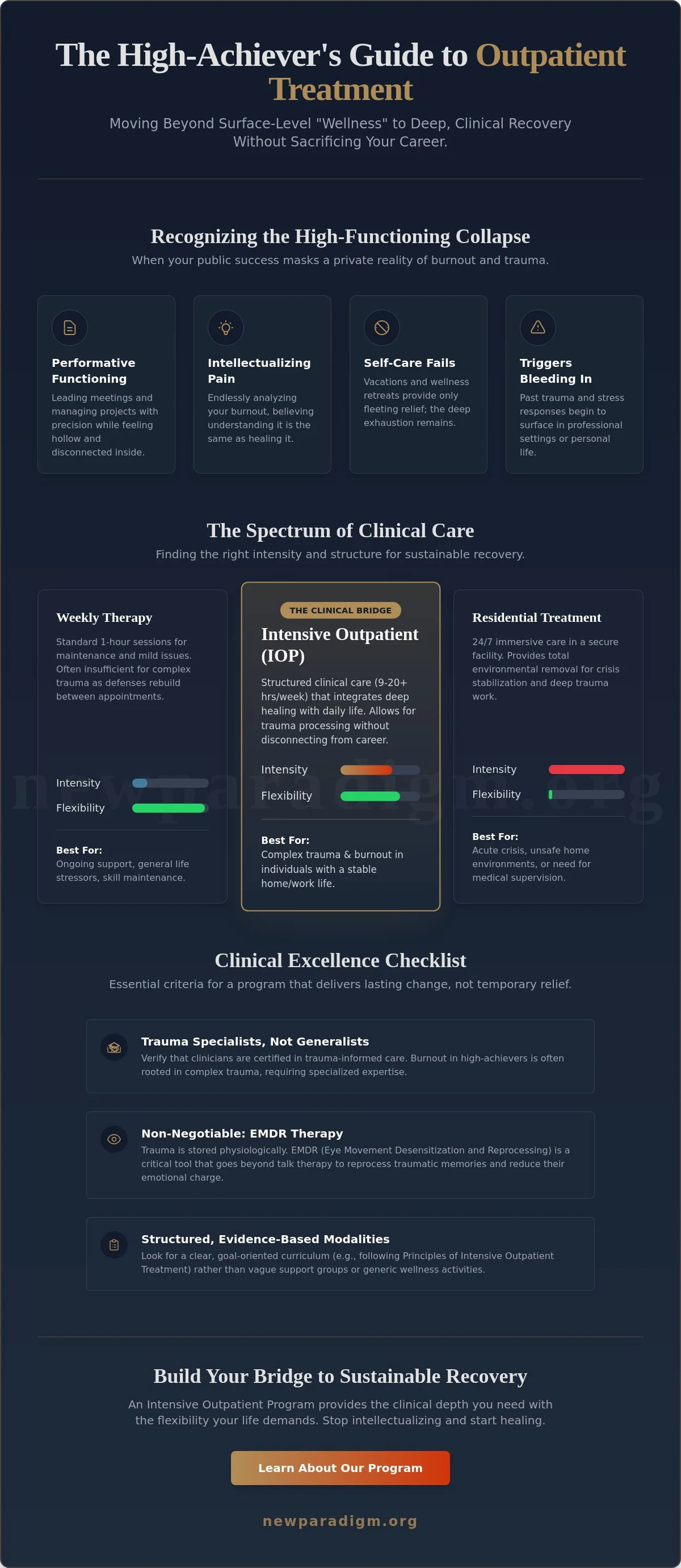
The "wellness retreat" you booked isn't failing because you aren't trying hard enough; it's failing because a weekend of yoga cannot repair a nervous system shattered by years of high-stakes trauma. You've likely spent months intellectualizing your pain, convincing yourself that if you can just understand the burnout, you can manage it. Yet, the hidden exhaustion remains, and the fear of losing your professional momentum keeps you tethered to the very environment that is draining you.
Selecting an outpatient treatment program in 2026 requires a shift in perspective. It's not about finding a "lite" version of care. It's about finding a clinical bridge that integrates deep, internal transformation into your actual existence. You don't have to choose between your career and your sanity. This guide will show you how to evaluate a program that provides a rigorous clinical framework, including access to specialized tools like EMDR, while protecting your daily life.
We'll examine the essential criteria for clinical excellence, the difference between standard care and intensive recovery, and how the latest mental health parity regulations ensure your path to long-term stability is fully supported.
Key Takeaways
- Recognize why high-achievers often intellectualize their pain and how to identify the specific signals of internal collapse that require clinical intervention.
- Evaluate the credentials and evidence-based tools of an outpatient treatment program to ensure you aren't just receiving general counseling.
- Map out the daily rhythm of high-intensity recovery to see how it bridges the gap between acute crisis and a sustainable return to your professional life.
- Explore how a change in environment provides the necessary isolation from noise to foster deep, internal transformation and long-term stability.
Identifying the Need: How to Know if an Outpatient Treatment Program Fits Your Recovery
For many high-achievers, the distance between their public reputation and their private reality is a widening chasm. You may lead a team, close deals, or manage a household with precision, yet you feel as though you are observing your life from behind a thick pane of glass. This is the hallmark of the high-functioning collapse. An outpatient treatment program is not a series of casual appointments; it is a structured clinical intervention designed to address this specific internal disintegration without requiring you to vanish from your world entirely.
This model often takes the form of an Intensive Outpatient Program (IOP), providing a level of care that moves beyond the limitations of the traditional therapy hour. Traditional weekly talk therapy often fails when dealing with complex trauma and professional burnout. It allows too much time between sessions for old defenses to rebuild. You spend forty minutes catching up and only ten minutes touching the wound. By the time you reach the core of the pain, the hour is up, and you are forced to go back to your desk while still emotionally raw. The outpatient model serves as a vital clinical bridge, connecting the immediate need for crisis stabilization with the long-term goal of sustainable, grounded living.
To better understand how these clinical levels of care differ, watch this helpful overview:
Signs You Require More Than Weekly Therapy
Your burnout isn't a problem that a two-week vacation can resolve. If you find yourself performatively functioning while feeling utterly hollow inside, you've moved beyond the reach of standard self-care. Persistent symptoms that ignore your attempts at rest are biological signals. When trauma triggers begin to bleed into your board meetings or your evening conversations, it's a sign that your nervous system can no longer regulate itself without intensive, professional support, such as that offered by Awaken Counselling Centre.
Outpatient vs. Residential: Making the Clinical Choice
Choosing between levels of care depends on your current environment. If your home life is a source of constant triggers or if you lack the safety required to process deep trauma, you may need the immersive containment of a residential trauma treatment program. However, if you have a stable foundation and need to maintain specific professional or family commitments, an outpatient treatment program offers the intensity of clinical work with the flexibility to stay connected to your responsibilities.
Evaluating Clinical Standards: How to Choose a Program for Trauma and Burnout
Selecting an outpatient treatment program isn't about finding a sympathetic ear or a temporary escape from your inbox. It's about clinical precision. Many high-achievers settle for generic wellness activities that offer fleeting relief but leave the underlying architecture of their trauma untouched. You need to look for evidence-based modalities that go beyond intellectualizing your pain. This means verifying that the staff are trauma specialists rather than generalists who occasionally see burnout cases. A high-standard program should adhere to the Principles of Intensive Outpatient Treatment, which prioritize structured, goal-oriented care over vague support groups.
The Role of Specialized Modalities like EMDR
Trauma isn't just a story you tell; it's a physiological state trapped in the body. Talk therapy often misses the mark because it engages the logical mind while the nervous system remains in a state of high alert. This is why EMDR therapy sessions are a non-negotiable component of a serious recovery plan within an outpatient treatment program. EMDR allows for the reprocessing of traumatic memories, moving them from an active, triggering state to a place of historical neutrality. In a high-quality setting, these sessions are integrated into a rhythm that focuses on nervous system regulation, ensuring you don't just understand your burnout, but actually heal the biological response to it.
Clinical Authority vs. Luxury Amenities
Don't confuse a beautiful view with clinical depth. A wellness spa provides comfort, but it isn't a substitute for a dedicated burnout recovery program. True recovery requires a private, supportive environment where you can do intensive internal work without the noise of the outside world. Look for a facility that prioritizes a Compassionate Realism approach. This means they acknowledge the gravity of your struggle without offering superficial platitudes. Capacity matters here. A smaller, boutique setting ensures that you aren't just another file in a cabinet; it allows the clinical team to adjust your treatment in real-time, focusing on somatic healing alongside intellectual understanding.
If you're ready to move beyond management and toward true resolution, you can speak with a clinical coordinator about your specific needs.
The Mechanics of Healing: How to Navigate an Intensive Outpatient Program
Entering an outpatient treatment program marks the transition from reactive crisis management to proactive clinical recovery. For the high-achiever, life has likely become a series of frantic attempts to stay afloat while the weight of burnout pulls you under. Structure provides safety. By moving through a predictable sequence of somatic work, individual therapy, and group integration, you create a container for the nervous system to finally settle. According to NAMI's guide to outpatient programs, these structured environments are essential for those who require intensive intervention but maintain enough stability to remain in their home environment.
In a limited-capacity setting, the day is not a factory line of generic sessions. It's a personalized map. You might begin the morning with neuro-meditation to quiet the internal noise, followed by deep trauma processing in the afternoon. This rhythm allows you to move from "crisis mode," where you're simply trying to survive the next hour, to "reintegration mode," where you begin to practice new ways of being in the world. The focus remains on you, ensuring that the clinical team can pivot as your internal state shifts.
Integrating Recovery into a High-Functioning Life
The primary fear for many professionals is that seeking help will destroy their momentum. However, an outpatient treatment program allows for "real-world testing." You don't process your trauma in a vacuum. You process a difficult memory in the morning and practice regulating your response during a family dinner that same evening. This is the core of an effective anxiety treatment program. It moves you beyond mere coping and into active nervous system regulation, all while you maintain the boundaries necessary to protect your recovery from professional demands.
The Importance of Structured Aftercare
Recovery doesn't end when the intensive phase concludes. The transition back to full-time life is often where the most significant challenges arise. A structured aftercare program serves as the critical bridge to long-term stability. It prevents the common pitfall of returning to intellectualized pain, where you start talking about your trauma again instead of actually feeling and healing it. Sustainable health requires ongoing professional support to identify early signs of relapse, such as a return to performative functioning or the sudden reappearance of hidden exhaustion.
If you're ready to design a recovery path that respects your professional reality, contact our clinical team to discuss a personalized schedule.
Beyond the Clinic: How to Use Outpatient Care as a Bridge to Stability
The final stage of recovery isn't about leaving the clinical world behind; it's about integrating your transformation into the fabric of your daily existence. An outpatient treatment program serves as the critical bridge that prevents your progress from dissolving when you face the inevitable pressures of your professional life. At New Paradigm Mental Health Retreat, we don't just treat symptoms. Our approach blends rigorous clinical methodology with contemplative practices to guide you from a state of internal collapse to a grounded, integrated sense of self. This isn't a superficial management technique. It's a deep, internal rewiring that demands focus, time, and a supportive environment.
Why Chiang Mai Provides a Unique Healing Context
Environment plays a decisive role in the speed and depth of nervous system repair. Recovery is difficult when you're surrounded by the same professional triggers and external noise that contributed to your burnout. Choosing a mental health facility in Thailand offers a unique advantage. Chiang Mai provides international clinical standards within a calm, spiritual grounding that is often missing in Western medical settings. The restorative power of nature, combined with the isolation of a private, boutique clinical setting, allows you to process trauma without the constant interruption of your old life. It's the difference between surviving your environment and being transformed by it.
Taking the First Step Toward Deep Recovery
Initiating the journey toward recovery requires a discernment of your specific needs. You must determine if the immersive containment of a residential stay or the strategic flexibility of an outpatient treatment program is the right fit for your current stability. New Paradigm Mental Health Retreat values depth over scale. Our limited capacity isn't a marketing claim; it's a clinical requirement for the level of individual focus we provide. If you're ready to stop intellectualizing your pain and begin the actual work of healing, you can contact New Paradigm Mental Health Retreat to discuss your personalized outpatient treatment plan. Your path to long-term mental health stability begins with a single, intentional consultation.
Reclaiming Your Life Through Clinical Precision
The choice to seek help is often the most difficult decision a professional will make. It requires admitting that outward success no longer masks the internal collapse you feel when the laptop closes. As we've explored throughout this guide, recovery isn't found in superficial wellness retreats but in a rigorous clinical framework that respects both your history and your daily reality. A high-quality outpatient treatment program provides the necessary structure to move from performative functioning to genuine, integrated stability.
At New Paradigm Mental Health Retreat, we offer a path toward resolution backed by decades of clinical expertise. We prioritize depth over scale, maintaining a strictly limited capacity to ensure every individual receives the focus they deserve. Through specialized EMDR and trauma-informed care, we help you process the pain you've spent years intellectualizing. This isn't about managing your burnout; it's about ending it.
Begin your journey to internal stability-Explore our Outpatient Programs
You've carried the weight of hidden exhaustion for long enough. It's time to lay it down and begin the work of coming home to yourself. There is a way through the noise, and you don't have to navigate it alone at New Paradigm Mental Health Retreat.
Frequently Asked Questions
What is the difference between an outpatient treatment program and traditional therapy?
Traditional therapy is a weekly check-in; an outpatient treatment program is a comprehensive clinical intervention. While weekly therapy offers maintenance, the outpatient model provides the intensity required for deep transformation. It combines multiple modalities, such as EMDR and somatic work, into a daily rhythm that prevents the old defenses of the high-achieving mind from rebuilding between sessions.
How many hours a week does an intensive outpatient program (IOP) require?
An intensive outpatient program typically requires nine to fifteen hours of clinical engagement per week. These hours are usually spread across three to five days to provide a consistent rhythm for recovery. This structure allows you to dive deep into trauma processing while maintaining the stability of your home environment, ensuring that the work of healing remains a priority without requiring total life interruption.
Can I continue to work while enrolled in an outpatient mental health program?
You can maintain your professional responsibilities while enrolled, as the outpatient treatment program is designed to bridge the gap between treatment and daily life. This model allows for "real-world testing," where you apply new regulatory tools to work stressors immediately. It's a strategic choice for those who cannot disappear from their lives but recognize that their current way of functioning is unsustainable.
Is an outpatient program effective for treating complex PTSD and trauma?
Outpatient care is highly effective for trauma when it integrates specialized tools like EMDR therapy sessions. For complex PTSD, the frequency of sessions provides the clinical containment needed to safely process deep-seated memories. It prevents the "emotional cliff" that often occurs in traditional therapy, where you're forced to return to work while still raw from a single hour of processing.
What happens if I start an outpatient program but realize I need residential care?
If the outpatient structure doesn't provide enough stability for your recovery, your clinical team will recommend a transition to a residential trauma treatment program. We prioritize your safety and progress above all else. Moving to a residential setting offers the total isolation from triggers and the immersive support required when the internal collapse is too severe for an outpatient setting to manage.
How long does a typical outpatient treatment program last?
Most outpatient programs last between eight and twelve weeks depending on the complexity of your trauma. This duration provides enough time to stabilize the nervous system, process underlying wounds, and practice new regulatory skills in real-time. The goal is to move beyond temporary relief toward a permanent shift in how you navigate the demands of a high-pressure career and personal life.
Article by
Dirk J. Lambert (MSc. - CCTS-I)
Dirk J. Lambert is a Licensed Psychotherapist, Mentor, Author, and Certified Trauma & EMDR Specialist with more than 25 years of experience helping people recover from trauma, depression, burnout, emotional abuse, and long-standing unresolved pain. His work is known for being direct, compassionate, and highly practical.
A twice-ordained Buddhist monk, Dirk bridges clinical trauma care with mindfulness, discipline, self-observation, and deep emotional honesty. He does not hide behind jargon, labels, or unnecessary complexity. He listens carefully, speaks plainly, and works toward meaningful change.
New Paradigm reflects the philosophy he has built over decades: intentionally small, deeply personal, private by design, and focused on what actually helps people recover from the inside out rather than simply cope more elegantly.