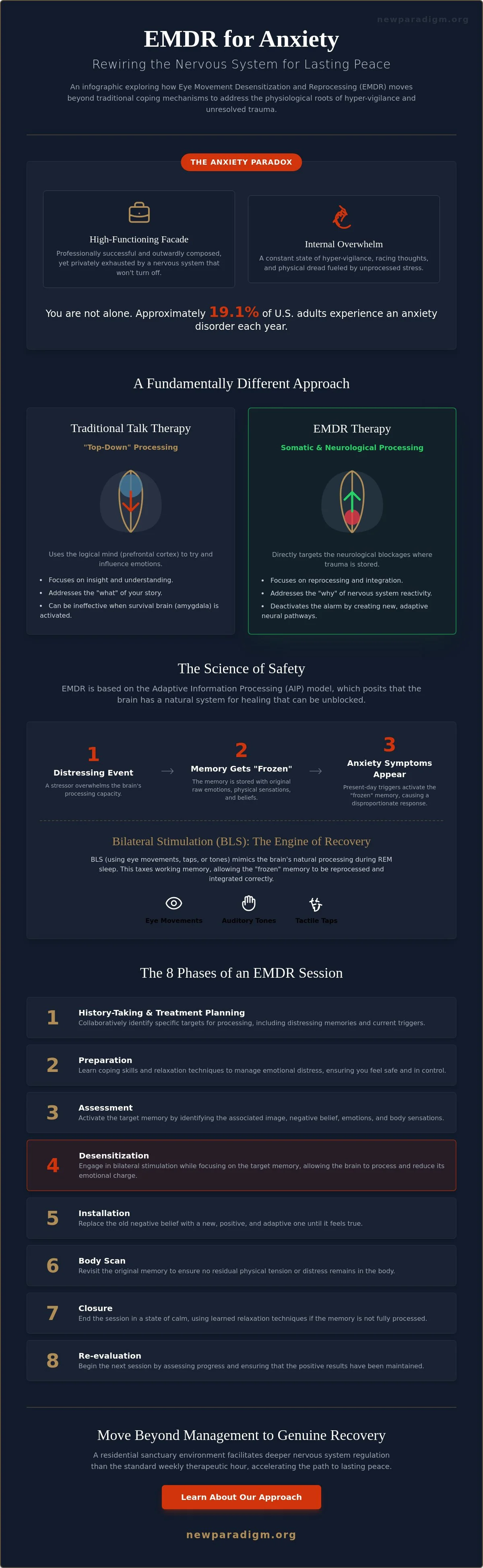
What if the anxiety you've spent years trying to manage isn't a personality trait, but a physiological backlog? You might be high-functioning on paper, yet you're privately exhausted by a nervous system that never turns off. With approximately 19.1% of U.S. adults experiencing an anxiety disorder each year, you are far from alone in this struggle. If you've spent countless hours intellectualizing your fears without feeling emotional relief, it's because traditional talk therapy often misses the basement where trauma lives. EMDR for anxiety offers a different path by targeting the neurological blockages that keep you in a state of constant hyper-vigilance.
We understand the weight of maintaining a facade while your internal world feels like it's privately falling apart. You've likely tried every coping mechanism available, only to find that "coping" is just another word for surviving the day. This guide will show you how to move beyond management into genuine recovery from the inside out. We'll explore the clinical mechanism of EMDR therapy, how it reprocesses the root causes of your distress, and why restoring your nervous system is the only way to find lasting peace.
Key Takeaways
- Learn why EMDR for anxiety is more than a management tool, targeting the neurological roots of hyper-vigilance to resolve unresolved pain.
- Understand the Adaptive Information Processing (AIP) model and how bilateral stimulation mimics the brain's natural healing mechanisms.
- Explore the eight distinct phases of a clinical session designed to keep you in full control while processing deep-seated distress.
- Discover how a residential sanctuary environment facilitates deeper nervous system regulation than the standard weekly therapeutic hour.
Beyond 'Coping': Why EMDR for Anxiety Targets the Root Cause
For many high-achieving individuals, anxiety isn't a lack of discipline or a failure of will. It's a physiological state of alarm that persists despite professional success. You might appear composed in boardrooms or social circles while feeling privately exhausted by a racing heart or a mind that won't stop scanning for threats. This is the high-functioning paradox. You possess the intellectual tools to understand your triggers, yet the physical sensation of dread remains untouched. Eye Movement Desensitization and Reprocessing (EMDR) is an evidence-based, somatic modality designed to bridge this gap between what you know and what you feel.
Utilizing EMDR for anxiety allows us to move beyond the surface level of behavior management. It isn't about learning to breathe through a panic attack more elegantly; it's about deactivating the alarm itself. When you're privately falling apart, your nervous system is likely stuck in a loop of unprocessed stress. This therapy provides a structured way to regulate that system and find genuine relief.
To better understand this concept, watch this helpful video:
The Limitation of Talk Therapy for Anxiety
Traditional talk therapy relies on a "top-down" approach, using the logical mind to influence emotions. While helpful for gaining insight, it often fails when the amygdala takes over. You can't always think your way out of a visceral panic response because the survival brain works faster than the rational brain. Talk therapy addresses the "what" of your story, while EMDR addresses the "why" of your nervous system's reactivity.
Anxiety as a Somatic Memory
Anxiety is often a somatic memory; a physical echo of a past stressor that the body hasn't fully released. Even when the mind forgets the specific trigger, the amygdala remains hyper-vigilant, keeping you in a state of chronic alarm. At New Paradigm Mental Health Retreat, we shift the focus from "what is wrong with me" to "what happened to my nervous system." This perspective allows for a compassionate, clinical path toward reclaiming your internal sanctuary and moving toward true recovery.
The Science of Safety: How EMDR Reprocesses the Anxious Brain
To understand why your anxiety persists despite your best efforts to "think" it away, we must look at how the brain stores information. The clinical foundation of this work is the Adaptive Information Processing (AIP) model. This model posits that your brain has an inherent system for emotional health, much like your body has a system for healing a physical wound. However, when a stressor is too intense or repetitive, this processing system can become overwhelmed. Distressing experiences get "frozen" in their original, raw state, complete with the same physical sensations and beliefs you felt at the time. This is why EMDR for anxiety is so effective; it doesn't just talk about the problem, it restarts the brain's natural processing engine.
The primary tool used to unfreeze these memories is bilateral stimulation (BLS). Research, including insights from the APA on EMDR, suggests that BLS mimics the rapid eye movement (REM) sleep phase. During REM sleep, your brain integrates the day's events, turning raw data into long-term memory. By using eye movements, taps, or tones while focusing on an anxious trigger, we facilitate this same integration process while you're fully awake. This allows the brain to physically rewire itself, moving the memory from the "alarm" center of the amygdala to the "narrative" center of the prefrontal cortex.
Bilateral Stimulation: The Engine of Recovery
Bilateral stimulation works by taxing your working memory. As you track a moving light or listen to alternating tones, the emotional charge of your anxious thoughts begins to diminish. You don't forget what happened; rather, the "heat" leaves the memory. This work requires a stable environment where you feel truly secure. For many, a Residential Trauma Treatment program provides the necessary foundation of safety to engage in this deep neurological work without the distractions of daily life.
Desensitization vs. Avoidance
Most traditional anxiety management strategies are actually sophisticated forms of avoidance. You might avoid certain social settings, skip travel, or stay late at the office to outrun your thoughts. While this feels like coping, it reinforces the brain's belief that the world is dangerous. EMDR builds your capacity to face triggers without a physiological spike. It facilitates a profound shift from the visceral feeling of "I am in danger" to the grounded realization that "I am safe now." If you're ready to stop managing symptoms and start changing your biology, you may wish to reach out for a private consultation to discuss your path forward.
Navigating the 8 Phases: What to Expect in an EMDR Session
Engaging in EMDR for anxiety is not a passive experience. It is a highly structured, eight-phase protocol that requires your active participation. There is a common misconception that this therapy is similar to hypnosis, but that is a myth. You remain in full control and fully awake throughout every session. You are the navigator; the therapist is simply the guide. This structure provides the clinical safety needed to touch unresolved pain without being consumed by it. It is a predictable framework designed to lead you out of the darkness of hyper-vigilance.
Phase 1 & 2: Building the Foundation
We begin by identifying "touchstone" memories. These are the early experiences that set your nervous system to a default state of alarm. We don't dive into the deep end without a lifejacket. Phase 2 focuses on resource development, where you learn the "Safe State" or "Container" exercises. These are clinical tools used to stabilize your system before any processing begins. If you are seeking this level of specialized support in a private environment, New Paradigm Mental Health Retreat offers a sanctuary designed for this specific depth of work.
Phase 3-6: The Deep Work of Reprocessing
This is where we move into the core of the recovery process. We identify the negative belief that fuels your anxiety, such as "I am not safe" or "I am not enough." Processing feels visceral. It's often a sequence of shifting sensations: a sudden coldness in the limbs, a heavy pressure on the sternum, or the release of a long-held tension in the jaw. During the "Body Scan" phase, we track these physical sensations as they shift and eventually dissolve. As the old memory is integrated, we install a positive, adaptive belief that reflects your current reality of safety and competence. This movement from a state of alarm to a state of peace is the hallmark of genuine healing.
If you're ready to stop intellectualizing your pain and begin the work of physical recovery, we invite you to reach out for a private consultation to discuss your path forward.
The Case for Intensity: Why Residential EMDR Accelerates Healing
Standard outpatient therapy often operates on the "therapeutic hour," a 50-minute window that can feel insufficient for the depth of work required to resolve chronic distress. When you're using EMDR for anxiety, sessions can be emotionally demanding. Opening a core negative belief or a significant trauma only to have the clock run out can leave you feeling raw and exposed as you return to a stressful office or a busy home. This fragmented approach often forces the brain to spend more time "closing down" the session than actually processing the pain. It's a cycle that can make recovery feel like a slow, exhausting climb.
Intensity provides a clinical shortcut to stability. By stepping away from the daily demands of your life, you allow your nervous system the space it needs to truly recalibrate. Our sanctuary in Chiang Mai offers a secluded environment where the work of recovery is the only priority. We deliberately limit our intake to a maximum of four clients at any given time. This focus ensures that your treatment is never diluted by the needs of a crowd. It allows for a level of personalized clinical depth that is simply impossible in larger facilities. We blend evidence-based trauma care with the grounded principles of monastic mindfulness, providing a path that is both scientifically rigorous and deeply human.
Recovering Away from the Triggers
It's difficult to heal in the same environment where you became unwell. If you're attempting to process deep-seated anxiety while simultaneously managing professional crises or family obligations, your nervous system remains in survival mode. Uninterrupted time is the primary currency of regulation. This intensive focus is also a core component of our Burnout Recovery path. We acknowledge that for the high-functioning individual, exhaustion and anxiety are often intertwined, requiring a unified approach to restore the self.
The New Paradigm Mental Health Retreat Approach
We don't believe in helping you cope more elegantly; we believe in helping you recover from the inside out. Our approach prioritizes personalized intensity, offering multiple EMDR for anxiety sessions per week rather than the standard weekly check-in. This isn't a hospital, a crowded clinic, or a conventional rehab. It is a private environment for deep work, designed for those who are successful on paper but privately falling apart. We invite you to explore our residential programs at New Paradigm Mental Health Retreat and begin the journey back to a regulated, peaceful life.
Reclaiming Your Internal Sanctuary
Anxiety doesn't have to be a permanent state of being. You've spent long enough intellectualizing the pain while your body remains in a state of high alarm. By choosing EMDR for anxiety, you're opting for a clinical path that reprocesses the root cause rather than just trimming the branches of your symptoms. This work requires depth, focus, and a safe environment where you can finally let the facade drop. It's about moving from a state of survival to a state of genuine integration.
At New Paradigm, we provide a secluded environment for this profound transformation. Backed by 25+ years of clinical expertise, our team specializes in intensive EMDR sessions that accelerate the healing process. We strictly limit our intake to a maximum of four clients to ensure your recovery is private, uninterrupted, and deeply personalized. You've been high-functioning on paper while privately falling apart for too long. It's time to move beyond coping and begin recovering from the inside out.
Begin your recovery at New Paradigm today. True peace is not the absence of stress, but the presence of a regulated nervous system. You are ready to step back into the light.
Common Questions About EMDR for Anxiety
Is EMDR effective for generalized anxiety disorder (GAD)?
Yes, EMDR is highly effective for Generalized Anxiety Disorder. While GAD is often treated as a purely cognitive issue, it's actually a symptom of a nervous system that has lost its ability to return to a baseline of safety. By reprocessing the underlying stressors that keep your brain in a state of hyper-vigilance, we can deactivate the constant background noise of worry that characterizes GAD.
How many EMDR sessions are typically needed for anxiety?
The number of sessions depends on the complexity of your history and whether your anxiety stems from a single event or years of chronic stress. Research indicates that 84% to 90% of single-trauma victims no longer have PTSD symptoms after just three sessions, while 77% of those with multiple traumas find relief after six sessions. In our intensive residential setting, we compress this timeline to facilitate deeper progress in a shorter window.
Can EMDR make my anxiety worse before it gets better?
It's common to feel a temporary increase in emotional sensitivity as we begin to unfreeze long-held stress. This visceral experience is why we prioritize the resourcing phase to ensure you have the internal container needed to manage these sensations. At New Paradigm, we move at the pace of your nervous system to ensure you feel supported and secure throughout the entire processing journey.
What is the success rate of EMDR for anxiety compared to CBT?
Research indicates that EMDR for anxiety is as effective as other leading therapies like Cognitive Behavioral Therapy but often works through the body's physiological response more directly. A 2024 meta-analysis found that EMDR had a significant impact on reducing depressive and anxious symptoms. While CBT helps you manage thoughts, EMDR targets the neurological root, often providing relief for those who found talk therapy to be intellectually helpful but emotionally stagnant.
Do I need to have a major 'trauma' to benefit from EMDR for anxiety?
You don't need a catastrophic event to benefit from this work. Anxiety is frequently the result of "small-t" traumas; recurring life events that taught your nervous system that the world is unpredictable or unsafe. These touchstone memories are just as valid and treatable as major events. We focus on how your body stores the stress today, regardless of how you label the original cause.
What happens if I can't visualize well during EMDR sessions?
Visualization is only one way to process information and it's not a requirement for success. If you struggle to see memories clearly, we focus on somatic sensations, auditory cues, or the visceral felt sense in your body. EMDR for anxiety is a flexible protocol that adapts to how your specific brain stores information, ensuring the healing process remains accessible even if you aren't naturally visual.

Article by
Dirk J. Lambert (MSc. - CCTS-I)
Dirk J. Lambert is a Licensed Psychotherapist, Mentor, Author, and Certified Trauma & EMDR Specialist with more than 25 years of experience helping people recover from trauma, depression, burnout, emotional abuse, and long-standing unresolved pain. His work is known for being direct, compassionate, and highly practical.
A twice-ordained Buddhist monk, Dirk bridges clinical trauma care with mindfulness, discipline, self-observation, and deep emotional honesty. He does not hide behind jargon, labels, or unnecessary complexity. He listens carefully, speaks plainly, and works toward meaningful change.
New Paradigm reflects the philosophy he has built over decades: intentionally small, deeply personal, private by design, and focused on what actually helps people recover from the inside out rather than simply cope more elegantly.