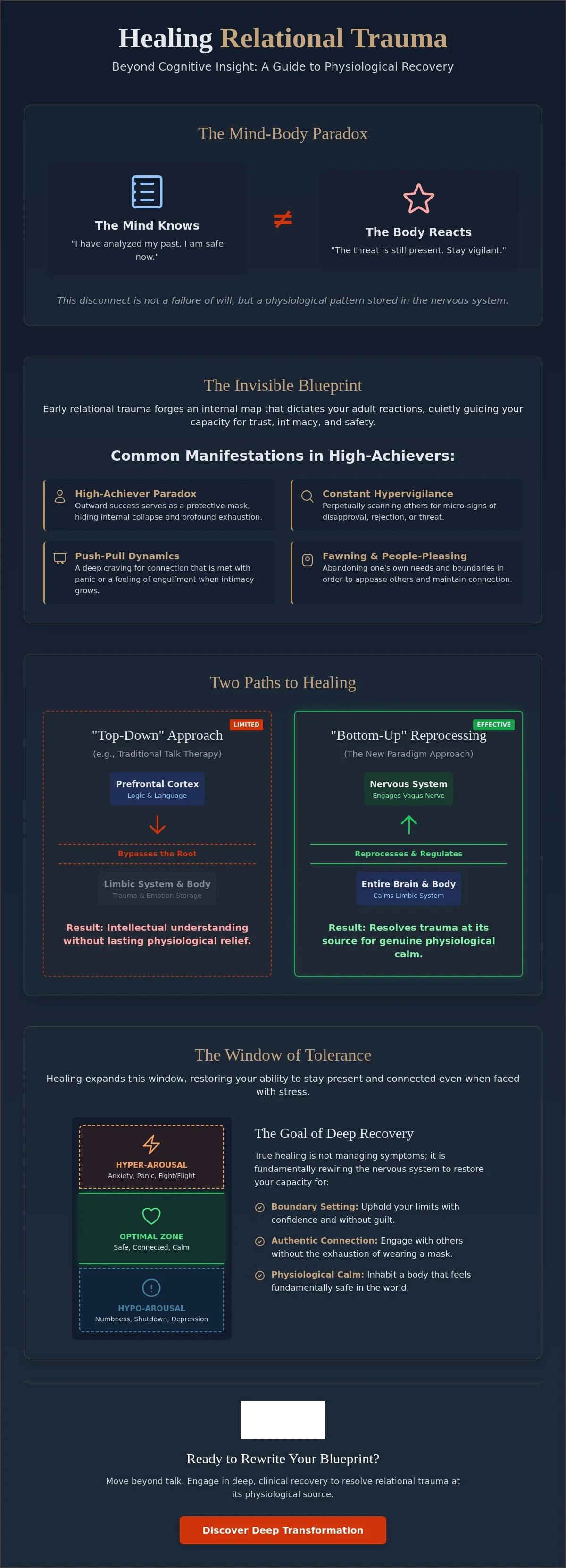
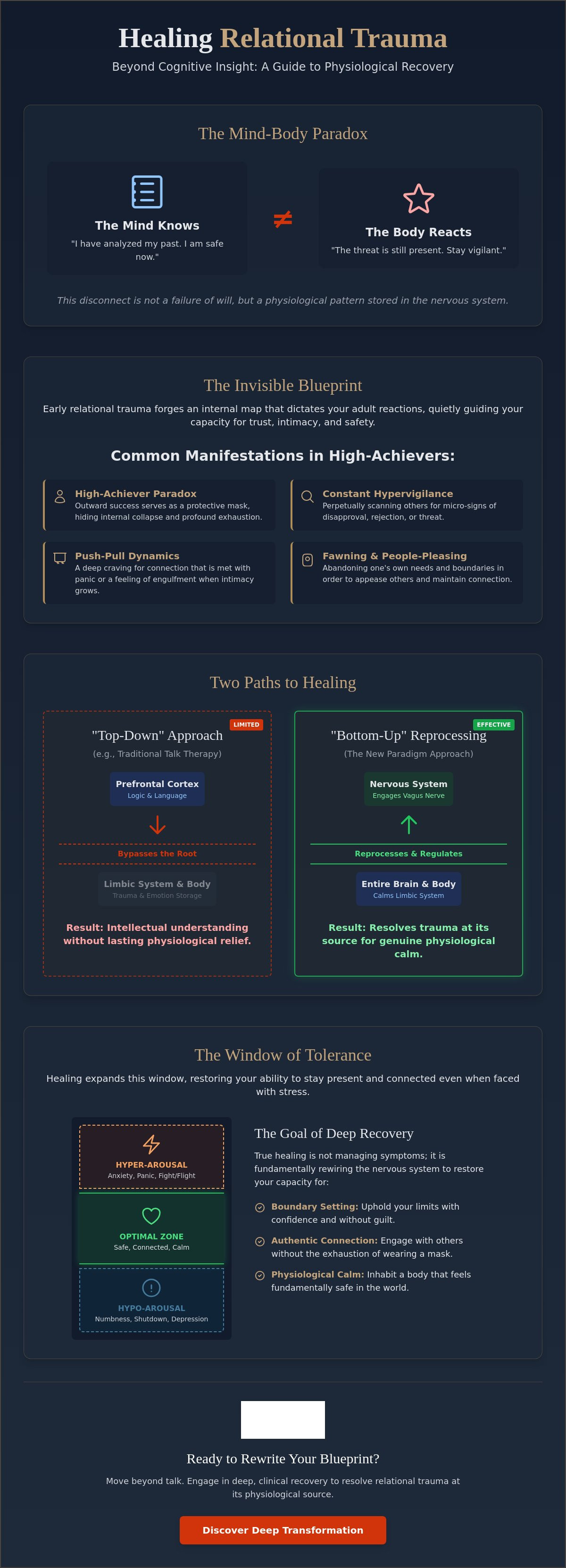
You've likely spent years analyzing your history, yet your body still reacts as if the threat is present today. It's a frustrating paradox where you possess a clear intellectual map of your past, but you're still lost in the emotional woods. True healing from relational trauma in adults isn't found in merely narrating your story; it requires a physiological shift that talk therapy alone often cannot reach.
It's exhausting to live with a mind that knows you're safe while your nervous system remains trapped in constant hypervigilance. You might find yourself sabotaging the very connections you crave or feeling a heavy, chronic fatigue that seems to live in your bones. We understand that this disconnect isn't a failure of will. Recovery is not about learning new coping skills to manage the pain; it's about resolving the pain at its source. This guide explores how to move beyond cognitive insight into deep, clinical recovery. You'll discover how to reprocess these internal patterns to achieve a state of physiological calm, allowing you to set boundaries without guilt and connect with others without the exhaustion of wearing a mask.
Key Takeaways
- Identify the "invisible blueprint" of early attachment and how these historical patterns dictate your current capacity for intimacy.
- Understand why healing from relational trauma in adults requires moving beyond intellectual insight to physiologically reprocess wounds stored in the nervous system.
- Learn why "top-down" talk therapy often bypasses the limbic system and how to engage the Vagus nerve for true emotional regulation.
- Explore the critical pillars of recovery, from establishing foundational safety to restoring the ability to hold boundaries without guilt.
- Discover the role of intensive containment in deep transformation, providing the isolation from external noise required for profound internal work.
The Invisible Blueprint: Understanding Relational Trauma in Adulthood
Relational trauma is not merely a memory of a difficult childhood; it's the wounding of the attachment system during your most formative developmental years. When the people you relied on for safety were the same people who caused you fear or neglect, your nervous system was forced to adapt. This creates what we call the Invisible Blueprint. This internal map remains active long after you've left your childhood home, quietly dictating how you perceive trust, how you handle conflict, and how you allow yourself to be known by others. When you begin the process of healing from relational trauma in adults, you aren't just changing your thoughts. You're rewriting the very foundation of how you exist in relation to the world.
For many professionals, this trauma is hidden behind a High-Achiever Paradox. You might possess an impeccable career, a stable home, and a reputation for competence, yet you feel a sense of internal collapse when the lights go down. This outward success often serves as a protective mask, a way to ensure safety through performance. However, this mask comes with a hidden cost of profound exhaustion. This chronic state of survival is frequently associated with Complex Post-Traumatic Stress Disorder, a condition that arises from repeated rather than singular traumatic events.
Relational trauma is a physiological adaptation to an unsafe environment, not a character flaw.
To better understand how these early experiences shape your current reality, watch this helpful video:
Signs of Unresolved Relational Wounds in Successful Adults
The "Mask of Competence" is a common survival strategy. You become the reliable one, the fixer, and the leader, but you do so at the expense of your own vitality. You may also rely heavily on intellectualization, using your sharp mind to analyze your pain rather than feeling it. This keeps the trauma at a distance, but it also prevents it from ever truly leaving your body. You might also notice a persistent hypervigilance, where you are constantly scanning the micro-expressions of others for signs of disapproval or rejection.
How Relational Trauma Manifests in Modern Relationships
In your personal life, these wounds often appear as a push-pull dynamic. You may desperately crave connection but feel a sense of engulfment or panic when someone gets too close. This often leads to "fawning," where you abandon your own boundaries to keep the peace. You might even find yourself in a repetition compulsion, where you unconsciously choose partners or friends who mirror the painful patterns of your past. True healing from relational trauma in adults involves breaking these cycles by addressing the physiological roots of these choices at New Paradigm Mental Health Retreat, where we focus on deep, internal transformation.
Beyond Talk Therapy: Why Relational Wounds Require Physiological Reprocessing
Traditional talk therapy is a top-down approach. It relies on the prefrontal cortex to analyze and manage emotions through language. However, relational trauma lives in the bottom-up structures of the brain. It's stored in the limbic system and the brainstem, areas where logic and vocabulary don't reach. This is why you can understand your childhood history perfectly but still feel a surge of panic when a partner is five minutes late. True healing from relational trauma in adults requires addressing the Vagus nerve and the Social Engagement System. These physiological pathways determine whether you feel safe enough to connect or if your body remains stuck in a state of fight, flight, or shutdown.
When you're perpetually pushed outside your Window of Tolerance, your nervous system is either hyper-aroused, manifesting as anxiety and hypervigilance, or hypo-aroused, appearing as numbness and depression. You aren't simply overreacting to the present. You're responding to a physiological cue that the world is unsafe, a message your body has carried for decades. According to Trauma and Healing Resources, recovery isn't a matter of willpower. It's about shifting these deep-seated biological responses so your system can finally settle into a state of rest.
The Clinical Power of EMDR for Relational Trauma
Reprocessing attachment memories isn't about forgetting the past. It's about moving trauma from stuck emotional loops into long-term narrative memory. Through EMDR therapy sessions, we help the brain digest the felt sense of being unloved or unsafe. This modality is particularly effective for complex wounds because it bypasses the need to find the perfect words for your pain. We find that intensive reprocessing is often more effective than weekly 50-minute appointments, as it provides the necessary time to descend into the deep layers of the psyche without the interruption of daily life.
Somatic Awareness: Reconnecting with the Body's Wisdom
Deep healing from relational trauma in adults isn't an intellectual exercise. It's a physical one. You must move from thinking about the trauma to feeling through it. This requires a safe, clinical environment where your body feels secure enough to release the tension it has held since childhood. By grounding yourself in the present moment, you break the cycle of intellectualized pain. You stop managing symptoms and start experiencing a genuine internal shift. If you're ready to move beyond management and toward true resolution, you can speak with a clinical specialist about our intensive recovery options.
The Architecture of Recovery: 4 Pillars of Healing Relational Trauma
Recovery is not a passive event. It is a deliberate, clinical construction. To achieve genuine healing from relational trauma in adults, we move through a structured architecture that prioritizes your physiological state over your historical narrative. This framework provides the stability necessary to dismantle the defenses you've carried since childhood. It is not about managing symptoms; it's about rebuilding your internal foundation from the ground up.
- Pillar 1: Establishing Physiological Safety. You cannot process deep wounds while your body is in a state of alarm. We begin by calming the nervous system, moving you from a state of survival into a state of receptivity.
- Pillar 2: Boundary Restoration. This is the experiential practice of reclaiming your internal "yes" and "no". It is the process of learning where you end and another person begins.
- Pillar 3: Grief and Integration. We honor the child who wasn't protected. This somber work is necessary to free the adult who is safe today. It allows you to integrate your past without being defined by it.
- Pillar 4: Relational Re-learning. We provide a controlled, supportive environment to practice authentic connection. You learn to trust your own discernment rather than your historical fears.
Breaking the Cycle of Self-Sabotage
You may recognize parts of yourself that pull away just as things are going well. These are "Protector" parts. They use sabotage as a clinical tool to prevent the vulnerability they once found dangerous. In our work, we don't pathologize these parts. We use self-compassion as a practical methodology to negotiate with them. By understanding their intent, we can replace reactive patterns with intentional, grounded responses. This shift is essential for anyone seeking long-term healing from relational trauma in adults, as it moves you from internal conflict to internal alignment.
Cultivating Sustainable Intimacy and Boundaries
There is a vital distinction between rigid boundaries and healthy ones. Rigid boundaries are walls built in isolation; healthy boundaries are flexible gates that you control. You'll learn how to communicate your needs clearly without the paralyzing fear of immediate rejection. This isn't just a social skill. It's a physiological capacity that you implement daily to maintain your peace. If you feel ready to move from intellectual understanding to this level of deep, structural change, contact our clinical specialists to explore an intensive path to recovery.
Intensive Intervention: The Path to Deep Transformation
Managing symptoms at home is often a full-time job that leaves little energy for actual recovery. When you're constantly navigating the triggers of your professional and personal life, your nervous system remains too reactive for the deep work required for healing from relational trauma in adults. This is why a residential trauma treatment program is not a luxury, but a clinical necessity for those seeking to move beyond mere coping. It provides a level of "containment" that outpatient therapy cannot match. By removing the external noise and daily obligations that keep you in a state of high alert, you create the internal space necessary to focus entirely on your recovery.
Our environment in Chiang Mai is designed to facilitate a specific state of Spiritual Calm. It's a place where the physical surroundings mirror the internal peace we're working to build. This isn't about escaping your life; it's about stepping into a protective atmosphere where you can finally lower your guard. In this space, the work of transforming your physiological responses becomes the priority, allowing you to move from a state of hidden exhaustion to one of grounded presence.
Why a Clinical Setting Outperforms 'Wellness Retreats'
It's vital to distinguish between relaxation and reprocessing. A wellness retreat or a spa stay might offer temporary relief from burnout, but it doesn't address the limbic system's trauma. Spa stays aren't enough for the internal collapse that accompanies deep relational wounds. We provide 24/7 clinical support because intensive EMDR often results in an "emotional hangover." You need more than a massage; you need a multidisciplinary team that understands the intersection of depression, anxiety, and attachment trauma. We don't just offer comfort; we offer a rigorous clinical methodology within a compassionate, expert-led framework.
Taking the First Step Toward a New Paradigm
The most common objection to intensive care is the perceived difficulty of taking time off. We invite you to reframe this not as an absence from your life, but as a vital investment in the rest of it. Healing from relational trauma in adults requires a dedicated period of focus to break decades-old patterns. To ensure your progress is sustainable, we implement a structured aftercare program. This serves as the critical bridge, helping you integrate your new physiological calm into your home environment without losing the ground you've gained. Discover how our Residential Trauma Treatment Program can help you reclaim your life.
Reclaiming Your Internal Peace
The journey toward resolution begins when you stop trying to think your way out of a physiological state. We've explored how the invisible blueprint of childhood shapes adult intimacy and why true recovery requires a bottom-up approach that addresses the nervous system directly. By focusing on foundational safety and experiential boundary restoration, you can move beyond the mask of competence into a life of authentic connection. Healing from relational trauma in adults is a profound undertaking that demands a departure from the noise of daily life and a commitment to deep, internal work.
At our private, clinical environment in Chiang Mai, we provide the containment necessary for this transformation. Our evidence-based EMDR therapy sessions and multidisciplinary approach are delivered within a strictly limited capacity to ensure highly personalized, intensive care. This is not a temporary retreat; it's a structural realignment of your well-being. If you're ready to transition from managing your pain to resolving it, we invite you to Explore our Residential Trauma Treatment Program in Chiang Mai. You deserve a future that is no longer dictated by the wounds of your past.
Frequently Asked Questions
Can relational trauma truly be healed in adulthood, or am I permanently wired this way?
Yes, relational trauma can be healed because the nervous system remains capable of change throughout your life. While your early experiences have wired you for survival, targeted clinical intervention can update these default settings. It's not a matter of erasing your history but of resolving the physiological charge it carries. You aren't permanently broken; your body is simply operating on an outdated map that no longer serves your current safety.
How long does it take to see progress when healing from complex relational trauma?
Progress varies depending on the depth of the wounding, but many individuals experience a shift in their internal calm within weeks of beginning intensive work. Healing from relational trauma in adults is a process of layers rather than a singular event. You may notice a decrease in chronic hypervigilance first, followed by a greater capacity for setting boundaries. Sustainable transformation requires a committed period of focused reprocessing to ensure these changes take root.
Is EMDR effective for relational trauma if I don't have one single 'big' traumatic event?
EMDR is highly effective for the "death by a thousand cuts" often found in attachment wounds. It isn't reserved for singular catastrophic events. In the context of relational history, we use EMDR to reprocess the "felt sense" of chronic neglect or emotional misattunement. This allows the brain to finally digest the cumulative weight of repeated relational failures that have become stuck in your emotional loops and physiological responses.
What is the difference between relational trauma and C-PTSD?
Relational trauma describes the specific wounding of the attachment system, while Complex Post-Traumatic Stress Disorder (C-PTSD) is the clinical diagnosis that often results from it. Think of relational trauma as the cause and C-PTSD as the collection of symptoms, such as emotional flashbacks and chronic shame. Both conditions require a bottom-up approach that prioritizes nervous system stabilization over simple cognitive management or traditional talk therapy techniques.
Why is residential treatment often recommended over weekly therapy for relational wounds?
Residential treatment provides the containment necessary to descend into deep trauma without the constant interruption of daily life triggers. Weekly therapy often spends too much time managing the week's stressors, which prevents the deep dive required for physiological reprocessing. An intensive, private environment allows for consecutive days of focused work. This is often more effective for resolving complex attachment wounds and the hidden exhaustion they cause in high-achieving adults.
How do I know if my current relationship struggles are actually due to past relational trauma?
You can identify the influence of past trauma by looking for patterns of overreaction or internal collapse that feel disproportionate to the present situation. If you find yourself fawning, withdrawing, or feeling chronic hypervigilance even in safe connections, your nervous system is likely reacting to the invisible blueprint of your past. Healing from relational trauma in adults involves recognizing these physiological echoes and addressing them at their source rather than just managing the symptoms.

Article by
Dirk J. Lambert (MSc. - CCTS-I)
Dirk J. Lambert is a Licensed Psychotherapist, Mentor, Author, and Certified Trauma & EMDR Specialist with more than 25 years of experience helping people recover from trauma, depression, burnout, emotional abuse, and long-standing unresolved pain. His work is known for being direct, compassionate, and highly practical.
A twice-ordained Buddhist monk, Dirk bridges clinical trauma care with mindfulness, discipline, self-observation, and deep emotional honesty. He does not hide behind jargon, labels, or unnecessary complexity. He listens carefully, speaks plainly, and works toward meaningful change.
New Paradigm reflects the philosophy he has built over decades: intentionally small, deeply personal, private by design, and focused on what actually helps people recover from the inside out rather than simply cope more elegantly.