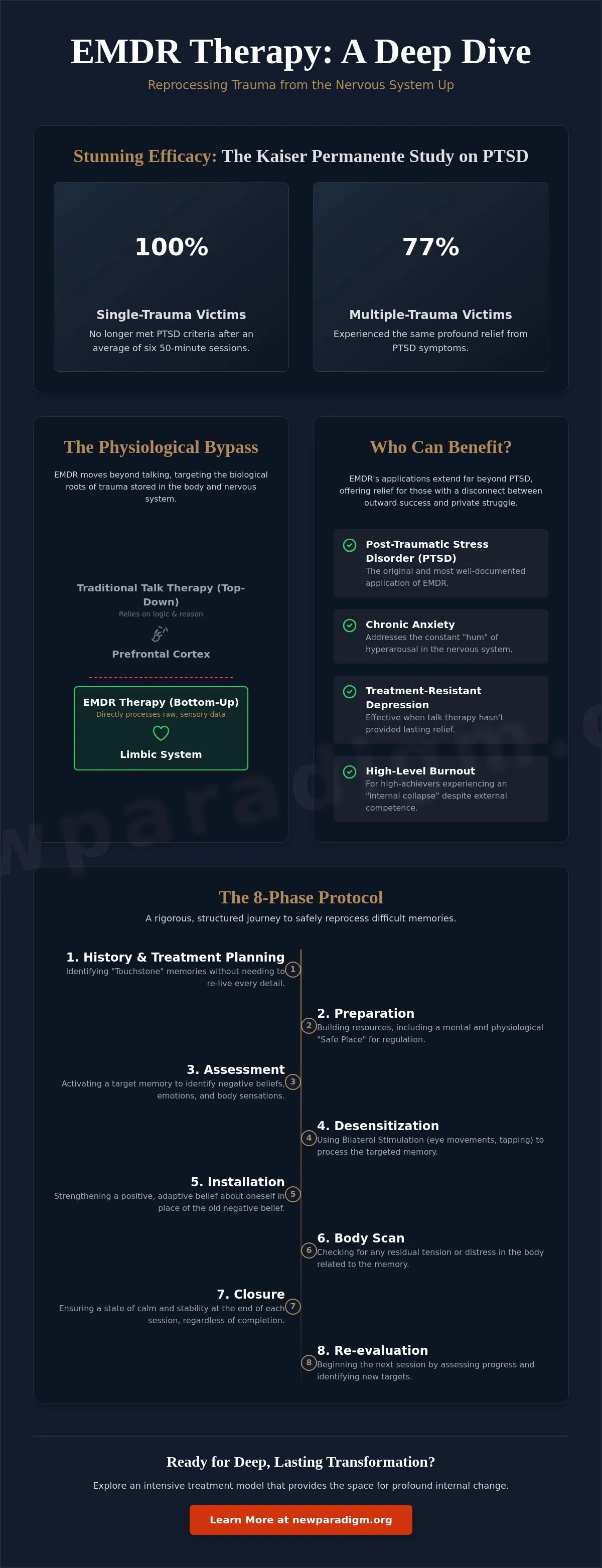
A Kaiser Permanente study found that 100 percent of single-trauma victims and 77 percent of multiple-trauma victims no longer met the criteria for PTSD after an average of six 50-minute EMDR therapy sessions. This statistic isn't just a number; it represents a fundamental shift in how we approach the architecture of human suffering. You've likely spent years in traditional talk therapy, skillfully intellectualizing your pain while your body remains in a state of high alert. You understand the "why" of your struggle, yet the physiological tension and the sense of being stuck persist despite your outward success.
It's exhausting to live with a nervous system that refuses to settle. This guide will show you how EMDR therapy sessions bypass those intellectual defenses to target the biological roots of trauma, offering evidence-based relief that goes beyond mere symptom management. We'll explore the science of the Adaptive Information Processing model, walk through the specific expectations of the 8-phase protocol, and discuss why an intensive treatment model may be the catalyst for the deep, internal transformation you've been seeking.
Key Takeaways
- Learn how EMDR functions as a somatic bypass, allowing the brain to process traumatic memories that remain inaccessible to logic or reason.
- Understand the structured eight-phase journey of EMDR therapy sessions, moving from initial stabilization to the deep desensitization of stored survival data.
- Discover why bottom-up interventions succeed where traditional talk therapy often falters by addressing the nervous system's response before the thinking brain.
- Identify practical steps for preparing your nervous system for clinical work and managing the temporary physiological shifts that follow deep reprocessing.
- Gain clarity on how an intensive treatment model provides the necessary space for profound, lasting internal transformation rather than temporary relief.
What Are EMDR Therapy Sessions? A Physiological Bypass for Traumatic Memory
Many people arrive at their first consultation feeling articulate but exhausted. They can describe their history with surgical precision, yet they remain trapped in a body that feels perpetually unsafe. Standard talk therapy often hits a ceiling because it relies on the prefrontal cortex to solve problems located in the mid-brain. EMDR therapy sessions represent a shift from talking about the past to physically reprocessing it. This approach, known formally as Eye movement desensitization and reprocessing (EMDR), is a somatic-based therapy designed to neutralize the emotional charge of difficult memories.
EMDR is a physiological intervention that targets the limbic system rather than just the thinking mind. While the name highlights eye movements, modern clinical practice utilizes various forms of Bilateral Stimulation (BLS), including rhythmic tactile tapping or auditory tones. The core philosophy is simple yet profound: your brain possesses a natural drive toward mental health. Much like a physical wound heals when the debris is removed, your mind can move toward resolution once the blockage of unprocessed trauma is cleared.
To better understand this concept, watch this helpful video:
The Adaptive Information Processing (AIP) Model
The success of EMDR is grounded in the Adaptive Information Processing model. When an experience is overwhelming, the brain fails to store it as a functional, narrative memory. Instead, it becomes "stuck" in its raw, sensory form. You don't just remember the event; you relive the racing heart, the cold sweat, and the visceral dread. EMDR therapy sessions help unlock this innate processing system. By engaging both hemispheres of the brain through BLS, the therapy moves these memories from a state of "living" trauma into a functional past that no longer dictates your present physiological state.
Who Can Benefit from EMDR Sessions?
While originally developed for PTSD, the clinical applications have expanded significantly. We now see profound results for those struggling with chronic anxiety, treatment-resistant depression, and the specific "internal collapse" associated with high-level burnout. For the high-achiever, the need for EMDR often stems from a disconnect between outward success and private struggle. You might lead a company or a household with total competence, yet feel an inexplicable hollow fatigue or a constant "hum" of hyperarousal. If you find yourself intellectualizing your pain without feeling relief, exploring EMDR for Anxiety can be the first step toward a recovery that reaches the roots of your exhaustion.
The 8-Phase Protocol: What Happens During an EMDR Session?
EMDR is not a series of random exercises or a simple distraction technique. It is a rigorous, eight-phase journey designed to provide a safe container for the most difficult internal work. Your experience in EMDR therapy sessions will follow a precise sequence that ensures you are never overwhelmed by the memories we seek to process. This methodology aligns with the American Psychological Association guidelines, which recognize its efficacy in treating trauma through a structured, clinical approach. The process begins not with the trauma itself, but with the establishment of a profound sense of safety.
Phases 1-3: History, Preparation, and Assessment
We begin with history taking, but this is not a traditional interrogation. You don't need to over-share every harrowing detail to find relief. We identify "Touchstone" memories, which are the foundational events that shaped your current distress. The goal is resolution. In Phase 2, we focus on preparation. We build your "Safe Place," a mental and physiological sanctuary that you can access at any time. Finally, in Phase 3, we select the specific target: the image, the negative belief such as "I am powerless," and the physical sensation that signals your distress.
Phases 4-6: Desensitization, Installation, and Body Scan
This is where the active reprocessing occurs. During EMDR therapy sessions, we use Bilateral Stimulation to lower your distress levels. As the memory loses its visceral grip, we move to Phase 5, the Installation phase. Here, we strengthen a new, positive belief, such as "I am safe now." We conclude this active work with a Body Scan. We don't stop until the final physical residues of trauma are cleared from your system, ensuring your body agrees with your mind's new perspective.
Phases 7-8: Closure and Re-evaluation
Each session concludes with grounding. We ensure you leave regulated and composed, ready to return to your daily life. The work does not stop when you leave the room; your brain continues to reprocess the data in the days that follow. If you feel ready to move beyond management and toward true resolution, you may wish to speak with a clinical specialist about our intensive options. For a more detailed look at the physiological changes you might expect, see our EMDR Therapy Benefits checklist.
The Disconnect: Why EMDR Succeeds Where Traditional Talk Therapy Falters
Many individuals arrive at our program with a shared frustration: "I've talked about this for years, and it hasn't changed how I feel." This is the inherent limitation of traditional talk therapy, which operates as a "top-down" approach. It attempts to use the prefrontal cortex, the seat of logic and reason, to manage the subcortical regions of the brain where trauma actually lives. The amygdala, your brain's alarm system, doesn't communicate through narrative or vocabulary. When you're triggered, your thinking brain is effectively offline, making it impossible to "reason" your way out of a physiological panic response.
EMDR therapy sessions utilize a "bottom-up" methodology. Instead of analyzing the story, they target the "Visceral Goad" of the trauma, the raw physical sensation that keeps your nervous system in a state of chronic hyperarousal. This direct physiological intervention is why the National Center for PTSD highlights EMDR for PTSD as an effective, evidence-based treatment. It addresses the survival response where it originates, bypassing the need for the endless retelling of events that often leads to re-traumatization rather than resolution.
Intellectualization as a Defense Mechanism
For the high-achiever, logic is often a well-honed shield. You use your intellect to distance yourself from the raw sensation of trauma, creating a sophisticated narrative that explains your pain without actually touching it. However, understanding your trauma is not the same as healing it. You can know exactly why you feel broken and still feel the same internal collapse every time you're stressed. EMDR therapy sessions provide the breakthrough that intellectualization prevents. They force the brain to move beyond the safety of the story and into the somatic work required for true internal transformation.
Neuroplasticity and the Hippocampus
Trauma causes memories to lose their "time-stamp," leaving them to float in the present as if the danger is still happening. During EMDR, the REM-like eye movements facilitate a process of memory consolidation. This helps the hippocampus finally categorize old experiences as past events rather than current threats. EMDR physically alters the neural pathways associated with fear, creating a calmer, more resilient baseline for your nervous system. If you're ready to stop managing your symptoms and start changing your brain's response, we encourage you to contact our clinical specialists to explore our intensive trauma programs.
Integrating the Experience: Preparation and Aftercare for EMDR Sessions
The work of healing is not confined to the time spent in the clinician's office. While EMDR therapy sessions are the catalyst for change, the period immediately following a session is where the brain does its most significant restructuring. You aren't just "talking" through a memory; you're physically rewiring your nervous system's response to it. This process requires a specific kind of preparation and a dedicated space for aftercare that traditional outpatient models often overlook. Standard weekly sessions can feel like opening a wound and having to close it before the work is done. An intensive model allows you to stay in the work until resolution is reached, providing the difference between a quick repair and a full structural renovation.
Many clients experience what is commonly called the "EMDR Hangover." This isn't a sign of regression, but a marker of deep physiological work. You might feel a profound sense of fatigue, encounter vivid dreams, or notice sudden emotional shifts as your brain finishes the processing we began. It's a somber reality of recovery: true transformation is often tiring. For those seeking a deeper level of support, our guide to residential trauma treatment explains how an immersive environment can help manage these shifts safely.
Why Environment Matters: The Residential Advantage
There is a distinct limitation to the standard 50-minute therapy hour. Attempting to process deep-seated survival data and then immediately returning to a high-pressure office or a chaotic home environment can feel jarring, even counterproductive. At New Paradigm Mental Health Retreat, we believe in the power of a focused environment. Our setting in Chiang Mai provides the isolation from external noise necessary for integration. Here, EMDR therapy sessions are complemented by contemplative practices like mindfulness, creating a synergy that allows the nervous system to settle into its new, calmer baseline.
The Path Forward: Aftercare and Stability
Healing is not a single event, but a transition into a new way of being. Successful recovery involves moving from a life dictated by past survival instincts to one grounded in present-day reality. This is why we prioritize a comprehensive Aftercare Program to bridge the gap between intensive treatment and daily life. You don't have to navigate the complexities of integration alone. If you're ready to explore a path toward lasting relief, contact New Paradigm Mental Health Retreat to discuss personalized EMDR therapy sessions and begin your journey toward physiological peace.
Reclaiming Your Nervous System through Physiological Resolution
Understanding the biology of your trauma is a vital first step, but it's rarely the final one. You've seen how EMDR therapy sessions move beyond the limitations of the thinking brain to address the raw, stored survival data that keeps you in a state of chronic exhaustion. By following a structured eight-phase protocol within a protective clinical environment, you can finally time-stamp your past and find stability in the present. This isn't about simply talking through your history; it's about physically altering your brain's response to it.
At New Paradigm Mental Health Retreat, we offer a path toward deep, internal transformation rather than superficial management techniques. Our clinical facility was founded by experienced mental health professionals who specialize in intensive residential trauma recovery. Because we maintain a strictly limited capacity, we ensure every individual receives the highly personalized care required for such delicate internal work. You don't have to remain stuck in the visceral echo of what has happened. Peace is a practical, evidence-based destination, and we're here to help you navigate the way.
Request a Clinical Consultation for EMDR Therapy at New Paradigm Mental Health Retreat
Frequently Asked Questions
Is EMDR therapy a form of hypnosis?
No, EMDR is not hypnosis. You remain fully awake, alert, and in control throughout the entire process. Unlike hypnosis, which often involves an altered state of consciousness, EMDR relies on "dual awareness." You keep one foot in the present moment while observing past memories; this allows your brain to reprocess information without losing touch with the safety of the clinical room.
How many EMDR therapy sessions will I need to see results?
Many individuals experience significant relief within 6 to 12 sessions. Research indicates that 84 to 90 percent of single-trauma victims no longer meet the criteria for PTSD after only three 90-minute EMDR therapy sessions. While complex trauma or chronic stress may require a longer duration, the structured nature of the protocol often leads to faster resolution than traditional talk therapy.
Can I do EMDR therapy sessions online, or is in-person better?
You can effectively participate in EMDR therapy sessions virtually. Current research confirms that online EMDR produces equivalent outcomes to in-person treatment. While virtual sessions offer convenience, many high-achievers find that a residential setting is superior; it provides the necessary isolation from professional stressors and a contained environment for deep integration that a home office cannot provide.
What happens if I can't remember the details of my trauma?
You don't need a clear, chronological narrative for EMDR to be successful. Trauma is frequently stored as raw sensory data; it manifests as a sudden scent, a specific physical tension, or an intrusive image. We work with whatever fragments your body has preserved. The goal is to process these "body memories" so they no longer trigger your nervous system, even if the story remains incomplete.
Are there risks of being re-traumatized during an EMDR session?
EMDR is specifically designed to avoid re-traumatization by emphasizing the preparation phase. We never move into active reprocessing until you have mastered self-regulation tools and established a physiological "Safe Place." This protective structure ensures you stay within your window of tolerance, allowing you to observe the memory without being consumed by it.
What should I do if I feel overwhelmed after a session?
Feeling emotionally raw or physically exhausted is a natural part of the "EMDR Hangover" as your brain continues to reprocess data. You should prioritize rest, minimize external noise, and use the grounding techniques practiced in your sessions. If you are in a residential program, our clinical team is available to provide immediate support and guidance as your nervous system settles into its new, healthier baseline.

Article by
Dirk J. Lambert (MSc. - CCTS-I)
Dirk J. Lambert is a Licensed Psychotherapist, Mentor, Author, and Certified Trauma & EMDR Specialist with more than 25 years of experience helping people recover from trauma, depression, burnout, emotional abuse, and long-standing unresolved pain. His work is known for being direct, compassionate, and highly practical.
A twice-ordained Buddhist monk, Dirk bridges clinical trauma care with mindfulness, discipline, self-observation, and deep emotional honesty. He does not hide behind jargon, labels, or unnecessary complexity. He listens carefully, speaks plainly, and works toward meaningful change.
New Paradigm reflects the philosophy he has built over decades: intentionally small, deeply personal, private by design, and focused on what actually helps people recover from the inside out rather than simply cope more elegantly.