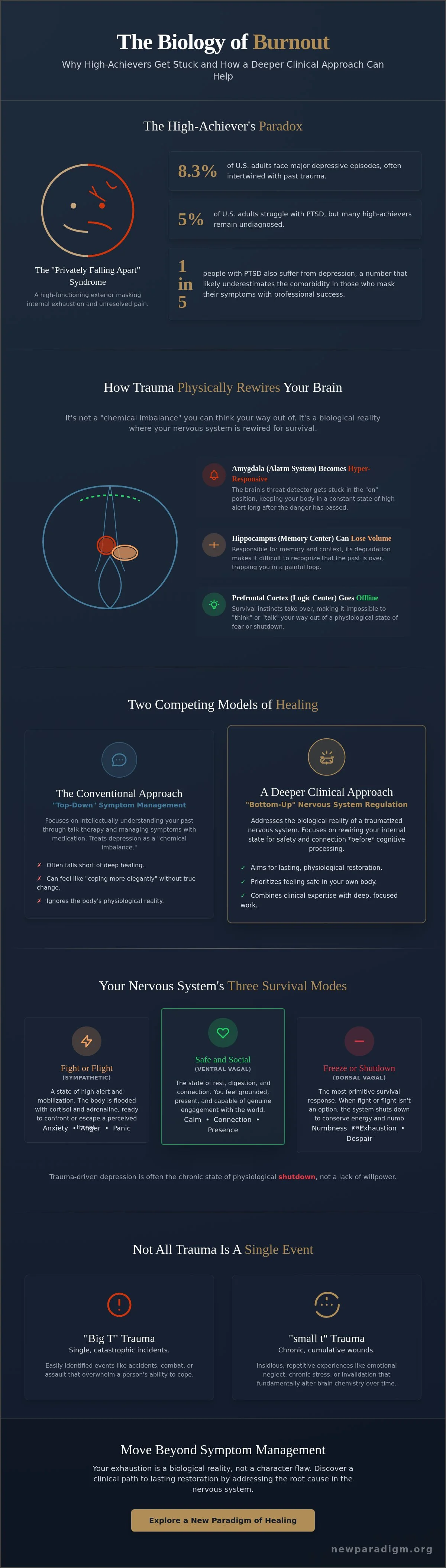
What if the reason you feel privately exhausted despite your professional success isn't a lack of willpower, but a nervous system that's been physically rewired by the past? You've likely tried the standard protocols. Perhaps you've cycled through different SSRIs or attempted to think your way out of the darkness, only to find yourself still stuck in a cycle of fight, flight, or freeze. In 2026, with 8.3% of U.S. adults facing major depressive episodes and 5% struggling with PTSD, it's clear that the intersection of trauma and depression requires a deeper, more clinical approach than traditional talk therapy provides.
You know that your suffering is real, yet you're tired of simply coping more elegantly while feeling like you're falling apart inside. This article explores why trauma-driven depression is a biological reality rather than a character flaw. You'll discover how evidence-based clinical interventions move you beyond symptom management to actually rewire your internal state for lasting recovery. We'll outline a roadmap for healing that prioritizes nervous system regulation, providing the validation and clinical clarity you need to finally step back into the light.
Key Takeaways
- Recognize the invisible architecture that connects professional success with private exhaustion, revealing why your high-functioning mask may be hiding unresolved pain.
- Shift your perspective from a simple chemical imbalance to the reality of nervous system regulation, where trauma and depression physically rewire the amygdala and hippocampus.
- Learn why intellectually understanding your past isn't the same as emotionally processing it, and why top-down talk therapy often falls short of deep healing.
- Identify the roadmap for an inside-out recovery that combines clinical trauma expertise with the quiet discipline of monastic mindfulness for lasting restoration.
The Invisible Architecture: How Trauma and Depression Intertwine
Unresolved psychological trauma and clinical depression don't just exist side-by-side; they feed one another in a symbiotic loop. While situational sadness might lift after a life event passes, trauma-induced depression is a physiological state where the body remains stuck in a past it cannot escape. We call this "Compassionate Realism." It's the honest acknowledgment that your exhaustion isn't a failure of character. It's a biological reality. While standard data from ptsd.va.gov suggests that 1 in 5 people with PTSD also suffer from depression, this number often misses the high-functioning professional who has spent years perfecting a mask of stability while their internal architecture is under siege.
To better understand how these hidden emotions manifest, watch this helpful video:
The "Privately Falling Apart" Syndrome
High-achievers often turn work into a sophisticated coping mechanism. It's a way to feel in control when the internal world feels chaotic. But there is a heavy tax for "coping more elegantly" instead of healing. You might find yourself intellectually active but emotionally deadened, unable to feel joy even when you hit major milestones. This "privately falling apart" syndrome is the hallmark of someone whose trauma and depression have been masked by a high-functioning exterior. You aren't lazy. You are simply running a marathon on a broken ankle, using sheer willpower to compensate for a nervous system that hasn't felt safe in years. The May 4, 2026 HHS action plan highlights a national shift toward addressing the overuse of psychiatric medications, reinforcing the need to look deeper than a pill to solve these complex architectural issues.
Big T vs. Small t Trauma: Why Your History Matters
Trauma is not always a single, catastrophic explosion. While "Big T" events like accidents are easily identified, "small t" traumas are often more insidious. These involve chronic neglect, emotional unavailability, or persistent high-stress environments that accumulate over decades. These smaller, repetitive wounds fundamentally alter our brain chemistry without us ever realizing a "trauma" occurred. Developmental trauma is a specific, foundational injury to a child's sense of safety that often serves as the primary precursor to adult depression. At New Paradigm, we look past the professional accolades to address these deep-seated roots in an environment designed for deep, uninterrupted work.
The Biology of Despair: How Trauma Rewires Your Nervous System
For decades, we've been told that depression is simply a "chemical imbalance" in the brain. While neurotransmitters like serotonin play a role, this explanation is incomplete. It ignores the physical reality of how your nervous system responds to threat. When you experience prolonged stress, your amygdala, which acts as the brain's alarm system, becomes hyper-responsive. Simultaneously, your hippocampus, responsible for memory and context, can actually lose volume. This biological shift means your body stays in a state of high alert long after the danger has passed. Depression often occurs after trauma because the body eventually runs out of the resources needed to maintain this constant "fight or flight" state. Chronic cortisol elevation doesn't just make you feel stressed; it leads to the visceral, bone-deep exhaustion that characterizes trauma and depression in high-functioning adults.
The Polyvagal Perspective on Depression
The feeling of being "numb" or "dead inside" isn't a lack of emotion. It's a biological survival mechanism known as the dorsal vagal state. When your system decides that neither fighting nor fleeing is possible, it initiates a total shutdown to protect you from further pain. This "freeze" response is the physiological precursor to many depressive symptoms. You can't "think" your way out of a shutdown because your prefrontal cortex, the logical part of your brain, has essentially been taken offline by the survival centers. It's a state of being biologically trapped in a body that has chosen stillness as its only defense.
EMDR and the Mechanics of Reprocessing
Recovery requires moving beyond talk therapy to address these stuck physiological patterns. EMDR therapy sessions offer a way to reprocess traumatic memories by using bilateral stimulation to engage both hemispheres of the brain. This process helps "unstick" memories that are trapped in the nervous system, allowing the amygdala to finally stand down. By integrating these fragmented experiences, EMDR targets the root of trauma-driven depression by allowing the brain to file away past events as finished rather than ongoing threats. If you feel ready to move from intellectual understanding to true physiological relief, you might consider reaching out to explore a personalized path to recovery.
This biological rewiring explains why standard treatments often feel like they're only scratching the surface. When the "freeze" response becomes a permanent baseline, your body requires a clinical intervention that speaks the language of the nervous system. Understanding this is the first step toward moving from a state of survival to a state of living.
Beyond Talk Therapy: Why Conventional Approaches Often Fail
Many individuals arrive at our sanctuary as "therapy veterans." You might have spent years in traditional talk therapy, intellectually dissecting your childhood, yet you still feel privately exhausted. This frustration is common when conventional "top-down" approaches like Cognitive Behavioral Therapy (CBT) are applied to "bottom-up" physiological issues. While CBT is often cited as a standard, it can be ineffective or even re-traumatizing if your nervous system is stuck in a chronic freeze state. You simply cannot talk your way out of a physiological shutdown. Understanding the complex relationship between depression and PTSD requires acknowledging that the body remembers what the mind tries to forget.
The Trap of "Coping" vs. The Goal of "Recovery"
Coping is the art of managing symptoms so you can continue to function in your daily life. It's what allows you to maintain your professional mask while you're falling apart inside. Recovery, however, is about resolving the source of the pain from the inside out. High-functioning clients are often exceptionally good at "faking" progress in weekly sessions because they are intellectually gifted. They can describe their history with clinical precision without ever emotionally processing the weight of it. True healing requires uninterrupted time for the nervous system to reset, away from the constant triggers of a demanding career and domestic life.
When Outpatient Care Isn't Enough
If you find that your weekly 50-minute session provides only a temporary reprieve before the numbness returns, it's a sign that outpatient care is insufficient for the depth of your pain. Deep-seated trauma and depression often require a level of immersion that standard clinics or crowded hospitals cannot provide. A residential trauma treatment program offers a secluded environment for deep work. In this private sanctuary, you aren't just another patient in a ward; you are an individual engaging in the profound work of reclaiming your life. If you're tired of merely surviving and want to move toward genuine restoration, reach out to our clinical team to explore an intensive path forward.
The Path to Restoration: Intensive Clinical Healing
When the intersection of trauma and depression has become your baseline, the logical conclusion is often an intensive residential intervention. This isn't about escaping your life; it's about reclaiming it. At New Paradigm, we don't operate like a hospital, a crowded clinic, or a conventional rehab. We provide a personal environment for deep work where clinical trauma expertise meets the quiet discipline of monastic mindfulness. This unique intellectual and emotional signature allows for a recovery that begins from the inside out. By limiting our intake to a maximum of four clients, we ensure a level of personalized safety and clinical focus that is impossible in larger, more sterile facilities.
Our approach acknowledges that you aren't a case file to be managed. You are an individual whose nervous system requires a specific, uninterrupted space to move from survival to restoration. The transition from the intensity of residential care to long-term stability is built on a foundation of evidence-based practices that rewire the brain's response to past pain. It is the difference between learning to manage your symptoms and finally resolving the biological roots of your despair.
Why Chiang Mai is a Global Hub for Healing
The environment in which you heal is just as critical as the therapy you receive. Chiang Mai has become a global center for recovery because its natural calm facilitates immediate nervous system regulation. The seclusion of our private sanctuary allows you to step away from the noise of professional demands and domestic triggers. This environment acts as a clinical tool, where nature and quiet facilitate the deep emotional processing required for lasting change. As a premier mental health facility Thailand represents the gold standard for clinical excellence in a serene, sanctuary-like setting.
Taking the First Step Toward a New Paradigm
It's natural to feel a sense of fear or hesitation when considering stepping away from your professional life. You might worry about the optics of absence or the momentum of your career. However, consider the long-term ROI of reclaiming your professional spark and your personal joy. Staying privately exhausted is a sustainable strategy for only so long before the mask begins to crack. You don't have to keep falling apart in secret. Choosing to address your trauma and depression with intensive clinical care isn't a sign of weakness; it's a strategic investment in the rest of your life. We are here to lead you back to the light with the quiet authority of those who know the way through the dark.
Reclaiming Your Life from the Inside Out
The path forward requires more than just intellectually understanding your past; it demands a fundamental shift in how your nervous system processes the world. The reality remains that the link between trauma and depression is biological, not a character flaw. Traditional outpatient models often fail to reach the root of deep-seated pain because they prioritize talk over physiological regulation. You don't have to settle for coping more elegantly while remaining privately exhausted. Real restoration happens when you give yourself the permission and the sanctuary to do the deep work of emotional processing.
At New Paradigm, we provide the specific environment needed for this journey. Led by our founder with over 25 years of clinical experience, our program remains strictly private with a maximum of four clients at any time. We utilize evidence-based EMDR and somatic processing to help you move beyond symptom management into true recovery. It's time to stop simply surviving and start truly living again. Begin your journey to inside-out recovery at New Paradigm today. You've carried the weight of the past long enough. There is a way back to the light, and you don't have to find it alone.
Frequently Asked Questions
Can trauma really cause clinical depression even years later?
Yes, unresolved trauma acts as a biological blueprint that often manifests as clinical depression decades after the initial events. In 2026, data suggests that 8.3% of U.S. adults will face a major depressive episode, many of which stem from childhood experiences that rewired the nervous system. This delayed response happens because high-functioning individuals often use professional success to suppress internal pain until the body's compensatory mechanisms finally exhaust themselves.
Why hasn't traditional talk therapy worked for my depression?
Traditional talk therapy often fails because it targets the logical prefrontal cortex rather than the physiological survival centers where trauma is stored. If your nervous system is stuck in a chronic freeze state, intellectually understanding your past won't release the physical tension. You don't have to stay stuck; you simply need clinical interventions that address the intersection of trauma and depression by regulating the autonomic nervous system directly.
What makes EMDR specifically effective for trauma-driven depression?
EMDR is effective because it uses bilateral stimulation to move traumatic memories from the "active" survival brain to the "narrative" long-term memory. Instead of just talking about the pain, EMDR allows the amygdala to stand down and the hippocampus to contextualize the event as something that is over. This process resolves the biological triggers that fuel depressive symptoms, providing a path to recovery that goes beyond merely managing your daily mood.
How do I know if I need a residential program or just a better therapist?
You likely need a residential program if your symptoms persist despite years of outpatient therapy or if you feel privately exhausted while maintaining a high-functioning career. When weekly 50-minute sessions aren't enough to break a cycle of chronic shutdown, an intensive environment provides the uninterrupted time necessary for deep work. A residential setting offers a sanctuary where you can step away from professional triggers to focus exclusively on recovery.
Is it possible to recover from burnout and depression at the same time?
Recovery from both is possible because burnout and depression are frequently different expressions of the same exhausted nervous system. In 2024, data showed that 34.5% of adults with mental health conditions also struggled with co-occurring disorders, highlighting the need for integrated care. By addressing the underlying trauma that drives the need for perfectionism and overwork, you can resolve the biological burnout while simultaneously lifting the weight of clinical despair.
What is the difference between a wellness retreat and a clinical trauma center?
A wellness retreat focuses on general leisure and temporary relaxation, while a clinical trauma center provides evidence-based psychological intervention for deep-seated pain. We are not a spa stay or a general rehab; we are a specialized environment for intensive emotional processing. While a retreat offers a brief pause from life, a clinical program led by experienced professionals offers the tools to fundamentally rewire your internal state for a lasting, inside-out recovery.

Article by
Dirk J. Lambert (MSc. - CCTS-I)
Dirk J. Lambert is a Licensed Psychotherapist, Mentor, Author, and Certified Trauma & EMDR Specialist with more than 25 years of experience helping people recover from trauma, depression, burnout, emotional abuse, and long-standing unresolved pain. His work is known for being direct, compassionate, and highly practical.
A twice-ordained Buddhist monk, Dirk bridges clinical trauma care with mindfulness, discipline, self-observation, and deep emotional honesty. He does not hide behind jargon, labels, or unnecessary complexity. He listens carefully, speaks plainly, and works toward meaningful change.
New Paradigm reflects the philosophy he has built over decades: intentionally small, deeply personal, private by design, and focused on what actually helps people recover from the inside out rather than simply cope more elegantly.