By Liz Moran - Psychotherapist - Trauma Specialist
Trauma can leave individuals feeling confused, overwhelmed, and disconnected from themselves. Many survivors ask questions such as, "Why do I react this way?", "Why am I unable to move on?", or "What is wrong with me?"
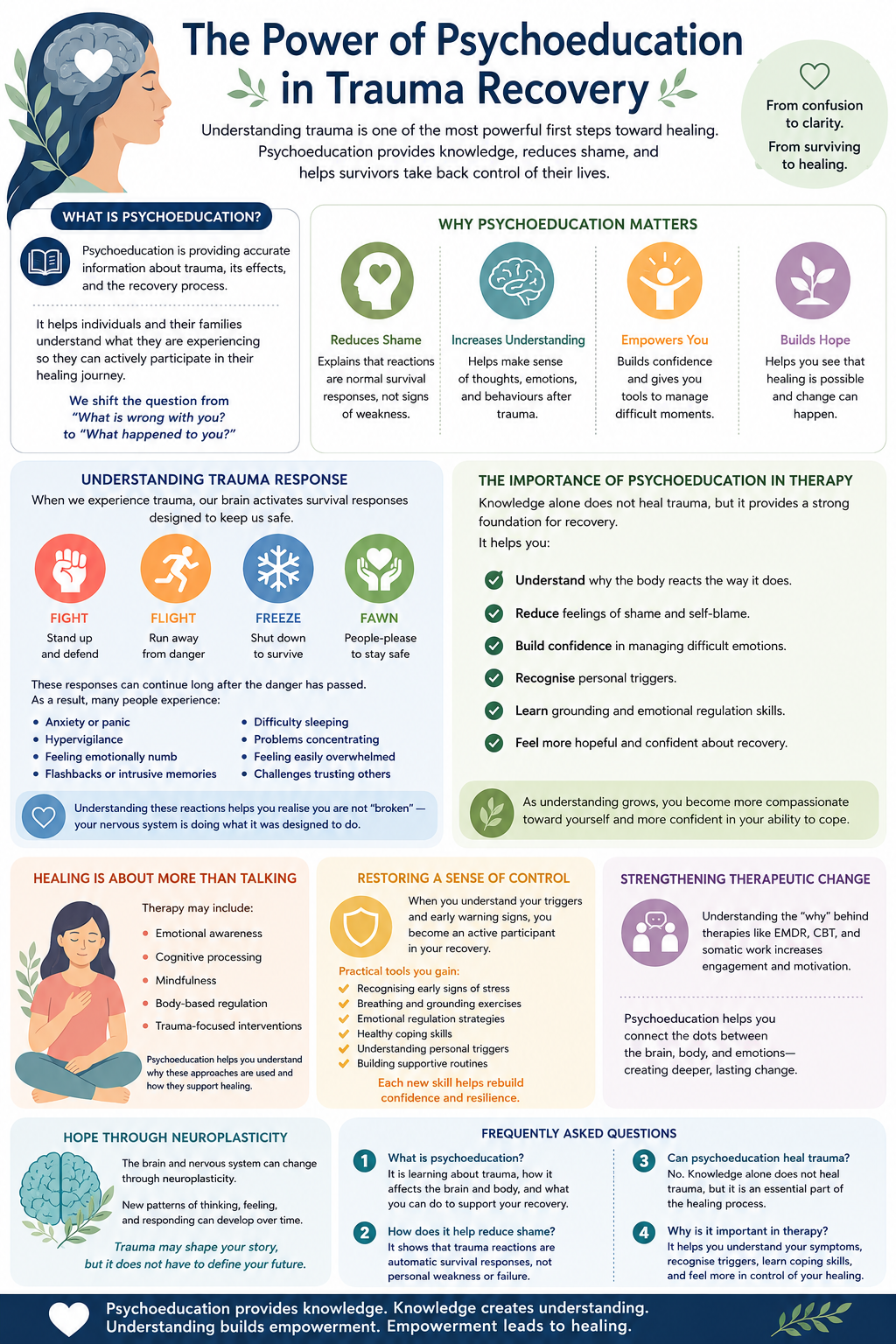
Psychoeducation is a fundamental component of trauma therapy. It provides individuals and their families with accurate information about trauma, its psychological and physical effects, and the recovery process. By increasing understanding and awareness, psychoeducation empowers individuals to actively participate in their treatment and reduces the fear and confusion often associated with trauma-related symptoms.
While it may seem simple, understanding what is happening within you can be one of the most empowering parts of the healing journey.
Psychoeducation combines psychological knowledge with practical strategies to support recovery. It helps individuals understand what they are experiencing and explains why certain thoughts, emotions, and behaviours occur after distressing experiences.
Rather than focusing on "What is wrong with you?", psychoeducation helps answer a much more compassionate question: "What happened to you?" This shift in perspective creates a foundation for healing by replacing fear and self-judgment, reducing shame, and helping individuals view themselves with more understanding and self-compassion.
One of the greatest barriers to recovery is shame. Many trauma survivors believe they should have reacted differently during the traumatic event or feel guilty for struggling long afterwards. Psychoeducation helps challenge these beliefs by explaining how the brain prioritises survival over conscious decision-making during trauma. Understanding that reactions were automatic often reduces feelings of guilt and self-blame, allowing space for self-compassion to grow.
Understanding Trauma Response
When we experience trauma, our brain automatically activates survival responses designed to keep us safe. These responses are commonly known as:
- Fight
- Flight
- Freeze
- Fawn
Although these responses are protective during a threatening event, they can continue long after the danger has passed. As a result, many people experience:
- Anxiety or panic
- Hypervigilance
- Feeling emotionally numb
- Flashbacks or intrusive memories
- Difficulty sleeping
- Problems concentrating
- Feeling easily overwhelmed
- Challenges trusting others
Learning about these responses often brings a sense of relief. Understanding their symptoms helps individuals realise they are not "broken" and that their nervous system is simply doing what it was designed to do. One of the most empowering steps in healing is discovering that these reactions are not signs of weakness. They are normal responses to abnormal experiences.
The Importance of Psychoeducation in Therapy
Knowledge alone does not heal trauma. It does, however, provide an important foundation for recovery. When an individual understands how trauma affects the brain and body, the therapeutic journey often feels less confusing and more collaborative.
Instead of fearing their symptoms, individuals begin to recognise patterns, identify triggers, and develop skills to regulate their emotions and nervous system.
Psychoeducation can support recovery by helping individuals:
- Understand why the body reacts the way it does
- Reduce feelings of shame and self-blame
- Build confidence in managing difficult emotions
- Recognise personal triggers
- Learn grounding and emotional regulation skills
- Feel more hopeful and confident about recovery
As understanding grows, many people become more compassionate towards themselves and more confident in their ability to cope. Since trauma affects both the mind and the body, effective therapy combines understanding with practical strategies that help regulate the nervous system and process difficult experiences safely.
Healing Is About More Than Talking
Depending on an individual’s needs, therapy may include approaches that focus on emotional awareness, cognitive processing, mindfulness, body-based regulation, or trauma-focused interventions. Throughout this process, psychoeducation helps make sense of why these approaches are used and how they support healing.
One of the most reassuring aspects of trauma recovery is knowing that the brain and nervous system can change. Through a process known as neuroplasticity, new patterns of thinking, feeling, and responding can develop over time.
Trauma affects both the mind and the body. For this reason, effective counselling often combines understanding with practical strategies that help regulate the nervous system and process difficult experiences safely.
Healing does not mean forgetting what happened. It means reducing the impact trauma has on daily life, creating a stronger sense of safety, and helping the individual feel more connected and present.
Restoring a Sense of Control
When individuals understand their triggers, recognise signs of nervous system activation, and learn grounding techniques, they become active participants in their recovery rather than passive recipients of symptoms.
Psychoeducation equips people with practical tools, such as:
- Recognising early signs of stress
- Breathing and grounding exercises
- Emotional regulation strategies
- Healthy coping skills
- Understanding personal triggers
- Building supportive routines
Each new piece of knowledge helps rebuild confidence and resilience.
Strengthening Therapeutic Control
Therapy is often more effective when the individual understands the purpose behind the techniques being used.
For example, learning how the brain stores traumatic memories can make approaches such as trauma-focused cognitive behavioural therapy, EMDR, or somatic therapies feel less intimidating. Understanding why certain exercises are recommended can increase engagement and motivation throughout the healing process.
Encouraging Hope
One of the most reassuring aspects of trauma recovery is knowing that the brain and nervous system can change. Through neuroplasticity, new patterns of thinking, feeling, and responding can develop over time.
Research into neuroplasticity shows that the brain has the capacity to adapt and reorganise throughout life. Combined with evidence-based trauma therapies, psychoeducation helps individuals understand that recovery is possible.
Trauma may shape an individual’s story, but it does not have to define their future.
As individuals gain knowledge, they often begin to replace fear with curiosity, confusion with clarity, and hopelessness with possibility. Healing does not mean forgetting what happened. It means reducing the impact trauma has on daily life so they can feel safer, more connected, and more present.
Perhaps one of the greatest benefits of psychoeducation is the hope that recovery is possible.
A Final Reflection
Healing from trauma is not simply about forgetting the past. It is about understanding how the past continues to influence the present and learning ways to move forward with greater awareness and compassion.
Psychoeducation offers more than information. It provides validation, reduces shame, strengthens resilience, and empowers individuals to take an active role in their recovery. By understanding the connection between the brain, body, and emotions, trauma survivors can begin to make sense of their experiences and recognise that healing is not only possible but achievable.
Knowledge alone does not heal trauma, but it creates the foundation upon which healing can begin. When individuals understand what has happened within their minds and bodies, they are better equipped to reclaim their lives with confidence, resilience, and hope.
References
- American Psychiatric Association. (2022). Diagnostic and statistical manual of mental disorders, 5th edition, text revision.
- Bath, H. (2008). The three pillars of trauma-informed care.
- Cohen, J. A., Mannarino, A. P., and Deblinger, E. (2017). Treating trauma and traumatic grief in children and adolescents.
- Courtois, C. A., and Ford, J. D. (2016). Treatment of complex trauma.
- Doidge, N. (2015). The brain's way of healing.
- Foa, E. B., Keane, T. M., Friedman, M. J., and Cohen, J. A. (2009). Effective treatments for PTSD.
- Herman, J. L. (2022). Trauma and recovery.
- Porges, S. W. (2011). The polyvagal theory.
- Shapiro, F. (2018). Eye movement desensitization and reprocessing therapy.
- Substance Abuse and Mental Health Services Administration. (2014). SAMHSA's concept of trauma and guidance for a trauma-informed approach.
- Van der Kolk, B. A. (2014). The body keeps the score.
- World Health Organization. (2019). International classification of diseases, 11th edition.