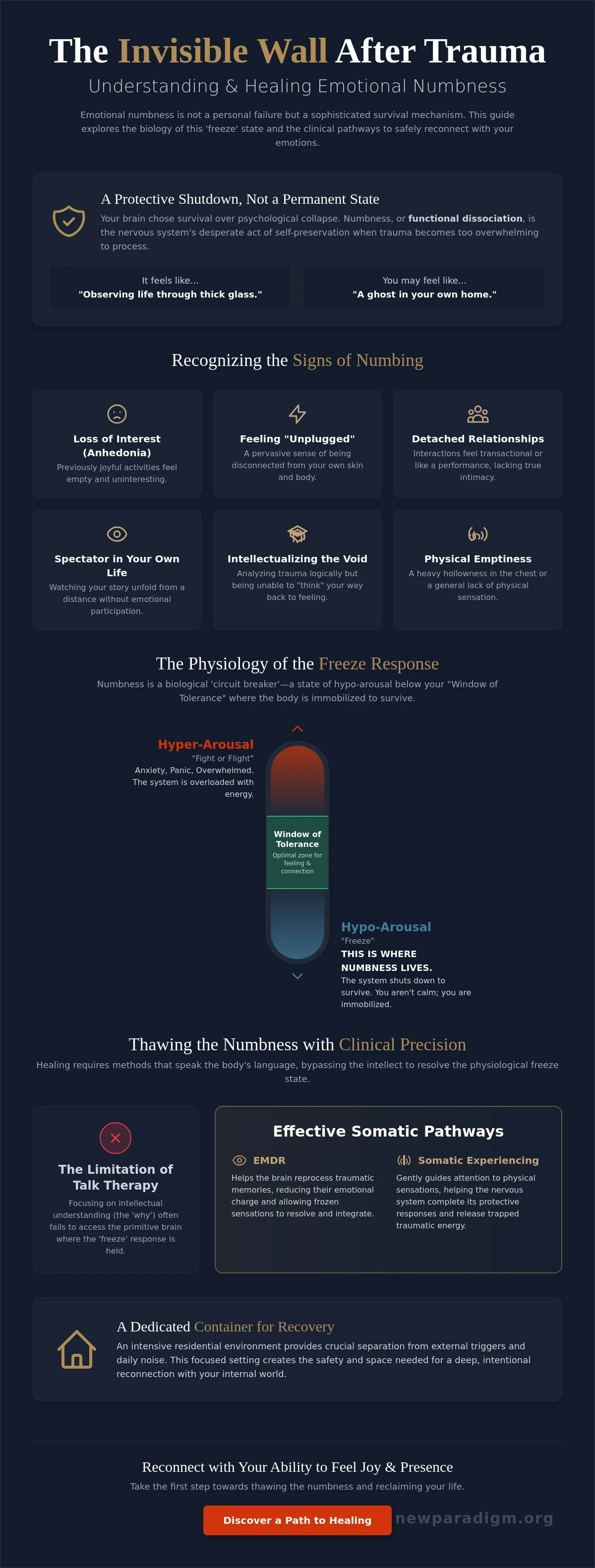
You sit across from someone you love, watching their mouth move and hearing their laughter, yet you feel like you're observing life through a thick pane of glass. It's a lonely, quiet exhaustion. You're physically present, but the internal version of yourself feels like a ghost in your own home. This isn't a failure of character or a lack of will; it's your nervous system performing a desperate act of protection. Seeking effective treatment for emotional numbness after trauma requires more than just intellectualizing your experiences or waiting for the fog to lift on its own.
We recognize the frustration of traditional talk therapy that stays on the surface while your internal world remains frozen. Healing isn't about simply managing symptoms or learning to tolerate the void; it's about a fundamental physiological reset. This guide will help you understand the biological roots of this shutdown and discover the evidence-based clinical pathways to safely reconnect with your emotions. We'll explore why the brain chooses silence over pain and how specialized interventions go beyond "just talking" to restore your ability to feel joy and presence once again.
Key Takeaways
- Understand that emotional numbness is not a permanent loss of self but a functional dissociation designed to protect you from internal collapse.
- Learn why the biological "freeze" response prevents you from thinking your way back to feeling, and how the Window of Tolerance dictates your capacity for connection.
- Discover how clinical precision through EMDR and Somatic Experiencing provides a path for treatment for emotional numbness after trauma by safely re-entering the body's sensations.
- Explore why an intensive residential environment offers the necessary isolation from external noise to facilitate a deep, intentional reconnection with your internal world.
Understanding Emotional Numbness: The Invisible Wall After Trauma
Emotional numbness is not a permanent loss of your capacity to feel, nor is it a failure of character. It is a functional dissociation, a sophisticated survival mechanism deployed by your nervous system when the weight of experience exceeds your capacity to process it. You might feel like you're living behind an invisible wall. You know you should feel joy at a child's birthday or grief at a loss, yet you experience only a vast, echoing emptiness. This state, often clinically described as Reduced affect display, is actually a testament to your brain's resilience. It chose survival over psychological collapse. When seeking treatment for emotional numbness after trauma, it's vital to recognize that your brain chose silence over processing. Paradoxically, the absence of pain can be more distressing than the pain itself, leaving you in a state of quiet, hidden exhaustion.
To gain a deeper perspective on how this shutdown operates within the mind and body, watch this clinical overview:
Identifying the Signs of Post-Traumatic Numbing
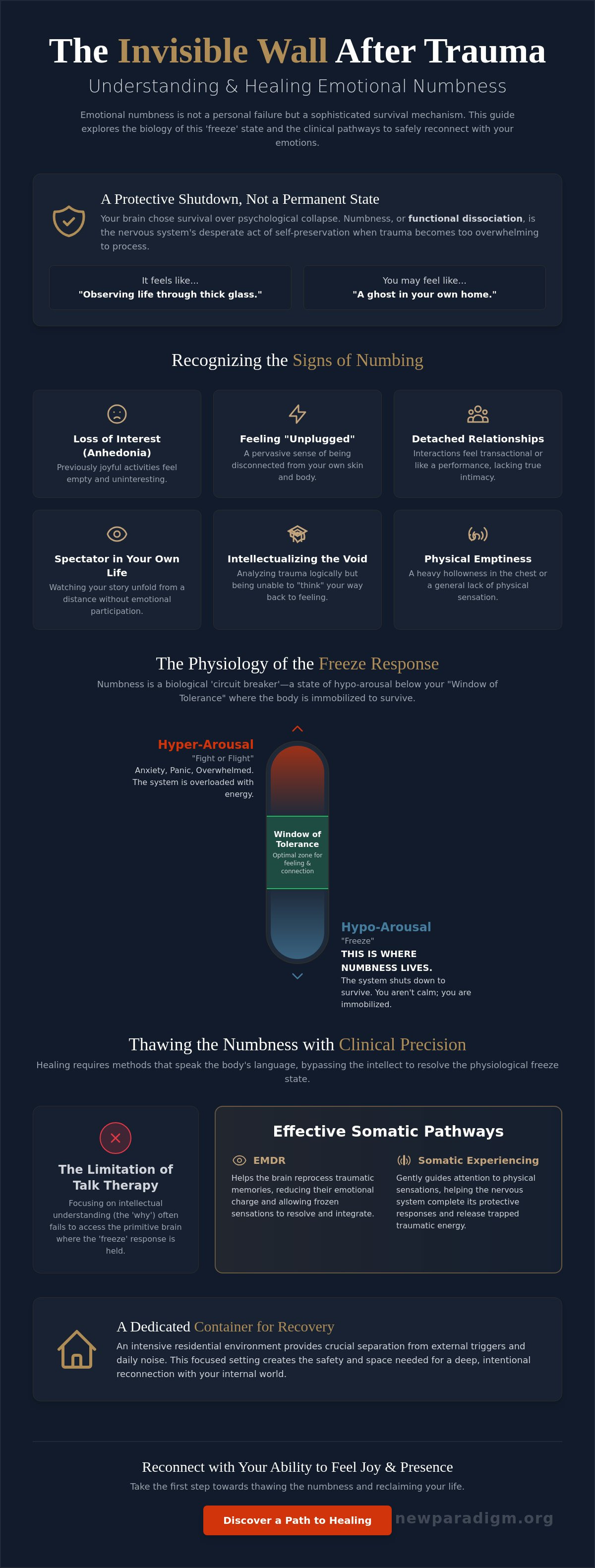
This internal shutdown rarely announces itself with a sudden shift. Instead, it's a slow erosion of presence. You might notice a profound loss of interest in previously joyful activities, a condition known as anhedonia. Relationships feel transactional rather than intimate. You become a spectator in your own story, watching your life unfold from a distance. Physically, this often manifests as a heavy hollowness in the chest or a pervasive sense of being "unplugged" from your own skin. It is the body's way of going offline to prevent further damage.
The High-Achiever’s Paradox: Intellectualizing the Void
For high-functioning individuals, the void is often masked by a sharp intellect. You might find yourself performing emotions for the sake of social cohesion, mimicking the cues of empathy or excitement while feeling nothing inside. This performance is draining. You try to think your way out of the fog, analyzing the trauma until you have a perfect logical map of why you feel this way. However, understanding the "why" does not provide the treatment for emotional numbness after trauma that you actually need. Logic is a function of the prefrontal cortex, but numbness is a lock on the primitive brain. Resolving it requires a somatic key rather than an intellectual one.
The Physiology of the 'Freeze' Response: Why You Can't Think Your Way Out
Imagine your nervous system as a complex electrical grid designed to handle specific loads of energy. Under normal stress, the system fluctuates within a manageable range. However, when a traumatic event occurs, the amygdala signals a level of danger that the body cannot outrun or fight. To prevent a total system overload, the brain flips a circuit breaker. This is the physiological reality of the freeze response. Emotional numbing is a trauma response designed to preserve the system from permanent damage. It is a biological fuse that blows to prevent an electrical fire. While this shutdown is protective in the moment, staying in this defensive state leads to a pervasive, hidden exhaustion. Your system is working overtime just to remain "off."
Most people are familiar with the "high" state of anxiety or hyper-arousal. Numbness exists at the opposite end of the spectrum. This is the Window of Tolerance, a clinical concept describing the zone where we can effectively process emotions. When the trauma is too great, we fall below the bottom of this window into a state of hypo-arousal. In this cellar of the nervous system, the body enters a forced stillness. You aren't calm; you are immobilized. Finding an effective treatment for emotional numbness after trauma requires recognizing that this isn't a mindset you can simply change with positive thinking.
The Neurobiology of Dissociation
The brain achieves this state by decoupling the emotional significance from the factual memory of the trauma. This process is mediated by the dorsal vagal complex, the most primitive part of our parasympathetic nervous system. When this circuit is active, heart rate drops, the pain threshold increases, and the world feels distant. Hypo-arousal is a state of physiological immobilization where the body is literally too "low" to feel. This biological wall is the primary obstacle in finding effective treatment for emotional numbness after trauma because the body has prioritized safety over sensation.
Why Traditional Talk Therapy Often Fails Numbness
Traditional talk therapy is a "top-down" approach. It relies on the prefrontal cortex, the part of the brain responsible for logic and language, to resolve the issue. But numbness is not a logical problem; it's a subcortical one. The "freeze" is stored in the limbic system and the brainstem, areas that don't speak the language of words. If you only talk about the void, you stay trapped in your head while the body remains frozen. Statistics show that first-line therapies often have civilian non-response rates around 39%, largely because they don't always reach these deeper physiological roots. If you feel like you've been performing wellness while remaining internally frozen, it may be time to explore a clinical path designed for deep reconnection.
Evidence-Based Pathways: Thawing the Numbness with Clinical Precision
Reconnecting with your internal world is not an act of willpower; it's a process of careful, clinical titration. You cannot simply force the "circuit breaker" back on without risking another system overload. Effective treatment for emotional numbness after trauma requires a path that respects the body’s need for safety while gently inviting it back to life. This isn't about superficial management or "thinking positive." It's about a precise, evidence-based thaw that addresses the physiological roots of your shutdown. We approach this work as compassionate realists, acknowledging the gravity of your internal collapse while providing the grounded, authoritative guidance necessary for recovery.
EMDR Therapy: Reprocessing the 'Frozen' Memory
Unlike traditional talk therapy, EMDR therapy sessions bypass the intellectual guardrails of the prefrontal cortex. This modality uses bilateral stimulation to access the subcortical areas where the "freeze" response is locked. The process relies on dual awareness. You remain anchored in the safety of the present moment while the brain finally reprocesses the traumatic memory that caused the initial shutdown. It moves the trauma from a "live" threat to a historical fact, allowing the nervous system to finally release its defensive posture.
Somatic and Contemplative Integration
Recovery involves learning to safely re-enter the body's sensations. We utilize Somatic Experiencing to help you notice the "edges" of your numbness without judgment. This work is steady, patient, and intentional. According to the National Institute of Mental Health, evidence-based psychotherapies are critical for addressing the complex symptoms of PTSD, including the persistent void of emotional blunting. By blending clinical methodology with contemplative practices, we create a secure container for you to experience small, manageable doses of feeling. This synergy is essential because safety is the absolute prerequisite for any emotional thaw. If you're ready to move beyond the performance of wellness and begin the work of deep, internal transformation, you can contact our clinical team to discuss a personalized path toward reconnection.
Intensive Residential Treatment: A Dedicated Container for Recovery
For those living in a state of chronic dissociation, the world feels thin and colorless. While weekly outpatient sessions provide valuable support, they often struggle to penetrate the deep, physiological "circuit breaker" we discussed earlier. Severe numbness requires more than a temporary reprieve; it requires a dedicated container where you can safely dismantle the walls your nervous system has built. This is why a Residential Trauma Treatment Program is often the most effective path for those seeking comprehensive treatment for emotional numbness after trauma. It is not a general leisure stay or a surface-level retreat. It is a personal environment designed for intensive internal work, isolated from the external noise that usually keeps your defensive systems on high alert.
Our approach in Chiang Mai, Thailand, provides a premium, protective atmosphere where the focus is entirely on your internal depth. We maintain a strictly limited and intentional capacity, ensuring that every individual receives the quiet authority of an expert team. This seclusion is not about escaping life, but about creating the safety necessary to re-enter it. By removing the demands of your professional and personal life, you allow your nervous system the space to finally step out of its "freeze" state and begin the process of thawing.
The Case for Intensive Intervention
One hour of therapy per week is often insufficient for deep unfreezing. In a residential setting, the clinical work is daily and cumulative. This intensity allows us to work through the layers of hidden exhaustion and intellectualized pain without the interruption of daily stressors. When you spend weeks in a focused clinical environment, the physiological shifts become more sustainable. You don't just talk about the void; you spend the time necessary to move through it. This immersive experience is what allows the brain to finally decouple the emotional meaning from traumatic memories, leading to a lasting sense of presence.
Transitioning to a New Paradigm of Living
The goal of specialized treatment is to move you from "coping" with numbness to experiencing active emotional vitality. Reconnection is a skill that must be practiced and protected. As you begin to feel again, our Aftercare Programs serve as the critical bridge to ensure these changes hold when you return to your world. We provide a structured path that supports your continued growth, helping you maintain the connection you've worked so hard to restore. If you are tired of feeling like a ghost in your own life, it is time for a deeper intervention. Learn more about our personalized trauma recovery programs at New Paradigm and discover how we can help you find your way back to your internal world.
Reclaiming Your Internal Vitality
Emotional numbness is a sophisticated biological safeguard, but it is not your permanent identity. You have learned that this internal silence is a physiological shutdown, a protective "freeze" that cannot be resolved through logic alone. True recovery requires moving beyond the performance of wellness and into the deep, somatic work of unfreezing the nervous system. By choosing a specialized treatment for emotional numbness after trauma, you are opting for a clinical methodology that respects the gravity of your experience while providing a safe, evidence-based path back to feeling.
At New Paradigm, we offer a boutique clinical facility with a strictly limited and intentional capacity. Our work is grounded in decades of professional experience and utilizes advanced EMDR and somatic interventions to facilitate a genuine internal thaw. This is not a generic wellness retreat; it's a protective container where you can finally address the hidden exhaustion of a life lived behind a glass wall. If you're ready to step out of the shadows and restore your capacity for joy and connection, we invite you to discover our specialized Residential Trauma Treatment Program in Chiang Mai. You don't have to navigate the void alone. There is a practical way through the fog, and a more vibrant, present version of yourself is waiting on the other side.
Frequently Asked Questions
Is emotional numbness after trauma permanent?
Emotional numbness is a functional adaptation of the nervous system, not a permanent structural change to your identity. It's a biological response that can be reversed through targeted clinical intervention. While the shutdown feels absolute, your capacity to feel remains intact beneath the defensive layer. Recovery is possible once the system perceives enough safety to release the "freeze" response and re-engage with the world once again.
Can EMDR therapy help if I can't feel anything during the session?
Yes, EMDR is specifically designed to work with the physiological remnants of trauma that logic cannot reach. You don't need to feel a specific emotion for the bilateral stimulation to begin reprocessing the frozen information. In fact, the numbness itself is the primary target. A skilled clinician uses the void as a starting point, helping your brain move past the blockage without forcing an emotional performance.
How long does it take to 'thaw' from emotional numbness?
The timeline for recovery is deeply individual and depends on the duration of the shutdown and the level of internal safety established. It's not a linear process but rather a series of gradual, rhythmic shifts. Intensive treatment for emotional numbness after trauma often accelerates this "thaw" by providing a consistent, protective container that allows the nervous system to remain in a processing state for extended, intentional periods.
Why do I feel numb even when I'm not thinking about the trauma?
Numbness is a physiological state of hypo-arousal, not merely a reaction to active thoughts. Your nervous system has adopted a defensive posture that remains active even when your mind is focused elsewhere. This is the "circuit breaker" effect where the body stays offline to prevent any potential over-stimulation. It is a background setting of your biology, which is why intellectual distraction doesn't dissolve the fog.
What is the difference between emotional numbness and clinical depression?
While they share symptoms like anhedonia, emotional numbness after trauma is primarily a dissociative defense rather than a mood disorder. Depression often involves heavy sadness or hopelessness, whereas numbing is characterized by a lack of any affect at all. It's the difference between feeling "bad" and feeling "nothing." Understanding this distinction is vital for selecting a clinical path that addresses the root physiological cause of the shutdown.
Can I recover from emotional numbness without revisiting the traumatic event?
You can recover without a detailed, narrative retelling of the event. Somatic and evidence-based treatment for emotional numbness after trauma focuses on the body's stored response rather than the story itself. By addressing the "freeze" at a physiological level, you can release the defensive state and restore emotional vitality without the risk of re-traumatization that sometimes accompanies traditional talk therapy methods that focus on verbal narratives.

Article by
Dirk J. Lambert (MSc. - CCTS-I)
Dirk J. Lambert is a Licensed Psychotherapist, Mentor, Author, and Certified Trauma & EMDR Specialist with more than 25 years of experience helping people recover from trauma, depression, burnout, emotional abuse, and long-standing unresolved pain. His work is known for being direct, compassionate, and highly practical.
A twice-ordained Buddhist monk, Dirk bridges clinical trauma care with mindfulness, discipline, self-observation, and deep emotional honesty. He does not hide behind jargon, labels, or unnecessary complexity. He listens carefully, speaks plainly, and works toward meaningful change.
New Paradigm reflects the philosophy he has built over decades: intentionally small, deeply personal, private by design, and focused on what actually helps people recover from the inside out rather than simply cope more elegantly.