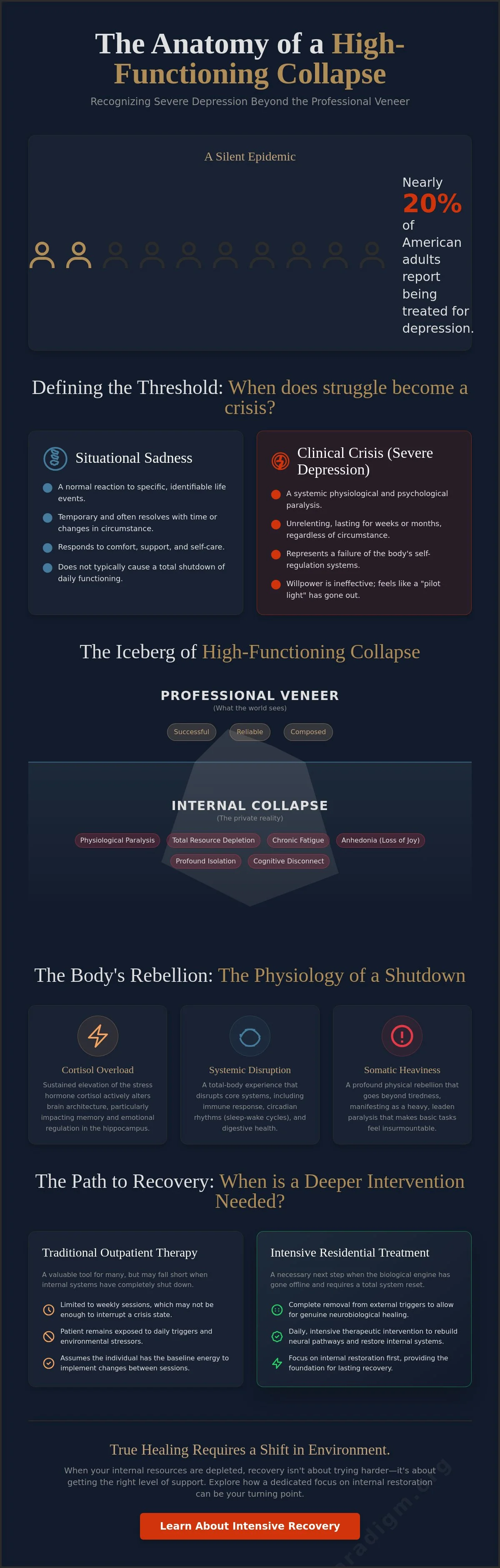
You can spend years perfecting the architecture of a successful life only to find that the foundation has quietly turned to ash. For many high achievers, the most dangerous aspect of their struggle is the ability to hide it; they maintain a professional veneer while experiencing a total internal collapse. It's a heavy, physiological paralysis that goes beyond a simple "rough patch." In early 2026, nearly 20 percent of American adults reported they were currently being treated for depression. When you're searching for the signs of severe depression, you aren't just looking for sadness; you're looking for the moment your internal resources have completely depleted.
We recognize that traditional talk therapy sometimes fails to reach the depths of this systemic shutdown. This article provides a clear framework to help you validate the gravity of your suffering and understand its physiological roots. We'll examine the specific cognitive and behavioral markers that signal it's time to step away from the noise. You'll gain a logical path toward intensive recovery and a better understanding of when professional residential intervention is the necessary next step for true healing.
Key Takeaways
- Distinguish between situational sadness and the systemic, physiological shutdown that characterizes a clinical crisis.
- Identify the physical signs of severe depression, including chronic fatigue and the neurological impact of prolonged cortisol elevation.
- Recognize the subtle behavioral red flags of a high-functioning collapse, where professional success masks a private state of paralysis.
- Understand why deep recovery often requires a complete removal from external triggers and daily therapeutic intervention.
- Evaluate when the limitations of traditional outpatient therapy indicate a need for more intensive, residential support.
Defining the Threshold: When Sadness Becomes Severe Depression
Severe depression is not merely an extension of sadness; it's a systemic state of psychological and physiological paralysis. While situational sadness typically responds to time, comfort, or a change in circumstances, the clinical shutdown of Major Depressive Disorder (MDD) represents a neurobiological emergency. By 2026, clinical perspectives have shifted to view these signs of severe depression as a total failure of the body's regulatory systems rather than a simple "mood" issue. It is the point where the internal pilot light goes out, leaving the individual in a cold, unresponsive state of being.
For many high-functioning individuals, this manifests as intellectualized pain. You may be able to describe your symptoms with clinical precision; you might even recognize the irrationality of your despair. However, your body cannot follow your mind's logic. This disconnect creates a profound sense of isolation, as the mind maps out the exit routes while the physical self remains anchored in a visceral, heavy exhaustion. It is a state where knowing the "why" does nothing to alleviate the "how" of your daily suffering.
To better understand this concept, watch this helpful video:
The Clinical vs. Experiential Reality
The DSM-5-TR provides the diagnostic scaffolding, but it often fails to capture the lived horror of a systemic collapse. When clinicians speak of "anhedonia," they are describing the literal death of joy; the inability to feel even a flicker of warmth from things that once defined your identity. Severe depression is the precise point where an individual's internal self-regulation mechanisms fail entirely. It is marked by a duration that stretches into weeks of unrelenting darkness and an intensity that makes basic survival feel like an insurmountable task.
The Myth of "Snapping Out of It"
The cultural stigma of "weakness" often prevents people from seeking the intensive care they require. In reality, the signs of severe depression are evidence of a biological engine that has gone offline. When your neurotransmitters are depleted and your neural pathways are locked in a stress response, willpower becomes an ineffective tool. You cannot "think" your way out of a physiological crisis any more than you can "think" a broken limb back together. Your exhaustion is not a character flaw; it is a legitimate medical symptom of a brain that is struggling to maintain its most basic functions.
At New Paradigm, we understand that this level of collapse requires more than a weekly conversation; it requires a complete shift in environment and a dedicated focus on internal restoration.
The Visceral Anatomy of Severe Depression: Beyond the DSM-5
The body is often the first witness to a psychological crisis. While diagnostic checklists focus on mood, the signs of severe depression frequently manifest as a profound physical rebellion. This isn't just a lack of energy; it's a systemic failure. When you live in a state of chronic clinical despair, your adrenal glands flood the system with cortisol. Over time, this sustained elevation doesn't just make you feel "stressed." It actively alters the architecture of the brain, specifically impacting the hippocampus, which is responsible for memory and emotional regulation. The result is a body that feels like it's under siege from the inside out.
According to research highlighted by the National Institute of Mental Health, depression is a total-body experience that disrupts everything from your immune response to your circadian rhythms. Understanding this physiological reality is crucial. It validates that your struggle isn't a failure of character, but a measurable biological event. If you find that your physical health is deteriorating alongside your mental state, it may be time to speak with a clinical professional who understands the depth of this intersection.
Physical Shutdown and Somatic Heaviness
Many individuals describe a sensation of leaden paralysis. It's a visceral weight where your limbs feel physically impossible to move, as if they've been cast in concrete. Sleep no longer provides restoration. You might find yourself trapped in the agitation of chronic insomnia or, conversely, seeking the "escape" of hypersomnia, where you sleep for twelve hours and wake up feeling even more depleted. This state often triggers digestive issues and a weakened immune system, leaving you vulnerable to recurring physical ailments that traditional medicine can't quite explain.
The Cognitive Fog: When Thinking Becomes Labor
In the depths of a severe episode, executive dysfunction takes hold. Simple decisions, such as what to eat or which shirt to wear, become grueling cognitive marathons. The world begins to feel muted. Colors lose their vibrancy; music sounds like distant noise; even your favorite foods may taste like ash. This sensory dampening is a protective shutdown, often rooted in the complex relationship between trauma and depression. When the nervous system can no longer process the intensity of your internal pain, it simply begins to dim the lights on your entire reality.
Behavioral Red Flags and the High-Functioning Collapse
High achievers often possess a remarkable capacity for compartmentalization. You may find yourself leading meetings, hitting targets, and maintaining a social calendar while an internal void grows larger every day. This phenomenon, often called "smiling depression," allows the signs of severe depression to remain invisible to colleagues and even family members. It isn't a lack of ambition that defines this state, but rather a desperate attempt to outrun a collapse that feels inevitable. You might rely on the NIMH Guide to Depression Signs and Symptoms to check your progress, but for the high-functioning individual, the markers are often more subtle and behavioral.
The most common objection we hear is the belief that because you're still performing at work, the situation isn't critical. This is a dangerous fallacy. Professional output is often the last pillar to crumble because it's tied to your identity and survival. However, when your career is the only thing left standing while your personal relationships and physical health have turned to dust, you aren't "coping." You're merely surviving. Social withdrawal becomes a survival mechanism; you stop answering texts and decline invitations because you simply don't have the metabolic energy to perform the "okay" version of yourself anymore.
The Mask of Competence
For the perfectionist, over-functioning acts as a shield against the internal shutdown. You might work longer hours not because of passion, but because the silence of home is unbearable. Irritability is frequently mislabeled as "high standards," and your withdrawal from friends is framed as being "too busy." If your professional life is thriving but your private life has completely evaporated, the threshold for intensive care has likely been crossed. This disconnect between outward success and private suffering is a primary indicator that your current path is unsustainable.
When Coping Mechanisms Fail
As the internal shutdown deepens, healthy habits are replaced by numbing behaviors. You might find yourself lost in hours of mindless scrolling, relying on alcohol to quiet the mind, or overworking to avoid feeling the weight in your chest. At this stage, passive suicidal ideation often emerges. It isn't necessarily a specific plan to cause harm, but a persistent, quiet wish to simply not wake up. If these behaviors resonate with your current reality, we invite you to reach out for a confidential assessment of your needs at New Paradigm.
From Recognition to Recovery: The Case for Intensive Residential Treatment
Once you recognize the visceral signs of severe depression, the question shifts from "what is happening?" to "how do I stop it?" Traditional outpatient models often expect you to heal while you're still submerged in the very environment that triggered your collapse. We believe this is a fundamental flaw in the current standard of care. True recovery requires a new paradigm; a deliberate, total removal from external noise to focus entirely on internal restoration. Choosing a residential trauma treatment program isn't a surrender or a sign of failure. It is a proactive hunt for health, designed to provide the space needed for deep, systemic healing.
In this protected environment, we utilize evidence based tools like EMDR and somatic therapies to reprocess the roots of your depression. Rather than waiting a week between sessions to discuss your struggles, you engage in daily, intensive work. This frequency allows for a momentum that outpatient care simply cannot match. It addresses the physiological shutdown by providing a consistent, safe container where your nervous system can finally begin to regulate itself. We don't just manage symptoms; we work to resolve the underlying trauma that anchors the depressive state.
Why Outpatient Care Often Stalls
Many high achievers find themselves in a "one step forward, two steps back" cycle. You might have a breakthrough in a Tuesday afternoon therapy session, only to have that progress erased by a Wednesday morning crisis at the office. This environment makes it nearly impossible to sustain the neurobiological changes required for recovery. Our burnout recovery programs are specifically designed to halt this professional collapse. By providing a 24/7 supportive container, we ensure that you don't have to navigate the hardest moments of your recovery in isolation.
The Path Forward at New Paradigm
At New Paradigm, our philosophy is rooted in Compassionate Realism. We don't offer superficial positivity or generic wellness; we provide a sophisticated, clinical environment for individuals who require depth and absolute privacy. Our facility maintains an extremely limited capacity to ensure that your recovery is intentional and focused. If you've reached the point where the signs of severe depression have become impossible to ignore, we invite you to step out of the noise. The path to reclamation begins with a single, clear decision to prioritize your internal world. Reach out to our clinical team today to discuss your path toward intensive recovery.
Reclaiming Your Internal Landscape
Severe depression is more than a persistent weight; it is a systemic biological emergency that demands an equally systemic response. You've seen how the signs of severe depression manifest through physical paralysis, cognitive fog, and the exhausting effort of maintaining a professional mask. When weekly therapy no longer bridges the gap between your public success and private suffering, it is a signal that your nervous system requires a different environment to heal. True transformation requires more than just coping; it requires a total realignment of your internal state.
At New Paradigm, we don't offer generic wellness or superficial management. We provide a boutique environment with a strictly limited capacity; this ensures your recovery is both private and deeply intentional. Our clinical team combines decades of expertise with evidence-based EMDR and somatic therapies to address the root causes of your shutdown. This is a space designed for intensive internal work, far removed from the noise and triggers of your daily life. It is a place where you can finally stop performing and start the grounded work of restoration.
Begin your journey to recovery with our private residential program. You don't have to navigate this collapse alone. There is a practical, logical path back to yourself.
Frequently Asked Questions
How do I know if my depression is "severe" enough for residential treatment?
Residential treatment is appropriate when your symptoms have created a state of functional paralysis that traditional outpatient therapy cannot penetrate. If you find yourself unable to perform basic self-care, maintain personal safety, or if your professional life is on the verge of a total collapse, the threshold has been crossed. It isn't about a specific score on a test; it's about the failure of your current support systems to provide meaningful relief.
Can severe depression cause physical pain or illness?
Severe depression frequently manifests as physical pain, including chronic headaches, joint pain, and significant digestive distress. These aren't "imaginary" symptoms; they're the result of a nervous system locked in a state of high alert. Chronic cortisol elevation can weaken your immune system and lead to recurring illnesses. Recognizing these physical signs of severe depression is essential for a comprehensive recovery plan that treats the body alongside the mind.
What is the difference between severe depression and professional burnout?
While burnout is primarily a response to chronic workplace stress, severe depression is a pervasive state that persists even when the work environment is removed. Burnout often improves with rest and boundary setting; clinical depression does not. If a month of leave doesn't alleviate your sense of internal void or leaden fatigue, you're likely dealing with a deeper clinical episode that requires professional intervention rather than just a career change.
Is it possible to recover from severe depression if therapy hasn't worked before?
Recovery is absolutely possible even if traditional talk therapy has failed to provide lasting results in the past. Often, the issue isn't your "resistance" but the limitations of the outpatient environment and the specific therapeutic modality being used. Intensive residential care allows for deeper work using tools like EMDR and somatic therapies that reprocess trauma at a nervous system level. This immersive approach provides a dedicated container for healing that weekly sessions simply cannot offer.
What happens if I ignore the signs of severe depression?
Ignoring the signs of severe depression often leads to a total systemic collapse that affects your physical health, cognitive abilities, and social connections. Untreated depression can cause lasting changes in brain architecture, specifically in areas related to memory and emotional regulation. Over time, the energy required to "mask" your suffering will deplete entirely. This typically leads to a crisis that requires emergency intervention rather than a planned, proactive path toward recovery.
How long does a typical residential program for depression last?
The duration of a residential program depends entirely on your clinical needs and the depth of the underlying trauma. Most intensive programs range from 30 to 90 days to allow the nervous system sufficient time to stabilize and integrate new regulatory mechanisms. At New Paradigm, the focus is on achieving a sustainable internal shift rather than adhering to a rigid calendar. We prioritize a pace that ensures you're truly ready for a successful transition back to your daily life.

Article by
Dirk J. Lambert (MSc. - CCTS-I)
Dirk J. Lambert is a Licensed Psychotherapist, Mentor, Author, and Certified Trauma & EMDR Specialist with more than 25 years of experience helping people recover from trauma, depression, burnout, emotional abuse, and long-standing unresolved pain. His work is known for being direct, compassionate, and highly practical.
A twice-ordained Buddhist monk, Dirk bridges clinical trauma care with mindfulness, discipline, self-observation, and deep emotional honesty. He does not hide behind jargon, labels, or unnecessary complexity. He listens carefully, speaks plainly, and works toward meaningful change.
New Paradigm reflects the philosophy he has built over decades: intentionally small, deeply personal, private by design, and focused on what actually helps people recover from the inside out rather than simply cope more elegantly.