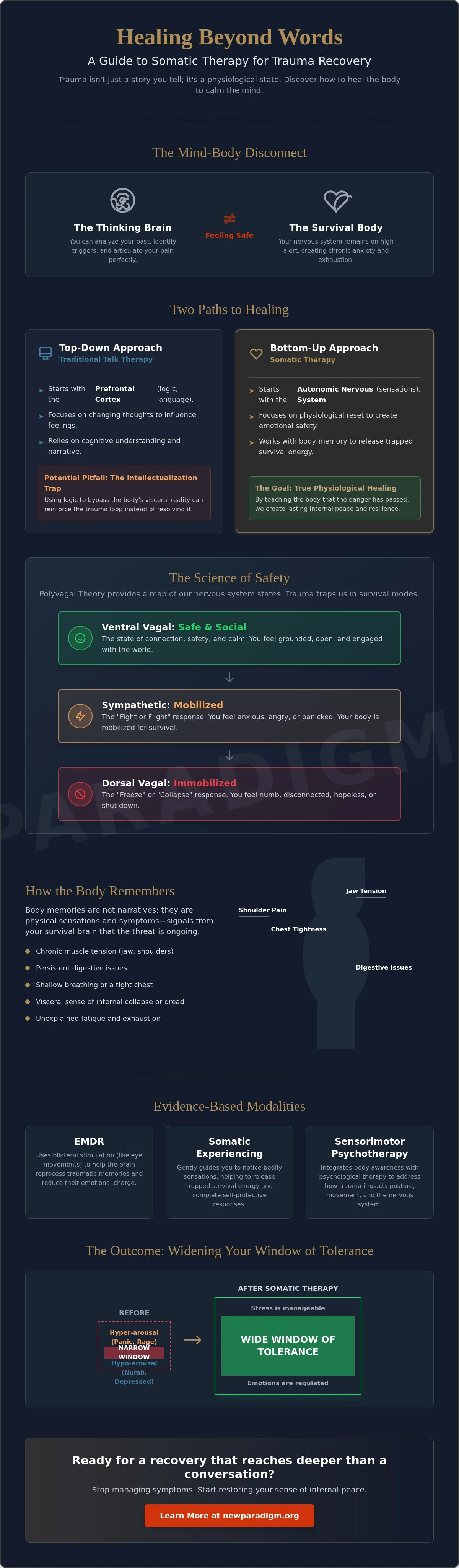
Why does your body still feel like it's in danger even though you've spent years talking through your past in therapy? You've analyzed the memories, identified the triggers, and mastered the language of your struggle, yet the chronic exhaustion and that underlying hum of anxiety remain. It's a frustrating paradox: you can explain your pain perfectly, but you can't think your way into feeling safe. This disconnect exists because trauma isn't just a story you tell; it's a physiological state. Utilizing somatic therapy for trauma recovery allows you to move past the intellectualization of your history and address the survival responses still firing in your nervous system.
You deserve a recovery that reaches deeper than a conversation. We understand that true healing requires a physiological reset rather than just a cognitive achievement. In this guide, you'll discover how somatic therapy bridges the gap between clinical psychology and biological healing to resolve the body-memory of your past. We will explore the shift toward bottom-up processing, the role of Polyvagal Theory in restoring vitality, and how evidence-based modalities like EMDR and Sensorimotor Psychotherapy provide a path out of the freeze response. It's time to stop managing your symptoms and start restoring your sense of internal peace.
Key Takeaways
- Understand why trauma resides in the autonomic nervous system rather than just cognitive memory, requiring a shift from thinking to physiological healing.
- Identify how the intellectualization trap serves as a defense mechanism that prevents deep recovery by bypassing the survival brain's need for safety.
- Discover how specialized techniques like EMDR therapy sessions and somatic therapy for trauma recovery release trapped energy to complete the body's natural threat response cycle.
- Explore why intensive residential environments offer the necessary isolation to re-pattern the nervous system beyond what a standard therapy hour can provide.
Understanding Somatic Therapy for Trauma Recovery
Traditional therapy often starts with the mind, assuming that if we change our thoughts, our feelings will eventually follow. This is a top-down approach. However, somatic therapy for trauma recovery reverses this hierarchy. It's a bottom-up clinical intervention that prioritizes the body's physiological state. We recognize that for many, trauma isn't just a memory of what happened; it's a persistent state of the autonomic nervous system. It's the feeling of a racing heart, a hollow chest, or a sudden tightening in the throat that persists long after the threat has vanished.
When you live with unresolved trauma, your Window of Tolerance often shrinks. This window represents the zone where you can manage your emotions and function effectively. Outside this zone, you either spiral into hyper-arousal, such as panic or rage, or collapse into hypo-arousal, characterized by numbness and depression. Unlike general wellness practices or massage therapy, which focus on temporary relaxation, this is a targeted clinical process. At New Paradigm Mental Health Retreat, we use these principles to widen that window through intentional re-patterning of the nervous system. It's about moving beyond superficial management and into deep, internal transformation.
To better understand the connection between your physical state and your emotional well-being, watch this helpful video on restoring safety through the body:
How the Body Remembers What the Mind Forgets
Body memories manifest as physical sensations rather than clear narratives. You might experience chronic tension in your jaw, persistent digestive issues, or a visceral sense of internal collapse that no amount of sleep seems to fix. These aren't just symptoms; they're signals from the amygdala and the HPA axis keeping your biology on high alert. Somatic therapy serves as the clinical bridge between physiological arousal and psychological meaning. By working with Somatic Experiencing, practitioners help you release the survival energy that became stuck during the original event. This process allows the body to finally acknowledge that the danger has passed.
The Science of the Nervous System
Modern trauma recovery is anchored in Polyvagal Theory, which centers on the Vagus nerve's role in emotional regulation. Your nervous system typically moves between three distinct states. Ventral Vagal is the state of social engagement, safety, and connection. Sympathetic is the mobilization of fight or flight energy. Dorsal Vagal is the immobilization of freeze or collapse when a threat feels inescapable. Trauma often leaves you trapped in those survival states, leading to the hidden exhaustion common in high-achievers. Somatic work provides a concrete map to navigate back to regulated safety. It isn't about ignoring the story, but about teaching the body that the story has ended.
Why Talk Therapy Often Fails for Complex Trauma
Many high-achieving individuals enter the therapeutic process with a sharp intellect and a polished narrative. They've analyzed their history, identified their patterns, and mastered the language of their struggle. Yet, despite this cognitive clarity, the internal collapse remains. This is the intellectualization trap. It's a sophisticated defense mechanism that uses logic to bypass the visceral reality of pain. When you use your mind to explain away your suffering, you aren't healing; you're simply managing the story from a safe distance.
Traditional talk therapy relies on a top-down approach, assuming that the prefrontal cortex can govern the rest of the brain. However, trauma doesn't live in the prefrontal cortex. It resides in the survival brain, an area that doesn't speak in words or logic. Recounting traumatic stories without physiological grounding often leads to re-traumatization. Instead of resolving the event, you're simply reinforcing the trauma loop in your nervous system. For those struggling with treatment-resistant depression or chronic anxiety, somatic therapy for trauma recovery provides the missing link by addressing the biological roots of the distress. If you feel stuck in this cycle, you might consider reaching out to a specialist for professional guidance.
The Limits of Cognitive Processing
During a trauma trigger, the prefrontal cortex essentially shuts down. This part of the brain is responsible for reasoning and speech, which is why you often find yourself speechless or unable to "think straight" when overwhelmed. While Cognitive Behavioral Therapy (CBT) is effective for many issues, it can't reach the parts of the brain that are stuck in a survival response. High-functioning individuals often excel at talk therapy because they can discuss their trauma with clinical detachment, but their bodies remain in a state of high alert. Utilizing a somatic connection for healing allows you to access the physiological layers that logic cannot touch.
Moving from "Why" to "How"
To find true resolution, we must shift the inquiry. We stop asking "Why did this happen?" and begin asking "How is my body holding this right now?" This shift moves you away from the narrative and into a felt-sense resolution. It's the difference between knowing you are safe and actually feeling safe in your own skin. Breaking the cycle of intellectualization often requires a dedicated, immersive environment where you can focus entirely on your internal state. Programs like our Residential Trauma Treatment Program are designed specifically to facilitate this deep nervous system re-patterning, providing the isolation and peace necessary for profound transformation.
Core Modalities: From Somatic Experiencing to EMDR
Effective healing requires more than a single technique. It demands a suite of physiological tools designed to meet the nervous system where it lives. Choosing the right modality is essential when seeking somatic therapy for trauma recovery. These methods are not superficial exercises in relaxation; they are precise clinical interventions. They work by addressing the biological "stuckness" that remains long after a traumatic event has ended. By blending clinical methodology with contemplative practices, we provide a structured path to move from internal collapse to a state of regulated vitality.
To ensure safety, practitioners utilize two foundational principles: titration and pendulation. Titration is the clinical process of breaking down traumatic charge into small, manageable pieces to ensure the nervous system remains regulated. Pendulation involves the rhythmic shift between areas of tension and areas of resource or safety within the body. This approach prevents the "flooding" often experienced in traditional exposure therapies. It allows you to process the past without being consumed by it.
Somatic Experiencing (SE): Releasing the Freeze Response
Developed by Peter Levine, Somatic Experiencing is based on the observation of animals in the wild. Animals frequently experience life-threatening stress but rarely suffer from long-term trauma because they instinctively "shake off" the survival energy once the danger passes. Humans often suppress these natural discharges due to social conditioning or fear. In an SE session, a practitioner helps you track visceral sensations like heat, trembling, or tension. By staying present with these signals, you can finally complete the thwarted survival response and release the energy trapped in your tissues. It is a slow, intentional process of teaching your body that the threat is gone.
EMDR Therapy: Reprocessing the Physiological Stuckness
Eye Movement Desensitization and Reprocessing (EMDR) acts as a physiological bridge for memories that have been stored incorrectly. During EMDR therapy sessions, bilateral stimulation, such as guided eye movements or rhythmic taps, is used to activate both hemispheres of the brain. The process mimics the rapid eye movement (REM) sleep phase, which is when the brain naturally sorts and files experiences. This synergy between EMDR and somatic grounding ensures that as you reprocess a memory, your body stays anchored in the present moment. This integrated approach to somatic therapy for trauma recovery ensures that no part of your experience is left behind. If you are ready to move beyond the narrative of your past, you can speak with a clinical specialist about our intensive recovery options.
Integrating Somatic Healing into Residential Recovery
Many people attempt to resolve years of physiological trauma through a single 50-minute session once a week. While this provides a degree of support, it's often insufficient for deep nervous system re-patterning. Trauma isn't a part-time experience; it's a constant biological state. Attempting to down-regulate your nervous system in an hour while returning immediately to the stressors of your daily life creates a cycle of temporary relief followed by rapid re-activation. For those stuck in a chronic state of survival, the standard outpatient model can feel like trying to empty an ocean with a teaspoon.
True somatic therapy for trauma recovery requires a sustained period of safety and isolation from external noise. It isn't about a leisure stay. It's about an intensive internal focus. At New Paradigm, we maintain an extremely limited capacity to ensure every individual receives the clinical attention necessary for their specific survival responses. This exclusivity isn't just about premium service; it's a core requirement for maintaining the psychological and physiological safety needed for deep work. By removing the demands of your professional and personal life, you create the space for your body to finally acknowledge that the danger has passed.
The Intensity of Inpatient Somatic Intervention
A residential stay creates a compounded effect that weekly therapy cannot match. Daily somatic work allows the body to stay in a state of processing rather than constantly resetting to a baseline of stress. Our Burnout Recovery Program utilizes these principles to help high-achievers address the hidden exhaustion that persists despite their outward success. The physical environment in Chiang Mai acts as a clinical tool, providing a tranquil atmosphere that naturally supports the parasympathetic nervous system. This setting encourages a transition out of chronic fight-or-flight and into a state of restorative rest.
Creating a Sanctuary for Nervous System Reset
The journey from internal collapse to grounded vitality isn't a linear path. It requires a "Compassionate Realist" approach that acknowledges the gravity of your suffering while providing a clear methodology for recovery. In our sanctuary, the focus is on the "how" of your internal experience. We help you navigate the transition from a frozen, defensive state to one of fluid, embodied presence. Once this reset is achieved, the focus shifts to sustainability. Our clinical aftercare program ensures that the new patterns of safety you've established are integrated into your life back home. If you're ready to move beyond the story and into a life of restored vitality, you can contact New Paradigm to discuss your residential recovery path.
Restoring Your Internal Sense of Safety
The path toward recovery requires more than understanding your past; it demands a fundamental shift in how your nervous system responds to the present. You've likely spent years analyzing the "why" of your struggle, yet the hidden exhaustion and internal collapse persist. By embracing somatic therapy for trauma recovery, you move beyond the limits of logic and address the survival responses stored within your biology. True transformation happens when your body finally feels the safety that your mind has long tried to rationalize.
At New Paradigm, we provide a sanctuary designed for this deep, internal work. Our clinically-led residential facility in Chiang Mai, Thailand, offers a boutique environment with a strictly limited capacity. This intentional focus ensures the personalized safety and isolation from external noise necessary for a complete nervous system reset. Through the specialized integration of EMDR and Somatic Experiencing, we help you navigate the journey from a state of chronic high alert to one of grounded vitality.
Begin your somatic healing journey; Contact New Paradigm today to explore how our intensive programs can help you resolve the body-memory of trauma. You don't have to remain trapped in a cycle of intellectualized pain. There is a practical, evidence-based methodology for navigating through the hardship and reclaiming your life.
Frequently Asked Questions
Is somatic therapy safe for people with severe PTSD?
Somatic therapy is safe for severe PTSD when conducted by clinically trained practitioners who utilize titration to prevent nervous system flooding. This method ensures you aren't overwhelmed by traumatic material by processing it in small, manageable segments. It isn't a "no-pain, no-gain" approach; rather, it's a careful recalibration of your survival responses. This controlled process allows your biology to find a sense of safety that logic alone cannot provide.
How many sessions of somatic therapy are needed for trauma recovery?
The duration of somatic therapy for trauma recovery varies based on the complexity of your history and the state of your nervous system. Research indicates that for single-event trauma, 84 to 90 percent of victims no longer have PTSD after three sessions of EMDR. Those with multiple traumas may require six or more sessions. Deep re-patterning of chronic, long-term survival states often requires the sustained clinical commitment found in intensive residential programs.
Can somatic therapy be done alongside traditional talk therapy?
Somatic work can be integrated with traditional talk therapy to bridge the gap between cognitive understanding and physiological healing. While talk therapy addresses the narrative of what happened, somatic techniques resolve the biological "stuckness" in the body. Using both allows you to process the meaning of your trauma while simultaneously regulating the autonomic nervous system. It's an effective way to ensure your intellectual insights are matched by felt-sense resolution.
What does a typical somatic therapy session feel like?
A typical session feels like a guided exploration of your internal landscape. You'll work with a practitioner to track visceral sensations such as heat, muscle tension, or tingling as they arise. It isn't about recounting every detail of your story; it's about noticing how your body holds the memory. You may experience a sense of release, such as deep breathing or a reduction in chronic tension, as your nervous system completes thwarted survival responses.
Why is a residential setting better for somatic trauma healing?
A residential setting is superior because it provides the isolation from external noise required for intensive internal transformation. Unlike weekly outpatient appointments, a residential trauma treatment program allows for daily clinical intervention and a consistent state of safety. This immersive environment prevents the rapid re-activation that often occurs when you return to a stressful home or work life immediately after a session. It allows the nervous system to stay in a restorative state.
What is the difference between Somatic Experiencing and EMDR?
Somatic Experiencing focuses on completing the physiological threat response cycle by releasing trapped survival energy stored in the body. EMDR therapy sessions use bilateral stimulation to re-file traumatic memories that have been stored incorrectly in the brain. While SE works primarily with the body's sensations to resolve the freeze response, EMDR acts as a physiological bridge to reprocess specific traumatic events into a narrative that no longer feels threatening to your biology.
Article by
Dirk J. Lambert (MSc. - CCTS-I)
Dirk J. Lambert is a Licensed Psychotherapist, Mentor, Author, and Certified Trauma & EMDR Specialist with more than 25 years of experience helping people recover from trauma, depression, burnout, emotional abuse, and long-standing unresolved pain. His work is known for being direct, compassionate, and highly practical.
A twice-ordained Buddhist monk, Dirk bridges clinical trauma care with mindfulness, discipline, self-observation, and deep emotional honesty. He does not hide behind jargon, labels, or unnecessary complexity. He listens carefully, speaks plainly, and works toward meaningful change.
New Paradigm reflects the philosophy he has built over decades: intentionally small, deeply personal, private by design, and focused on what actually helps people recover from the inside out rather than simply cope more elegantly.