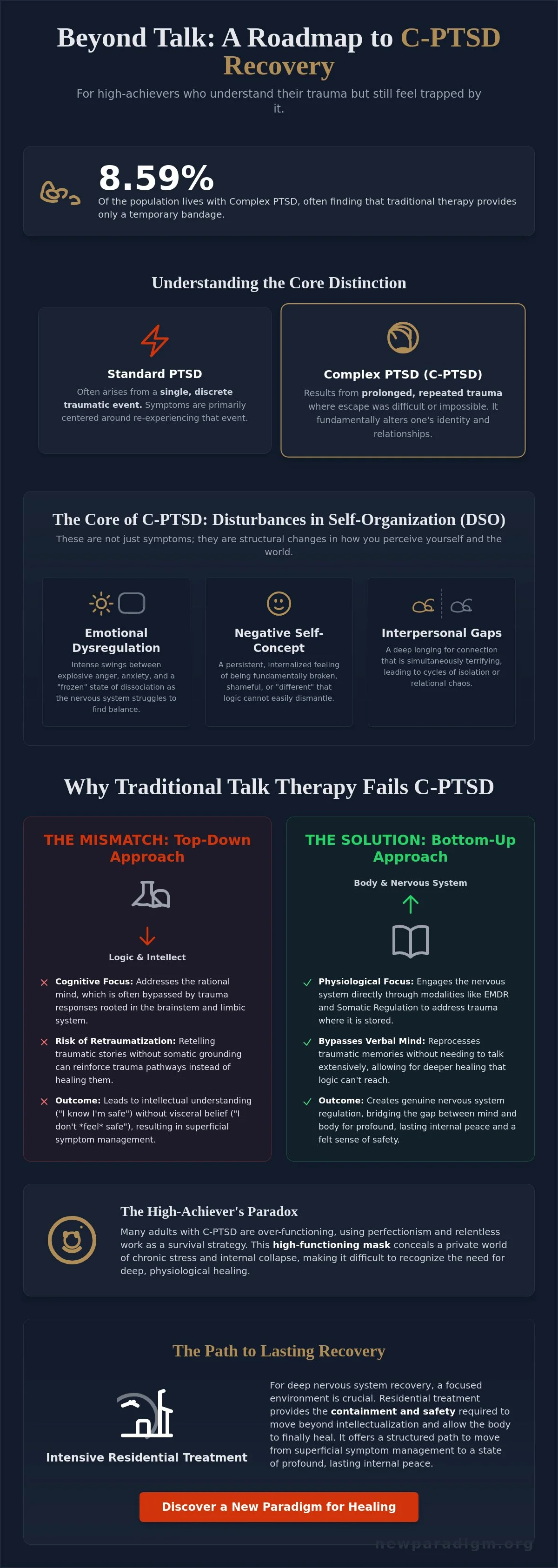
What if the reason you haven't found relief isn't a lack of effort, but a mismatch in methodology? You might be part of the 8.59% of the population living with Complex PTSD who find that intellectualizing their trauma only provides a temporary bandage. For many high-achieving individuals, the search for effective therapy for complex PTSD (c-ptsd) in adults often leads to a frustrating cycle of talk therapy that addresses the mind while leaving the body in a state of chronic, hidden exhaustion. You understand your history perfectly, yet the visceral sense of dread and relational chaos remains unchanged.
It's exhausting to maintain a veneer of professional success while your internal world feels like it's constantly collapsing. Real recovery is not about learning to cope with your triggers or simply managing your daily stress. We've seen that traditional approaches often fail because C-PTSD is a disorder of the nervous system, not just a collection of intrusive thoughts. This article will show you why deep recovery requires moving beyond simple symptom management. We'll explore the intensive, evidence-based modalities like EMDR and somatic regulation that align with the latest APA guidelines for integrated, sequential care. You'll discover a clear roadmap for nervous system regulation that promises a path toward a life that feels grounded, quiet, and finally, your own.
Key Takeaways
- Understand the clinical distinction between standard PTSD and the triad of self-organization disturbances that impact your identity and relationships.
- Learn why top-down approaches often fail to reach the deep-seated physiological roots of prolonged trauma.
- Discover how specialized therapy for complex PTSD (c-ptsd) in adults, including EMDR, reprocesses trauma by bypassing the verbal mind.
- Identify why a focused residential setting is often necessary to provide the containment and safety your nervous system requires for recovery.
- Gain a clear perspective on moving beyond superficial symptom management toward a state of profound, lasting internal peace.
What is Complex PTSD (C-PTSD) in Adults? Beyond the Flashback
Most people understand PTSD as a reaction to a single, violent event. However, Complex post-traumatic stress disorder (C-PTSD) is fundamentally different. It arises from prolonged, repeated trauma where escape is physically or psychologically impossible, such as childhood neglect, long-term domestic abuse, or systemic captivity. While the ICD-11 recognizes the core symptoms of PTSD, it adds a specific triad of symptoms known as Disturbances in Self-Organization (DSO). These are not merely memories; they are structural changes in how you perceive yourself and the world. Complex PTSD is a physiological adaptation to chronic unsafety, rather than a character flaw or a lack of resilience.
To better understand how these adaptations shape your daily life, watch this helpful video summary of core recovery concepts:
The Triad of DSO: Emotional Dysregulation, Negative Self-Concept, and Interpersonal Gaps
The "Complex" in C-PTSD refers to the pervasive nature of these three specific disturbances. They often create a sense of internal collapse that persists long after the external threat has passed. When seeking therapy for complex PTSD (c-ptsd) in adults, it is vital to address these specific layers:
- Emotional Dysregulation: You may experience intense swings between explosive anger and a "frozen" state of dissociation. This is your nervous system struggling to find a middle ground between hyper-vigilance and total shutdown.
- Negative Self-Concept: This is the persistent, heavy feeling of being fundamentally "broken," "different," or "shameful." It is an internalized version of the trauma that logic cannot easily dismantle.
- Interpersonal Gaps: You might feel a deep longing for connection while simultaneously finding intimacy terrifying. This leads to a cycle of isolation or relational chaos that feels impossible to break.
How C-PTSD Manifests in High-Achieving Adults
Many adults with C-PTSD are not visibly struggling; they are over-functioning. You might be the most reliable person in your office, using "fawn" or "flight" responses to stay safe through perfectionism and relentless work. This high-functioning mask allows you to excel professionally while you collapse privately under the weight of hidden exhaustion.
The danger for high-achievers is the trap of intellectualization. You use logic and professional expertise to distance yourself from visceral body pain. You can explain your trauma with clinical precision, yet your body remains trapped in a state of chronic stress. This disconnect is why traditional talk therapy often fails to provide relief. For those who have reached the limit of what intellectual understanding can provide, a Residential Trauma Treatment program offers a necessary environment to move beyond the mask and begin genuine nervous system recovery. Effective therapy for complex PTSD (c-ptsd) in adults must eventually bridge the gap between what the mind knows and what the body feels.
Why Traditional Talk Therapy Often Fails for Complex Trauma
Many high-achievers walk into a therapist's office expecting a cognitive solution to a physiological problem. They assume that if they can name the trauma, they can conquer it. This is the central fallacy of traditional talk therapy for complex PTSD (c-ptsd) in adults. While cognitive approaches are effective for many conditions, they often hit a wall with complex trauma because C-PTSD lives in the brainstem and limbic system, areas inaccessible to pure logic. When you rely solely on a "top-down" approach, you're asking the rational mind to manage a survival response that has already bypassed it.
There's also a significant risk of re-traumatization in traditional settings. Retelling a traumatic story without somatic grounding isn't healing; it's often just rehearsing the pain. This reinforces the traumatic loops in the brain rather than resolving them. For the high-achieving adult, this often leads to the intellectualization trap. You talk about your history with clinical detachment, using logic to distance yourself from the visceral tremors or hidden exhaustion in your body. It's a sophisticated form of avoidance that feels like progress but leaves the underlying nervous system state unchanged. If you find your professional drive is masking a deeper internal collapse, exploring a Burnout Recovery Program: A Clinical Guide can help you understand how chronic trauma often mimics professional fatigue.
The Role of the Nervous System in C-PTSD Recovery
Healing requires an understanding of your Window of Tolerance. Pushing through a session when you feel overwhelmed often leads to a sympathetic spike or a dorsal vagal collapse. Recovery is not a matter of cognitive willpower; it is a physiological recalibration. From a Polyvagal perspective, the goal is to shift from a state of chronic shutdown or agitation into a state of ventral vagal safety. You can't think your way into safety. Safety must be felt in the tissues and the breath before any meaningful cognitive work can begin.
The Need for Specialized Trauma Modalities
Effective evidence-based treatment for C-PTSD moves beyond simple management toward deep reprocessing of traumatic memory. This requires a therapist who understands that relational trauma is a marathon, not a sprint. It involves moving from "talking about" the past to "processing through" the physical sensations the past left behind. If you are ready to move beyond superficial management and start the work of internal transformation, you may wish to speak with a clinical specialist about an intensive, evidence-based approach to recovery.
Evidence-Based Therapy for C-PTSD: EMDR and Somatic Approaches
Recovery from complex trauma isn't a matter of willpower. It's a matter of biological recalibration. While standard PTSD treatment approaches often focus on managing symptoms through cognitive behavioral tools, effective therapy for complex PTSD (c-ptsd) in adults requires modalities that reach the subcortical brain. This is where Eye Movement Desensitization and Reprocessing (EMDR) becomes indispensable. EMDR is a tool that allows the brain to resume its natural healing process by unblocking stuck memories. By using bilateral stimulation, it bypasses the verbal mind, allowing traumatic material to move from a state of active crisis to a settled past.
Somatic Experiencing complements this by addressing the "thwarted survival energy" trapped in the physical body. When a person is unable to fight or flee during a traumatic event, that energy stays locked in the nervous system. It manifests as chronic tension, fatigue, or a persistent sense of dread. Relational therapy then provides the container for this work, using the therapeutic bond to heal the deep attachment wounds that are often at the core of C-PTSD. It's not enough to heal the memory; one must also heal the capacity for connection.
EMDR for C-PTSD: A Modified Approach
For those with complex histories, standard EMDR protocols are often too intense to start immediately. We prioritize a modified approach where "Phase 2," or Resource Installation, is significantly longer and more critical. This involves building internal "safe places" and emotional anchors before any core trauma is addressed. This preparation ensures you don't destabilize during the process. While weekly one-hour appointments can feel like opening a wound only to close it before progress is made, intensive EMDR sessions allow for sustained, deep work that respects the complexity of your history.
Integrating Somatic and Cognitive Modalities
A truly effective plan for therapy for complex PTSD (c-ptsd) in adults is rarely a single-modality effort. It is a multi-modal integration. We often incorporate Dialectical Behavior Therapy (DBT) to provide immediate skills for emotional regulation and distress tolerance. This "bottom-up" approach starts by calming the body to eventually clear the mind. By integrating somatic awareness with cognitive stability, we create a path to recovery that feels permanent rather than performative. If you're ready to explore these evidence-based modalities in a focused environment, you can request a clinical consultation to discuss a personalized treatment path.
The Case for Intensive Residential Treatment in 2026
For many high-achieving individuals, the traditional model of weekly therapy for complex PTSD (c-ptsd) in adults feels like trying to extinguish a forest fire with a garden hose. You might find a moment of clarity during a Tuesday session, only to have that progress undone by professional triggers on Wednesday. This cycle of "one step forward, two steps back" is not a failure of your will; it's a limitation of the outpatient environment. Real recovery from deep-seated trauma often requires a level of containment that daily life cannot provide. A residential setting creates a 24/7 environment of safety, allowing your nervous system to finally down-regulate from a state of perpetual alarm to a state of receptive healing.
Isolation from external "noise" is not a luxury. It is a clinical necessity for those dealing with internal collapse and hidden exhaustion. By removing the immediate demands of work and family, you create the space required for intensive somatic and psychological work. In the quiet clinical setting of Chiang Mai, we leverage the natural spiritual calm and surrounding nature to support your physiological recovery. This environment isn't a distraction; it's a protective boundary that ensures your energy is directed entirely toward your internal transformation. Within this space, the power of a therapeutic community becomes evident. Healing relational wounds often requires the shared experience of others who understand the gravity of your struggle, providing a mirror for your own recovery.
Why Intensity Matters for Complex Trauma
The cumulative effect of daily clinical intervention and somatic work cannot be overstated. When you engage in therapy for complex PTSD (c-ptsd) in adults within an intensive framework, you bypass the "re-entry" stress that occurs between weekly appointments. This allows for a deeper dive into traumatic reprocessing without the constant interruption of survival-based obligations. If you are considering this level of care, our Mental Health Facility Thailand: A Clinical Guide provides a detailed look at how we structure this journey toward reclaimed life.
Compassionate Realism: Choosing a Path Forward
We approach this work with a sense of compassionate realism. A residential program is not a "spa stay" or a temporary escape; it's a rigorous clinical journey that acknowledges the somber reality of your suffering. We maintain an extremely limited capacity to ensure that every individual receives the personalized, protective care they deserve. This focused attention is the hallmark of a premium service designed for those who value depth and permanent results. The first step is often the hardest, as it requires you to move from a state of "surviving" your private relational chaos to "living" with a grounded, quiet confidence. You don't have to navigate the depths of your struggle alone.
Reclaiming Your Life Through Deep Nervous System Recovery
True healing begins when you stop trying to manage your symptoms and start addressing the physiological roots of your distress. You've likely spent years intellectualizing your pain, but the path to recovery requires a shift from the mind to the body. By integrating evidence-based EMDR and somatic modalities, you can finally move beyond the "high-functioning" mask that conceals your internal exhaustion. We understand that effective therapy for complex PTSD (c-ptsd) in adults isn't about learning new coping mechanisms; it's about the profound recalibration of a nervous system that has been stuck in survival mode for far too long.
Our approach is not a general wellness retreat. It is a focused environment for intensive internal work, defined by a strictly limited capacity and a commitment to personalized clinical focus. Led by experts with decades of trauma experience, we provide a protective atmosphere where deep work is the priority. You don't have to keep living in the disconnect between your professional success and your private relational chaos. It's time to choose a path that offers more than just temporary relief.
Discover a New Paradigm for C-PTSD recovery at our private Chiang Mai facility.
Real transformation is possible. You deserve a life that feels grounded, quiet, and entirely your own.
Frequently Asked Questions
What is the difference between PTSD and Complex PTSD (C-PTSD) in adults?
C-PTSD is distinguished by its origin in prolonged, repeated trauma where escape was impossible, whereas standard PTSD typically stems from a single event. Beyond the standard symptoms of flashbacks and hypervigilance, C-PTSD includes Disturbances in Self-Organization (DSO). These manifest as severe emotional dysregulation, a persistent negative self-concept, and significant interpersonal difficulties. It's an adaptation to chronic unsafety that reshapes how you perceive your identity and your relationships.
How long does therapy for C-PTSD usually take to show results?
While initial stabilization can occur within weeks, deep recovery from complex trauma is a gradual process of nervous system recalibration. Research indicates that while 77% of individuals with multiple-trauma PTSD may see significant results within six EMDR sessions, therapy for complex PTSD (c-ptsd) in adults usually requires a longer, phased approach. The timeline depends on the depth of the attachment wounds and the intensity of the clinical intervention.
Can EMDR therapy be effective for someone with childhood trauma?
EMDR is exceptionally effective for childhood trauma because it targets how the brain stores early sensory memories. Unlike talk therapy, it doesn't require you to verbally explain every detail of your history. Instead, it uses bilateral stimulation to process the "stuck" survival energy from your youth. For adults with C-PTSD, we prioritize an extended preparation phase to ensure you have the internal resources needed to process these deep-seated memories safely.
Is residential treatment necessary for C-PTSD, or is outpatient therapy enough?
While outpatient therapy is a viable starting point, residential treatment is often necessary for those who find their progress stalled by daily triggers. A residential setting provides the containment and safety required for the nervous system to fully down-regulate. It allows for an intensity of work that's impossible to achieve in one-hour weekly sessions. This focused environment is especially beneficial for high-achievers who need to isolate from professional noise to prioritize internal healing.
Why does talk therapy sometimes make C-PTSD symptoms feel worse?
Talk therapy can feel worse because retelling traumatic stories without somatic grounding can trigger a survival response in the limbic system. When you're pushed to discuss trauma while your prefrontal cortex is "offline," you aren't processing the memory; you're simply re-living the distress. This can lead to a cycle of re-traumatization and internal collapse. Effective therapy for complex PTSD (c-ptsd) in adults must prioritize felt safety in the body before cognitive exploration begins.
What should I look for in a specialized C-PTSD treatment center?
Look for a center that offers integrated, multi-modal care led by experts who specialize specifically in complex trauma rather than general mental health. A premium facility should emphasize a limited capacity to ensure personalized clinical attention. It's essential that the program includes both top-down cognitive work and bottom-up somatic modalities like EMDR and Somatic Experiencing. Ensure the environment provides genuine containment and a distance from the stressors of your daily life.
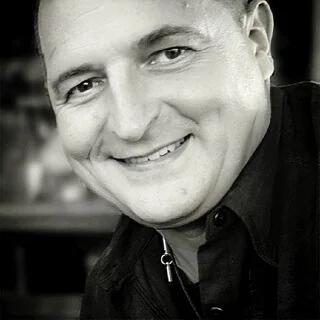
Article by
Dirk J. Lambert (MSc. - CCTS-I)
Dirk J. Lambert is a Licensed Psychotherapist, Mentor, Author, and Certified Trauma & EMDR Specialist with more than 25 years of experience helping people recover from trauma, depression, burnout, emotional abuse, and long-standing unresolved pain. His work is known for being direct, compassionate, and highly practical.
A twice-ordained Buddhist monk, Dirk bridges clinical trauma care with mindfulness, discipline, self-observation, and deep emotional honesty. He does not hide behind jargon, labels, or unnecessary complexity. He listens carefully, speaks plainly, and works toward meaningful change.
New Paradigm reflects the philosophy he has built over decades: intentionally small, deeply personal, private by design, and focused on what actually helps people recover from the inside out rather than simply cope more elegantly.