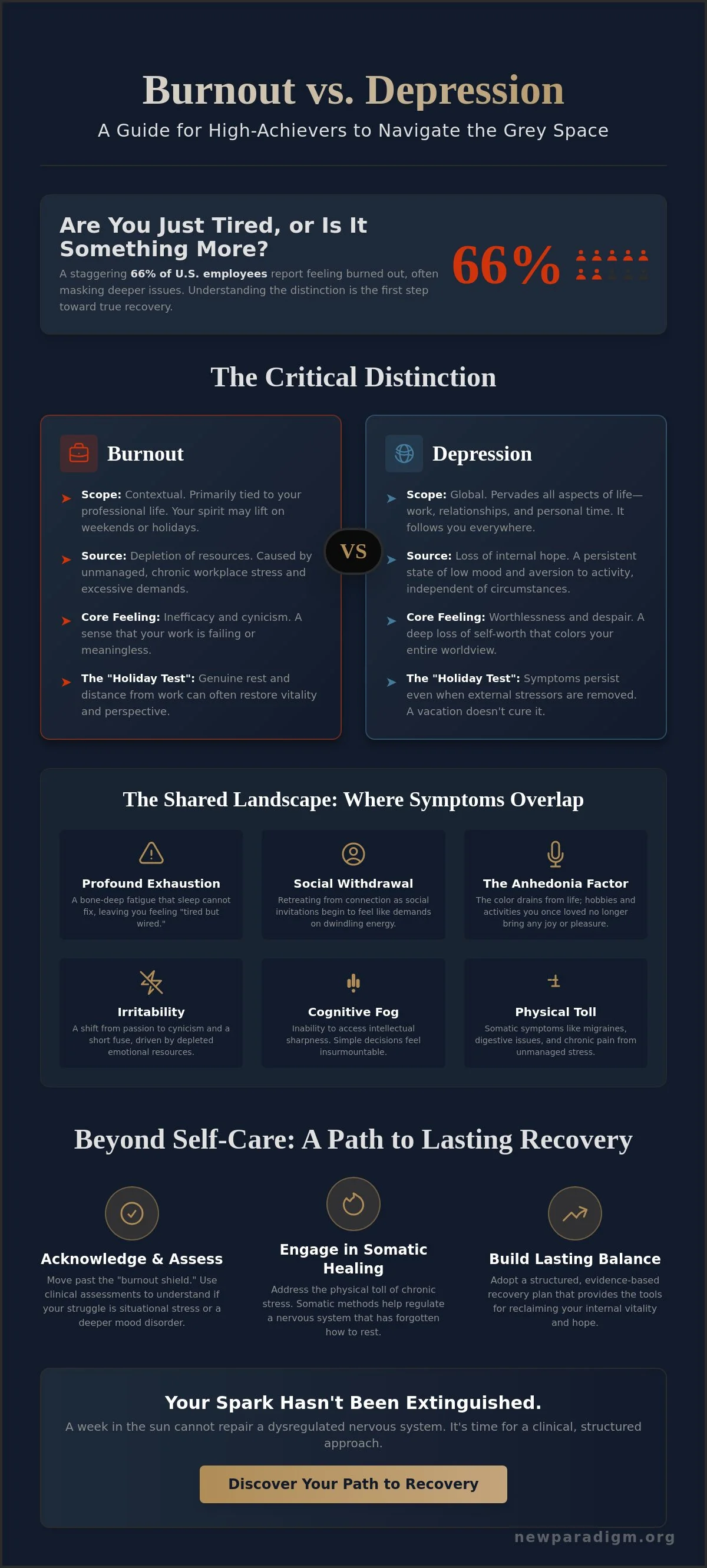
A week in the sun cannot repair a nervous system that has forgotten how to rest. You have likely reached the height of your professional career only to find that the view is blurred by a persistent, heavy fog. You feel used up, not just tired; you wonder if the spark that defined your success has been extinguished forever. It's common to feel trapped in this grey space, especially when 66% of U.S. employees report feeling burned out in some form. Many high-achievers struggle to navigate the distinction of burnout vs depression, often dismissing a clinical mood disorder as mere workplace fatigue.
Understanding this difference is the vital first step toward reclaiming your life. You will learn to identify whether your state is a situational depletion of resources or a more pervasive loss of self. We provide a clear framework to validate your suffering; this involves looking at the specific clinical criteria that separate occupational stress from major depressive disorder. This article explores a path forward that moves beyond the limitations of simple self-care, offering a structured way to find your specific route to recovery.
Key Takeaways
- Identify the subtle overlap between cognitive fatigue and the loss of pleasure to understand the true depth of your internal collapse.
- Distinguish between situational workplace exhaustion and the global, persistent weight of clinical depression to determine if a change of scenery is enough.
- Navigate the complexities of burnout vs depression by examining whether your struggle is rooted in professional inefficacy or a deeper loss of self-worth.
- Learn why high-achievers often adopt the "burnout shield" as a socially acceptable way to intellectualize and hide profound mental health crises.
- Explore how clinical assessments and somatic recovery methods provide a focused, evidence-based path to healing that superficial self-care can't reach.
The Shared Landscape: Where Burnout and Depression Overlap
It's often impossible to pinpoint the exact moment when high-level performance transforms into a desperate struggle for survival. You might notice that your morning coffee no longer provides a lift, or that the projects which once fueled your ambition now feel like leaden weights. This shared landscape is where the distinction of burnout vs depression becomes blurred, as both conditions cast a long shadow over your physical and mental vitality. Both manifest as a profound, bone-deep exhaustion that sleep cannot fix.
The "Anhedonia factor" is perhaps the most distressing commonality. You stop enjoying the things you once loved; it isn't just that you're too busy for hobbies, but that the color has drained out of them entirely. This emotional flatlining is paired with a thick cognitive fog that makes simple professional decisions feel insurmountable. You find yourself staring at a screen for hours, unable to access the intellectual sharpness that built your career. Your performance slips, not because you lack discipline, but because your internal engine has stalled.
To better understand this concept, watch this helpful video:
The Physical Toll of Chronic Stress
Chronic stress doesn't just live in your mind; it settles in your marrow. When you're caught in a cycle of high-stakes performance, your body relies on a constant flood of cortisol and adrenaline. Over time, this biological system breaks. You might experience the paradox of being "tired but wired," where your body is physically spent but your mind refuses to shut down at 2:00 AM. This Occupational Burnout Overview highlights how this syndrome results from unmanaged workplace stress, yet the somatic symptoms like migraines or digestive distress are indistinguishable from clinical depression. High-performers are particularly prone to "intellectualized pain," where they use logic to dismiss the very real signals of physical collapse.
The Emotional Mirror: Irritability and Withdrawal
Social withdrawal becomes a survival mechanism in both states. You begin to see invitations not as opportunities for connection, but as demands on your dwindling energy. This retreat is often accompanied by a shift from passion to cynicism. What was once a dedicated drive for excellence becomes a hollow, defensive posture. You feel a sense of internal emptiness that bridges the gap between situational stress and a deeper mood disorder. Whether you're navigating burnout vs depression, this irritability and emotional distance serve as a warning that your internal resources are completely spent.
Distinguishing Situational Stress from Clinical Depression
The primary differentiator between these two states lies in their scope. Burnout is contextual; it's a fire that consumes specific areas of your life, typically those tied to your professional identity. If you find your spirit lifting on a Saturday morning only to feel it collapse as Sunday evening approaches, you're likely dealing with situational depletion. Depression, however, is global. It follows you into your home, your relationships, and your quietest moments of solitude, regardless of your calendar or your environment.
Burnout: The Depletion of External Resources
Burnout is a situational response to unmanaged stress. It is the state of running on empty because the demands of your environment have exceeded your internal capacity for too long. In this state, you may still have the desire to connect with loved ones or engage in a hobby, but you simply lack the fuel to do so. The "holiday test" is a helpful diagnostic tool here: if a week of genuine isolation and rest restores your vitality, the issue is likely your environment. However, we often find that for high-performers, chronic burnout is a secondary symptom of unresolved trauma that leaves the nervous system unable to regulate itself. It isn't just about a heavy workload; it's about a nervous system that has lost its way.
Depression: The Pervasive Loss of Internal Hope
Depression isn't defined by what's happening around you, but by what's happening within you. It's a pervasive loss of internal hope that persists even when external circumstances are "perfect." You might have the ideal career, a supportive family, and a beautiful home, yet still feel a profound sense of worthlessness. While burnout makes you feel ineffective at your job, depression makes you feel fundamentally flawed as a human being. It doesn't require a specific trigger or a bad boss to exist; it's a shift in your internal landscape that colors every perception of the world and yourself.
There is a somber but necessary distinction to make regarding safety. While burnout leads to a desire to escape or quit, it rarely involves the recurrent thoughts of death or self-harm found in clinical depression. If you find yourself feeling that the world would be better without you, this is a clear clinical marker that you've moved beyond exhaustion into a major depressive episode. Professional guidance is essential in differentiating burnout from depression to ensure you receive the correct level of care. If you feel your internal spark has been replaced by a heavy, immovable darkness, it may be time to speak with a clinical professional who understands the unique pressures of your position and the nuances of burnout vs depression.
Why High-Performers Mistake Depression for Burnout
For the individual whose identity is built on competence and resilience, admitting to a clinical mood disorder feels like an admission of a fundamental defect. It's far easier to claim you are "burned out" by a demanding quarter than to acknowledge a pervasive sense of despair. This is the "Burnout Shield." It's a socially acceptable cover that allows you to intellectualize your pain as a byproduct of success rather than a symptom of a deeper crisis. In the high-stakes environment of 2026, the language of workplace exhaustion is often used to mask a functioning depression that allows you to maintain a facade of achievement while you crumble in private.
This deception is dangerous because it fuels a cycle of trying to work your way out of a physiological collapse. You believe that if you can just clear your inbox or finish the next project, your spark will return. It won't. When your nervous system is no longer able to regulate itself, more effort only accelerates the internal damage. This is why a clinical burnout treatment is often the only path forward when self-management fails to stop the slide toward total depletion. You cannot solve a clinical problem with a professional solution.
The Myth of the "Wellness Spa" Cure
Passive leisure is not the same as clinical recovery. While a week on a beach might sound like the solution, it can actually increase anxiety for a nervous system that has lost the ability to be still. You find yourself sitting in silence, yet your mind is racing with the very thoughts you tried to escape. General Leisure Spa Stays are designed for those who are merely tired, not for those whose internal foundations have fractured. There's a vital difference between resting and recovering; true recovery requires a structured, clinical environment where you can do the intensive internal work that a massage cannot reach.
When Burnout Becomes the Gateway to Depression
Chronic stress is a physiological precursor to a depressive state. When your body is flooded with cortisol for months or years, the brain eventually protects itself by "shutting down" emotional systems, leading to the hollow feeling often confused with mere fatigue. This transition is frequently fueled by unresolved trauma, which makes the "burnout-depression" loop feel impossible to break. Understanding how to recover from burnout involves more than just a lighter schedule. It requires addressing the underlying trauma that drives the need for constant over-extension. If you recognize that your exhaustion has become a permanent weight, it's time to reach out for a professional assessment to navigate the complexities of burnout vs depression.
Moving Toward Clinical Recovery and Lasting Balance
Recovery is a deliberate act of reclamation. It isn't a passive event that occurs during a vacation; it's a structured process of realigning your internal landscape. To move forward, you must first have an accurate map of where you are standing. A comprehensive clinical assessment is the only way to resolve the confusion of burnout vs depression. Without this clarity, you risk applying a temporary bandage to a deep, structural wound. We use evidence-based modalities like EMDR and somatic work because they address the neurobiology of stress. These methods bypass your intellectualized defenses, targeting the physiological imprints of chronic exhaustion and despair. Transitioning from survival mode to a burnout recovery program marks the end of the "work harder" cycle and the beginning of genuine healing.
The Power of Intensive Intervention
For a high-performer in the midst of a nervous system collapse, one hour of weekly therapy is often insufficient. It's a drop of water in a desert of depletion. Total immersion at a mental health facility in Thailand provides the isolation, safety, and clinical intensity required for deep repair. This is Compassionate Realism in practice. It acknowledges the gravity of your collapse while offering the practical methodology to navigate through it. Navigating burnout vs depression requires this level of dedicated, expert focus.
Choosing Your Path to Healing
Choosing your path requires a discerning look at your current state. You may need residential support if your fatigue survives a week of rest, if your sense of self-worth has vanished, or if you feel a pervasive sense of hopelessness. Healing is not a linear journey. It requires a protective environment and a robust aftercare program to ensure the old cycles of over-extension don't return. Discover our specialized Burnout Recovery Program at New Paradigm.
Reclaiming Your Internal Spark
Understanding the nuances of burnout vs depression is the difference between seeking a temporary rest and finding a permanent recovery. You've learned that your exhaustion isn't a failure of will; it's a physiological signal that your nervous system has reached its limit. While burnout often stems from situational depletion, clinical depression involves a more pervasive loss of self that follows you into every corner of your life. Recognizing this distinction allows you to stop fighting the symptoms and begin addressing the root cause.
The path forward isn't found in a crowded wellness retreat or a superficial management technique. It requires a focused, clinical environment designed for deep, internal transformation. Our boutique facility at New Paradigm Mental Health Retreat maintains a strictly limited capacity to ensure you receive the intentional, personalized care your recovery demands. Clinically led by experts in high-performer recovery, we utilize evidence-based EMDR and somatic trauma therapy to help you rebuild from the inside out. You don't have to carry this weight alone. Begin your journey to recovery with our private residential programs and rediscover the clarity you thought was lost forever. There is a way back to the person you used to be.
Frequently Asked Questions
Can burnout turn into clinical depression?
Yes, untreated burnout often serves as a gateway to clinical depression. When your nervous system is trapped in a state of chronic depletion for too long, the brain's ability to regulate mood begins to fracture. What started as situational workplace stress can evolve into a global, pervasive loss of hope that no longer depends on your professional environment for its existence.
Is burnout a medical diagnosis in 2026?
Burnout is not classified as a medical condition in 2026; instead, the World Health Organization defines it as an occupational phenomenon. According to the ICD-11, it's a syndrome resulting from chronic workplace stress that hasn't been successfully managed. This distinction is vital because it anchors the struggle to your environment, whereas major depressive disorder is a diagnosable clinical mood disorder.
How long does it typically take to recover from severe burnout?
Recovery from severe depletion typically requires several months of intentional, structured intervention. For many high-performers, a simple weekend away is insufficient to repair a fractured nervous system. The duration depends on your willingness to step away from the stressors and engage in deep internal work; some individuals find that a full return to vitality takes between six and eighteen months.
What is the "test" to see if I am burned out or depressed?
The most effective way to navigate the burnout vs depression divide is the "holiday test." If your energy and interest return after a week of total isolation from work, you're likely experiencing burnout. If the heavy, hollow feeling persists even in the absence of professional demands, it suggests that your struggle has moved into the territory of clinical depression.
Can I recover from depression without medication?
Many people find lasting recovery through intensive clinical programs that don't rely solely on medication. Evidence-based modalities such as EMDR and somatic trauma therapy target the physiological roots of your suffering. While medication is a valid tool for some, deep internal transformation often comes from addressing the underlying trauma and nervous system dysregulation that fuel your collapse.
Why does my burnout feel like physical pain?
Your body is expressing the "intellectualized pain" that your mind has tried to ignore. Chronic stress keeps your system flooded with cortisol and adrenaline, which eventually manifests as visceral physical symptoms. These often include persistent migraines, digestive distress, and a bone-deep muscle tension that feels like a physical weight on your chest or shoulders.

Article by
Dirk J. Lambert (MSc. - CCTS-I)
Dirk J. Lambert is a Licensed Psychotherapist, Mentor, Author, and Certified Trauma & EMDR Specialist with more than 25 years of experience helping people recover from trauma, depression, burnout, emotional abuse, and long-standing unresolved pain. His work is known for being direct, compassionate, and highly practical.
A twice-ordained Buddhist monk, Dirk bridges clinical trauma care with mindfulness, discipline, self-observation, and deep emotional honesty. He does not hide behind jargon, labels, or unnecessary complexity. He listens carefully, speaks plainly, and works toward meaningful change.
New Paradigm reflects the philosophy he has built over decades: intentionally small, deeply personal, private by design, and focused on what actually helps people recover from the inside out rather than simply cope more elegantly.