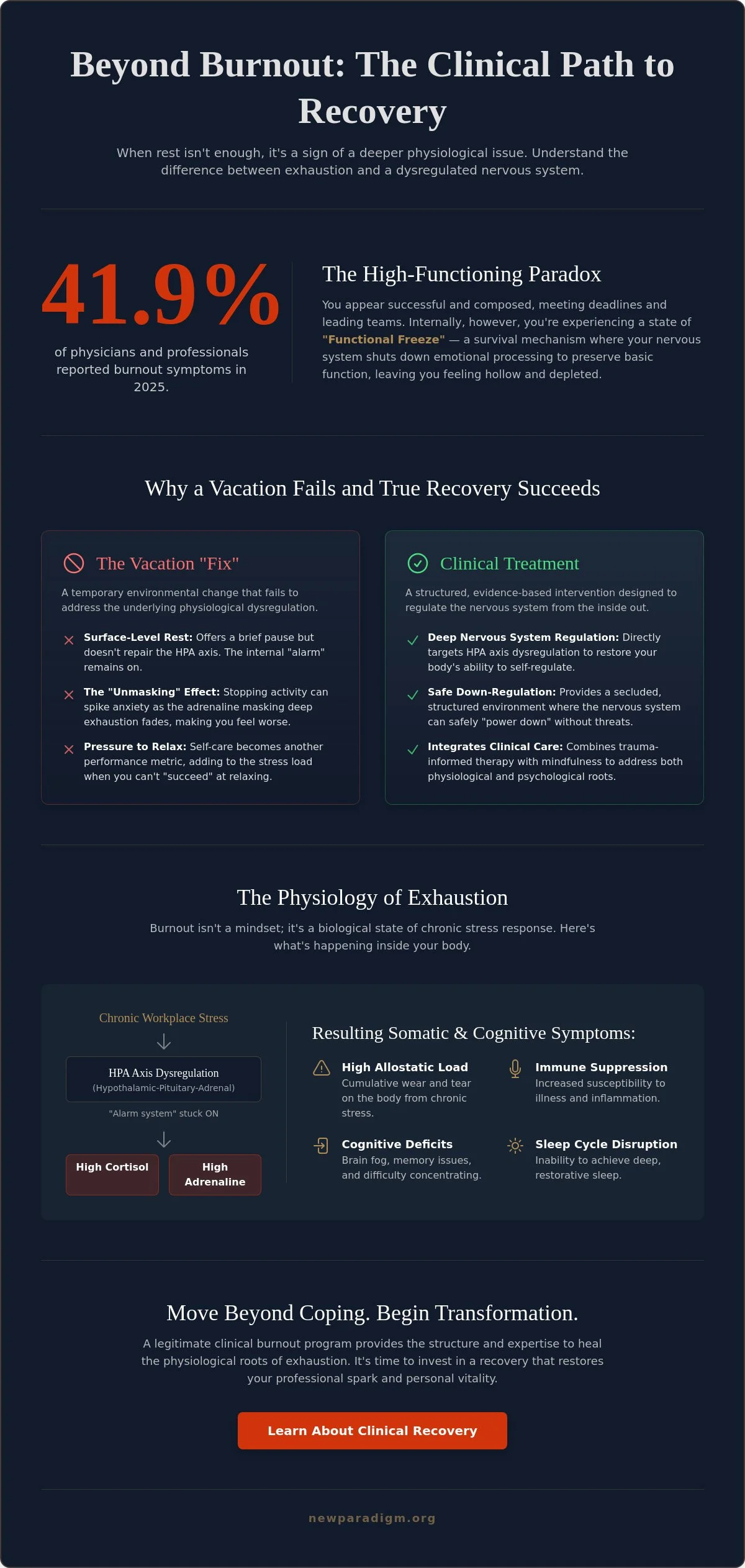
You've spent weeks dreaming of a vacation, yet when you finally reach the sand, your body refuses to settle. You're physically still, but your mind is racing; your chest feels tight with a dread you can't quite name. You've become high-functioning on paper but are privately falling apart. It's a heavy reality for the 41.9% of physicians and professionals who reported burnout symptoms in 2025. You intellectually understand your stress, yet you feel like a failure for not "handling" it better. The truth is that a week of rest cannot repair a collapsing nervous system. You don't need a holiday. You need a specialized clinical burnout treatment that addresses the physiological roots of your exhaustion.
In this guide, you'll learn why deep-seated cynicism and physical depletion require more than just "coping" or better time management. We'll examine the clinical reality of why your body has lost its ability to reset. We'll also provide a clear framework for identifying intensive, evidence-based interventions that go deeper than surface-level wellness. It's time to move past the temporary fix and find a treatment plan that restores your professional spark and personal vitality from the inside out.
Key Takeaways
- Understand why traditional rest fails to resolve HPA axis dysregulation and why a vacation often leaves you feeling more depleted upon your return.
- Identify the signs of "Functional Freeze," a physiological state where you continue to perform professionally while feeling emotionally hollow and privately exhausted.
- Learn how to distinguish between a luxury wellness spa and a legitimate clinical burnout treatment center that focuses on deep nervous system regulation.
- Discover why a secluded, private environment for uninterrupted deep work is necessary to move beyond "coping more elegantly" and into true internal recovery.
- Gain a clear framework for a recovery program that integrates clinical trauma care with monastic mindfulness to restore your professional spark and personal vitality.
The Myth of the Vacation Fix: Why Rest Isn't Clinical Burnout Treatment
Many high-performers believe that a week on a beach will reset their internal clock. They view their state as a temporary lapse in energy rather than a profound physiological shift. However, true Occupational burnout is not a matter of being tired; it is a state of chronic HPA (Hypothalamic-Pituitary-Adrenal) axis dysregulation. This means your internal alarm system is stuck in the "on" position, even when the external threat has passed. You might appear successful and composed to your colleagues, but you are privately exhausted and struggling to find meaning in work you once loved.
A one-week vacation often leaves you feeling worse upon your return because it highlights the gap between your environment and your internal state. Leisure rest is designed for those with a healthy baseline. For someone in need of clinical burnout treatment, simple rest is insufficient. You aren't just tired; your nervous system has lost the ability to regulate itself. This is the difference between situational stress, which resolves with sleep, and a systemic burnout collapse that requires deep, evidence-based intervention.
To better understand the signs that your state requires professional care, watch this helpful video:
When Self-Care Becomes Another To-Do Item
When you are in the depths of exhaustion, even wellness can feel like a burden. You might find yourself "trying harder" at yoga or meditation, only to feel like a failure when your heart rate doesn't drop. This creates a psychological trap where self-care becomes another metric to optimize, increasing your already heavy stress load. Clinical intervention is required when your internal mechanisms for self-regulation are so depleted that you can no longer find your way back to calm on your own.
The "Unmasking" Effect: Why Stopping Feels Dangerous
There is a specific, visceral crash that occurs when a high-performer finally stops moving. Without the constant hum of adrenaline to mask the pain, the full weight of your exhaustion hits all at once. Your nervous system stays in survival mode, interpreting the sudden silence of a peaceful environment as a new kind of threat. This unmasking effect is why many people experience a spike in anxiety or physical illness the moment their vacation begins. Recovering from this state requires a structured clinical burnout treatment protocol that provides a sanctuary for the nervous system to safely down-regulate without the pressure of a quick return to productivity.
The Physiology of Exhaustion: What Happens Inside Your Nervous System
Burnout is often described as a mental state, but it's fundamentally a biological one. When you experience chronic workplace stress, your HPA (Hypothalamic-Pituitary-Adrenal) axis remains on high alert, flooding your system with cortisol and adrenaline. Over time, this leads to a high allostatic load, which is the cumulative wear and tear on the body from being chronically "stressed out." You aren't just tired; you're operating on a profound physiological deficit that impacts your ability to regulate your heart rate, sleep cycles, and immune response.
You might find yourself in a state of "Functional Freeze." In this state, you continue to answer emails, lead meetings, and hit deadlines, but you feel emotionally dead inside. It's a survival mechanism where the nervous system, overwhelmed by the demands of your career, shuts down your emotional processing to preserve basic function. This chronic cortisol elevation is the direct cause of the brain fog and memory issues you likely experience. When your body is in a state of shut-down, traditional talk therapy often fails because the "thinking" part of your brain is no longer communicating effectively with the "feeling" part of your body.
Beyond the Mind: The Somatic Reality of Burnout
The body keeps the score of your professional life. Digestive issues, chronic pain, and persistent insomnia aren't side effects; they're the primary language of a system that can no longer cope. This is why effective clinical burnout treatment must involve somatic work. There's a deep connection between residential trauma treatment and burnout recovery because the physiological markers of both states are nearly identical. Your body must be regulated and brought back to a state of safety before your mind can begin to process the stress or find its way back to vitality.
Why You Can't "Think" Your Way Out of Burnout
When the prefrontal cortex is compromised by long-term stress, cognitive strategies like "positive thinking" or "better boundaries" simply don't take root. You cannot use the mind to fix a problem that's stored in the nervous system. To truly recover from burnout, you need evidence-based modalities like EMDR to reprocess workplace events that your body has stored as trauma. If you feel you've reached this point of collapse, you might find it helpful to reach out for a private consultation to discuss a path forward. For a deeper look at the recovery process, read our companion piece, How to Recover from Burnout: A Clinical Guide for High-Performers.
Evaluating Clinical Treatment: Wellness Retreats vs. Residential Care
When you are privately falling apart, a luxury spa is not enough. A general leisure spa stay focuses on surface-level relaxation; it offers massages and facials that provide a temporary reprieve but leave the underlying nervous system collapse untouched. True clinical burnout treatment is fundamentally different. It is not a holiday. It's a structured, evidence-based environment for deep work. At New Paradigm, we maintain a strict maximum of four clients at any given time. This exclusivity isn't about luxury. It's about safety. It ensures that every individual receives the uninterrupted attention required to navigate the depths of their exhaustion without the noise of a crowded clinic or a generic rehab facility.
Choosing a program requires a discerning eye. You must look for a sanctuary that prioritizes nervous system regulation over simple pampering. This involves a monastic mindfulness approach that combines discipline, self-observation, and silence. Unlike the "toxic positivity" often found in wellness circles, a clinical program acknowledges the gravity of your suffering. It provides a grounded, calm atmosphere where you can face the darkness of your exhaustion with the guidance of a team anchored by the twenty-five-year career of our founder. This level of focus is what allows for a recovery that goes beyond "coping more elegantly" and addresses the problem from the inside out.
The Checklist for High-Performer Recovery
The path to recovery requires clinical staff who understand that burnout is often a symptom of unresolved pain. Unlike general wellness practitioners, our team uses evidence-based modalities to address the somatic roots of your state. This includes the integration of EMDR therapy sessions, which allow high-performers to reprocess the specific workplace stressors that have become lodged in their nervous systems. We don't just teach you to manage stress; we help you resolve the emotional processing gaps that lead to systemic collapse.
Why Location Matters: The Sanctuary of Chiang Mai
There is a profound clinical benefit to geographic distance. When you remain close to the source of your stress, your nervous system stays on high alert, anticipating the next crisis. A mental health facility in Thailand provides a necessary "pattern interrupt." Our sanctuary in Chiang Mai offers a secluded, private space where the clinical discipline of trauma care meets the spiritual groundedness of Buddhist philosophy. This combination creates a unique intellectual and emotional signature, allowing you to recover in a location designed for peace and uninterrupted reflection. If you are ready to move beyond temporary fixes and begin true recovery, speak with our clinical team today.
A New Paradigm for Recovery: From Coping to Transformation
True recovery is not about returning to the same high-pressure environment with a few better "coping skills." If your nervous system has already collapsed, the goal isn't to manage the stress more elegantly; it's to recover from the inside out. This requires a fundamental shift in how you inhabit your body and your career. A comprehensive burnout recovery program provides the space to dismantle the belief that your worth is tied solely to your productivity. It is the necessary transition from professional survival to a state of genuine, sustainable vitality.
The journey from a state of "functional freeze" to one of presence is a clinical process. It begins with safety and ends with a new way of being. At New Paradigm, we focus on depth over scale, ensuring that your clinical burnout treatment is not just a temporary pause, but a permanent recalibration. We prioritize aftercare because the work doesn't end when you leave our sanctuary. Building a sustainable life requires a bridge between the secluded peace of treatment and the complex demands of your professional reality.
The Clinical Protocol: What Real Recovery Looks Like
Recovery follows a specific, patient sequence. We prioritize nervous system regulation as the first necessity. Without a calm body, the mind cannot engage in meaningful emotional processing. We measure success by the shift from "doing" to "being." This is a measurable clinical outcome where the prefrontal cortex regains its ability to regulate the emotional centers of the brain. You move from a state of constant, frantic reaction to one of grounded, intentional action.
Taking the First Step: The Compassionate Realist Approach
Choosing to step away for intensive care is a difficult decision for those accustomed to carrying the weight of an organization. However, talking to your family or employer about the need for residential care is an act of professional integrity. When you consider the $4.6 billion annual cost of burnout in the medical field alone, it's clear that choosing a burnout recovery retreat is a strategic professional investment, not a luxury. It is the only way to ensure you can continue to lead and contribute for the next twenty years of your career. If you feel you have no energy left to choose, let us help you find the path back. You can consult with New Paradigm about our strictly private recovery programs to begin your journey toward a life that feels as good on the inside as it looks on the outside.
Reclaim Your Life Through Deep Clinical Work
You've spent years pushing through the exhaustion. You've mastered the art of appearing successful while privately falling apart. However, your nervous system doesn't care about your professional accolades. It only knows that it's stuck in a state of survival. As we've explored, a temporary pause or a week of leisure cannot repair a system that has fundamentally collapsed. True recovery requires a structured clinical burnout treatment that addresses the biological roots of your depletion through somatic regulation and emotional processing. It is the necessary transition from professional survival to genuine vitality.
At New Paradigm, we provide the sanctuary you need for this profound transformation. Our boutique facility in Chiang Mai is intentionally small; we are strictly limited to four clients at a time to ensure maximum focus and clinical safety. Led by our founder with over 25 years of clinical experience, we offer a path out of the darkness that respects both your high-functioning nature and your need for deep, uninterrupted peace. Begin your recovery at New Paradigm; the world's most private clinical sanctuary for burnout. You have the strength to choose a different way of living. We are here to guide you back to the light.
Frequently Asked Questions
Is burnout a clinical diagnosis that requires residential treatment?
While the World Health Organization (WHO) classified burnout as an occupational phenomenon in 2019, severe cases often manifest as clinical HPA axis dysregulation. Residential care becomes necessary when your nervous system reaches a state of collapse where self-regulation is no longer possible. It's designed for those who remain high-functioning on paper but are privately falling apart and cannot find safety in their current daily environment.
How is clinical burnout treatment different from a regular vacation?
A vacation is a passive break; clinical burnout treatment is an active, evidence-based intervention. While a holiday provides temporary distance, clinical protocols focus on down-regulating the nervous system through somatic work and emotional processing. You aren't just resting; you're working with a professional team to dismantle the physiological survival mechanisms that keep you in a state of chronic, unresolved exhaustion.
How long does it take to recover from clinical burnout in a residential setting?
Most intensive residential programs span between 30 and 90 days depending on the severity of the collapse. The first 14 days are typically dedicated to physical stabilization and down-regulating the HPA axis. True transformation requires enough time to move from professional survival back into genuine vitality, followed by a structured aftercare plan to ensure the recovery is sustainable upon your return home.
Can I recover from burnout while still working my current job?
It's extremely difficult to repair a collapsing nervous system while remaining in the environment that triggered the collapse. If you are experiencing systemic burnout, your body interprets your workplace as a constant threat. Intensive recovery usually requires a "pattern interrupt" and geographic distance to allow your system to exit survival mode. Continuing to work often results in "coping more elegantly" rather than true internal recovery.
What is the role of EMDR therapy in treating professional burnout?
EMDR therapy is used to reprocess workplace events that the body has stored as trauma. High-performers often experience years of "micro-traumas" from high-stakes decisions and chronic stress. EMDR helps desensitize these triggers, allowing your nervous system to stop reacting to work demands as if they are life-threatening emergencies. This modality is a core component of modern, evidence-based burnout recovery protocols.
Why do high-performers struggle more with traditional talk therapy for burnout?
High-performers are often highly intellectual and can naturally "talk around" their problems without ever feeling them. When the prefrontal cortex is compromised by chronic stress, cognitive strategies alone are insufficient. Talk therapy stays in the mind, whereas burnout is stored in the body's nervous system. Effective treatment must include somatic regulation to reach the parts of the physiology that words alone cannot access.
Article by
Dirk J. Lambert (MSc. - CCTS-I)
Dirk J. Lambert is a Licensed Psychotherapist, Mentor, Author, and Certified Trauma & EMDR Specialist with more than 25 years of experience helping people recover from trauma, depression, burnout, emotional abuse, and long-standing unresolved pain. His work is known for being direct, compassionate, and highly practical.
A twice-ordained Buddhist monk, Dirk bridges clinical trauma care with mindfulness, discipline, self-observation, and deep emotional honesty. He does not hide behind jargon, labels, or unnecessary complexity. He listens carefully, speaks plainly, and works toward meaningful change.
New Paradigm reflects the philosophy he has built over decades: intentionally small, deeply personal, private by design, and focused on what actually helps people recover from the inside out rather than simply cope more elegantly.