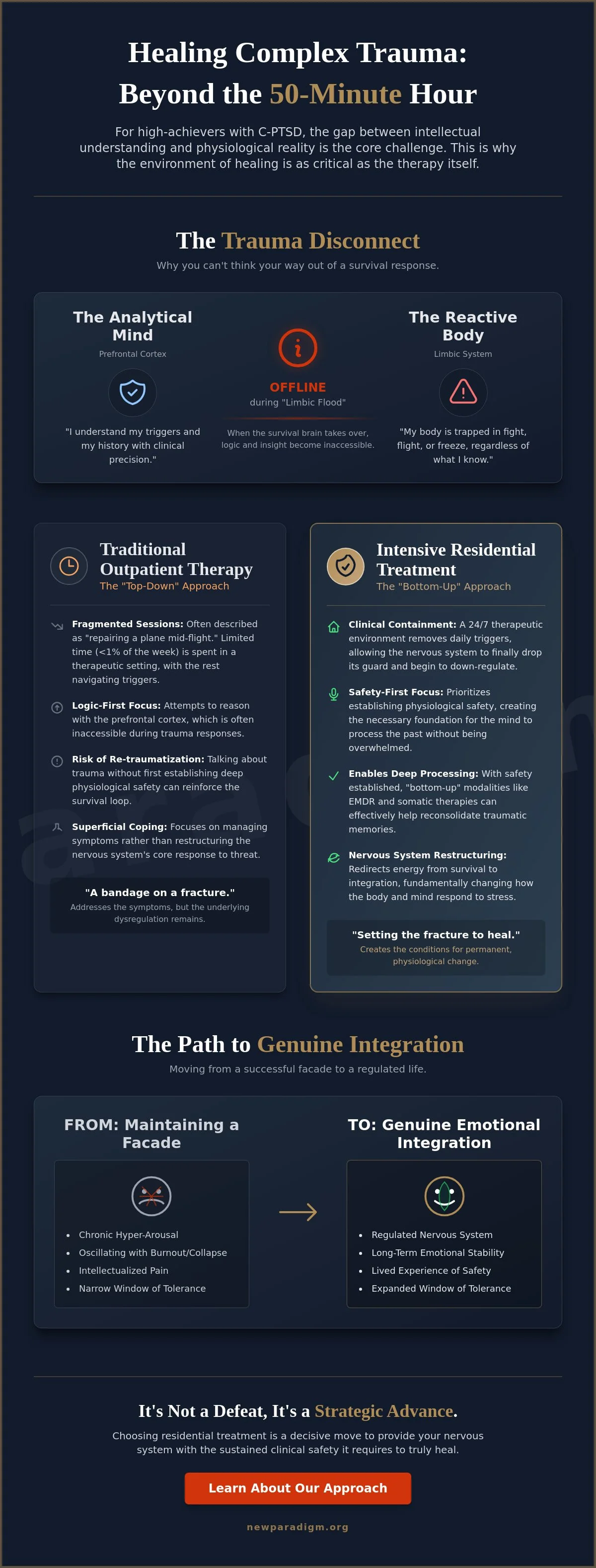
You cannot think your way out of a physiological response that has been etched into your nervous system over decades. For many high-achieving individuals, the most frustrating part of complex trauma is the gap between what you know and what you feel. You understand your history and you've analyzed your triggers; yet, your body remains trapped in a perpetual state of fight, flight, or freeze. This is why standard outpatient sessions often feel like putting a bandage on a fracture. Seeking residential treatment for c-ptsd isn't an admission of defeat. It's a strategic move to provide your nervous system with the sustained clinical safety it needs to finally down-regulate.
You've likely spent years maintaining a successful facade while feeling a sense of internal collapse just beneath the surface. We agree that recovery requires more than just talking it out or learning superficial coping skills. This guide will show you why intensive residential care is the gold standard for healing complex trauma by targeting the root of the issue: the nervous system. You'll learn how to identify a program that prioritizes memory integration and provides practical tools for long-term emotional stability. We'll explore the clinical necessity of a focused environment and how a dedicated period of internal work can lead to a truly regulated life.
Key Takeaways
- Understand how the "limbic flood" keeps your brain in a survival loop, making intellectual insight insufficient for true physiological recovery.
- Learn why residential treatment for c-ptsd provides the necessary clinical containment to allow a chronically dysregulated nervous system to finally drop its guard.
- Discover the clinical power of "bottom-up" healing through modalities like EMDR that target memory reconsolidation rather than just superficial symptom management.
- Explore how a focused therapeutic landscape, away from daily triggers, accelerates the transition from maintaining a successful facade to achieving genuine emotional integration.
Understanding Complex PTSD (C-PTSD) and the Dysregulated Nervous System
Unlike a single, isolated incident, Complex post-traumatic stress disorder arises from prolonged, repeated interpersonal trauma where escape was physically or emotionally impossible. It isn't just a collection of intrusive memories. It's a fundamental reorganization of how your brain perceives safety. While standard PTSD often centers on a specific event, C-PTSD impacts your very sense of identity and self-worth. It leaves you in a state of chronic "limbic flood," where the brain's survival centers remain stuck in a loop, constantly scanning for threats that are no longer present.
To better understand how clinical guidelines are evolving to address this complexity, watch this helpful overview:
Many high-achieving individuals experience what we call intellectualized pain. You can map your history and identify your triggers with clinical precision, yet your body doesn't listen to your logic. This disconnect is why seeking residential treatment for c-ptsd becomes a clinical necessity rather than a luxury. It provides the immersion required to bridge the gap between your analytical mind and your reactive body, moving beyond simple understanding into lived experience.
The Polyvagal Perspective: Fight, Flight, and Freeze
Your nervous system operates in three primary states. Ventral vagal is the state of safety and social engagement. The sympathetic state is your "fight or flight" response, while the dorsal vagal state leads to "freeze" or total collapse. C-PTSD survivors often oscillate violently between hyper-arousal and the heavy exhaustion of burnout. This constant turbulence fundamentally narrows a person's window of tolerance, making even minor stressors feel like existential threats to the system.
Why Traditional Talk Therapy Often Falls Short
Traditional therapies often use a "top-down" approach, targeting the prefrontal cortex to change behavior through logic. However, when the nervous system is dysregulated, the prefrontal cortex essentially goes offline. Talking about trauma without first establishing physiological safety can actually re-traumatize the system. This is why a specialized residential trauma treatment program is so effective. It prioritizes "bottom-up" regulation to ensure the body feels safe enough for the mind to process the past. Comprehensive residential treatment for c-ptsd recognizes that you cannot talk a survival response into submission.
Why Residential Treatment for C-PTSD is the Logical Next Step
Weekly therapy often feels like trying to repair a plane while it is mid-flight. You spend the first twenty minutes of a session decompressing from the week and the last ten minutes preparing to go back into the noise. This leaves very little time for the deep, internal work required for nervous system recovery. Choosing residential treatment for c-ptsd provides what clinicians call "containment." It's a 24/7 therapeutic environment where the external triggers of your daily life are removed, allowing your nervous system to finally drop its guard. In this protected space, the energy you usually spend on survival can be redirected toward integration.
It's vital to distinguish clinical residential care from a general wellness spa stay. A spa offers a temporary escape from stress; clinical care offers a permanent restructuring of your response to it. According to the National Center for PTSD, complex trauma often requires a phase-based approach that prioritizes stabilization before moving into memory processing. Residential care provides the safety net needed for this transition. It also breaks the profound isolation that defines the trauma experience. Being surrounded by peers who understand the visceral weight of "hidden" pain helps dissolve the shame that often keeps survivors silent.
The Clinical Advantage of Intensive Intervention
The concept of "dosage" is critical in trauma recovery. Thirty days of intensive, daily intervention can often achieve more than several years of disjointed weekly sessions. When you are in a dedicated mental health facility in Thailand that operates at international standards, you have immediate support after difficult processing sessions. You don't have to drive home in traffic or cook dinner after a breakthrough. You are held in a clinical container that ensures you remain regulated as you do the hardest work of your life.
Addressing the High-Achiever's Dilemma
If you are a functional survivor, you might fear that stepping away will cost you your professional edge. You've likely used your trauma-driven hyper-vigilance as a fuel for success. But this is a diminishing return. Eventually, the internal collapse becomes impossible to hide. Residential treatment is not an admission of failure. It's a strategic investment in your future performance. By restoring your internal architecture, you ensure that your success is built on a foundation of stability rather than a state of constant, exhausting crisis. If you're ready to explore how this structure can support your specific needs, speak with a clinical coordinator to learn more about our intentional approach.
Bottom-Up Healing: EMDR and Somatic Modalities
Talk therapy often fails complex trauma survivors because it relies on the prefrontal cortex, the part of the brain responsible for logic and reasoning. When you are triggered, this "top" part of the brain essentially goes offline, leaving the "bottom" centers, the limbic system and brainstem, to run a survival script. Bottom-up healing reverses this hierarchy. Instead of trying to talk your way into feeling better, these modalities target the body's physiological state first. By settling the nervous system, we create the internal quietude necessary for the mind to finally process what has happened. This is a primary reason why residential treatment for c-ptsd is so effective; it provides the time and safety to engage these deep, body-based interventions without the interference of daily life.
How EMDR Reprocesses Complex Trauma
EMDR, or Eye Movement Desensitization and Reprocessing, is a clinically validated treatment for complex PTSD that facilitates memory reconsolidation. It follows a rigorous 8-phase protocol designed to stabilize the individual before moving into active processing. In a residential setting, the "dosage" of EMDR can be significantly higher than in outpatient care. Multiple sessions per week allow you to move through layers of complex history while remaining in a supported environment. It's important to understand that EMDR doesn't erase your history or the memories themselves; rather, it removes the visceral, overwhelming emotional charge attached to them, allowing the past to finally feel like it is truly in the past.
Somatic Healing and Nervous System Regulation
Somatic work involves the deliberate practice of tracking internal sensations to build self-regulation. While many programs offer "coping skills" that merely distract you from your pain, somatic experiencing focuses on discharging the survival energy that remains stuck in your muscles and fascia. This isn't about intellectualizing your stress. It's about feeling the physical reality of your triggers and learning to navigate them without collapsing into burnout. This focused attention on the body's wisdom is the foundation for lasting burnout recovery. If you are tired of knowing why you feel this way but never actually feeling different, contact our clinical team to discuss how a bottom-up approach can change your baseline.
The New Paradigm: A Compassionate Realist Approach in Chiang Mai
Recovery from complex trauma requires a philosophy that acknowledges the gravity of your experience without resorting to superficial positivity. At New Paradigm, we operate from a standpoint of Compassionate Realism. This means we don't ignore the somber reality of internal collapse or the exhaustion of maintaining a successful facade. Instead, we meet that pain with grounded, clinical authority. By choosing residential treatment for c-ptsd in a setting that prioritizes depth over scale, you allow yourself to be seen as an individual rather than a diagnosis. Our approach is intentionally designed for those who value quiet confidence and evidence-based methodology over loud, generic wellness promises.
Chiang Mai serves as more than just a location; it is a therapeutic landscape that facilitates deep internal work. The natural stillness of Northern Thailand provides a stark contrast to the high-pressure environments where most of our clients struggle. This isolation from external noise is essential for a nervous system that has been stuck in a survival loop for years. In this space, the clinical excellence of our practitioners merges with a contemplative atmosphere, creating a protective container where you can finally address the roots of your dysregulation. We maintain an extremely limited capacity to ensure that every participant receives the focused, rhythmic attention required for genuine transformation.
A Sanctuary for Deep Internal Work
The physical environment is a fundamental tool for safety. We invite you to view the New Paradigm facility as a private space for profound change, far removed from the triggers of your professional and personal life. It isn't a leisure stay, but a dedicated environment for intensive internal work. Here, you'll find the clinical structure needed to process traumatic memories alongside the spiritual calm necessary for contemplative practice. This unique intellectual and emotional signature is what distinguishes our program from traditional medical settings.
Sustainable Recovery and Aftercare
The work doesn't end when you leave the sanctuary of Chiang Mai. A critical part of residential treatment for c-ptsd is building a sturdy bridge back to your daily life. We focus on sustainable recovery by providing a customized aftercare program that prevents the common "post-rehab slump." We help you integrate the practical tools for emotional stability into your existing architecture, ensuring that your regulated nervous system can withstand the demands of the real world. If you're ready to move beyond intellectualized pain and begin a journey of true integration, contact New Paradigm to discuss your personalized recovery path.
Reclaiming Your Internal Baseline
You don't have to remain a prisoner to a nervous system that feels permanently stuck in survival mode. True recovery from complex trauma isn't found in more intellectual analysis. It's found in the physiological safety of deep, bottom-up processing. By choosing residential treatment for c-ptsd, you provide your body with the clinical containment necessary to discharge years of accumulated survival energy. This isn't just about learning new coping mechanisms. It's about a fundamental transition from merely surviving to genuinely living.
New Paradigm is not a high-volume medical center or a generic wellness retreat. It's a boutique clinical facility that maintains a strictly limited capacity to ensure every individual receives the depth of focus they deserve. Located in the healing environment of Chiang Mai, Thailand, we combine evidence-based EMDR and somatic protocols to help you restore your internal architecture. It's time to stop managing your symptoms and start healing your system. You deserve a life defined by presence rather than protection.
Begin Your Journey to Recovery at New Paradigm
Frequently Asked Questions
Is residential treatment necessary for C-PTSD if I am still "functional"?
Functionality does not equal wellness. Many survivors maintain high level careers while their internal architecture is crumbling from chronic hyper-vigilance. Residential treatment for c-ptsd is often the only way to break the cycle of functional burnout because it provides the sustained clinical safety that outpatient care cannot match. It allows you to stop performing and start the heavy work of internal restructuring.
How long is a typical residential program for complex trauma?
A standard residential stay typically lasts between 30 and 60 days. This timeframe allows enough space for initial stabilization, intensive memory processing, and the development of long term regulation tools. The exact duration is determined by your clinical progress and the depth of your history. We prioritize the quality of the intervention over a rigid calendar, ensuring you feel sturdy before transitioning home.
What is the difference between a trauma retreat and a clinical residential program?
A clinical program is defined by its evidence based methodology and professional oversight. While a trauma retreat might offer temporary peace through leisure, it lacks the therapeutic containment necessary for deep integration. Clinical residential treatment for c-ptsd utilizes specific protocols like EMDR and somatic experiencing to target the nervous system directly. It is a focused environment for internal transformation rather than a general escape from stress.
Can C-PTSD actually be cured, or is it just managed?
C-PTSD is a physiological state of dysregulation that can be integrated and resolved. While the memories of your past remain, their ability to hijack your nervous system can be neutralized. Through successful memory reconsolidation, the brain learns that the threat is over. You move from a state of constant survival to a regulated baseline where you are no longer defined by your triggers.
Will I have to talk about my trauma in front of a group?
You are never required to share the specific details of your trauma in a group setting. While peer support is a vital component of recovery, intensive processing occurs in private sessions with experienced clinicians. Group work focuses on building regulation skills, understanding the mechanics of trauma, and breaking the isolation that often accompanies complex PTSD. Your privacy and emotional safety are always the primary clinical priorities.
What happens if I feel overwhelmed during intensive EMDR sessions?
Clinical staff are trained to recognize the signs of hyper arousal and will intervene immediately to help you ground. If a session becomes too intense, we utilize somatic tools and regulation techniques to bring you back into your window of tolerance. You are held in a safe clinical container where the pace of work is carefully calibrated to your system's capacity for processing.
Article by
Dirk J. Lambert (MSc. - CCTS-I)
Dirk J. Lambert is a Licensed Psychotherapist, Mentor, Author, and Certified Trauma & EMDR Specialist with more than 25 years of experience helping people recover from trauma, depression, burnout, emotional abuse, and long-standing unresolved pain. His work is known for being direct, compassionate, and highly practical.
A twice-ordained Buddhist monk, Dirk bridges clinical trauma care with mindfulness, discipline, self-observation, and deep emotional honesty. He does not hide behind jargon, labels, or unnecessary complexity. He listens carefully, speaks plainly, and works toward meaningful change.
New Paradigm reflects the philosophy he has built over decades: intentionally small, deeply personal, private by design, and focused on what actually helps people recover from the inside out rather than simply cope more elegantly.