What if the very intellect that built your success is the same mechanism preventing your recovery? For many high-achievers, the exhaustion of maintaining a perfect facade eventually leads to a collapse that traditional talk therapy cannot reach. You've likely spent years analyzing your symptoms, yet the heavy, visceral weight of despair remains unchanged. When seeking depression treatment Chiang Mai offers a unique intersection of clinical depth and restorative isolation, but not all programs are equipped to handle the complexities of treatment-resistant, trauma-based depression.
It's isolating to feel like a "case to be managed" rather than a person to be understood, especially when your internal world feels like it's crumbling despite your outward achievements. This article explores how a specialized, trauma-focused approach provides the intensive clinical intervention necessary to move beyond superficial symptom management. You'll discover how a private, limited-capacity environment integrates evidence-based tools like EMDR therapy with the profound peace of Northern Thailand to facilitate a genuine clinical breakthrough. We will examine a specific case study that illustrates the journey from intellectualized pain to deep, trauma-informed recovery.
Key Takeaways
- Understand why effective depression treatment in Chiang Mai requires a blend of rigorous international clinical standards and the restorative silence of a contemplative environment.
- Learn why chronic depression often serves as a protective mechanism against unresolved trauma, and why "top-down" talk therapy frequently fails to reach these deeper layers.
- Identify the signs of functional depression through a clinical case study of an executive navigating the shift from internal collapse to a genuine recovery breakthrough.
- Discover why limited capacity and high staff-to-client ratios are the most critical metrics for ensuring your recovery is an intentional journey rather than a standardized process.
The Reality of Depression Treatment in Chiang Mai for High-Achievers
Chiang Mai has emerged as a global destination for mental health, but for the high-achiever, it's more than a scenic backdrop. It represents a precise synthesis of international clinical standards and the profound, contemplative calm of Northern Thailand. Unlike a generic vacation, effective depression treatment Chiang Mai offers is a rigorous medical intervention designed to address the unique neurobiology of the high-functioning individual. It's an intentional space where the noise of professional obligation is replaced by a structured, evidence-based path toward internal stability.
To better understand this concept, watch this helpful video:
It's essential to distinguish between clinical mental health facilities and generic wellness retreats. While a spa stay might offer temporary relief from stress, it lacks the depth required to treat the physiological roots of treatment-resistant depression. True recovery necessitates an environment grounded in trauma-informed care principles, where licensed practitioners utilize advanced modalities to reach the core of the struggle. This isn't about pampering; it's about a profound physiological reset that goes beyond mere symptom management to address underlying nervous system dysregulation.
The Disconnect: Outward Success and Private Suffering
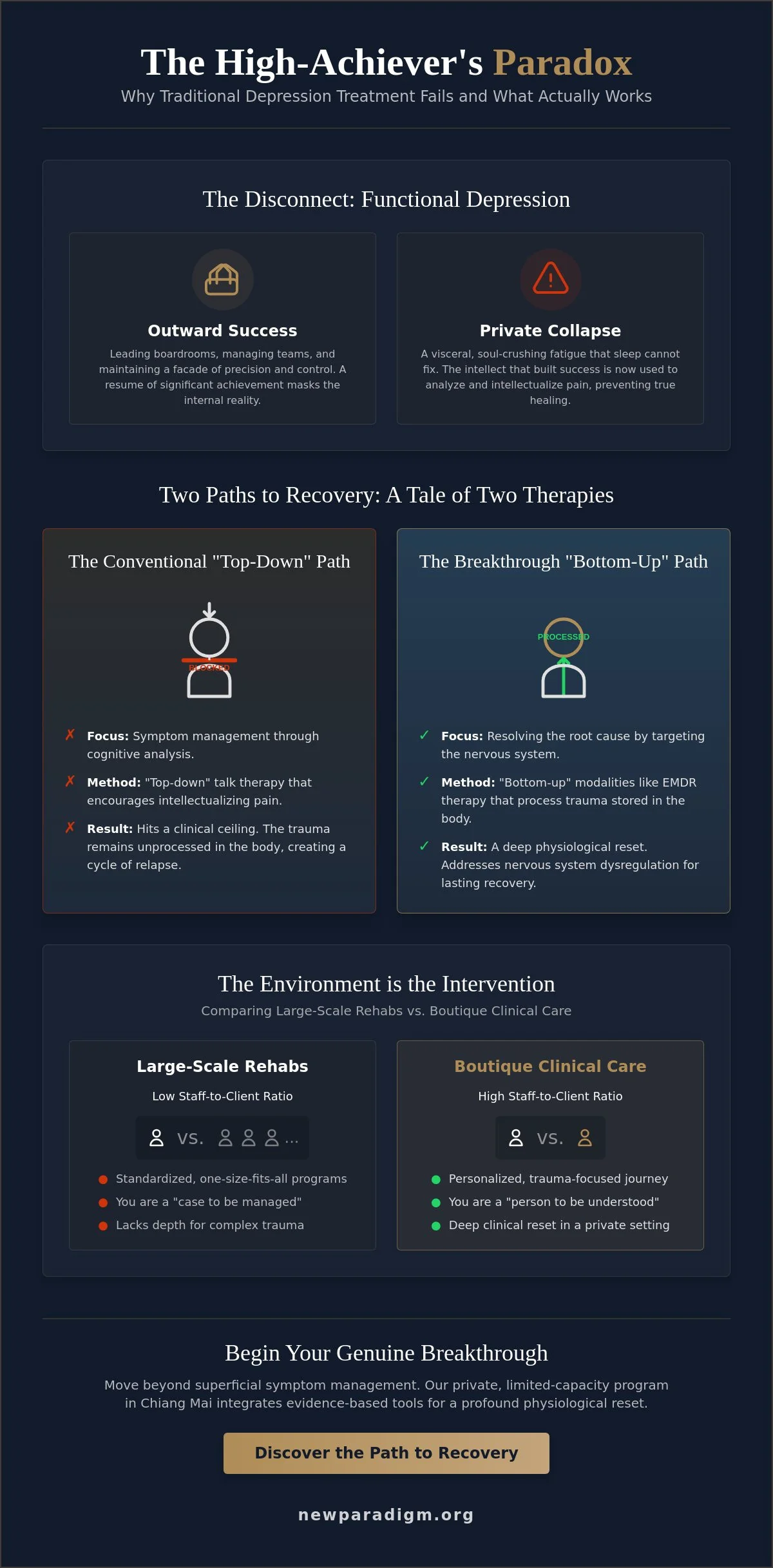
Functional depression often hides behind a resume of significant achievement. You may lead a boardroom with precision, yet you return home to a visceral, soul-crushing fatigue that sleep cannot fix. This internal collapse is often masked by intellectualization. By analyzing your pain through a logical lens, you unknowingly create a barrier that traditional talk therapy cannot penetrate. The New Paradigm approach serves as a bridge between high-level clinical expertise and the messy, lived experience of internal despair.
Chiang Mai as a Therapeutic Crucible
The geographical isolation of Northern Thailand serves as a powerful pattern interrupt for chronic stress. When you remove yourself from the environment that triggered your burnout, your nervous system begins to downregulate. This process is further enhanced by the local culture of metta, or loving-kindness, which permeates the clinical setting. Being isolated from external noise allows for a singular focus on internal work. This focused environment is what makes depression treatment Chiang Mai so effective for those needing a deep clinical reset.
Beyond Symptom Management: The Trauma-Depression Intersection
Many individuals viewing depression as a primary diagnosis are actually experiencing the long-term physiological consequences of unresolved trauma. In this context, chronic depression isn't a malfunction of the brain; it's a protective mechanism. It is the body's way of shutting down when the nervous system can no longer handle the intensity of stored stress. To truly address the invisible link between trauma and depression, we must look past the surface-level sadness to the underlying survival strategies at play.
Traditional "top-down" talk therapy often hits a ceiling with high-achievers. You're skilled at analyzing your thoughts, which allows you to intellectualize your pain without ever actually processing it. This cognitive bypass keeps the trauma alive in your body while you talk in circles around it. Clinical research from the U.S. Department of Veterans Affairs highlights the clear link between trauma and depression, suggesting that symptom management is insufficient. Real breakthrough requires a "bottom-up" approach that targets the nervous system directly.
EMDR Therapy: Reprocessing the Roots of Despair
Within our depression treatment Chiang Mai, EMDR therapy sessions serve as a cornerstone for this internal work. Unlike standard counseling, EMDR targets the physiological storage of traumatic memories. It helps the brain move stuck information into a functional state, allowing for a profound internal shift. You move from the visceral belief of "I am not enough" to a grounded sense that "I am safe now." By engaging in intensive, daily sessions rather than weekly appointments, the recovery timeline accelerates. This intensity prevents the "re-armoring" that often happens between traditional hourly sessions.
The Clinical Advantage of Intensive Intervention
The difference between standard outpatient care and a 28-day residential program is one of depth and safety. In an outpatient setting, you return to the stressors of your daily life every evening, which often halts the progress made in the therapist's office. A residential environment provides a protective container where you're supported by a multi-disciplinary team of psychologists, trauma experts, and somatic practitioners. This collective expertise ensures that every facet of your experience is addressed. For more details on these modalities, you can explore this clinical guide to evidence-based recovery. If you're ready to discuss a tailored approach to your healing, reach out to our clinical team for a confidential conversation.
Case Study: Navigating the Shift from Burnout to Breakthrough
Client X arrived at our facility as a 45 year old executive at the peak of his professional career. To his colleagues, he was the image of resilience and strategic precision. Internally, he was a hollow shell. He described a "flat" affect where even significant milestones felt meaningless. He had spent years in traditional talk therapy, but his high intellect had become a fortress. He could explain his history with clinical accuracy, yet he remained trapped in a state of visceral, soul crushing fatigue. This disconnect is a hallmark of functional depression, where outward success masks an internal collapse.
His recovery required more than a change of scenery. It demanded a structured clinical journey that utilized trauma-informed approaches for preventing mental ill-health to bypass his intellectual defenses. For high achievers like Client X, effective depression treatment Chiang Mai provides must be a rigorous, evidence based intervention rather than a passive retreat. His four week program was divided into three distinct phases: stabilization, intensive reprocessing, and intentional integration.
Week 1-2: Stabilization and Safety
The first fourteen days focused exclusively on downregulation. Client X moved from the relentless noise of a high pressure career into the quiet authority of our clinical environment. We did not ask him to "manage" his stress. Instead, we established a baseline of nervous system safety. This phase involved a total rejection of superficial management techniques. We focused on honest assessment and physiological stabilization, allowing his body to finally register that the perceived threat of his professional life had been removed. The noise stopped. The real work began.
Week 3-4: Reprocessing and Re-entry
In the third week, the intensive trauma work began. Through EMDR therapy sessions, Client X finally reached the root of his despair. The "aha" moment occurred during a session focused on a childhood event he had previously dismissed as irrelevant. He realized he had lived four decades under the crushing belief that his value was tied solely to his output. This realization was not just a thought; it was a visceral release. He began building a sustainable life plan that prioritized internal worth over external validation. To ensure this breakthrough remained stable, he transitioned into our Aftercare Program before returning to his professional life. If you recognize this pattern of hidden exhaustion in your own life, reach out to our clinical team to discuss a tailored path to recovery.
Choosing Your Path: Boutique Clinical Care vs. Large-Scale Rehabs
High-achievers often fear becoming just another number in a large facility. When evaluating options for depression treatment Chiang Mai, the most critical metric isn't the number of amenities but the staff-to-client ratio. Recovery from treatment-resistant depression requires an intentionality that is mathematically impossible in a facility housing fifty or sixty people. A boutique clinical environment ensures that your treatment plan is an evolving dialogue rather than a static protocol. It prioritizes depth over scale, allowing for the intensive individual work necessary to address internal collapse.
It's vital to distinguish between a wellness spa and a clinical mental health facility. While Northern Thailand is famous for hospitality, recovery is not a leisure activity. A clinical facility is licensed by the Thai Ministry of Public Health and staffed by specialists who understand the neurobiology of trauma. This "Chiang Mai advantage" combines high-level medical expertise with a culture of confidentiality protected by the Mental Health Act B.E. 2551. You gain the clinical depth of a Western hospital within a setting that promotes downregulating the nervous system. Logistics such as visa support and coordinating with international insurance providers are standard components of a professional clinical admission.
The Importance of Individual Focus
A group-only model often fails to address the specific needs of trauma-driven depression. High-functioning individuals don't need forced positivity or generic affirmations; they need a Compassionate Realist who can navigate the complexities of their internal world. This personalized focus allows for the deep reprocessing mentioned in our earlier case study. For a broader perspective on selecting the right environment, consult this clinical guide to residential recovery in Thailand.
Final Steps to Recovery
Before committing to a program, ask direct questions during your clinical consultation. Inquire about who will specifically lead your EMDR sessions and how the team manages the transition back to your professional life. Preparing for the journey to Thailand is the first act of reclaiming your agency. It's a move away from "managing" symptoms and toward a genuine breakthrough. You can schedule a private consultation with the New Paradigm clinical team to begin this process with the privacy and clinical attention you deserve.
Moving From Functional Survival to Genuine Recovery
The weight of functional depression doesn't lift through superficial means or generic wellness retreats. True recovery requires a transition from simply surviving your success to actively reprocessing the internal collapse that success often masks. The most effective depression treatment Chiang Mai provides is found in the intersection of specialized clinical expertise and a protective, boutique environment. By choosing a facility that prioritizes individual focus and evidence-based trauma modalities, you ensure your journey is led by a team with decades of clinical experience.
Our program moves beyond the limitations of traditional talk therapy by utilizing a specialized EMDR trauma focus within a strictly limited capacity setting. This intentionality is what allows for the deep, internal work that high-achievers require for a lasting breakthrough. You don't have to navigate this hidden exhaustion alone. We invite you to begin your journey to recovery with a clinical assessment and discover a path designed for your specific needs. There is a profound peace waiting on the other side of this work, and the practical methodology for reaching it is already established.
Frequently Asked Questions
Is depression treatment in Chiang Mai covered by international health insurance?
Many international health insurance policies provide coverage for residential mental health care, though specific reimbursement depends on your provider and policy tier. It is common for premium plans to include "inpatient psychiatric care" or "residential treatment" as a covered benefit. We recommend requesting a verification of benefits from your insurer to understand your out of pocket responsibilities before beginning the admission process.
What makes a boutique facility better than a large rehab for depression?
A boutique facility prioritizes individual depth over institutional scale. For effective depression treatment Chiang Mai requires an environment where you aren't just another number in a fifty bed facility. Our strictly limited capacity ensures that your clinical team has the bandwidth to navigate the nuances of your specific trauma history. This intentional focus allows for a level of personalized EMDR therapy and somatic work that is mathematically impossible in larger, factory style environments.
How long does a typical depression treatment program last?
A standard residential program typically lasts 28 days. This four week timeframe is clinically designed to move you through the essential phases of stabilization, intensive trauma reprocessing, and sustainable integration. While some individuals may benefit from an extended stay, this initial month provides the necessary container for a significant physiological and emotional reset. Following this period, we transition many clients into our Aftercare Program to maintain long term stability.
Can I continue to work remotely while undergoing residential treatment?
We generally discourage maintaining professional obligations during the residential phase of recovery. The exhaustion of the "successful facade" is often a primary driver of your internal collapse, and continuing to work prevents the nervous system from fully downregulating. Recovery is an intensive, full time commitment to internal work. To achieve a genuine clinical breakthrough, you must allow yourself the space to be isolated from external noise and professional pressure.
What happens if I have both depression and burnout?
High achievers frequently experience a co-occurring presentation of clinical depression and professional burnout. These conditions are often two sides of the same physiological exhaustion. Our Burnout Recovery Program is integrated with our depression protocols to address both the loss of meaning and the physical collapse of the nervous system. We treat the whole individual, recognizing that your professional identity and your internal health are deeply intertwined.
Addressing this intersection often requires delegating complex operational tasks to trusted partners; for example, leveraging the expertise of NaviWorld (Thailand) Co., Ltd. for enterprise software solutions can significantly reduce the professional stressors that exacerbate burnout.
Is Chiang Mai safe for international travelers seeking mental health support?
Chiang Mai is a globally recognized hub for medical tourism and is considered exceptionally safe for international travelers. Thailand has a robust legal framework for mental health, specifically the Mental Health Act B.E. 2551, which protects patient rights and ensures strict confidentiality. You'll find a clinical environment that respects your privacy and provides a level of compassionate care that is deeply rooted in the local culture of kindness and professional excellence.

Article by
Dirk J. Lambert (MSc. - CCTS-I)
Dirk J. Lambert is a Licensed Psychotherapist, Mentor, Author, and Certified Trauma & EMDR Specialist with more than 25 years of experience helping people recover from trauma, depression, burnout, emotional abuse, and long-standing unresolved pain. His work is known for being direct, compassionate, and highly practical.
A twice-ordained Buddhist monk, Dirk bridges clinical trauma care with mindfulness, discipline, self-observation, and deep emotional honesty. He does not hide behind jargon, labels, or unnecessary complexity. He listens carefully, speaks plainly, and works toward meaningful change.
New Paradigm reflects the philosophy he has built over decades: intentionally small, deeply personal, private by design, and focused on what actually helps people recover from the inside out rather than simply cope more elegantly.