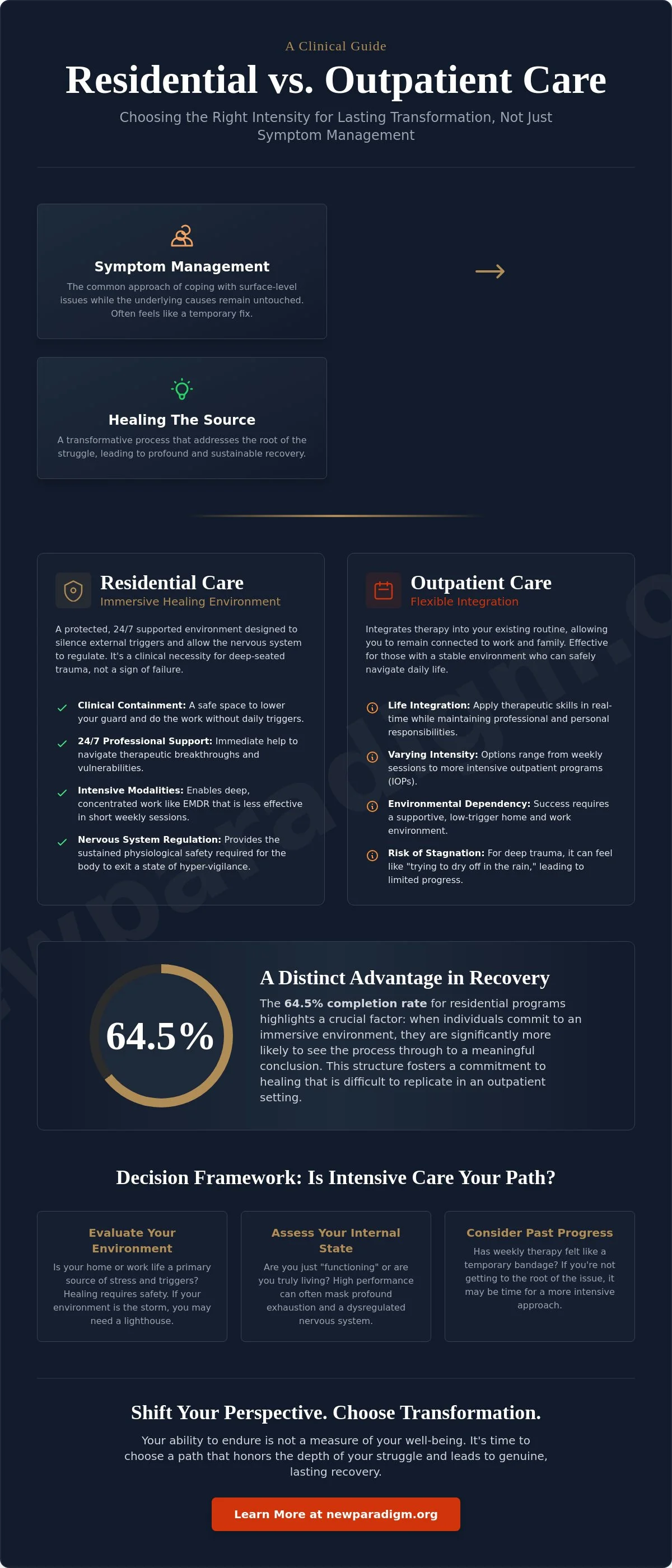
You've spent years perfecting the art of being okay while everything inside feels like it's slowly collapsing. When you're weighing residential vs outpatient treatment, the question isn't just about your schedule. It's about whether you're ready to stop managing symptoms and start healing the source. You might feel that stepping away for residential care is a sign of failure or a crack in your professional armor. It's common to believe that if you can still function, you don't deserve the highest level of care.
We understand that intellectualizing your pain hasn't made it disappear. This clinical guide helps you discover the differences between residential and outpatient care to determine which intensity is required for your lasting recovery. We'll examine how 2026 insurance parity updates and integrated care models influence your options. You'll see why the 64.5% completion rate of residential programs offers a distinct advantage over standard symptom management. It's time to choose a path that honors the depth of your struggle rather than just your ability to endure it.
Key Takeaways
- Distinguish between the immersive clinical work of residential care and the flexible integration offered by an outpatient model.
- Learn why nervous system regulation often requires a degree of safety and isolation that weekly talk therapy cannot provide.
- Evaluate residential vs outpatient treatment using a framework that prioritizes the depth of your internal struggle over your external productivity.
- Recognize that high-level professional functioning is often a mask for exhaustion, not a reason to avoid intensive care.
- Shift your perspective from "symptom management" to a new paradigm of thriving through intentional, focused transformation.
The Fundamentals of Residential vs. Outpatient Care
Choosing between residential and outpatient care is not a logistical decision about your schedule or your professional obligations. It's a clinical determination based on the depth of your internal struggle. While you might feel that your ability to maintain a high-level career suggests you only need a few hours of therapy a week, the reality of recovery is often more complex. The debate of residential vs outpatient treatment centers on whether you need to manage your current life or fundamentally transform the way you inhabit it.
Outpatient care is designed for those who possess a high degree of environmental stability and a supportive home life. It integrates therapy sessions into your existing routine, allowing you to remain connected to your family and career. Residential care, conversely, offers a protected environment where the external noise of your life is silenced. This isolation isn't a punishment or a sign of failure. It's a clinical necessity for those whose nervous systems have been pushed to the point of collapse by chronic stress or deep-seated trauma.
To better understand the core distinctions between these two levels of intensity, watch this helpful video:
The Structure of Residential (Inpatient) Care
The primary benefit of a residential setting is clinical containment. When you're dealing with complex PTSD or severe burnout, your environment is often a minefield of triggers that keep your body in a state of high alert. A residential program provides 24/7 support that goes beyond simple crisis monitoring; it creates a space where you can finally lower your guard. To understand the broader scope of these facilities, you can research What is a Residential Treatment Center? and how they differ from hospital settings. Within this community of peers and clinicians, you aren't just a patient; you're a participant in a shared experience of healing that honors the gravity of your suffering.
The Flexibility of Outpatient Programs
Outpatient programs vary in intensity, ranging from standard weekly sessions to Intensive Outpatient Programs (IOP) that meet several times a week. These models are effective for individuals who don't require 24-hour supervision and can safely navigate their daily triggers. However, outpatient care has its limitations. If your home or work environment is the primary source of your exhaustion, trying to heal while remaining in that environment is like trying to dry off while standing in the rain. For those facing deep-seated trauma, the "management" focus of outpatient care often feels like a temporary bandage rather than a path to lasting peace. At New Paradigm, we recognize that true recovery requires the depth that only a focused, immersive environment can provide.
Clinical Efficacy: When Intensity Becomes Necessary for Healing
Healing isn't just about insight; it's about biology. When the nervous system is stuck in a loop of hyper-vigilance, talk therapy once a week often fails to penetrate the protective layers of the mind. For those with complex PTSD or profound burnout, the body requires a sustained period of physiological safety to begin regulation. This is the clinical pivot point in the residential vs outpatient treatment debate. One model manages the stress. The other provides the silence necessary to dismantle it.
We view the physical environment as the "third therapist" in the room. A clinical setting that removes you from the chaos of your daily life allows your prefrontal cortex to come back online. Intensive trauma therapy utilizes the residential model to accelerate healing by ensuring that every hour of your day supports the work done in session.
Intensive EMDR and Reprocessing
Concentrated EMDR therapy sessions allow for a level of depth that's impossible to achieve in 50-minute increments. The "EMDR hangover" often leaves individuals feeling raw and vulnerable. In a residential setting, you have professional support to navigate this vulnerability immediately, rather than waiting a week to process the fallout. This continuity prevents the emotional "shutting down" that often stalls progress in outpatient settings. Residential intensives create rapid shifts by staying with the memory until it's fully reprocessed.
The "Trigger-Free" Environment
Your brain cannot prioritize neuroplasticity while it's busy scanning for threats. Daily stressors like urgent emails, family tensions, or traffic keep you in survival mode. While government agencies define various Levels of Addiction Care and mental health support, they often overlook the neurological benefit of simple, intentional isolation. When comparing residential vs outpatient treatment, the most significant factor is often the presence of environmental triggers. Removing yourself from the environment where your burnout was created isn't an escape. It's a strategic reconnection to your own internal rhythm. If you feel your current environment is hindering your progress, you may want to speak with a clinical coordinator about a more intensive approach.
The Decision Framework: Assessing Your Level of Need
The choice between residential vs outpatient treatment often feels like a negotiation with your own productivity. For the high-achiever, the "mask" of outward success is the greatest barrier to receiving appropriate care. You might believe that because you haven't missed a deadline or a board meeting, your struggle isn't severe enough to warrant stepping away. This is the High-Achiever Trap: the false belief that functional capacity equals internal well-being. Clinical reality suggests otherwise. If you're using intellectualization to bypass your pain, or if your "coping mechanisms" are simply ways to numb the exhaustion of your own success, you aren't managing your life; you're surviving it.
Stepping away for intensive care is often viewed as a sign of failure, but it's actually a strategic investment in your future self. When we examine the Clinical Efficacy of Treatment Settings, data shows that residential programs have a significantly higher completion rate of 64.5% compared to 51.9% for outpatient alternatives. This discrepancy exists because residential care removes the daily obligation to perform, allowing the brain to focus entirely on the labor of recovery. For many, a burnout recovery program in a residential setting is the only way to break the cycle of chronic stress that outpatient therapy cannot reach.
Evaluating Your Internal Safety
Assessment begins with an honest look at your physiological state. Ask yourself if you can truly regulate your emotions when you're surrounded by the same environment that triggered your collapse. Physical indicators often tell the story that your mind tries to hide. If you're experiencing chronic fatigue, persistent digestive issues, or sleep disturbances that don't respond to standard hygiene, your body is signaling a need for a higher level of clinical containment. Your healing requires a stable, neutral ground that your current home or work environment may not be able to provide.
Comparing Residential vs. Outpatient Logistics
The primary difference in residential vs outpatient treatment lies in the depth of clinical hours and the speed of transformation. Outpatient care is a marathon, often requiring months or years of fragmented work while you continue to navigate the stressors of your life. Residential care is a sprint, condensing years of traditional therapy into a few focused weeks. Consider the opportunity cost of the slower path. If outpatient care takes two years to achieve what residential care can do in thirty days, the "convenience" of staying home becomes a heavy tax on your quality of life. When you're ready to discuss these logistics with your family or employer, frame it as a necessary pause to ensure your long-term contribution and presence. If you're unsure which path fits your current clinical profile, reach out to our clinical team for a confidential assessment.
Beyond Management: The New Paradigm for Lasting Recovery
Recovery shouldn't feel like a life sentence of symptom management. While many programs prioritize sobriety or stability as the final destination, we view these as merely the foundation. The New Paradigm philosophy moves you from the exhaustion of "coping" toward the vitality of thriving. When you evaluate residential vs outpatient treatment, consider which model facilitates post-traumatic growth rather than just temporary relief. Choosing residential trauma treatment is a protective investment in your future self. It provides the space to rewrite the internal narratives that have kept you in a state of hidden collapse.
The unique clinical environment of trauma treatment in Chiang Mai serves as a powerful catalyst for this change. It isn't a leisure stay. It's a focused, clinical intervention set against a backdrop of stillness. This intentional isolation allows you to move from the noise of a high-pressure career into a grounded, sustainable life. The journey from crisis to peace requires more than a change in schedule; it requires a change in perspective.
The Boutique Clinical Advantage
We maintain an extremely limited capacity because deep psychological work cannot be done in a crowd. This boutique approach ensures that your treatment is personal, discerning, and quiet. By blending rigorous evidence-based methodology with contemplative practices, we address the intellectualized pain that traditional settings often miss. Our private, non-institutional environment is designed to reduce the shame of seeking help. You aren't entering a hospital. You're entering a sanctuary for intensive internal work where your privacy and dignity are the highest priority.
Transitioning with an Aftercare Program
The journey doesn't end when you leave the residential setting. A structured aftercare program is essential for bridging the gap between clinical care and your professional life. It's about maintaining the "Chiang Mai Calm" even when you return to a high-pressure environment. We provide a path to long-term stability that ensures your transformation isn't a fleeting experience, but a permanent shift in how you inhabit the world. Our commitment is to provide the practical methodology you need to stay grounded, composed, and truly well. You've spent enough time managing your symptoms. It's time to begin living beyond them.
Choosing Depth Over Convenience
The decision to seek help is a profound act of courage, but the decision to seek the right level of help is an act of wisdom. You've seen that the choice between residential vs outpatient treatment isn't about your ability to function; it's about your need to heal. While outpatient models provide flexibility, they often lack the clinical containment required to dismantle deep-seated trauma and exhaustion. Lasting recovery demands a space where you don't have to perform or manage the expectations of your daily life.
At New Paradigm, we offer a path that moves beyond superficial management. Our practitioners bring decades of clinical experience in complex trauma to a setting defined by its highly limited capacity and individualized focus. By utilizing specialized EMDR intensive protocols, we help you address the source of your pain rather than just its outward symptoms. This is a personal environment for intensive internal work, designed for those who are ready to trade the exhausting mask of success for genuine, grounded peace. Begin Your Journey to Deep Recovery at New Paradigm and discover a life that's no longer dictated by the weight of your past. You've carried this burden long enough; it's time to let us help you navigate the way through it.
Frequently Asked Questions
Is residential treatment only for people with severe drug or alcohol addiction?
No, residential care is not limited to substance use disorders. It's a clinical environment designed for anyone facing complex trauma, severe depression, or chronic anxiety that hasn't responded to traditional therapy. The intensity of the program is based on the depth of your internal struggle rather than the specific nature of the symptoms. Many high-achieving individuals utilize these programs to address the hidden exhaustion that outpatient care cannot reach.
Can I continue to work remotely while in a residential trauma program?
We generally discourage remote work during the intensive phase of recovery. Clinical containment requires a temporary disconnection from the professional triggers and stressors that contributed to your collapse. True transformation happens when your prefrontal cortex is allowed to rest and refocus on your own biology. Engaging in work while in treatment often dilutes the therapeutic process and prevents the deep nervous system regulation needed for lasting change.
How long does a typical residential treatment program last compared to outpatient?
Residential programs are typically shorter and more intensive, often spanning 30 to 90 days of focused work. In contrast, outpatient care is a slower process that can last for months or even years while you manage your daily life. When weighing residential vs outpatient treatment, it's important to consider that the residential model condenses years of traditional talk therapy into a single, immersive experience to accelerate your healing.
What happens if I start with outpatient therapy and it isn't enough?
Transitioning to a higher level of care is a clinical adjustment, not a sign of failure. If weekly outpatient sessions aren't providing the stability or relief you need, it's an indication that your nervous system requires more containment. Moving into a residential program allows you to stop simply managing your symptoms and start addressing the underlying trauma in a safe, trigger-free environment. We often see clients who find their breakthrough only after stepping away from their daily routines.
Will my insurance cover residential mental health treatment in Thailand?
Coverage for international treatment depends entirely on your specific insurance provider and policy details. While 2026 parity updates have improved domestic mental health coverage, international programs often fall under out-of-network or specialized benefit categories. You should contact your insurer to verify your international mental health benefits. We recommend requesting a clear summary of what's covered for residential stays outside of your home country to avoid unexpected costs.
How do I know if my "burnout" is actually severe enough for a residential stay?
If your burnout has become a physiological state of collapse that talk therapy hasn't resolved, it's severe enough. Severe burnout is more than just feeling tired; it's an internal disconnect where you're "masking" outward success while feeling private despair. If you're experiencing chronic fatigue, emotional numbness, or a loss of purpose despite your professional achievements, you deserve a level of care that honors the gravity of your suffering.

Article by
Dirk J. Lambert (MSc. - CCTS-I)
Dirk J. Lambert is a Licensed Psychotherapist, Mentor, Author, and Certified Trauma & EMDR Specialist with more than 25 years of experience helping people recover from trauma, depression, burnout, emotional abuse, and long-standing unresolved pain. His work is known for being direct, compassionate, and highly practical.
A twice-ordained Buddhist monk, Dirk bridges clinical trauma care with mindfulness, discipline, self-observation, and deep emotional honesty. He does not hide behind jargon, labels, or unnecessary complexity. He listens carefully, speaks plainly, and works toward meaningful change.
New Paradigm reflects the philosophy he has built over decades: intentionally small, deeply personal, private by design, and focused on what actually helps people recover from the inside out rather than simply cope more elegantly.