Deciding to seek help after sexual abuse is not a small thing. For many survivors, it takes years - sometimes decades - to arrive at the point of reaching out. There may be shame, fear of not being believed, uncertainty about whether what happened was serious enough to warrant help, or a deep wariness about trusting another person with something so private and so painful. If you are reading this and considering the next step, that matters. It does not have to be a big step. It just has to be in the right direction.
This article is a practical guide to finding professional help as a survivor of sexual abuse - what to look for in a therapist, what types of treatment actually work, what to expect when you first make contact, and how to trust your own judgment about whether a therapeutic relationship feels safe enough to work within.
You Do Not Have to Explain Everything to Get Started
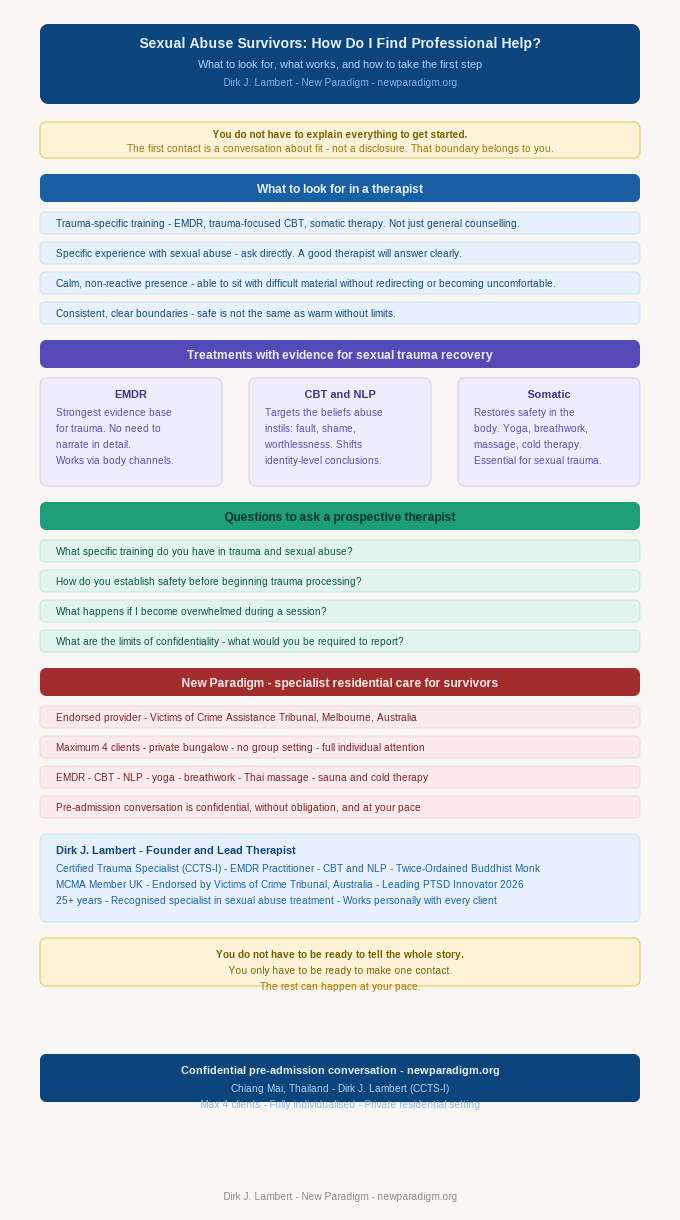
One of the barriers survivors describe most often is the anticipation of having to explain. Of having to tell the story, in detail, to a stranger, before knowing whether that person is safe. This is worth addressing directly: you do not have to explain anything in full to begin. The first contact with a therapist or treatment programme is not a disclosure. It is a conversation about whether the fit is right.
A good therapist will not press you for details you are not ready to share. They will ask about what you are experiencing now - the symptoms, the impact on daily life, what you are hoping for from treatment - and they will give you information about their approach. The question of what happened, and how much of it you choose to share, and when, is yours to decide throughout the entire process. That boundary belongs to you and a skilled trauma therapist will respect it completely.
What to Look for in a Therapist
Not all therapists are equally equipped to work with survivors of sexual abuse. Trauma is a specialist area, and sexual trauma in particular requires specific training, experience, and qualities in the therapeutic relationship.
The most important thing to look for is trauma-specific training. A therapist who is generally skilled in counselling or cognitive behavioural therapy but has no specific training in trauma may be well-intentioned but unprepared for the complexity of what sexual abuse survivors bring. Look for qualifications or training in EMDR (Eye Movement Desensitisation and Reprocessing), trauma-focused CBT, somatic therapies, or specialist trauma modalities. EMDR in particular has one of the strongest evidence bases for the treatment of sexual trauma and PTSD.
Experience matters alongside qualification. Ask, when you make initial contact, how much of their caseload involves trauma survivors, and whether they have specific experience with sexual abuse. A therapist who can answer these questions clearly and comfortably is more likely to have the grounding to work with the material you will bring.
The quality of the therapeutic relationship itself is not a secondary consideration - it is central. Research consistently shows that the therapeutic alliance is one of the strongest predictors of outcome in trauma treatment. You should feel, over time, that the therapist is genuinely present, genuinely consistent, and genuinely non-judgmental. If in early sessions you feel dismissed, rushed, or that your experience is being minimised, that is important information. Trust your response.
Specific qualities to look for include: calm and non-reactive presence, clear boundaries maintained consistently, the ability to sit with difficult material without becoming uncomfortable or attempting to redirect away from it, and genuine warmth that does not tip into over-involvement. The therapeutic relationship in sexual abuse work needs to be safe above all else - not warm in a way that feels boundary-less, but reliably present and consistently boundaried.
Types of Treatment That Work
Several evidence-based approaches have demonstrated effectiveness specifically with survivors of sexual abuse and sexual trauma.
EMDR has the most robust evidence base for trauma specifically. It works by activating traumatic memories in a controlled way while engaging bilateral stimulation - typically eye movements - that appears to facilitate the brain's own reprocessing mechanisms. Unlike talking therapies, EMDR does not require the survivor to narrate the traumatic event in detail. The processing happens through the somatic and associative channels that trauma actually occupies, rather than through verbal reconstruction. Many survivors who have found talking about their experience retraumatising report that EMDR feels more containable and produces more durable shifts.
Trauma-focused CBT addresses the cognitive consequences of sexual abuse - the beliefs the experience instilled about the self, about safety, about what the survivor deserves and what can be expected from others. Sexual abuse consistently produces distorted self-beliefs: that the abuse was the survivor's fault, that they are damaged or unlovable, that their body is not their own. Targeted work on these belief structures is a necessary part of recovery that EMDR alone may not fully address.
NLP - Neuro-Linguistic Programming - offers tools for working with the internal representations and language patterns that maintain trauma responses and distorted self-belief. In the hands of a skilled practitioner with trauma experience, it can be a powerful complement to EMDR and CBT - helping to shift not just the traumatic memory but the identity-level conclusions it has produced.
Somatic approaches - body-based therapies including yoga, breathwork, Thai massage and movement practices - address what is held in the body. Sexual abuse is specifically a violation of the body. Many survivors describe a profound disconnection from their physical self - feeling unsafe in their own skin, disowning their body, or experiencing chronic physical symptoms with no clear medical explanation. Somatic work that restores a sense of safety and ownership in the body is not optional for survivors of sexual trauma. It is part of the essential architecture of recovery.
Inpatient and Intensive Outpatient Options
For many survivors, standard weekly outpatient therapy is a meaningful part of recovery - but it has significant limitations. One hour per week provides a narrow therapeutic window. Between sessions, survivors return to ordinary life, often without the regulatory support or integration time that deep trauma work requires. Progress can be slow, and the gaps between sessions can feel very long when difficult material has been opened.
Intensive residential treatment - where the survivor lives within the therapeutic environment for a concentrated period - offers a fundamentally different structure. The density of therapeutic contact means the nervous system has sustained support to move through what it has been holding. The integration time between sessions is not lost to the demands of ordinary life. The body-based practices run alongside and between the clinical sessions, containing and continuing the work.
For survivors of sexual abuse specifically, the privacy and containment of a residential setting has additional value. There is no commute between a painful session and an open-plan office. There is no need to compose yourself before collecting the children. The therapeutic environment holds the process, which allows the process to go deeper than a weekly session can reach.
New Paradigm works with a maximum of four clients at any time. This is not incidental. For survivors of sexual abuse, the idea of sharing a therapeutic space with multiple strangers - of being one of many, of reduced individual attention, of a group setting - is often a significant barrier. The small, private structure of New Paradigm is specifically designed to provide the level of individual attention and privacy that sexual abuse recovery requires. Dirk J. Lambert works personally with every client, and the pre-admission assessment is thorough - not because admission criteria are restrictive, but because the programme is tailored individually from the outset.
How to Make the First Contact
Making the first contact is often the hardest step - not because of what follows, but because of what it represents. Reaching out is an acknowledgment that what happened was real, that it had consequences, and that you need and deserve support. For survivors who have spent years minimising or managing, that acknowledgment can feel enormous.
It does not need to happen in one move. If calling feels like too much, email or an online form is a legitimate first step. You do not need to explain your history in the first message. You do not need to use any particular words. "I am a survivor of sexual abuse and I am looking for help" is enough. Any reputable therapist or programme will take it from there.
When you do have an initial conversation - by phone or in person - pay attention to how it feels. Not just what is said, but how it is said. Does the person on the other end slow down to your pace, or do they move quickly? Do they ask about what you need, or do they launch into what they offer? Do you feel heard, or processed? Your nervous system's response to that first contact is data. It is allowed to inform your decision.
It is also entirely appropriate to speak to more than one therapist or programme before committing. Finding the right fit is not disloyalty to anyone. It is responsible self-care.
Questions Worth Asking a Prospective Therapist
You are entitled to ask questions before agreeing to work with anyone. Some that are worth raising directly: What specific training do you have in trauma and sexual abuse? How long have you been working with survivors? What treatment modalities do you use, and why? How do you handle it if I become overwhelmed during a session? What is your approach to confidentiality? How do you manage endings and transitions?
A therapist who responds to these questions with openness, clarity and without defensiveness is demonstrating qualities that will be important throughout the work. A therapist who becomes uncomfortable with being asked, or who answers vaguely, is giving you useful information at the earliest possible stage.
If You Are Considering New Paradigm
Dirk J. Lambert is a recognised specialist in the treatment of sexual abuse survivors. He is an endorsed provider through the Victims of Crime Assistance Tribunal in Melbourne, Australia - a designation specific to work with survivors of violent and sexual crime. His clinical background combines EMDR, CBT, NLP, somatic practices, and a contemplative framework developed across 25 years of intensive clinical work and two periods of Buddhist monastic ordination.
The pre-admission conversation at New Paradigm is confidential and without obligation. Its purpose is to understand your situation, answer your questions honestly - including the question of whether New Paradigm is the right fit - and give you the information you need to make a considered decision. There is no pressure and no sales process. If the programme is not the right match for your situation, that will be said clearly.
Understanding what conditions intensive residential treatment works best for gives context for where sexual abuse recovery fits within the broader range of presentations that benefit from this level of care. The emotional numbness and detachment that many survivors experience is addressed in depth elsewhere - it is one of the most common and least discussed consequences of sexual trauma. And how the therapeutic relationship itself produces change is directly relevant to why the quality of the therapist you choose matters as much as the modalities they use.
If you are ready to take the first step, or simply want to ask a question without any commitment, contact New Paradigm for a confidential conversation.
About the Author
Dirk J. Lambert is the founder and lead therapist at New Paradigm, a private mental health retreat in Chiang Mai, Thailand. He is a Certified Trauma Specialist (CCTS-I), EMDR practitioner, CBT and NLP specialist, and twice-ordained Buddhist monk with more than 25 years of clinical experience working with complex trauma, PTSD, depression, and attachment disorders. Dirk founded Thailand's first alternative recovery centre in 2000 and established New Paradigm in 2014. He is a recognised specialist in the treatment of sexual abuse survivors, an endorsed provider through the Victims of Crime Assistance Tribunal in Melbourne, Australia, a member of the Complementary Medical Association UK (MCMA), and was named Leading PTSD Innovator in 2026 by Global Health and Pharma. He works personally with every client who enters the programme.