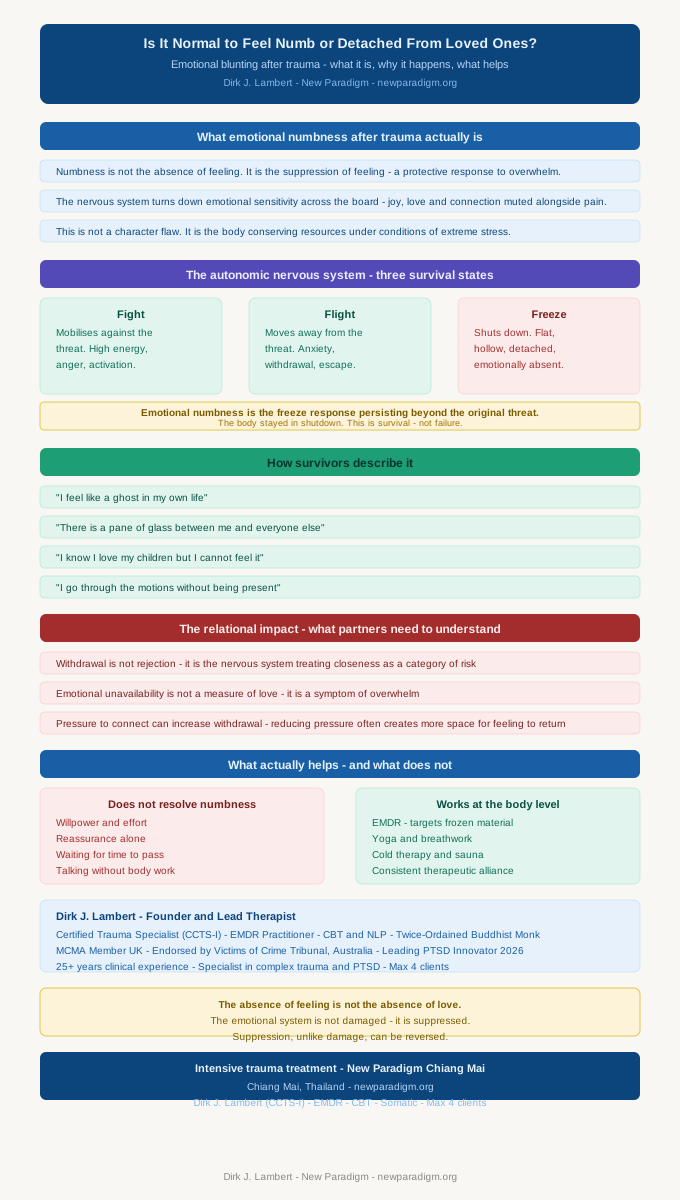
Many trauma survivors describe a version of the same experience. They are surrounded by people who love them - a partner, children, close friends - and they feel nothing. Not hostility. Not grief. Just an absence. A glass wall between themselves and the people they know they care about. They watch their own life from a slight distance, going through the motions of connection without actually feeling connected. And then comes the secondary fear: what if this is permanent? What if something in me has broken that cannot be repaired?
Emotional numbness and detachment from loved ones are among the most distressing and least talked-about consequences of trauma. They are also among the most common. Understanding why they happen - and what they actually represent - is the first step toward being able to move through them.
What Emotional Numbness After Trauma Actually Is
Numbness is not the absence of feeling. It is the suppression of feeling - a protective mechanism the nervous system deploys when the volume of emotional experience exceeds what it can safely process. After a traumatic event, the nervous system has been flooded. The emotional intensity of trauma is not something the mind and body can simply absorb and continue from. Something has to give.
What gives, in many cases, is the general capacity for emotional response. The nervous system effectively turns down the sensitivity of the emotional processing system - not selectively, not just for the painful feelings associated with the trauma, but across the board. Joy, love, connection, pleasure, interest, humour - all of it gets muted along with the pain. This is not a character flaw or a sign of emotional damage. It is the body doing what bodies do under conditions of extreme stress: conserving resources, reducing exposure, protecting the system from further overwhelm.
In clinical language, this is often described as emotional blunting, affective numbing, or, when the sense of unreality is prominent, depersonalisation or derealisation. These are not rare or unusual responses. They appear across trauma presentations - in PTSD, in complex trauma, in acute stress reactions, and in the period following significant loss or shock.
Why Trauma Specifically Affects Emotional Connection
Trauma, particularly interpersonal trauma - the kind that involves violation, betrayal, or harm inflicted by another person - does something specific to the relational system. When another person has been the source of overwhelming harm, the nervous system can generalise that threat signal to relationships in general. Closeness becomes associated with danger. Vulnerability becomes associated with exposure. The emotional system that would ordinarily draw a person toward connection begins, instead, to register connection as a risk to be managed.
This is particularly devastating in the context of intimate relationships. A partner who was not involved in the trauma, who is trying to be present and supportive, may find that the survivor withdraws precisely when they attempt closeness. The survivor may not be able to explain why. They may not understand it themselves. The withdrawal is not a rejection of the specific person. It is the nervous system's generalised response to intimacy as a category of experience that now carries an association with threat.
Even in cases where the trauma was not interpersonal - where it involved accident, illness, natural disaster - the emotional numbing can extend into relationships. The survivor has been through something that fundamentally changed their experience of the world. The gap between what they now know to be possible and the ordinary concerns of daily life can make it difficult to inhabit the same emotional register as the people around them. Connection requires a kind of presence that trauma makes difficult to sustain.
The Role of the Freeze Response
The autonomic nervous system has three primary responses to threat: fight, flight, and freeze. Most people are familiar with the first two. The freeze response is less discussed, but it is central to understanding emotional numbing after trauma.
Freeze - sometimes called the dorsal vagal shutdown response, following the work of Stephen Porges on polyvagal theory - is the nervous system's deepest protective state. When fight and flight are not available or have failed, the system moves into a kind of physiological shutdown. Metabolic activity reduces. Emotional responsiveness drops. The person may feel disconnected from their body, detached from their surroundings, flat, slow, or hollow. This is not passivity or weakness. It is a survival response that, in extreme situations, can be genuinely protective.
The difficulty is that the freeze response, like other trauma responses, can persist well beyond the situation that activated it. A person whose system moved into freeze during the traumatic event may find that freeze becomes their default state - or is easily triggered by anything that resembles the original conditions. The emotional blunting of chronic freeze can be profound, and it can be very difficult to shift through will or reasoning alone, because it is held in the body at a level below conscious control.
What Emotional Blunting Looks and Feels Like
Survivors often describe emotional numbing in ways that capture how alien it feels. Common descriptions include: feeling like a ghost in my own life, watching myself from outside, going through the motions without being present, feeling as if there is a pane of glass between me and everyone else, knowing I love my children but not being able to feel it, looking at my partner and feeling nothing when I know I should feel something.
The mood changes that accompany trauma are also frequently misunderstood. Irritability, emotional volatility, sudden anger, and flat affect can all be expressions of the same underlying dysregulation. The nervous system that has been through trauma is not simply sad. It is dysregulated - oscillating between states of high activation (anxiety, hypervigilance, intrusive memories) and low activation (numbness, withdrawal, shutdown). The emotional blunting often corresponds to the low-activation state, and it can shift unpredictably into the high-activation state without obvious reason.
This oscillation is confusing for partners and family members. The person they love is not consistently flat or consistently volatile - they are unpredictable, and the unpredictability itself becomes a source of strain in relationships that were previously stable.
The Impact on Relationships and Intimacy
The relational consequences of emotional numbing after trauma are significant and often compound over time. Partners who are not informed about trauma responses may interpret withdrawal and emotional unavailability as rejection, indifference, or loss of love. They may increase their bids for connection in response - which the trauma survivor's nervous system experiences as pressure, and which can trigger further withdrawal. A cycle develops that neither person understands and neither can break without outside support.
Physical intimacy is often particularly affected. The body holds trauma. Touch that would previously have felt safe and connecting can feel intrusive, threatening, or simply absent of sensation. Survivors may avoid physical contact or tolerate it without experiencing it. This can create significant distance in relationships where physical intimacy was previously part of the foundation of connection.
It is worth being clear about something that partners of trauma survivors often need to hear directly: the emotional unavailability is not a reflection of the depth of the love. A person can love their partner profoundly and still be unable to feel that love in the ordinary way, because the emotional processing system is temporarily offline or heavily suppressed. The absence of feeling is not evidence of the absence of love. It is evidence of an overwhelmed nervous system doing its best to manage an experience it has not yet been able to process.
What Helps - and What Does Not
Several things that seem like they should help often do not - and understanding why can reduce frustration for both survivors and the people around them.
Effort and willpower do not resolve emotional numbing. Telling someone to try harder to connect, to push through, to focus on what they have to be grateful for, does not address the physiological reality of a dysregulated nervous system. In many cases it increases shame and self-blame without producing any shift in the underlying state.
Reassurance alone does not resolve it either. Knowing intellectually that it is safe to feel, or that the people around you are trustworthy, is not sufficient to update a nervous system that is operating on a different level of processing. The update needs to happen in the body, not just in the mind.
What does help is a combination of approaches that work at the level at which the numbing is held. Somatic therapies - body-based practices that help the nervous system move through the interrupted activation-resolution cycle - are often more immediately effective than purely cognitive approaches. Yoga, breathwork, and movement work help to thaw the freeze response by restoring a sense of safety in the body. EMDR addresses the underlying traumatic material that the emotional system is protecting against. CBT and NLP help to identify and shift the belief structures that trauma builds - including the belief that connection is dangerous, or that feeling something will lead to being overwhelmed.
The therapeutic relationship itself is significant. A consistent, attuned, non-reactive therapist provides a relational experience in which the nervous system can begin to relearn that closeness does not lead to harm. This is why the quality of the therapeutic alliance is not incidental to trauma treatment - it is part of the mechanism of change, as the attachment theory framework for how therapy produces change describes in detail.
Whether numbness lasts, and which treatments help it lift, is covered in more detail in emotional numbness after trauma: is it permanent?
Numbness in the Context of Intensive Treatment
In a residential treatment setting, the experience of emotional numbing often shifts noticeably within the first week. This is not because the numbing was superficial. It is because the conditions that maintain it - ongoing stress, the demands of ordinary life, isolation from therapeutic support - are temporarily removed, and the density of therapeutic contact gives the nervous system something it rarely has: sustained, uninterrupted space to begin to thaw.
The body-based practices at New Paradigm are specifically chosen because they address the freeze and shutdown states that underlie emotional blunting. Cold therapy and sauna, martial arts, breathwork and yoga all engage the autonomic nervous system through the body in ways that gradually restore regulatory capacity. As the body begins to feel safer, emotional responsiveness returns - often tentatively at first, sometimes with a flood of previously suppressed feeling that itself needs careful containment and support.
This process is part of why the residential setting is particularly valuable for presentations involving significant emotional numbing. The continuity of support means that when feeling does begin to return - which can itself be distressing after a long period of numbness - the survivor is not navigating that experience alone, in the gap between weekly sessions.
Understanding why trauma responses feel so present and immediate provides the neurological context for why numbness and detachment develop as protective responses. How childhood trauma shapes adult relational patterns explores the longer arc of how early experiences affect the capacity for intimacy. And for those considering whether an intensive programme is the right step, the structure of a day at New Paradigm gives a concrete sense of what the treatment environment actually looks like.
If what you are experiencing - the glass wall, the absence of feeling for people you know you love, the sense of watching your own life from a distance - has not responded to time or talking alone, that is not a sign that you are beyond help. It is a sign that the level of intervention you have tried may not have been sufficient to reach what the nervous system is holding.
Contact New Paradigm to speak confidentially about whether an intensive trauma programme is appropriate for your situation.
About the Author
Dirk J. Lambert is the founder and lead therapist at New Paradigm, a private mental health retreat in Chiang Mai, Thailand. He is a Certified Trauma Specialist (CCTS-I), EMDR practitioner, CBT and NLP specialist, and twice-ordained Buddhist monk with more than 25 years of clinical experience working with complex trauma, PTSD, depression, and attachment disorders. Dirk founded Thailand's first alternative recovery centre in 2000 and established New Paradigm in 2014. He is a recognised specialist in the treatment of sexual abuse survivors, an endorsed provider through the Victims of Crime Assistance Tribunal in Melbourne, Australia, a member of the Complementary Medical Association UK (MCMA), and was named Leading PTSD Innovator in 2026 by Global Health and Pharma. He works personally with every client who enters the programme.