Most people who seek therapy are not simply struggling with thoughts or symptoms in isolation. They are struggling with relationships - with the patterns they bring to intimacy, the fears that surface when they feel vulnerable, the ways they react when someone gets too close or threatens to leave. Attachment theory offers a framework for understanding where those patterns come from and why they are so persistent. It also has direct implications for how therapy works - and what needs to happen inside the therapeutic relationship for meaningful change to occur.
This article introduces the core concepts of attachment theory, explains how they apply to the therapeutic process, and considers both the opportunities and the limitations of applying an attachment lens to clinical work.
The Foundation - Bowlby and the Internal Working Model
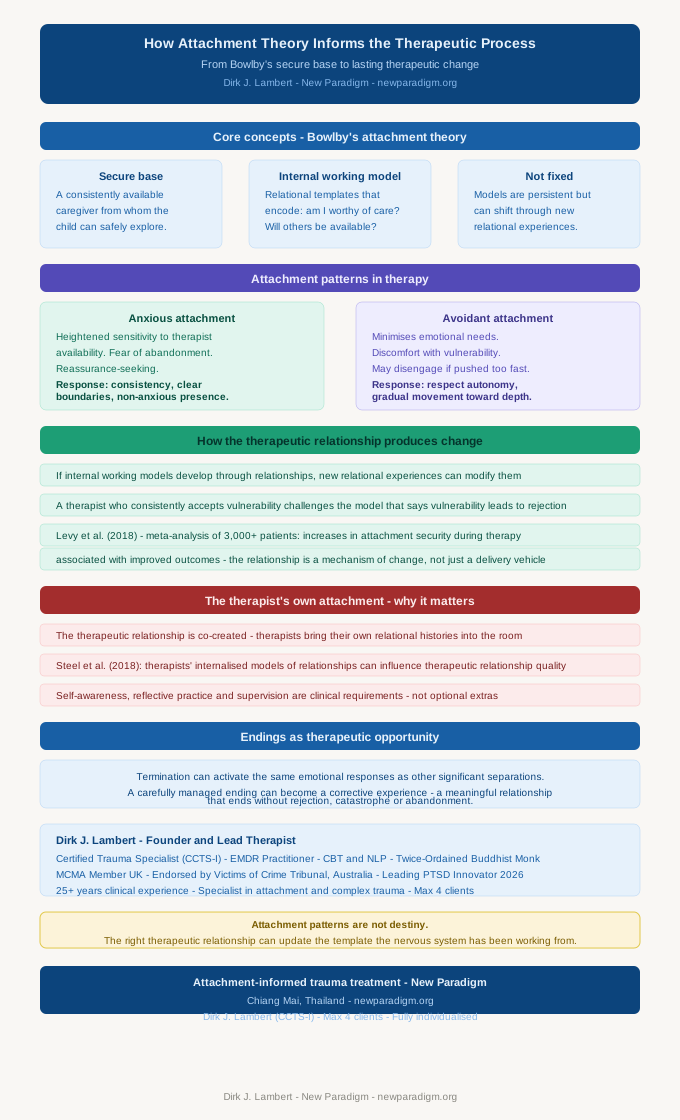
Attachment theory was developed by John Bowlby, who proposed that human beings have an innate need to form close emotional bonds with caregivers, particularly during periods of vulnerability or distress (Bowlby, 1982). The caregiver who responds consistently and sensitively provides what Bowlby called a secure base - a reliable point of return from which the child can explore the world with confidence that support is available when needed.
Through repeated interactions with early caregivers, children develop what Bowlby called internal working models - essentially, templates for how relationships work. These models encode expectations about the self (am I worthy of care?), others (will people be available when I need them?), and relationships (is emotional closeness safe?). These expectations are not purely cognitive - they become embedded in the nervous system and in patterns of emotional response that operate largely outside conscious awareness.
Internal working models are not fixed. But they are persistent. The person who learned early that emotional needs were met with inconsistency or rejection does not simply update those expectations when circumstances change. They bring those expectations into every significant relationship - including the therapeutic one.
Attachment Patterns in Adult Life
Adult attachment research has identified broadly distinct patterns that emerge from different early relational experiences. Secure attachment - shaped by consistent, responsive caregiving - is generally associated with greater comfort with both intimacy and autonomy, and a capacity to seek support when distressed without being overwhelmed by the need for it.
Anxious attachment tends to develop where caregiving was inconsistent - present sometimes, unavailable at others. This creates a heightened sensitivity to the availability of others and an underlying fear of abandonment or rejection. Anxiously attached individuals may seek frequent reassurance, become preoccupied with the relationship itself, and experience even minor shifts in a therapist's tone or availability as significant.
Avoidant attachment tends to develop where emotional needs were consistently minimised or met with withdrawal. Individuals with avoidant tendencies learn to rely on self-sufficiency and suppress emotional needs. In therapy, they may find emotional disclosure uncomfortable, minimise the importance of their own distress, or disengage when a therapist attempts to move toward more vulnerable material (Levy et al., 2018).
It is important to note that these are tendencies, not fixed categories. People can move between patterns depending on context, and later relationships - including therapeutic ones - can shift the underlying expectations considerably.
Attachment in the Therapeutic Relationship
Therapy is a relational process. Clients bring their attachment histories - their expectations about whether others will be available, trustworthy, and accepting - directly into the room with the therapist. How a client responds to the therapist, how comfortable they feel being dependent or vulnerable, how they react to changes in scheduling or perceived criticism, all of this is shaped by the relational template they have developed over a lifetime.
This is not something to be treated as an obstacle. It is the material. An anxiously attached client who becomes distressed about a cancelled appointment is not being difficult - they are demonstrating, in live form, the relational pattern that likely underlies much of their presenting difficulty. An avoidant client who deflects from emotional content is not failing to engage with therapy - they are showing what they learned about what happens when emotional needs are expressed.
An attachment-informed therapist understands these responses in their relational context rather than labelling them as resistance or non-compliance. This shifts the therapeutic question from what is wrong with this client? toward what relational experiences may have shaped the way this person responds? (Berry and Danquah, 2016).
Working With Different Attachment Patterns
Anxious and avoidant attachment tendencies require different therapeutic responses, though in both cases the goal is the same: to create a relational experience that is safe enough for the client's internal working model to begin to update.
With an anxiously attached client, the therapist's consistency matters enormously. Predictable boundaries, reliable availability within those boundaries, and empathic attunement to the client's emotional state all contribute to a therapeutic environment in which the underlying fear of abandonment can be explored rather than simply managed. The therapist needs to avoid reinforcing excessive reassurance-seeking while equally avoiding responses that could be experienced as rejecting. The balance is a steady, non-anxious presence that does not waver in response to the client's escalation or withdrawal.
With an avoidant-oriented client, the therapist needs to respect the client's need for autonomy and move gradually toward emotional material rather than pushing for disclosure. Pressing too hard too early can cause the client to disengage. The therapeutic task is to create conditions in which the client's experience of emotional vulnerability is genuinely different from what they have previously expected - that vulnerability does not lead to dismissal, intrusion, or rejection.
Attachment theory should not be used to predict precisely how every client will behave. These are frameworks for generating clinical hypotheses, not diagnostic boxes.
The Therapist's Own Attachment
Therapy involves two people, each bringing their own relational histories into the room. Therapists are not neutral observers who exist outside the relational process. A therapist who finds dependency uncomfortable may respond to an anxiously attached client in ways that inadvertently confirm the client's fear of rejection. A therapist who is particularly comfortable with closeness may need to be alert to the risk of over-involvement with a client whose primary difficulty is relational enmeshment.
Steel and colleagues (2018) conducted a systematic review and found that therapists' internalised models of relationships can influence aspects of the therapeutic relationship and, potentially, outcomes. This underlines the importance of therapist self-awareness, reflective practice, and supervision. The therapeutic relationship is co-created. Understanding attachment does not mean eliminating emotional responses - it means learning to notice, reflect on, and use them thoughtfully rather than simply reacting from them.
Attachment Theory and Therapeutic Change
One of the most clinically significant aspects of attachment theory is its explanation of how therapeutic relationships can produce lasting psychological change. If internal working models develop through relationships, then new relational experiences can provide the conditions in which those models become more flexible.
A client who has come to expect that emotional vulnerability will be met with rejection may initially avoid discussing difficult experiences. If the therapist responds consistently with empathy and acceptance - not once, not occasionally, but predictably over time - the client begins to have an experience that does not match their existing template. This is not simply an intellectual realisation that things can be different. It is a lived, somatic experience that gradually modifies the internal working model at the level at which it actually operates.
Levy and colleagues (2018) conducted a meta-analysis of 36 studies involving more than 3,000 psychotherapy patients and found that greater attachment security was associated with better therapeutic outcomes. Critically, they also found evidence that increases in attachment security during psychotherapy were associated with improved outcomes - suggesting that the therapeutic relationship itself can shift attachment functioning, and that this shift is relevant to therapeutic change.
Endings and Termination
The ending of a therapeutic relationship can be one of its most clinically significant phases, particularly for clients whose attachment history involves loss, abandonment, or abrupt relational endings. Termination can activate the same emotional responses that other separations have generated across the client's life - and it does so in a context where that activation can be noticed, named, and worked with.
An attachment-informed approach to termination involves preparing clients in advance, exploring their emotional responses to the approaching ending, and helping them understand what those responses reveal about how they have typically experienced separation. A carefully managed ending - one that is respectful, predictable, and acknowledges the significance of what has passed - can become a genuinely corrective experience. The client discovers that a meaningful relationship can end without rejection, catastrophe, or abandonment. That discovery can shift expectations about separation in ways that extend well beyond therapy.
This is also the appropriate place to note that attachment-informed therapy does not mean encouraging dependency or extending therapy indefinitely. Professional boundaries remain essential. The goal is the client's autonomous functioning, not the preservation of the therapeutic relationship itself.
Limitations and Critical Considerations
Attachment theory, despite its significant contribution to clinical practice, has important limitations. One concern is the risk of reducing complex human behaviour to attachment styles. People behave differently across different relationships and contexts, and attachment should not be treated as a fixed personality characteristic.
The evidence base for specific attachment-informed therapeutic approaches also requires ongoing development. Berry and Danquah (2016) and Degnan and colleagues (2015) both identify methodological limitations in the research examining therapist attachment, the therapeutic alliance, and outcomes. The theory's explanatory value is considerable; the evidence for specific clinical protocols derived from it is less established.
Cultural considerations are also significant. Much attachment research has developed within Western psychological traditions. Assumptions about emotional expression, independence, and family structure that are embedded in attachment theory may not apply universally. Clinicians should be careful not to interpret culturally normative relational behaviours as evidence of insecure attachment without considering the client's social and cultural context.
Finally, attachment history does not determine outcome. Individuals demonstrate significant resilience, and later relationships - including therapeutic ones - can provide genuine corrective experiences. Attachment patterns are not destiny.
Attachment Theory in Intensive Residential Treatment
In an intensive residential therapeutic environment, the relevance of attachment theory is amplified. The client is not arriving for one hour per week and returning to their ordinary life. They are living within the therapeutic environment for days or weeks at a time. The attachment dynamics that would surface gradually in weekly outpatient therapy surface quickly and with considerable clarity in the residential setting.
This creates an opportunity that is not available in outpatient work. The relational patterns are visible in real time. The therapeutic relationship has the consistency and intensity to function as a genuine secure base. And the integration time between sessions - the time that in outpatient therapy disappears into ordinary life - becomes part of the therapeutic work itself, allowing the relational experience to settle and develop rather than being constantly interrupted.
Understanding how childhood trauma shapes adult relational patterns is directly connected to the attachment framework and provides a practical lens for many of the difficulties clients bring to intensive residential treatment. The clinical assessment that precedes admission at New Paradigm specifically explores attachment history and relational experience as part of treatment planning, because the client's attachment tendencies directly shape how the therapeutic relationship needs to be managed from the outset.
For mental health practitioners who work with trauma themselves, the relevance of attachment to vicarious trauma and self-care is equally significant - the same relational processes that affect clients also operate for therapists in high-demand therapeutic work. And the structure of the daily programme at New Paradigm is designed, in part, around the conditions that attachment theory identifies as necessary for the nervous system to feel safe enough to do deep therapeutic work.
Contact New Paradigm today to discuss how an attachment-informed approach is integrated into your individual treatment programme.
References
Berry, K., and Danquah, A. (2016). Attachment-informed therapy for adults: Towards a unifying perspective on practice. Psychology and Psychotherapy: Theory, Research and Practice, 89(1), 15-32.
Bowlby, J. (1982). Attachment and loss: Vol. 1. Attachment (2nd ed.). Basic Books. (Original work published 1969).
Degnan, A., Seymour-Hyde, A., Harris, A., and Berry, K. (2015). The role of therapist attachment in alliance and outcome: A systematic literature review. Clinical Psychology and Psychotherapy, 22(6), 541-557.
Levy, K. N., Kivity, Y., Johnson, B. N., and Gooch, C. V. (2018). Adult attachment as a predictor and moderator of psychotherapy outcome: A meta-analysis. Journal of Clinical Psychology, 74(11), 1996-2013.
Steel, C., Macdonald, J., and Schroder, T. (2018). A systematic review of the effect of therapists' internalized models of relationships on the quality of the therapeutic relationship. Journal of Clinical Psychology, 74(1), 5-42.
Frequently Asked Questions
What is attachment theory and why does it matter for therapy?
Attachment theory, developed by John Bowlby, proposes that human beings develop expectations about relationships through early interactions with caregivers. These expectations - called internal working models - influence how we approach intimacy, manage vulnerability, and respond to perceived rejection or abandonment throughout life. They matter for therapy because clients bring these relational expectations directly into the therapeutic relationship. A client who learned that emotional needs are met with inconsistency will not automatically trust a therapist simply because the therapist is consistent. Understanding this dynamic allows therapists to respond to relational patterns with clinical awareness rather than taking them personally or misreading them as resistance.
What is the difference between anxious and avoidant attachment?
Anxious attachment tends to develop where early caregiving was inconsistent - present sometimes, unavailable or unpredictable at others. It typically involves a heightened sensitivity to the availability of others, a fear of abandonment, and a tendency to seek reassurance in relationships. Avoidant attachment tends to develop where emotional needs were consistently minimised or dismissed. It typically involves self-sufficiency, discomfort with emotional closeness, and a suppression of vulnerability. In therapy, these patterns manifest very differently. An anxiously attached client may be highly sensitive to changes in the therapist's tone or availability. An avoidant-oriented client may find emotional disclosure uncomfortable and may disengage if the therapist moves toward vulnerable material too quickly. Neither pattern represents a character flaw - both represent a learned adaptation to the relational environment the person grew up in.
Can a therapeutic relationship actually change attachment patterns?
Yes - and this is one of the most significant clinical contributions of attachment theory. Internal working models develop through relationships, which means they can also be modified through new relational experiences. A client who has come to expect that vulnerability will be met with rejection may, through consistent experience of a therapist who responds to vulnerability with acceptance and empathy, gradually develop an alternative template. This is not just an intellectual process - it occurs at the level of the nervous system and emotional response. Levy and colleagues (2018) found in a meta-analysis of more than 3,000 psychotherapy patients that increases in attachment security during therapy were associated with improved outcomes, suggesting that the therapeutic relationship itself is a mechanism of change rather than simply a vehicle for delivering techniques.
Does a therapist's own attachment history affect their work?
It can. A therapist who finds dependency uncomfortable may respond to an anxiously attached client in ways that inadvertently confirm the client's fear of rejection. A therapist who is particularly comfortable with closeness may need to be alert to the risk of over-involvement. Steel and colleagues (2018) found that therapists' internalised models of relationships can influence the quality of the therapeutic relationship and, potentially, outcomes. This is one of the primary reasons that therapist self-awareness, reflective practice, and regular supervision are not optional extras - they are clinical requirements. The therapeutic relationship is co-created by two people, each of whom brings a relational history into the room.
Is attachment theory relevant to intensive residential treatment?
It is particularly relevant. In an intensive residential setting, the therapeutic relationship is not limited to a fifty-minute weekly session. The client is living within the therapeutic environment for days or weeks at a time, which means the attachment dynamics that would surface gradually in outpatient work become visible quickly and with considerable clarity. The residential setting also creates the conditions that attachment theory identifies as necessary for deep therapeutic work: sustained safety, a consistent and reliable therapeutic relationship, and integration time that is not constantly interrupted by the demands of ordinary life. The pre-admission assessment at New Paradigm specifically explores attachment history as part of treatment planning, because understanding how a client is likely to approach the therapeutic relationship shapes the structure and approach of the programme from the outset.