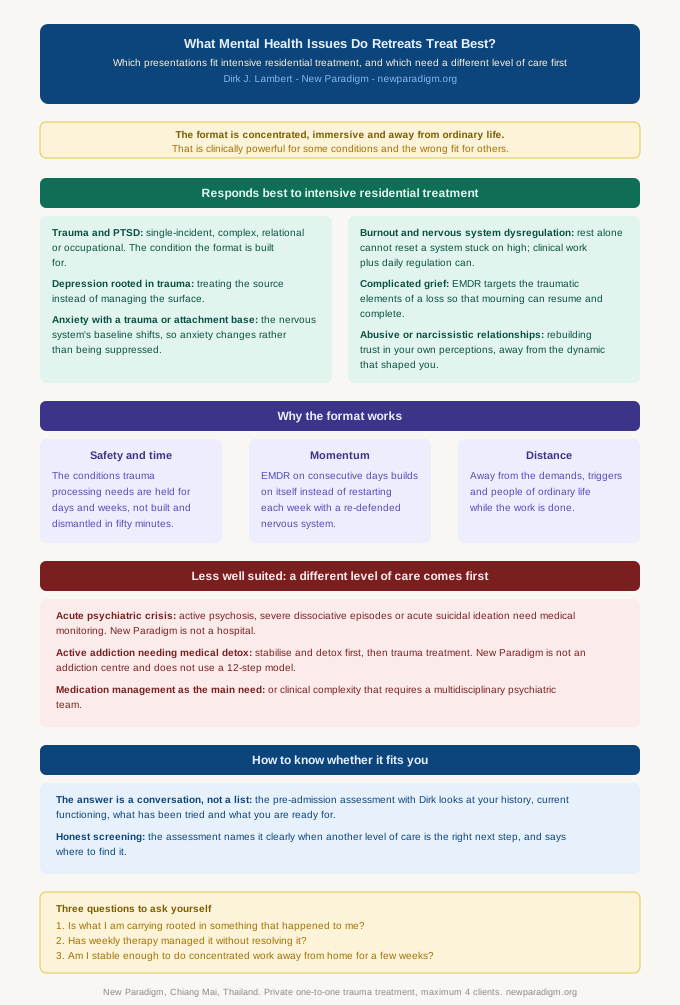
Not every mental health condition is equally well served by an intensive residential retreat. The format - concentrated, immersive, separated from ordinary life - creates particular conditions that are clinically powerful for some presentations and not the right fit for others. Understanding which conditions respond best to this approach, and why, is the most useful starting point for anyone considering a retreat as part of their recovery.
This article covers the conditions that benefit most from intensive residential treatment, why the format matters clinically, what New Paradigm specifically treats, and the situations where a different level or type of care is likely to be more appropriate. The goal is honest information rather than a sales pitch for retreats as a universal solution.
Trauma and PTSD
Trauma - in all its forms and at all its levels of complexity - is the condition that intensive residential retreat treatment is best designed for. This includes single-incident trauma (accidents, assaults, medical emergencies, acute loss), complex or developmental PTSD rooted in childhood experiences, relational trauma from abusive partnerships or family systems, occupational trauma (including vicarious or secondary trauma in practitioners), and the particular kind of cumulative, identity-level damage caused by long-term exposure to narcissistic or coercive dynamics.
The reason trauma responds so well to intensive residential treatment is that effective trauma processing requires specific conditions that ordinary weekly outpatient therapy often struggles to provide consistently. The nervous system needs safety, time, and the absence of the demands and triggers of ordinary life in order to access the material that needs processing. In an intensive residential setting, those conditions can be created and maintained across days and weeks rather than constructed and then dismantled at the end of a fifty-minute session.
EMDR - the primary trauma processing modality at New Paradigm - is among the most extensively evidence-based treatments for PTSD that exists. Its effectiveness is significantly enhanced by the intensive format, where multiple sessions across consecutive days allow processing to build on itself rather than starting from scratch each week with a nervous system that has re-regulated and re-defended in the interim. What takes months or years in weekly outpatient EMDR can sometimes be achieved in concentrated residential work - not because the work is rushed, but because the conditions for it are genuinely sustained.
Depression Rooted in Unresolved Trauma
Depression is a broad category that encompasses presentations with very different underlying causes and therefore very different treatment needs. Purely biological depression - where the dominant driver is neurochemical dysregulation with minimal psychological content - is primarily a medical condition and is typically best addressed through psychiatric management and medication, sometimes alongside psychotherapy.
But a significant proportion of people presenting with depression are carrying depression that is rooted in, or substantially maintained by, unresolved traumatic experience. Developmental trauma, early attachment disruptions, significant loss, chronic exposure to abusive or invalidating environments - these create the conditions in which depression takes root and persists. For this population, treating the depression without addressing the underlying trauma is like treating a wound on the surface while the source of the wound remains untouched. Intensive residential retreat treatment, which targets the underlying material directly through trauma-focused modalities, can produce lasting shifts in depressive states that medication and weekly therapy have managed but not resolved.
The pre-admission assessment at New Paradigm specifically explores the relationship between a person's depression and their history. The distinction between a presentation that needs primarily psychiatric support and one that needs intensive trauma work is clinically important, and it is one of the things that assessment is designed to establish.
Anxiety With a Trauma or Attachment Foundation
As with depression, anxiety is not a single condition with a single treatment. Anxiety that is primarily a product of autonomic nervous system dysregulation - a nervous system that learned early in life to operate in a state of heightened alert - responds well to intensive trauma-focused work that addresses the source of the dysregulation rather than managing its symptoms. When the nervous system's baseline shifts - which intensive somatic and trauma work can achieve - anxiety changes not because it has been suppressed but because the threat that organised it has been processed and updated.
Attachment-rooted anxiety - the kind that expresses itself in relationships, in difficulty tolerating uncertainty, in hypervigilance to the responses of others - is similarly responsive to EMDR and somatic work that targets the early relational experiences that shaped the attachment system. Cognitive approaches alone tend to produce intellectual understanding without the deeper nervous system shift that produces lasting change. The integration of CBT with body-based somatic work and EMDR in an intensive residential setting addresses this more comprehensively than any single modality applied in isolation.
Burnout and Chronic Nervous System Dysregulation
Burnout - particularly the kind that has moved beyond fatigue into a place where the capacity for recovery itself seems impaired - is increasingly recognised as a trauma-adjacent condition involving chronic nervous system dysregulation. The person in severe burnout is not simply tired. Their regulatory system has been operating beyond its capacity for long enough that its ability to return to baseline has been compromised. Rest alone does not resolve it because the nervous system cannot use rest effectively when it is stuck in a dysregulated state.
Intensive residential treatment that combines trauma-focused therapeutic work with the regulation practices built into the New Paradigm programme - yoga, meditation, breathwork, contrast therapy, martial arts practice, Thai massage - addresses burnout at the level of the nervous system rather than simply providing rest. The combination of clinical trauma work with daily body-based regulation is specifically effective for this presentation. Many of the high-functioning professionals who attend New Paradigm arrive with burnout as their presenting complaint and discover, in the course of the assessment and early sessions, that the burnout has a trauma history underneath it that has been driving their over-functioning for years.
Complicated Grief and Loss
Grief becomes complicated - clinically, and in terms of what it needs to resolve - when it is interrupted, suppressed, layered over earlier unprocessed losses, or entangled with trauma. The sudden death of someone significant, particularly when accompanied by shock, guilt, or circumstances that carry their own traumatic quality, can produce a grief that the ordinary process of mourning cannot complete. EMDR has a specific and well-evidenced application in complicated grief, targeting the traumatic aspects of loss and creating the conditions for mourning to resume and complete.
Intensive residential treatment for grief is not a place to be told how to grieve or to follow a programme of grief stages. It is a space in which the full complexity of the loss - including the traumatic elements, the anger, the unresolved relational material, and the implications for the person's sense of their own future - can be addressed with time, privacy, and therapeutic depth. The residential format provides that time. The clinical structure provides the safety for the depth.
Recovery From Abusive or Narcissistic Relationships
The damage caused by extended exposure to a narcissistic, coercive, or abusive relational dynamic is a specific and often underestimated form of complex trauma. People who have left such relationships typically carry a combination of trauma responses, profound self-doubt and confusion about their own perceptions, identity disruption, and a nervous system that has been shaped by years of living in an environment of chronic low-level threat. Standard relationship counselling is not the appropriate treatment for this presentation. Trauma-focused work that addresses the relational trauma directly, rebuilds the capacity to trust one's own perceptions, and processes the shame and self-blame that abuse typically instals is what this presentation needs.
At New Paradigm, this is one of the more common presentations and one for which the intensive residential format is particularly effective. The combination of EMDR, CBT, somatic work, and the containing environment of the retreat - away from the environment and people associated with the abusive dynamic - creates the conditions for genuine recovery rather than mere management.
What Retreats Are Less Well Suited For
Clinical honesty requires naming the presentations for which an intensive residential retreat is not the right level or type of care.
Acute psychiatric crisis - active psychosis, severe dissociative episodes, or acute suicidal ideation requiring medical monitoring and intervention - needs a clinical environment equipped to manage medical emergencies. New Paradigm is not a psychiatric hospital and does not provide the level of clinical and medical support that acute crisis presentations require. The pre-admission assessment specifically screens for these presentations.
Active addiction requiring medical detoxification is not appropriately managed in a trauma retreat setting. The physiological process of detox from alcohol, benzodiazepines, or opioids requires medical supervision that is outside the scope of residential retreat care. Where addiction and trauma coexist - which is extremely common, since addiction frequently develops as a response to unprocessed trauma - the appropriate sequence is typically medical stabilisation and detox first, followed by trauma-focused residential treatment. New Paradigm does not use a 12-step or abstinence contracting model, and is not an addiction treatment centre. The distinction between residential trauma treatment and addiction rehab is covered on our PTSD treatment page.
Presentations where the primary treatment need is ongoing psychiatric medication management, or where the clinical complexity requires a multidisciplinary team with psychiatric oversight, also fall outside the scope of a specialised trauma retreat. The pre-admission assessment with Dirk will identify these situations clearly and, where needed, provide guidance on what level of care is appropriate and how to access it.
How to Know Whether a Retreat Is the Right Fit for You
The honest answer to this question is not found in a list of conditions - it is found in a clinical conversation. The pre-admission assessment at New Paradigm is designed precisely to answer this question for each individual, taking into account not just the diagnosis or presenting complaint but the history, the current level of functioning, what has been tried before, and what the person is ready for. Understanding what a genuine clinical pre-admission assessment involves gives a clearer picture of how this works.
The broader question of whether the intensive residential format produces genuine, lasting results - as opposed to a temporary shift that dissipates once ordinary life resumes - is one that many people considering a retreat are thinking about. Whether mental health retreats are actually worth it addresses that directly. And what a typical day at New Paradigm looks like gives a concrete sense of how the programme is structured and what the experience of attending actually involves.
Contact New Paradigm today for a confidential conversation about your specific situation and whether intensive residential treatment is the right next step.
About the Author
Dirk J. Lambert is the founder and lead therapist at New Paradigm, a private mental health retreat in Chiang Mai, Thailand. He is a Certified Trauma Specialist (CCTS-I), EMDR practitioner, CBT and NLP specialist, and twice-ordained Buddhist monk with more than 25 years of clinical experience working with complex trauma, PTSD, depression, and attachment disorders. Dirk founded Thailand's first alternative recovery centre in 2000 and established New Paradigm in 2014. He is a recognised specialist in the treatment of sexual abuse survivors, an endorsed provider through the Victims of Crime Assistance Tribunal in Melbourne, Australia, a member of the Complementary Medical Association UK (MCMA), and was named Leading PTSD Innovator in 2026 by Global Health and Pharma. He works personally with every client who enters the programme.
Frequently Asked Questions
Can a mental health retreat treat depression without medication?
It depends on the nature and cause of the depression. Depression that is primarily rooted in unresolved trauma, early attachment disruption, or long-term exposure to adverse relational environments can respond very significantly to intensive trauma-focused residential treatment - without requiring medication as the primary intervention. Depression that is predominantly biological in origin, or where the severity requires medical management for safety, is typically best approached with psychiatric support either alongside or preceding residential treatment. The pre-admission assessment at New Paradigm specifically explores this distinction. Where medication is already in place and providing a degree of stability, continuing it while attending a residential programme is common and often appropriate. New Paradigm does not prescribe or manage medication, and clients on psychiatric medication are assessed on an individual basis.
Is a mental health retreat appropriate for anxiety disorders?
Yes - particularly for anxiety that has a trauma or attachment foundation. Generalised anxiety, social anxiety, panic disorder, health anxiety, and phobias that are rooted in earlier threatening experience respond well to EMDR and somatic work in an intensive residential setting. The intensive format allows the nervous system's baseline to shift in a way that weekly therapy often cannot sustain. Anxiety that is primarily physiological or that has not responded to outpatient approaches is one of the more common reasons people seek intensive residential care. That said, there is a wide spectrum within anxiety disorders, and the pre-admission assessment will establish whether the specific presentation and its causes are well suited to the intensive residential approach.
Can a retreat help with burnout if I do not have a trauma history?
Burnout at its more severe presentations is closely related to chronic nervous system dysregulation, regardless of whether there is a formal trauma history. Many people who arrive describing burnout discover in the course of assessment and early sessions that there is a longer history of stress, over-functioning, or adverse relational experience underneath the burnout that has been driving it for longer than they realised. Even for those where the burnout is genuinely situational rather than historically rooted, the intensive combination of clinical work, regulation practices, and residential separation from the environment that generated the burnout can produce significant recovery that rest alone cannot. The pre-admission conversation will establish what is driving the burnout and what the appropriate therapeutic approach looks like.
What is the difference between attending a retreat for trauma versus going to a psychiatrist?
Psychiatry and trauma-focused residential treatment are different levels and types of intervention that are sometimes complementary and sometimes sequential. Psychiatry - medication management, diagnostic assessment, crisis intervention - addresses the biological and medical dimension of mental health. Intensive trauma-focused residential treatment addresses the psychological, relational, and somatic dimension: the experiences that shaped the nervous system and the patterns they installed. For many presentations, both have a role. The most common sequence for people who have been in psychiatric care is that medication provides stability, and residential trauma work addresses the underlying material that medication alone does not resolve. New Paradigm works with clients who are currently under psychiatric care and coordinates with their treating clinician where appropriate.
How do I know if I am ready for intensive residential trauma work?
Readiness for intensive residential trauma work does not mean being in a good place or having resolved all acute symptoms - most people who attend are not in a good place, which is why they are attending. It means having sufficient stability to engage with the therapeutic process without being overwhelmed in a way that becomes counterproductive. This is assessed in the pre-admission conversation, where Dirk will ask about your current level of functioning, what has been tried before, what your support structure looks like, and what you are hoping to achieve. The assessment is designed to determine not just whether intensive treatment is appropriate, but what structure and pacing will serve you best. Some people need a period of outpatient preparation before intensive residential work is the right step. Others are ready now. The conversation establishes which is which.