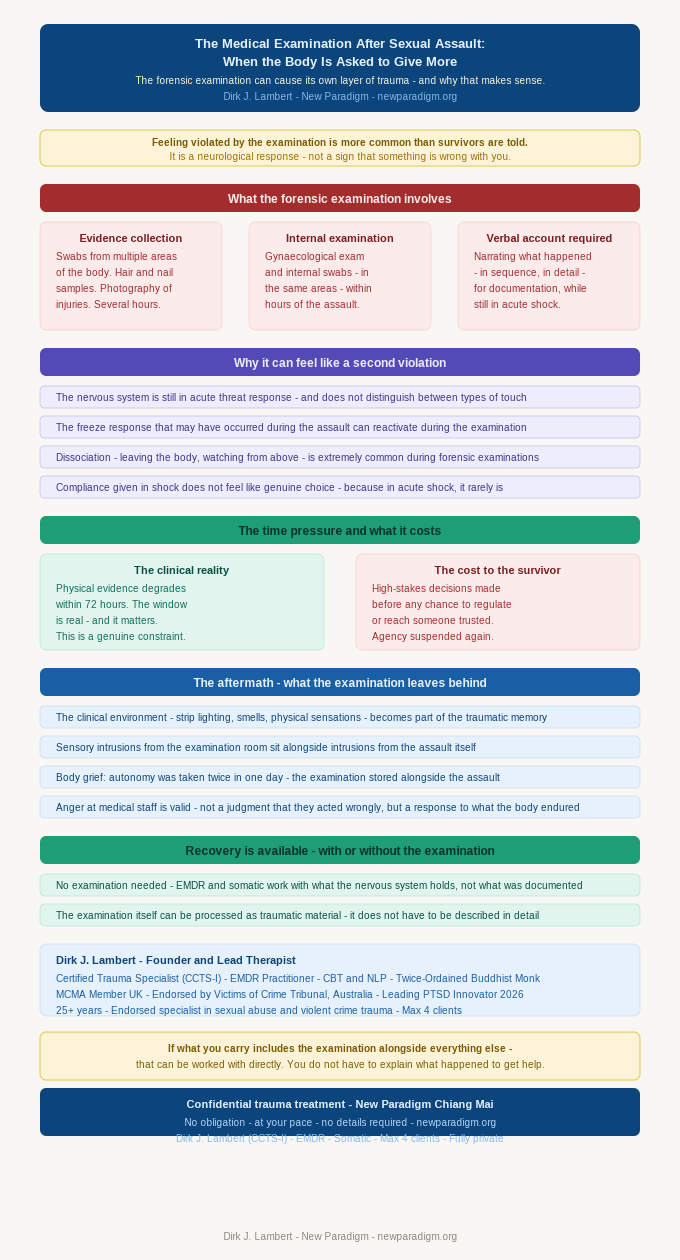
If you have been sexually assaulted and sought medical help in the hours that followed, you may have experienced something that is rarely acknowledged and almost never discussed: the medical examination itself - the forensic kit, the physical assessment, the documentation of injuries - can cause its own layer of trauma. Not because the medical professionals involved intended to cause harm. But because being required to submit your body, again, to strangers, in a clinical setting, while still in acute shock, while the nervous system is still processing what just happened, can feel like a continuation of the violation rather than the beginning of care.
This experience is more common than survivors are typically told. And the silence around it - the sense that you should be grateful for the examination, that it was necessary, that any distress you felt about it reflects something wrong with your response rather than something real about the experience - can add a second layer of shame to what was already an overwhelming situation. This article is here to name what many survivors have felt and not known how to say out loud.
What a Forensic Medical Examination Actually Involves
A forensic medical examination after sexual assault - sometimes called a rape kit examination or a SANE (Sexual Assault Nurse Examiner) assessment - is a clinical procedure designed to collect physical evidence of the assault and to assess and document any injuries. It is conducted by a medical professional, typically in a hospital or specialist sexual assault referral centre, and it involves a detailed physical examination of the body including, in most cases, a gynaecological or genital examination.
The examination typically includes a head-to-toe assessment of the body for injuries, the collection of swabs from multiple areas of the body, the collection of hair and nail samples, the documentation of bruising and other injuries through photography, and a gynaecological examination to collect internal swabs and assess internal injuries. The survivor is also asked, during or alongside the examination, to give an account of the assault - what happened, in what sequence, to which parts of the body - so that the clinical documentation is accurate and the evidence collection is targeted.
The examination takes several hours. It requires the survivor to be physically still, to cooperate with repeated handling of their body, to submit to an internal examination, and to narrate what happened to them - all within hours of the assault, and all within a clinical setting that, however sensitively managed, is characterised by strip lighting, disposable sheet covers, swab kits, and the presence of strangers with gloves and documentation forms.
Why the Examination Can Feel Like a Second Violation
The nervous system does not make clear distinctions between types of physical contact when it is in a state of acute trauma response. An assault that occurred an hour ago has activated the body's survival system - the fight, flight, and freeze responses - and that system remains activated in the hours that follow. The body is flooded with stress hormones. Muscles are tensed. The threat-detection system is running at full sensitivity.
Into that activated state comes a medical examination that requires the survivor to lie still, to remain passive, to allow strangers to touch and internally examine their body - in the same anatomical areas where the assault occurred, within hours of the assault occurring. The nervous system, which cannot fully distinguish between the circumstances of one physical contact and another, can process this as a continuation of the threat rather than a response to it. The freeze response - which may have been present during the assault itself - can reactivate during the examination. Dissociation, the experience of leaving the body or watching from above, is extremely common during forensic examinations in survivors of sexual assault.
Survivors often describe feeling that they simply endured the examination - that they left their bodies, went somewhere else internally, complied with what was asked of them because they understood it was necessary, and emerged from it feeling more violated, more exposed, and more exhausted than they had felt before it began. Some describe being unable to consent meaningfully - understanding that consent was requested, hearing themselves give it, but experiencing a version of shock-compliance that did not feel like genuine choice.
The requirement to narrate the assault during the examination adds another dimension. Having to produce a verbal account of what happened - in sequence, in detail, to a stranger with a documentation form - while still in acute shock, before the nervous system has had any opportunity to begin processing, is itself a clinical risk for retraumatisation. The narrative being asked for is not being asked in a therapeutic context. It is being asked for evidentiary purposes, which means it must be accurate, specific, and delivered in a form that will be legible to legal and medical documentation. This is a level of cognitive and emotional demand that many survivors in acute shock are not in a state to meet without significant cost.
The Time Pressure and What It Does
One of the most difficult aspects of the forensic examination is the window within which it must occur. Physical evidence - biological material, surface trace evidence, documentation of acute injuries - degrades over time. The evidentiary value of the examination diminishes significantly after 72 hours, and some forms of evidence collection are only viable within a much shorter window. Survivors are therefore often told, explicitly or by implication, that they must decide quickly. That they must go now, if they are going at all.
This time pressure is real and it reflects a genuine clinical and legal reality. But it creates a situation in which a person who has just experienced an overwhelming, violating, disorienting event is asked to make a series of high-stakes decisions - whether to have the examination, whether to involve the police, whether to preserve evidence - before they have had any opportunity to regulate, to reach someone they trust, or to be told that they have options.
The result, for many survivors, is that the examination is experienced not as a choice freely made but as something that happened to them in the aftermath of something that happened to them. The agency that was taken during the assault was not restored in the hours that followed. It was, in a sense, suspended again - by a system that had good reasons for doing what it did, but that did not, in the process, give the survivor's nervous system the time and space it needed to be able to make a genuinely informed and regulated choice.
The Aftermath of the Examination
The period after the forensic examination can produce a specific and disorienting form of distress. Survivors describe physical soreness that serves as a repeated reminder. The clinical experience - the strip lighting, the gloves, the swab kits, the specific smells of the examination room - can become part of the sensory landscape of the trauma, adding to the pool of triggers that subsequently activate the nervous system's threat response. The examination, intended to be part of the pathway to justice, can become part of the traumatic experience itself.
There is also, for many survivors, a particular form of grief about the examination. The body, which has just been violated, was then examined - documented, swabbed, photographed - in a process that, however medically necessary, required further exposure, further handling, further submission. Some survivors describe a sense that their body was taken from them twice in one day: once by the perpetrator, and once by a medical process that, however differently intended, felt similarly characterised by their own passivity and other people's actions upon their body.
This grief is valid. The distress about the examination is valid. And neither requires that the examination was wrong, that the medical professionals acted badly, or that you should not have gone. It simply acknowledges what the experience was - and gives it a name that allows it to be worked with rather than silently carried.
You Did Not Have to Have the Examination to Get Help Now
If you are reading this without having had a forensic examination - because you did not know about it, because you did not report to the police, because the window closed before you were ready, because the idea of it felt like too much on top of what had already happened - that is not a failure. Recovery from sexual assault is not conditional on having preserved evidence. The evidence is for the legal process. The healing is for you.
The treatments that produce the most significant and lasting recovery from sexual assault trauma - EMDR, somatic therapies, CBT and NLP - do not depend on the evidence having been collected, on the assault having been reported, or on any external process having taken place. They work with what the nervous system is holding, not with what was documented in a clinic. Whether or not you had the examination, whether it helped or added to the harm, whether you reported or did not - none of it determines what is now available to you therapeutically.
When the Examination Is Part of What Needs to Be Processed
For some survivors, the forensic examination is not background to the trauma - it is itself a significant traumatic event that sits alongside the assault and requires its own processing. The clinical experience, the feeling of freeze or dissociation during the examination, the shock-compliance that did not feel like genuine consent, the grief about what the body was asked to give before it had any chance to begin to recover - all of this can be held as traumatic material and worked with directly.
EMDR is particularly effective here because it works at the level of the sensory and somatic memories that the examination left behind - the specific sights, smells, physical sensations, and emotional states that are now part of the nervous system's held experience. It does not require a verbal account of the examination in order to reprocess it. It requires the willingness to hold the material in the room and allow the processing mechanism to do what it is designed to do.
Somatic work - yoga, breathwork, Thai massage, and body-based regulation practices - addresses the body-level consequences of the examination directly. The sense that the body does not fully belong to you, that physical contact is associated with submission rather than safety, that internal examination left an imprint - these are somatic realities that somatic approaches can help to gradually release and reintegrate.
You do not need to describe the examination or the assault in detail to receive effective treatment. The processing happens through the nervous system and the body, not through verbal narration. If you froze during the examination as you may have frozen during the assault, that is the same neurological response - and it requires the same compassion and the same lack of judgment. And the numbness and disconnection that many survivors feel in the aftermath is itself a consequence of what the body has been through - treatable, not permanent.
If what you are carrying includes the examination alongside everything else - or if the examination is the part you have found hardest to speak about - contact New Paradigm for a confidential conversation. You do not have to explain what happened. You only have to be ready to take the next step.
About the Author
Dirk J. Lambert is the founder and lead therapist at New Paradigm, a private mental health retreat in Chiang Mai, Thailand. He is a Certified Trauma Specialist (CCTS-I), EMDR practitioner, CBT and NLP specialist, and twice-ordained Buddhist monk with more than 25 years of clinical experience working with complex trauma, PTSD, depression, and attachment disorders. Dirk founded Thailand's first alternative recovery centre in 2000 and established New Paradigm in 2014. He is a recognised specialist in the treatment of sexual abuse survivors, an endorsed provider through the Victims of Crime Assistance Tribunal in Melbourne, Australia, a member of the Complementary Medical Association UK (MCMA), and was named Leading PTSD Innovator in 2026 by Global Health and Pharma. He works personally with every client who enters the programme.