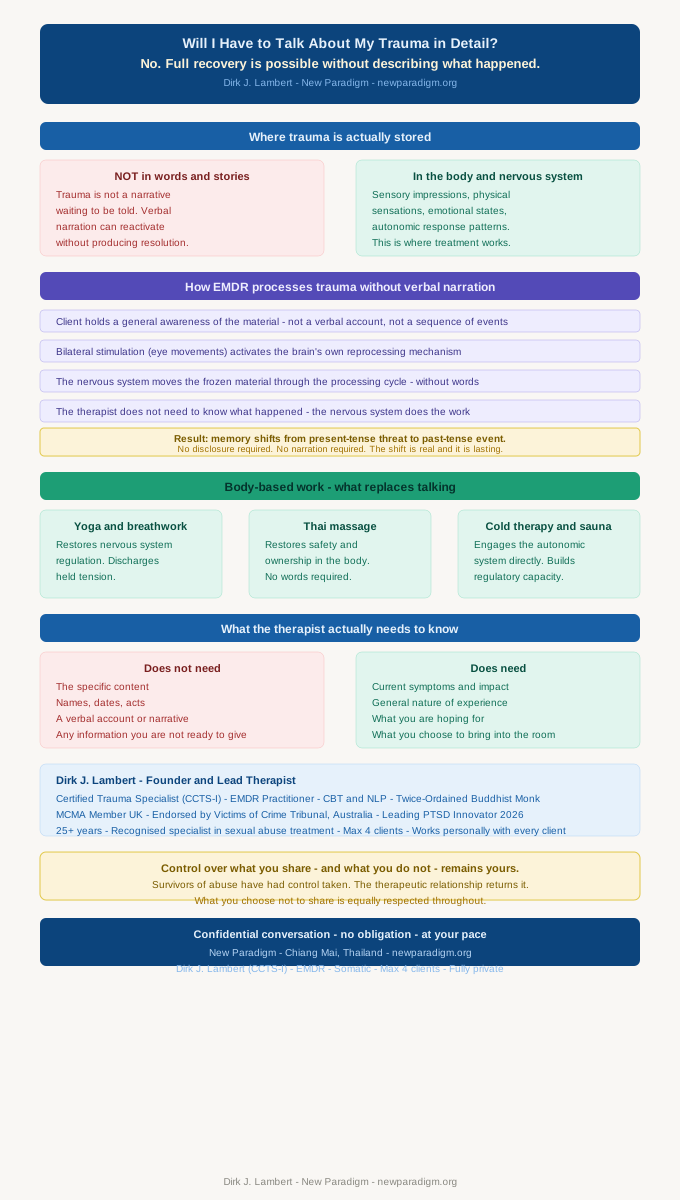
This may be the question that has kept more survivors from seeking help than any other. The idea of sitting across from a stranger and describing, in detail, what happened - the specific acts, the circumstances, the sensations, the shame - is, for many people, more frightening than the prospect of continuing to carry the weight of what they have been carrying. If the price of getting better is having to relive and recount everything, many survivors quietly decide the price is too high.
That belief is one of the most important misconceptions in trauma treatment - and it is worth addressing directly and without qualification: you do not have to talk about your trauma in detail to recover from it. Not at New Paradigm. Not in effective trauma treatment generally. Full recovery is possible without ever describing the specific content of what happened to you. The processing happens at a different level than verbal narration, and the most powerful approaches to trauma treatment were specifically designed to work that way. This applies equally to veterans, who often fear being asked to recount combat in detail; see our combat PTSD and military trauma retreat.
Where the Misconception Comes From
The assumption that trauma treatment requires detailed disclosure comes largely from older models of therapy - particularly the traditional psychoanalytic and talking therapy approaches that dominated clinical practice for much of the twentieth century. In those models, speaking the experience, articulating it, was itself the therapeutic mechanism. The theory was that bringing the unconscious into conscious verbal expression would allow it to be processed and released.
For certain kinds of difficulty, this model has genuine value. But trauma, particularly sexual trauma, does not respond to it in the way these approaches anticipated. When a survivor attempts to narrate in detail what happened to them, the act of narration can reactivate the same neurological responses that occurred during the original event - elevated heart rate, flooding, dissociation, shutdown. The telling does not always produce processing. It can produce retraumatisation: a repetition of overwhelm without the resolution that the approach was hoping for.
Modern trauma treatment has moved well beyond this model. The most effective approaches now work not through verbal narration but through the body, through bilateral stimulation, through somatic engagement with the autonomic nervous system. The verbal story is not the primary vehicle. The nervous system's held experience is.
How EMDR Works Without Requiring You to Tell the Story
EMDR - Eye Movement Desensitisation and Reprocessing - is the approach with the strongest evidence base for trauma treatment, and it is specifically designed not to require detailed verbal narration. Understanding why reveals something important about how trauma is actually stored and processed.
Trauma is not held primarily in the verbal, narrative parts of the brain. It is held in the subcortical structures - the amygdala, the brainstem, the body itself - as sensory impressions, emotional states, physical sensations, and autonomic response patterns. These structures do not speak in words. Asking them to produce a verbal account is not only unnecessary - it is, in a sense, addressing the wrong language entirely.
In EMDR, the therapist asks the client to hold a general awareness of the traumatic material - not to narrate it, not to describe it in sequence, but simply to bring it into the room in whatever form it arises. Alongside this, bilateral stimulation is applied: typically eye movements following the therapist's hand, though sound or tactile stimulation may also be used. The bilateral stimulation appears to activate the brain's own reprocessing mechanism - similar to what occurs during REM sleep - allowing the nervous system to move the frozen material through the processing cycle that was interrupted during the original event.
The therapist does not need to know the details of what happened. They do not need a narrative account. They need to know enough to set up the processing safely - the general nature of the experience, the current symptoms, the level of activation - and then the work proceeds through the client's internal process, not through verbal disclosure. Many clients process trauma in EMDR without ever once describing the specific content of what occurred. The material moves. The charge reduces. The quality of the memory shifts from present-tense threat to past-tense event. And none of that required telling the story in words.
The Body Processes What the Mind Does Not Have to Narrate
Alongside EMDR, the somatic practices at New Paradigm - yoga, breathwork, Thai massage, martial arts, sauna and cold therapy - address the dimension of trauma that is held most deeply: the body.
Sexual abuse is a violation of the body. The body carries the imprint of that violation in ways that persist long after the mind has done whatever it has done to manage the memory. Chronic tension, somatic symptoms without clear medical explanation, disconnection from physical sensation, a sense of not inhabiting one's own skin - these are body-level consequences that body-level work can address in ways that talking about the event cannot reach.
Yoga does not require the client to speak about what happened. Breathwork does not. Thai massage does not. What they require is the willingness to be present in the body - and even that willingness can be built gradually, with full respect for what the body has been through. The somatic practices create the conditions in which the nervous system can begin to discharge what it has been holding. That discharge is not verbal. It is physiological. And it is genuinely therapeutic.
The combination of EMDR and somatic work means that a substantial portion of the therapeutic work at New Paradigm happens at a level that never requires verbal narration of the traumatic event. The nervous system processes. The body releases. The internal working models shift. And none of it depends on the client having described, in detail, what happened to them.
What About the Talking Parts of Treatment?
There are talking components to the treatment programme - CBT and NLP sessions that work with the belief structures and thought patterns that trauma has installed. These conversations are important, and they are genuinely therapeutic. But they do not require detailed disclosure either.
CBT for trauma is not about narrating the event. It is about examining the conclusions the event produced - the beliefs about the self, about safety, about what the survivor deserves, about what can be expected from others and from the world. These beliefs can be identified and worked with without the client having to describe the specific content of what happened. "Something happened that led me to believe I am fundamentally unlovable" is sufficient material for this work. The specific details of that something are not required.
NLP works with internal representations - the way experience is encoded and held in the mind. Again, this does not require the client to narrate the traumatic event in detail. It works with the structure of the experience as held internally, not with the verbal account of it. The questions an NLP practitioner asks are about how the experience is represented - its qualities, its location, its emotional tone - not about what factually occurred.
Even in the talking components of treatment, the direction of travel is not toward a more complete verbal account of the traumatic event. It is toward a different relationship to the experience - one in which the event has less power over the present, the self-beliefs it produced have been examined and updated, and the nervous system is less organised around its ongoing threat.
What the Therapist Actually Needs to Know
A natural follow-on question is: if I do not have to describe what happened, what does the therapist need to know to help me? The answer is less than most survivors expect.
Before treatment begins, the therapist needs a general understanding of the presenting situation: that there has been a traumatic experience, what the current symptoms are, what the impact on daily life has been, and what the client is hoping for from treatment. They do not need the specific content of the trauma. They do not need dates, names, acts, or circumstances.
As treatment progresses, the therapist will work with what arises in the room - in the body, in the emotional state, in the client's responses to the therapeutic process. They do not need a narrative to work from. They work from what is actually present, in real time, which is a much richer and more clinically useful source of information than a verbal account.
At New Paradigm, the pre-admission assessment explores the current presentation and what the client needs. Dirk J. Lambert works with what is brought into the room, not with the expectation that it will arrive in the form of a complete verbal account of what happened. The confidentiality of the programme means that what is shared in the therapeutic space remains there entirely.
You Are in Control of What You Share
Throughout the entire therapeutic process - at New Paradigm and in any well-conducted trauma treatment - control over what is shared, when it is shared, and in what form it is shared remains with the client. This is not a courtesy. It is a clinical principle. Survivors of sexual abuse have had control taken from them. The therapeutic relationship is, in part, a space in which control is returned. A therapist who pressures a client to disclose more than they are ready to share, or who treats detailed disclosure as a precondition for genuine therapeutic work, is not working in the client's best interests.
If at any point in the process something arises that you choose to share in more detail, that is your decision. If it does not, the work continues without it. The measure of a good trauma therapist is not how much they know about what happened to you. It is how effectively they can help the nervous system process what it is holding - and that does not require them to know everything.
Understanding why trauma responses feel so present and immediate provides the neurological context for why body-based treatment works at a different level than verbal narration. A practical guide to finding the right professional help covers what to look for in a therapist and what questions to ask before committing. And the emotional numbness that many survivors experience is itself a sign that the nervous system needs work at the somatic level - not a sign that talking more will resolve it.
If the fear of having to tell the story has been keeping you from reaching out, this is your answer: it is not required. Contact New Paradigm for a confidential conversation, at your own pace, with no obligation to share more than you are ready to share.
About the Author
Dirk J. Lambert is the founder and lead therapist at New Paradigm, a private mental health retreat in Chiang Mai, Thailand. He is a Certified Trauma Specialist (CCTS-I), EMDR practitioner, CBT and NLP specialist, and twice-ordained Buddhist monk with more than 25 years of clinical experience working with complex trauma, PTSD, depression, and attachment disorders. Dirk founded Thailand's first alternative recovery centre in 2000 and established New Paradigm in 2014. He is a recognised specialist in the treatment of sexual abuse survivors, an endorsed provider through the Victims of Crime Assistance Tribunal in Melbourne, Australia, a member of the Complementary Medical Association UK (MCMA), and was named Leading PTSD Innovator in 2026 by Global Health and Pharma. He works personally with every client who enters the programme.