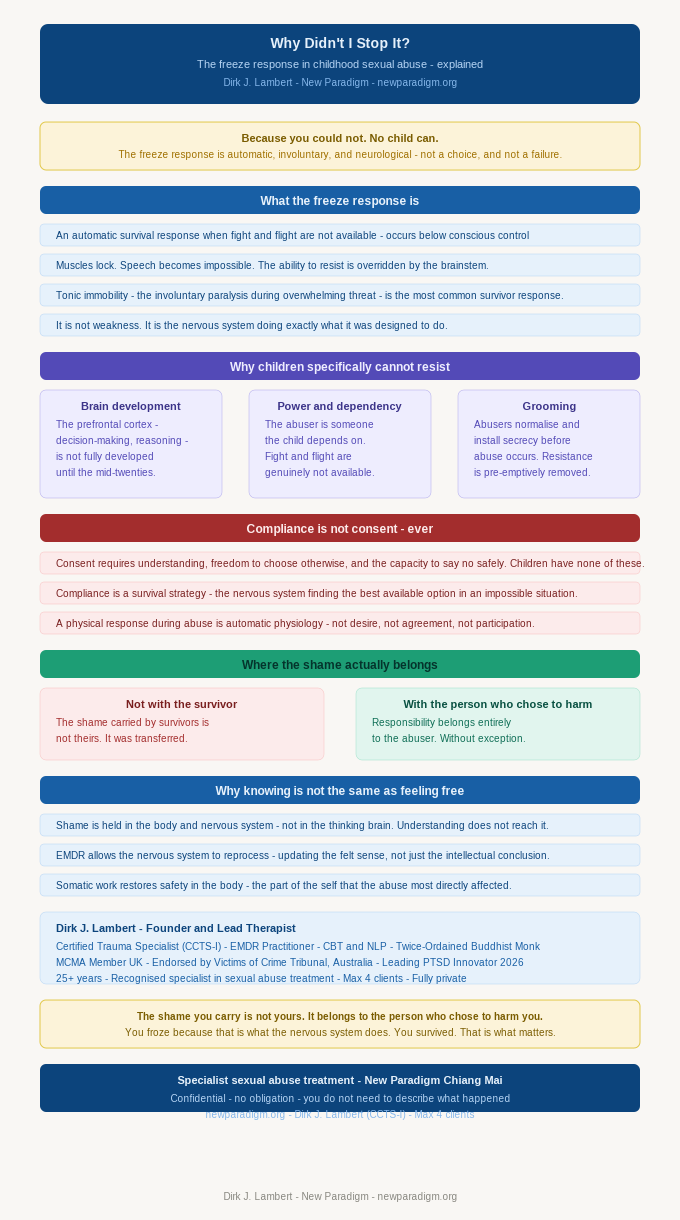
If you are a survivor of childhood sexual abuse, there is a question that may have lived inside you for years, quietly or loudly, shaping the way you understand what happened and what it means about you. Why didn't I stop it? Why didn't I say no? Why did I freeze? Why did I go back? Why didn't I tell anyone? And underneath all of those questions, the one that carries the most weight: does the fact that I didn't stop it mean that somehow I allowed it?
The answer to that last question is no. Unconditionally, clinically, and without qualification: no. What happened to you was not something you allowed. It was something that was done to you by someone with power over you, at an age when your nervous system, your brain, and your understanding of the world were not equipped to resist in the ways that, as an adult, you believe you should have been able to. The shame that tells you otherwise is one of the most common and most destructive consequences of abuse - and it is not the truth.
This article explains, in clinical terms, why children do not stop abuse - and why that does not in any way reflect on their character, their strength, or their responsibility for what happened.
The Freeze Response Is Not a Choice
When the human nervous system encounters a threat that it cannot fight or escape, it shifts into a third survival state: freeze. This is not a decision. It is not weakness. It is an automatic, involuntary neurological response that occurs below the level of conscious choice - in the same brainstem structures that control breathing and heart rate, not in the thinking, reasoning parts of the brain that make deliberate decisions.
In the freeze state, the body may become still. Muscles may lock. Speech may become impossible. The ability to cry out, to push away, to run - all of it may simply not be available, not because the person chose not to use it, but because the nervous system has shifted into a mode in which those functions are overridden. This is a survival mechanism that appears across the animal kingdom and that, in certain circumstances, is genuinely protective. It is not failure. It is physiology.
For children who are abused by someone known to them - a family member, a trusted adult, a person in a position of authority - the freeze response is particularly likely. The child is in a situation where the threat is coming from someone they depend on, someone they cannot simply flee from, someone whose power over their daily life is total. Fight is not an option. Flight is not available. The nervous system does what it is designed to do when fight and flight are not possible: it freezes.
Tonic Immobility - What the Research Shows
The freeze response in the context of sexual assault has been studied specifically, and the findings are both clear and clinically important. Researchers use the term tonic immobility to describe the involuntary paralysis that occurs in response to overwhelming threat - the physical inability to move, speak, or resist that the nervous system produces automatically.
Studies of adult survivors of sexual assault have found that tonic immobility is not rare or unusual - it is the most common response. A significant majority of survivors report some degree of physical paralysis or inability to resist during the assault. This is not a minority experience that reflects individual weakness. It is the normal neurological response to an overwhelming threat from which escape is not available.
For children, this response is even more pronounced - and the reasons are neurological as well as situational. The prefrontal cortex, which is responsible for deliberate decision-making, for assessing complex situations, for the kind of rapid strategic thinking that "stopping it" would require, is not fully developed in children. It continues to develop into the mid-twenties. A child's brain, when faced with overwhelming threat from a trusted adult, does not have access to the cognitive resources that adults assume should have been available.
What the child had was a nervous system doing its best to survive an experience it was never designed to face.
Why Children Don't Say No
The inability to say no - to verbalise refusal, to call for help, to tell someone what was happening - is one of the things survivors most often hold against themselves. It feels, in retrospect, like something that should have been simple. It was not simple. The reasons it was not simple are multiple and interconnected.
Children who are abused by someone they know and trust are dealing with a situation that fundamentally contradicts the relational reality they depend on. This person is supposed to be safe. This person may also be someone they love, or someone their family trusts, or someone whose approval they need. The abuse creates a contradiction that the child's mind cannot resolve through ordinary means - because the ordinary means would involve acknowledging that someone they depend on is causing them harm. For many children, the psyche finds it more manageable to absorb the harm than to acknowledge the source of it.
Saying no, in that context, is not simply a verbal act. It would require the child to name what is happening, to acknowledge it fully, to risk not being believed, to risk the consequences for the family, to risk losing the relationship with the abuser even where that relationship also contains things they value or need. These are calculations that adults find complex. They are completely beyond the developmental capacity of children - not because children are weak, but because children are children.
There is also the direct impact of grooming. Abusers, particularly those who abuse children they know, typically work over time to normalise what is happening - to gradually erode the child's sense of what is and is not acceptable, to establish secrecy as a condition of the relationship, to make the child feel that what is happening is their own doing or their own secret to keep. By the time the abuse occurs, many children have already been prepared to stay silent by a process they were not aware of and could not have resisted.
Compliance Is Not Consent
Some survivors carry a specific and particularly heavy form of shame: they complied. They did not resist. They may have participated in ways that, to the adult looking back, feel like evidence of involvement or even willingness. This needs to be addressed directly.
Compliance in the context of childhood sexual abuse is not consent. It cannot be, for reasons that are both legal and neurological. Children are not capable of consenting to sexual acts with adults - not because the law says so, though it does, but because consent requires an understanding of what is happening, an understanding of the significance of that act, and the freedom to genuinely choose otherwise. Children in abusive situations have none of these things. They are responding to power, to fear, to confusion, to the demands of someone they cannot safely refuse.
Compliance is often itself a survival strategy. When freeze fails to make the abuse stop, when resistance has been punished or has proved impossible, when the child has learned that compliance reduces the duration or the violence of what happens - compliance becomes what the nervous system turns to. It is adaptive. It is the body and mind finding the best available option in an impossible situation. It is not agreement. It is not desire. It is survival.
The body may also have responded physiologically in ways that the survivor carries enormous shame about - physiological arousal that occurred without any corresponding emotional willingness. The body's physiological responses to stimulation are automatic and do not require consent or desire. A physical response is not evidence of participation. It is evidence that a nervous system was being stimulated, nothing more.
Why the Shame Belongs to the Abuser
Shame is the most common and most disabling consequence of childhood sexual abuse, and it is almost universally misdirected. Survivors carry shame that belongs to the person who abused them - not because they have made a mistake in assigning it, but because the nature of abuse is to transfer responsibility from perpetrator to victim. Abusers, explicitly or implicitly, position the child as the one who is responsible, the one who wanted it, the one who allowed it, the one who must keep the secret to protect them. Children absorb this, because children are not yet equipped to see through it.
The shame that asks "why didn't I stop it" is not your shame. It is the abuser's shame, relocated. The question itself is built on a premise that is false - the premise that you had the power, the understanding, and the freedom to stop what was being done to you. You did not. No child does. The responsibility for what happened belongs entirely to the adult who chose to harm you, regardless of how it happened, regardless of how you responded, regardless of what followed.
Why Understanding This Is Not Enough on Its Own
Reading this and understanding it intellectually is not the same as being free of the shame it describes. This is one of the most frustrating aspects of trauma recovery for many survivors - they can understand, cognitively, that they were not responsible, that their response was normal, that the shame belongs elsewhere. And they still feel it. In the body, in the chest, in the way they hold themselves, in the relationships they move toward or away from.
This is because shame, like trauma itself, is not held primarily in the cognitive parts of the brain. It is held in the body - in the nervous system, in the patterns of physiological response that were laid down at the time of the abuse and have been reinforced every time the survivor has revisited the event and concluded that something about it reflects on them. Understanding alone cannot shift what is held somatically. It can provide the framework. It cannot do the work by itself.
EMDR specifically addresses shame-laden traumatic memories by allowing the nervous system to reprocess the experience - not to change what happened, but to change the emotional charge attached to it and the self-referential conclusions it has produced. The "I should have stopped it" belief that carries so much weight can, through EMDR processing, be genuinely updated at the level at which it is held - not just understood differently, but felt differently. The shift is not intellectual. It is neurological.
Somatic work - breathwork, yoga, movement - addresses the body-held shame directly. Many survivors carry abuse in their posture, in chronic physical tension, in a profound disconnection from their own bodies that is itself a consequence of the violation they experienced. Restoring a sense of safety and ownership in the body is not a peripheral part of recovery from sexual abuse. It is central to it.
You do not have to describe what happened in detail to receive effective treatment. EMDR and somatic approaches work at the level of the nervous system, not the verbal narrative, which means the processing can happen without you ever having to put into words the specific content of what occurred. Understanding why trauma responses feel so present provides the neurological context for why the shame, like the flashbacks, can feel as immediate as if it happened yesterday. And the emotional numbness and disconnection many survivors experience is directly connected to the freeze response that is at the centre of this question.
If you have been carrying the question "why didn't I stop it" for years, the answer is now here: because you could not. Because no child could. Because the nervous system that was supposed to protect you did exactly what it was designed to do in an impossible situation. Because the shame you feel belongs to someone else entirely.
Contact New Paradigm for a confidential conversation about treatment. You do not have to explain what happened. You only have to be ready to take the next step.
About the Author
Dirk J. Lambert is the founder and lead therapist at New Paradigm, a private mental health retreat in Chiang Mai, Thailand. He is a Certified Trauma Specialist (CCTS-I), EMDR practitioner, CBT and NLP specialist, and twice-ordained Buddhist monk with more than 25 years of clinical experience working with complex trauma, PTSD, depression, and attachment disorders. Dirk founded Thailand's first alternative recovery centre in 2000 and established New Paradigm in 2014. He is a recognised specialist in the treatment of sexual abuse survivors, an endorsed provider through the Victims of Crime Assistance Tribunal in Melbourne, Australia, a member of the Complementary Medical Association UK (MCMA), and was named Leading PTSD Innovator in 2026 by Global Health and Pharma. He works personally with every client who enters the programme.