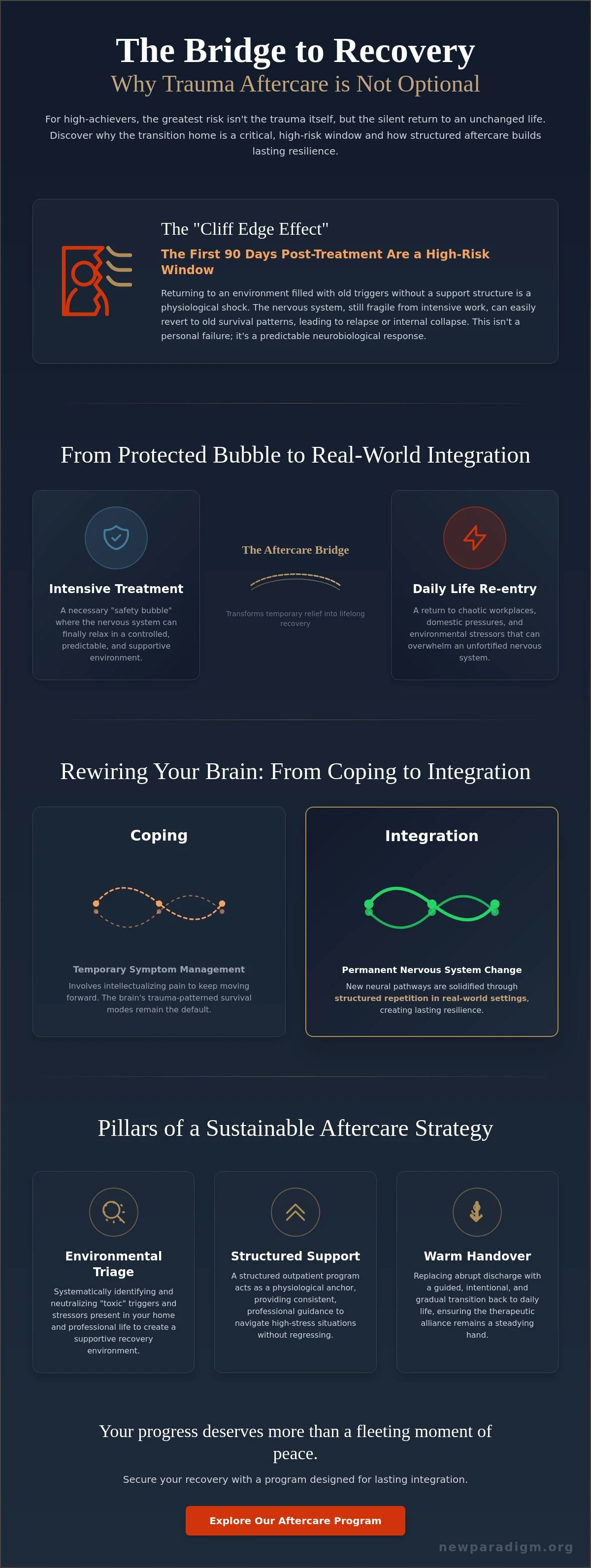
What if the greatest threat to your healing isn't the trauma itself, but the sudden silence of returning to a life that hasn't changed while you have? For many high-achieving individuals, the disconnect between a thriving career and a fragile internal state creates a profound sense of exhaustion. You might feel the pressure to perform while your nervous system is still learning how to feel safe. This is why understanding trauma aftercare importance is not just about a safety net; it's about the biological necessity of a slow ramp back into reality.
You likely believe that once a clinical intensive is over, you should be able to handle old triggers with ease. It's a common expectation, but it's often where the most significant risks reside. This article explains why the initial transition period is a high-risk window for your physiology and how a structured Aftercare Program provides the bridge required to transform temporary relief into lifelong recovery. We will outline a roadmap for maintaining nervous system regulation at home, giving you the confidence that your progress is sustainable rather than a fleeting moment of peace.
Key Takeaways
- Understand the "Cliff Edge Effect" and why the first 90 days post-treatment represent the most critical window for stabilizing your recovery.
- Discover the neurobiological trauma aftercare importance, specifically how your brain requires structured repetition in real-world settings to solidify new neural pathways.
- Learn how to conduct an environmental triage to identify and neutralize the "toxic" triggers present in your home and professional life.
- Identify the essential pillars of a structured outpatient treatment program that acts as a physiological anchor during times of high stress.
- Explore the "warm handover" methodology that replaces the traditional, abrupt discharge with a guided, intentional transition back to your daily environment.
Defining Trauma Aftercare: The Bridge Between Crisis and Integration
Trauma aftercare is the intentional, structured support phase that follows an intensive residential intervention. It isn't a suggestion; it's a clinical requirement. When you step out of a protected environment, your nervous system is still fragile. To truly understand the nature of psychological trauma and its lasting impact, we must recognize that healing doesn't end when you leave the clinic. This is where trauma aftercare importance becomes undeniable. Without it, you face the "Cliff Edge Effect." This term describes why the first 90 days post-treatment carry the highest risk for relapse or internal collapse. You aren't failing; you're simply unshielded.
To see why the brain struggles to adapt so quickly, watch this clinical perspective on the science of healing:
True recovery requires a shift from "coping" to "integration." Coping is a temporary management of symptoms, often involving the intellectualization of pain to keep moving forward. Integration, however, is a permanent change in your nervous system. A structured aftercare program provides the scaffolding for this integration. It ensures that the insights gained in isolation survive the noise and pressure of your everyday life.
The Myth of the 'Quick Fix' in Trauma Recovery
You might believe that a residential stay "cures" trauma in isolation. It doesn't. Healing is a rhythmic process, not a linear event. For the high-achiever, the urge to rush back to the boardroom or the family dynamic is a survival mechanism in itself. But rushing often leads to a silent internal collapse. We view recovery as a compassionate realist; we know that deep transformation takes time and steady, quiet work rather than a single, explosive breakthrough.
Why the Transition Home is a Physiological Shock
A clinical setting is a sterile safety bubble, but your home is filled with the ghosts of old triggers. Re-entry shock is the sudden return of environmental stressors to an unfortified nervous system. In the clinic, you were protected. At home, you face the same chaotic workplace and domestic pressures that contributed to your original state of burnout. The therapeutic alliance you built during treatment must continue through this transition, acting as a steady hand while you navigate the turbulence of returning to your life.
The Neurobiology of Re-entry: Why the Brain Demands Aftercare
Your brain doesn't solidify new habits in a vacuum. While residential care provides a necessary sanctuary, the true work of neuroplasticity happens in the friction of your daily life. Neuroplasticity is the brain's ability to reorganize itself by forming new neural connections, but these pathways require repetition in "real-world" settings to become permanent. Without the consistent reinforcement provided by a structured support system, the brain often defaults to its original, trauma-patterned survival modes. This reality underscores trauma aftercare importance; it is the laboratory where your new skills are tested and forged into lasting traits.
During treatment, you likely experienced the "Safety Bubble" effect. In this state, your nervous system finally relaxes because the external environment is controlled and predictable. However, when this bubble bursts upon your return home, your system may hyper-react to mundane stressors. The sudden surge of cortisol, the body's primary stress hormone, can feel overwhelming as you navigate old environments with a still-sensitizing system. Specialized anxiety treatment programs focus on this specific physiological hurdle, prioritizing active regulation over the mere suppression of symptoms.
From Amygdala Hijack to Prefrontal Integration
Recovery is not just an intellectual exercise. You can understand your trauma perfectly and still find yourself paralyzed by a sudden trigger. This happens because the amygdala, the brain's alarm center, can hijack your physiology before your prefrontal cortex, the seat of logic, even registers the threat. Successful trauma integration requires "bottom-up" regulation. You must learn to sense the subtle shifts in your body, using somatic awareness to calm your system before an emotional flood occurs.
Maintaining the Gains of EMDR Therapy
Many individuals find profound relief through EMDR therapy sessions, yet the work doesn't conclude when the session ends. Your brain continues the process of "consolidation," where it re-files traumatic memories into a more adaptive, less painful format. As you face new triggers at home, follow-up integration sessions are vital to prevent the "re-sensitisation" of these memories. This ongoing maintenance ensures that the heavy lifting done during intensive therapy isn't undone by the weight of daily responsibilities. If you feel the familiar pull of old patterns returning, it may be time to reconnect with a professional guide to stabilize your progress.
Core Components of a Sustainable Trauma Aftercare Strategy
A sustainable strategy for recovery isn't built on willpower alone. It requires a physical and psychological architecture that supports your nervous system when the initial motivation of treatment begins to fade. You need a safety anchor. This is why a structured outpatient treatment program is essential. It provides a consistent clinical touchpoint that prevents the isolation often felt during re-entry. By adhering to established trauma-informed care guidelines, these programs ensure that your transition is marked by safety, trust, and a gradual increase in autonomy.
Beyond clinical sessions, you must perform an "Environmental Triage." This involves a rigorous audit of your home and professional life to identify toxic triggers. You might find that certain digital habits, specific social circles, or even the lighting in your office contribute to a state of hyper-vigilance. While you can't always change your environment, you can change your interaction with it. This biological maintenance is supported by three foundational pillars:
- Restorative Sleep: Prioritizing circadian health to allow the brain to process emotional data.
- Targeted Nutrition: Using fuel that stabilizes blood sugar and reduces systemic inflammation.
- Intentional Movement: Engaging in somatic practices that discharge stored survival energy without overtaxing the system.
The Role of Remote and Digital Support
For the modern professional or expat, recovery doesn't happen in one city. Tele-therapy provides the necessary continuity to bridge the gap between our residential care in Thailand and your home location. Digital support allows for "in-situ" coaching, where you receive guidance while you're actually standing in the stressful environment. This real-time integration is a primary reason for trauma aftercare importance; it transforms abstract coping skills into practical, lived resilience.
Relapse Prevention vs. Proactive Integration
We don't just want you to avoid getting sick again. We want you to build a life that you don't feel the need to escape from. This requires moving from a defensive posture to one of proactive integration. You need a Crisis Plan that is somatic, not just cognitive. Instead of trying to "think" your way out of a panic attack, you need a pre-verified list of physical actions to ground your system. Recognizing the early warning signs of "nervous system debt" allows you to course-correct before a full internal collapse occurs. If you're ready to design a personalized roadmap for your transition, you can start your aftercare planning with our team today.
The New Paradigm Approach: Beyond Traditional Aftercare
At our mental health facility in Thailand, we don't treat aftercare as a concluding chapter. Instead, we begin building your integration strategy from the first day of your residential treatment. We recognize that the insights gained in a clinical setting are only as valuable as your ability to apply them in the noise of your daily life. This isn't a passive process of waiting for triggers to subside. It's an active, clinical architecture designed to support your nervous system during the most vulnerable stages of re-entry.
Our "Warm Handover" process replaces the traditional, abrupt discharge with a guided transition. We don't just hand you a list of local providers and wish you well. We bridge the gap between our clinical team and your home environment, ensuring that the therapeutic alliance remains intact when you need it most. This approach is rooted in Compassionate Realism. We won't promise an effortless return. We acknowledge that the path will be somber and difficult at times, but we also provide the practical methodology to make it navigable.
By integrating evidence-based clinical methodology with grounded contemplative practices, we create a foundation for long-term stability. This isn't about superficial symptom management. It's about a deep, internal transformation that allows you to remain composed even when your external world is chaotic. We don't offer generic wellness; we offer a protective, premium environment for intensive internal work.
Tailored Support for the High-Achiever
High-achieving individuals face a unique "Success Paradox." You're often expected to be high-functioning in corporate or creative roles while you're still healing on the inside. This hidden exhaustion can lead to a quick internal collapse if not managed with precision. We intentionally limit our capacity to a small, select group. This exclusivity isn't about status; it's about quality. It allows us to provide the personalized oversight required to manage the specific pressures of your professional life without compromising your recovery.
Your Next Steps Toward Lasting Stability
Take a moment to evaluate your current support system through the lens of trauma aftercare importance. Does it provide a physiological bridge, or is it merely a safety net that catches you after you've already fallen? True recovery isn't just about not getting sick again. It's an invitation to a deeper, more intentional way of living where your internal state is no longer at the mercy of your environment. If you're ready to transform temporary relief into a sustainable future, we invite you to consult with our team for a transition assessment.
Building Your Foundation for a New Life
Healing is a rhythmic process that requires more than a temporary escape. True integration happens in the friction of daily life, where new neural pathways must be solidified against the weight of old triggers. By recognizing trauma aftercare importance, you move beyond the "Cliff Edge Effect" and into a state of sustainable nervous system regulation. This transition is not a solitary burden; it's a clinical phase that demands professional oversight and intentionality. You have already navigated the depths of crisis. Now, the work turns toward making that peace permanent.
New Paradigm offers a path that bridges the gap between clinical safety and real-world resilience. Our approach provides evidence-based EMDR integration and clinical oversight by experienced trauma specialists within a boutique, limited-capacity environment. We don't just help you survive re-entry; we help you construct an internal state that remains composed even in the face of old pressures. Secure your long-term recovery with a bespoke Aftercare Program at New Paradigm. You have already done the hardest part by beginning this journey. Now, let us help you ensure that your progress becomes your permanent reality.
Frequently Asked Questions
Is aftercare really necessary if I feel completely better after my residential program?
Feeling better in a protected clinical setting is a positive sign, but it isn't a guarantee of long-term stability. Your nervous system has relaxed within a safety bubble where external triggers are absent. Once you return to the pressures of your professional and personal life, the risk of a physiological snap-back increases. Aftercare provides the necessary bridge to ensure your progress isn't just a temporary reprieve but a permanent integration into your daily reality.
How long does a typical trauma aftercare program last?
Most structured programs prioritize the first 90 days post-treatment, as this is the highest-risk window for relapse or internal collapse. However, a comprehensive Aftercare Program often extends to six months or a year. The duration depends on the complexity of your history and the intensity of the environment you are returning to. We view this as a rhythmic process of gradual autonomy rather than a fixed, linear timeline with a hard end date.
Can I do trauma aftercare remotely if I don't live in Thailand?
Remote support is a core component for our global clientele, particularly high-achieving expats and frequent travelers. We utilize secure tele-health platforms to provide continuity of care regardless of your physical location. This allows for in-situ coaching, where we help you navigate stressors as they happen in your home or office. It ensures that the distance from our facility in Thailand doesn't create a gap in your clinical oversight or emotional safety.
What happens if I experience a trigger or 'setback' during the aftercare phase?
Setbacks are viewed as critical data points for refining your regulation strategy rather than signs of failure. If a trigger causes a physiological surge, we use that moment to identify nervous system debt and adjust your somatic tools. Your aftercare team provides immediate containment to prevent a temporary lapse from becoming a full internal collapse. This proactive management is a primary reason for trauma aftercare importance, as it turns potential crises into opportunities for deeper integration.
How does aftercare differ from standard weekly talk therapy?
Standard talk therapy often focuses on intellectual understanding, but trauma aftercare is a specialized clinical phase focused on physiological regulation. It involves a warm handover from your residential team and utilizes targeted modalities like EMDR integration. Unlike generic weekly sessions, an Aftercare Program is specifically designed to stabilize the nervous system during the high-stress transition period. It prioritizes somatic awareness and environmental triage over simple conversational processing to ensure your recovery is truly sustainable.
What is the cost of aftercare compared to the risk of re-hospitalization?
Investing in aftercare is a strategic move to protect the significant emotional and financial resources already spent on residential treatment. The cost of a structured transition is substantially lower than the personal and professional toll of a full relapse or the need for re-hospitalization. By prioritizing trauma aftercare importance, you are securing your initial investment. You are choosing a proactive path that prevents the hidden exhaustion of a quick fix from leading back to a state of crisis.

Article by
Dirk J. Lambert (MSc. - CCTS-I)
Dirk J. Lambert is a Licensed Psychotherapist, Mentor, Author, and Certified Trauma & EMDR Specialist with more than 25 years of experience helping people recover from trauma, depression, burnout, emotional abuse, and long-standing unresolved pain. His work is known for being direct, compassionate, and highly practical.
A twice-ordained Buddhist monk, Dirk bridges clinical trauma care with mindfulness, discipline, self-observation, and deep emotional honesty. He does not hide behind jargon, labels, or unnecessary complexity. He listens carefully, speaks plainly, and works toward meaningful change.
New Paradigm reflects the philosophy he has built over decades: intentionally small, deeply personal, private by design, and focused on what actually helps people recover from the inside out rather than simply cope more elegantly.